
Erythrobatrachus noonkanbahensis (foreground) and Aphaneramma (middle ground)
AI-Generated image (ChatGPT 5.2)
Since the beginning of 2026, with only a few days spent on other projects, I’ve been able to write one or two articles every day about yet another paper that comprehensively refutes basic creationist dogma and illustrates the strength of the Theory of Evolution as the grand unifying theory of biology, without which little of it would make sense. Over the same period, there has not been the faintest hint of a paper providing peer-reviewed support for ID creationism, or even suggesting that the Theory of Evolution is in crisis and in need of replacement because it cannot explain the facts.
Today is no exception, with the second such paper. The first showed how people were using signs and patterns to communicate ideas 30,000 years before creationists think Earth was created; this one discusses the fossil record from 250 million years ago and what it tells us about the evolution of early marine tetrapods — animals that had returned to the marine environment from which their ancestors had originally emerged and had become apex predators. In this case, the focus is on an amphibian that had converged on a body shape resembling a crocodile.
It also shows how an environmental catastrophe — itself utterly inconsistent with creationist notions of a created perfection ideally suited for life — created opportunities that could be exploited by the evolutionary process, allowing surviving lineages to radiate into new species, exactly as evolutionary theory predicts. Again, this stands in stark contrast to the childish notion of special creation without ancestors by some unexplained magical process.
The paper, by an international team led by Dr Lachlan Hart of the University of New South Wales, has just been published in the Journal of Vertebrate Paleontology. It explains how fossils of a marine amphibian, Erythrobatrachus noonkanbahensis, found in the Blina Shale and originally described in 1972 from material recovered in the 1960s, turn out on re-examination to represent two different species, one of which rapidly achieved a near-global distribution, probably by coastal dispersal around the supercontinent Gondwana.
These species appear to have flourished soon after the ‘Great Dying’, the end-Permian mass extinction event that saw the disappearance of 90–96% of all species (around 96% of marine species and 70% of terrestrial species).
Dr Hart has explained his team’s research and its significance in a University of New South Wales news item. He has also written an article in The Conversation, reproduced below under a Creative Commons licence, reformatted for stylistic consistency. First, background information on the end Permian mass extinction or 'Great Dying':
The ‘Great Dying’^ Causes and Consequences. What Caused It?
Most evidence points to a cascade of environmental catastrophes triggered by massive volcanic activity in what is now Siberia — the eruptions that formed the Siberian Traps. These eruptions lasted for hundreds of thousands of years and released vast quantities of:The likely chain of events included:
- Carbon dioxide (CO₂) → intense global warming
- Sulphur dioxide (SO₂) → short-term cooling and acid rain
- Methane (CH₄) → amplified greenhouse warming
- Toxic metals and aerosols → ecological poisoning
- Rapid global warming
Average temperatures rose by an estimated 8–10°C or more. Polar regions became temperate; tropical oceans may have become lethally hot for many organisms.- Ocean acidification
Increased atmospheric CO₂ dissolved into seawater, lowering pH and impairing shell-forming organisms such as brachiopods, corals and ammonoids.- Ocean anoxia (oxygen depletion)
Warmer waters hold less oxygen. Stratified oceans prevented mixing, leading to widespread “dead zones”. Evidence suggests large parts of the oceans became anoxic and even euxinic (rich in toxic hydrogen sulphide).- Collapse of food webs
With primary producers and reef systems devastated, marine ecosystems unravelled from the bottom up.- Terrestrial ecosystem breakdown
Acid rain, extreme heat, drought, and wildfires destroyed vast forested regions. Soil erosion increased dramatically.
Some researchers also suggest that warming destabilised methane clathrates (methane trapped in ocean sediments), causing additional greenhouse feedback — a runaway amplification of climate change.
What Were the Effects?
The extinction reshaped life on Earth in profound ways:
- Reef systems collapsed and did not fully recover for millions of years.
- Many dominant Permian groups vanished, including trilobites (already declining), rugose corals, and several synapsid lineages.
- Ecosystems simplified dramatically, with low diversity and unstable communities in the early Triassic.
- Recovery was slow and uneven, taking 5–10 million years for biodiversity to approach previous levels.
Evolutionary Aftermath
Catastrophic though it was, the extinction created ecological vacancies. With dominant competitors removed:
- Early archosaurs began diversifying.
- Marine reptiles would later radiate into newly available niches.
- Surviving amphibians, such as temnospondyls, exploited freshwater and coastal environments.
- Ultimately, this reset paved the way for the Mesozoic world — including the rise of dinosaurs.
In evolutionary terms, the Great Dying represents a dramatic example of contingency: mass extinction pruned the tree of life, and the branches that survived determined the shape of all subsequent ecosystems.
This event provides a striking illustration that Earth’s history includes prolonged periods of extreme instability and devastation — entirely at odds with any notion of an originally perfect, unchanging world designed in a single creative episode.

250 million‑year‑old amphibian fossils from Australia reveal global spread of ‘sea‑salamanders’
Ancient marine amphibians Erythrobatrachus (foreground) and Aphaneramma (background).
Pollyanna von Knorring (Swedish Museum of Natural History)
But if you were to travel back to the Early Triassic period, 250 million years ago, you would see a very different landscape. Back then, the land was covered in brackish water and was more like a mudflat, on the shore of a shallow bay.
Inhabiting this area were creatures a far stretch from the dingoes, rock wallabies and livestock that populate the region today. Strange amphibians, called temnospondyls, which looked like a cross between a salamander and a crocodile, dominated this era, feeding on fish and other small animals.
A new study colleagues and I have just published in the Journal of Vertebrate Paleontology sheds new light on these animals. It shows for the first time how they were able to become an evolutionary success story.

Some 250 million years ago, the Kimberly region was covered in brackish water, similar to Roebuck Bay near present-day Broome, Western Australia.
Lost – then found
Palaeontologists uncovered fossils of these weird animals in rocks (known as the Blina shale) on Noonkanbah station, roughly 250 kilometres inland of Broome, during field expeditions in the 1960s.
Temnospondyls are an incredibly long and diverse lineage of vertebrates. Their fossil record extends some 210 million years, from the Carboniferous period through to the Cretaceous. They include prehistoric animals such as Eryops and Koolasuchus. Their story is one of great survival – one of the few vertebrate groups that persisted through the two mass extinctions at the end of the Permian and Triassic periods.
The temnospondyl discovered on Noonkanbah station was called Erythrobatrachus noonkanbahensis. It was named in 1972 by Cosgriff and Garbutt based on three fossil skull pieces that were retrieved on those field expeditions in the 1960s.
The specimens were sent to several museum collections in Australia and the United States. And some time in the following 50 years or so, they were lost.
Luckily, the Western Australian Museum retained a high quality plaster cast of one of the pieces. But our team was determined to find out more about these enigmatic fossils. We were completely blown away when one of the lost pieces turned up in a museum collection at Berkeley, in the US.
One species becomes two
Once we could look at these two pieces of Erythrobatrachus, we could see that they actually belonged to two different species of temnospondyl.
One of the original fossils was definitely unique enough to maintain the Erythrobatrachus name. The other one was more like a previously described, and well-known temnospondyl called Aphaneramma.
While both animals would have been roughly the same size (with skulls of about 40 centimetres long when complete), the shape of their skulls indicated different diets and hunting strategies.
Erythrobatrachus had a broader, more robust head and would have been a top predator in its environment.
Aphaneramma, on the other hand, had a long, thin snout probably adapted for catching small fish. They both lived in the same habitat, coexisting by hunting different prey.
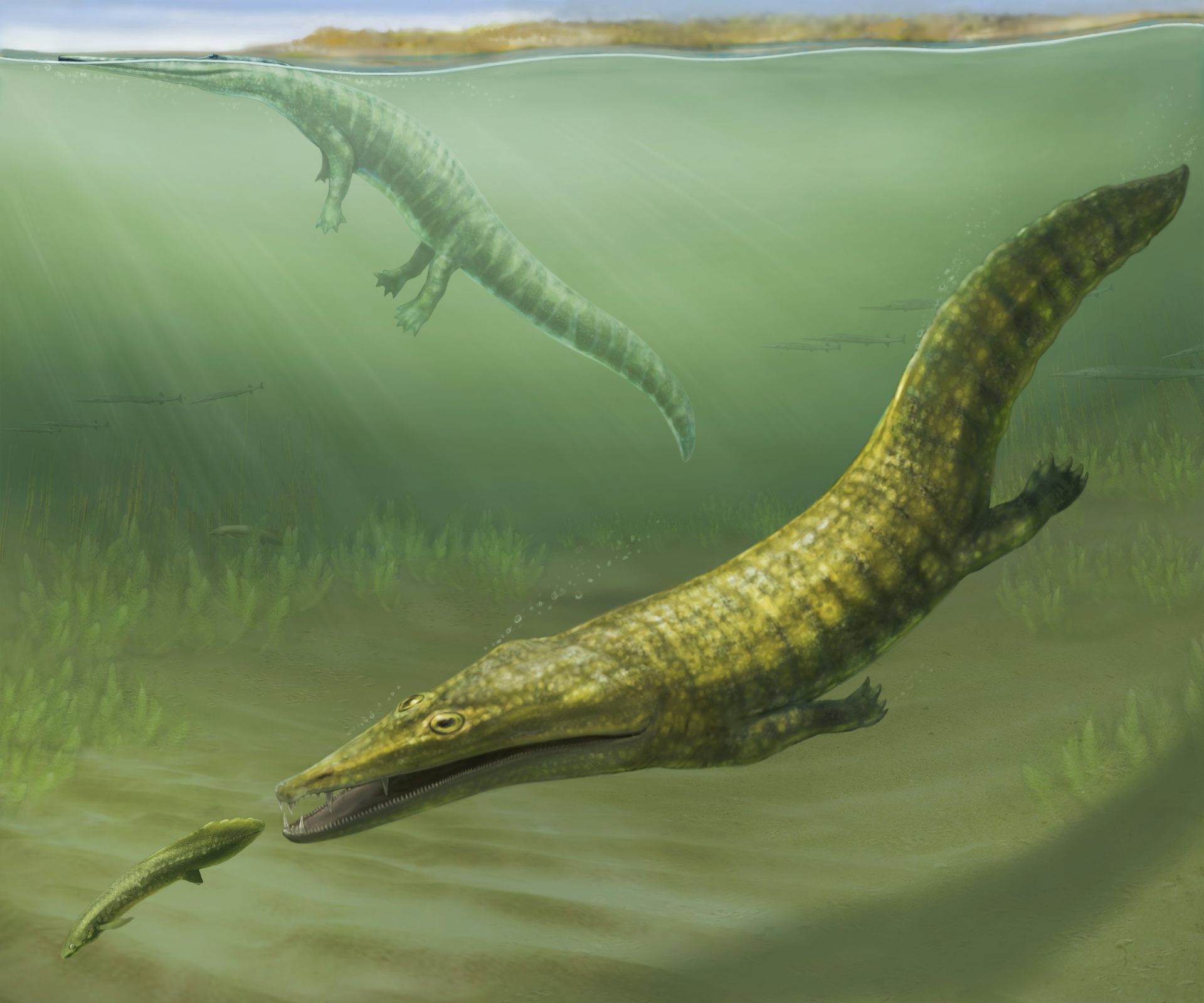
Ancient marine amphibians Erythrobatrachus (foreground) and Aphaneramma (background).
Pollyanna von Knorring (Swedish Museum of Natural History)
Modern amphibians are extremely sensitive to salt levels in water. This is why marine environments which have high salinity are generally not a place where amphibians like to live.
Temnospondyls of the family Trematosauria, to which both Erythrobatrachus and Aphaneramma belong, were apparently unbothered by salt water, as trematosaurid fossils are found in marine deposits around the world.
In fact, fossils of Aphaneramma have been found in localities of similar age to the Blina Shale – in Svalbard, Russia, Pakistan and Madagascar.
Trematosaurs are particularly notable as their fossils are found in rocks which date less than 1 million years after the mass extinction event at the end of the Permian period, also known as the Great Dying. This was the most catastrophic mass extinction in Earth’s history.
Confirmation that Aphaneramma’s range also included Australia shows these animals were dispersing worldwide during the earliest parts of the Mesozoic era.
Our research adds an exclamation point to just how adaptable temnospondyls were. They had an amazing ability to utilise a plethora of ecological niches to survive, even in the face of extreme global change – proving they were definitely one of evolution’s success stories.

Lachlan Hart, Lecturer, School of Education, UNSW Sydney
This article is republished from The Conversation under a Creative Commons license. Read the original article.

What this study demonstrates — yet again — is how palaeontology works. Fossils collected decades ago, re-examined with fresh comparative material and modern analytical methods, refine our understanding of past biodiversity and biogeography. A specimen once thought to represent a single species is revealed to record two distinct lineages, one of which dispersed widely across Gondwana in the ecological vacuum left by the end-Permian catastrophe. That is not ad hoc storytelling; it is hypothesis, re-analysis, correction and refinement — precisely how science progresses.
It also reinforces a central evolutionary principle: mass extinction does not “reset” life to a pristine beginning. It prunes the tree. The lineages that survive inherit a destabilised world rich in ecological opportunity, and natural selection acts on variation already present within those surviving populations. The rapid radiation of marine tetrapods after the Great Dying is exactly what evolutionary theory predicts when niches open and competition is temporarily reduced.
For creationism, however, each of these findings compounds the difficulty. The fossil record extends hundreds of millions of years beyond any proposed recent creation, documents successive faunas replacing one another through deep time, and shows clear patterns of descent, dispersal and adaptation following environmental upheaval. There is no evidence of sudden, independent creation of fully formed organisms without ancestry. Instead, there is continuity, modification and contingency.
Two hundred and fifty million years ago, in the wake of the most devastating extinction event in Earth’s history, amphibians were experimenting with new marine lifestyles along the shores of Gondwana. Their fossils remain as quiet testimony to a dynamic, ancient planet — one whose history is written in rock layers, not in myth.
Advertisement
Amazon

Amazon

Amazon

Amazon

Amazon

Amazon

Amazon

Amazon

Amazon

Amazon

Amazon

Amazon

All titles available in paperback, hardcover, ebook for Kindle and audio format.
Prices correct at time of publication. for current prices.

No comments:
Post a Comment
Obscene, threatening or obnoxious messages, preaching, abuse and spam will be removed, as will anything by known Internet trolls and stalkers, by known sock-puppet accounts and anything not connected with the post,
A claim made without evidence can be dismissed without evidence. Remember: your opinion is not an established fact unless corroborated.