

Geologists led by Professor Álvaro Penteado Crósta of the Institute of Geosciences at the State University of Campinas, Brazil (IG-UNICAMP), in collaboration with researchers from Brazil, Europe, the Middle East and Australia, have discovered evidence of an impact by a large extraterrestrial body at least 6.3 million years ago.
They have recently published their findings in the journal Geology. This impact joins the long list of such collisions in Earth’s history — not merely the one that marked the Cretaceous–Paleogene (K–Pg) mass extinction that eliminated the non-avian dinosaurs.
Creationists like to imagine they live in some sort of wonderland, specially created with them in mind — perfectly designed for human existence. Of course, this ignores the fact that much of the Earth is uninhabitable and even actively hostile to human life without specialised equipment. They often refer to Earth as existing in a ‘Goldilocks zone’ where everything is “just right”, forgetting that life could only have evolved on a planet where conditions permitted it. Our existence does not demonstrate improbability; it simply confirms that the necessary conditions were present.
Away from the tropics, ordinary human life is only possible with clothing, heating and buildings — or at least some form of shelter and a means of making fire. None of us would survive for more than a few hours naked outdoors in mid-winter at northern or southern latitudes.
Much of the planet is covered by deep oceans, and large areas of land consist of high plateaus or arid deserts where human life would again be impossible without specialised technology.
It also ignores the fact that, throughout its history, Earth has endured catastrophe after catastrophe. Mass extinctions have often been triggered by plate tectonics, which alter ocean currents and weather patterns, or by volcanic activity that disrupts the balance between CO2 production and its removal by plants. Earth exists within a cosmos capable of bombarding it with the debris left over from planetary formation — from microscopic dust grains to vast bodies of rock that release enough energy on impact to devastate regions hundreds of kilometres across. Such collisions can inject enormous quantities of dust and aerosols into the stratosphere, blocking sunlight for years and plunging the planet into prolonged global cooling, with devastating ecological consequences.
Tektites, Impact Ejecta and Glass Formation.The work of Professor Álvaro Penteado Crósta and his colleagues is explained in an Agência FAPESP news release. Agência FAPESP is the news agency of the São Paulo Research Foundation.What Are Tektites?
Tektites are small, natural glass objects formed when a large meteorite or asteroid strikes the Earth with enormous energy. They are not fragments of the impactor itself. Instead, they are made from terrestrial rocks that were instantaneously melted, blasted into the atmosphere, and rapidly cooled while flying through the air.
Key characteristics:
- Glassy texture (no crystals — cooling was too rapid)
- Very low water content
- Aerodynamic shapes formed during flight (buttons, teardrops, dumbbells)
- Often scattered over huge areas called strewn fields
Well-known examples include the green Moldavites of central Europe and the black australites of Australia.
What Is Impact Ejecta?
When a large extraterrestrial body strikes Earth, the kinetic energy released is equivalent to millions of nuclear bombs. The impact excavates a crater and hurls vast quantities of pulverised and molten material into the atmosphere. This material is known as impact ejecta.
Ejecta can include:
- Rock fragments
- Shocked minerals (such as quartz showing diagnostic pressure features)
- Melt droplets and glass spherules
- Vapourised rock that later condenses
Some ejecta fall back near the crater, forming an ejecta blanket. Other material travels hundreds or even thousands of kilometres before returning to Earth.
How Does Natural Glass Form in an Impact?
Under normal geological conditions, rocks cool slowly and form crystals. But an impact generates temperatures of several thousand degrees Celsius and pressures far beyond those found in volcanoes.
The process is roughly:
- Target rock is instantly melted or vaporised.
- Molten material is ejected at high velocity.
- While airborne, it cools extremely rapidly.
- The melt solidifies before crystals can grow, forming amorphous glass.
Because cooling happens during flight, surface tension and aerodynamic drag shape the droplets into smooth, sculpted forms.
Why Tektites Matter
Tektites are important because they:
- Provide unambiguous evidence of large impact events
- Help geologists identify previously unknown craters
- Allow precise dating of impact episodes
- Reveal information about the composition of the target rocks
In cases where the original crater has eroded or been buried, tektites may be the only surviving evidence that a major cosmic collision occurred.

Impact-formed glass evidence of cosmic collision in Brazil about 6 million years ago
A field of tektites extending across the states of Minas Gerais, Bahia, and Piauí, has been discovered in Brazilian territory for the first time. The more than 600 objects collected thus far may have been formed by a single collision event between an extraterrestrial body and the Earth’s surface.
By José Tadeu Arantes | Agência FAPESP – For the first time in Brazil, researchers have identified a field of tektites. These are natural glasses formed by the high-energy impact of extraterrestrial bodies against the Earth’s surface. These structures, named geraisites in honor of the Brazilian state of Minas Gerais, where they were first discovered, constitute a new strewn field. This expands the incomplete record of impacts in South America.
The discovery was described in an article published in the journal Geology by a team led by Álvaro Penteado Crósta, a geologist and senior professor at the Institute of Geosciences at the State University of Campinas (IG-UNICAMP). Crósta collaborated with researchers from Brazil, Europe, the Middle East, and Australia.
Until now, only five large tektite fields had been recognized on the planet: in Australasia, Central Europe, the Ivory Coast, North America, and Belize. The Brazilian field now joins this select group.
The geraisites were initially located in three municipalities in northern Minas Gerais – Taiobeiras, Curral de Dentro, and São João do Paraíso – in a strip about 90 kilometers long. Since the article was submitted, new occurrences have been recorded in the Brazilian states of Bahia and, more recently, Piauí. According to Crósta, this expands the known area to more than 900 kilometers in length.
This growth in the area of occurrence is entirely consistent with what is observed in other tektite fields around the world. The size of the field depends directly on the energy of the impact, among other factors.
Professor Álvaro Penteado Crósta, lead author
Instituto de Geociências
Universidade Estadual de Campinas
Campinas, Brazil.
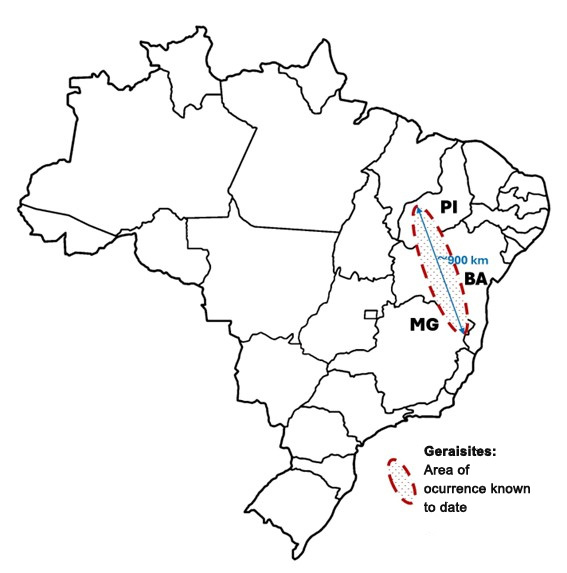 Map of the area where geraisites have been collected to date, covering regions in the states of Minas Gerais, Bahia, and Piauíimage: Álvaro Penteado Crósta/IG-UNICAMP
By July 2025, the authors had collected approximately 500 specimens, a number that has since grown to over 600 with the most recent findings. The fragments range in size from less than 1 gram to 85.4 grams and reach about 5 centimeters on the longest axis. Their shapes are typical of aerodynamic tektites: spherical, ellipsoidal, drop-shaped, discoid, dumbbell-shaped, or twisted.
Although they appear black and opaque at first, they become translucent under intense light and display a grayish-green color. This color is distinct from that of European moldavites, which have been used in jewelry since the Middle Ages due to their characteristic intense green color. Their dark surfaces are marked by many small cavities.
These small cavities are traces of gas bubbles that escaped during the rapid cooling of the molten material as it traveled through the atmosphere, a process also observed in volcanic lava but especially characteristic of tektites.
Professor Álvaro Penteado Crósta.
Geochemical analyses show that geraisites have a high silica (SiO2) content ranging from 70.3% to 73.7%. The combined content of sodium (Na2O) and potassium (K2O) oxides ranges from 5.86% to 8.01%, which is slightly higher than in other tektite fields. Small variations in trace elements, such as chromium (10-48 parts per million) and nickel (9-63 ppm), were identified, indicating that the original material was neither pure nor homogeneous. The presence of rare inclusions of lechatelierite, a form of glassy silica produced at extreme temperatures, further supports an impact origin.
One of the decisive criteria for classifying the material as a tektite was its very low water content, as measured by infrared spectroscopy: between 71 and 107 ppm. For comparison, volcanic glasses, such as obsidian, usually contain from 700 ppm to 2% water, whereas tektites are notoriously much drier.
Professor Álvaro Penteado Crósta.
Dating based on the ratio of argon isotopes (40Ar/39Ar) indicates that the event occurred approximately 6.3 million years ago, at the end of the Miocene epoch. Three groups of very similar ages were obtained (6.78 ± 0.02 Ma, 6.40 ± 0.02 Ma, and 6.33 ± 0.02 Ma), which is consistent with a single impact event.
The age of 6.3 million years should be interpreted as a maximum age since some of the argon may have been inherited from the ancient rocks targeted by the impact.
Professor Álvaro Penteado Crósta.
To date, no associated crater has been identified. According to Crósta, this is not unusual; only three of the six large classical tektite fields have known craters. In the case of the largest field, located in Australasia, the crater is believed to be oceanic. In Brazil, isotopic geochemistry indicates that the molten material originated in Archean continental crust between 3.0 and 3.3 billion years old. This directs the search to the São Francisco craton, an ancient and geologically stable portion of the continental crust and one of the oldest regions of the South American continent.
The isotopic signature indicates a very ancient continental, granitic source rock. This greatly reduces the universe of candidate areas.
Professor Álvaro Penteado Crósta.
In the future, aerogeophysical methods such as magnetic and gravimetric surveys may reveal circular anomalies associated with a buried or eroded crater.
While it is not yet possible to accurately estimate the size of the impacting body, researchers consider it unlikely that it was small. The large amount of molten material and the wide area of dispersion indicate a significant impact event, albeit smaller than the event responsible for the Australasia field, which extends for thousands of kilometers.
The team is currently working on a mathematical model of impacts to estimate parameters such as the energy released, the velocity, the angle of entry, and the volume of molten rock. They are doing this as new data on the spatial distribution of geraisites becomes available. The discovery of the geraisites fills an important gap in the record of impacts in South America. Only about nine large impact structures are known there, and almost all of them are much older and located in Brazil. This discovery also reinforces the idea that tektites may be more common than previously thought, but often go unnoticed or are mistaken for ordinary glass.
To combat sensationalist interpretations of cosmic impacts, Crósta manages the @defesaplanetaria Instagram profile with undergraduate students. The profile is dedicated to scientific dissemination and differentiating real risks from irresponsible speculation about meteorites and asteroids. Impacts were frequent during the formation of the solar system when a large amount of debris was scattered and planetary orbits were undefined. Large bodies migrated from one position to another, projecting smaller bodies in various directions. However, today, with the system stabilized, impacts are incomparably less frequent.
Understanding these processes is essential to separating science from speculation.
Professor Álvaro Penteado Crósta.
Publication:
So once again, reality refuses to conform to the comforting fantasy of a perfectly tuned world prepared for human comfort. The Earth is not a sanctuary designed with us in mind; it is a dynamic planet orbiting an ordinary star in a debris-filled galaxy. Its history is written in craters, flood basalts, shifting continents and mass extinctions — and now, in Brazilian tektites that record yet another cosmic collision.
Impacts are not rare anomalies in an otherwise serene creation. They are a normal and ongoing feature of planetary evolution. The same processes that helped shape the early Earth, possibly even contributing to the delivery of water and organic molecules, have also repeatedly devastated its biosphere. Life persists not because the planet was engineered to prevent catastrophe, but because evolution produces organisms resilient enough to survive it.
The discovery of tektites in Brazil is therefore more than a geological curiosity. It is another reminder that our planet exists in a universe governed by physical laws, not protective intent. Earth’s history is one of contingency, upheaval and adaptation — a far cry from the fragile, finely tuned stage imagined by those who prefer myth over evidence.
Advertisement


All titles available in paperback, hardcover, ebook for Kindle and audio format.
Prices correct at time of publication. for current prices.

No comments:
Post a Comment
Obscene, threatening or obnoxious messages, preaching, abuse and spam will be removed, as will anything by known Internet trolls and stalkers, by known sock-puppet accounts and anything not connected with the post,
A claim made without evidence can be dismissed without evidence. Remember: your opinion is not an established fact unless corroborated.