

This paper is another of those that will probably excite creationists initially, but then set up more cognitive dissonance because the timeline is utterly inconsistent with their preferred Biblical narrative. It will excite them because it suggests biologists might have been wrong about something; the dissonance then comes from the fact that the scientists involved have no doubts at all that the Theory of Evolution explains the facts, and that what they may have got wrong is merely the exact timing of events that happened many millions of years ago.
The possible mistake concerns the assumption that the ancestors of the extinct giant flightless geese of the Cnemiornis genus arrived in New Zealand about 14 million years ago. New evidence suggests that this may instead have been only about 7 million years ago, providing another example of the rapid evolution that can occur through the so-called 'island effect'.
The usual creationist response to the inevitable cognitive dissonance is either to ignore the findings altogether or to claim, with no evidence whatsoever, that the scientists got the dates wrong or invented figures to support a preconceived 'Darwinian' narrative.
But of course, what the paper actually demonstrates is the self-correcting nature of science, the contingency of scientific knowledge, and the willingness to change conclusions when the facts change — features of the scientific method that reflect the intellectual integrity of scientists and that give science its great power to determine the truth. This stands in stark contrast to creationism, which cannot move beyond the primitive superstitions of Bronze Age pastoralists, and which depends on intellectual bankruptcy — and the arrogance to believe one's opinions trump the evidence — in order to maintain belief in the face of overwhelming evidence to the contrary.
The paper in question was recently published in the journal Historical Biology by members of an international collaboration between scientists from Otago University, the Museum of New Zealand Te Papa Tongarewa, and the University of Cambridge (UK), led by Alan J. D. Tennyson of the Museum of New Zealand Te Papa Tongarewa.
So what exactly did the researchers discover that prompted this revision of the timeline? The answer lies in new fossil material and a re-examination of the evolutionary relationships of these remarkable birds. By comparing skeletal features and analysing their place within the broader family tree of waterfowl, the team were able to reassess when the ancestors of New Zealand’s giant flightless geese first arrived on the islands. Their results suggest that these birds colonised New Zealand far more recently than previously thought, after which they rapidly evolved into the large, flightless forms known from the fossil record.
This kind of rapid evolutionary change is a well-known phenomenon on islands, where isolation, the absence of mammalian predators, and new ecological opportunities can drive dramatic shifts in body size and behaviour. In the case of Cnemiornis, the descendants of ordinary flying waterfowl appear to have evolved into large, heavy, ground-dwelling birds in a relatively short geological time.
Island Evolution^ Why Islands Produce Strange Animals.Islands are natural laboratories for evolution. Because they are isolated from mainland ecosystems, species that reach them often encounter very different ecological conditions. These conditions can drive rapid evolutionary change, sometimes producing animals that look very different from their mainland ancestors.
Several key factors are responsible:
Isolation
When a small population reaches an island — often by flying, rafting on vegetation, or being blown off course by storms — it becomes genetically isolated from the parent population. With little or no gene flow from the mainland, natural selection and genetic drift can quickly push the island population in new evolutionary directions.
Ecological Opportunity
Islands often lack the full range of predators and competitors found on continents. This leaves many ecological niches unoccupied. Species that arrive can diversify to fill these empty roles, sometimes evolving new diets, behaviours, and body sizes.
Island Gigantism and Dwarfism
A common pattern known as the island rule affects body size:
- Small animals often evolve larger bodies (island gigantism).
- Large animals often evolve smaller bodies (island dwarfism).
Examples include the giant Komodo dragon of Indonesia, dwarf elephants that once lived on Mediterranean islands, and New Zealand’s enormous moa.
Loss of Flight
Birds that colonise predator-free islands frequently lose the ability to fly. Flight is energetically expensive, and when predators are absent the advantage of flight diminishes. Over generations, natural selection favours birds with heavier bodies and reduced flight muscles, eventually producing flightless species. Famous examples include the dodo of Mauritius, the kakapo of New Zealand, and the extinct giant geese of the genus Cnemiornis.
Rapid Evolution
Because island populations are often small and under strong ecological pressures, evolutionary change can occur relatively quickly in geological terms — sometimes within a few million years or less.
For evolutionary biologists, island ecosystems provide some of the clearest examples of how natural selection can reshape organisms when environmental conditions change.

The team's findings are the subject of a news item from Otago University.
‘Old Mother Goose’ adds to history of NZ birds
The discovery of a rare fossil goose in an ancient Central Otago lake shows the evolutionary history of Aotearoa New Zealand birds is much more dynamic than once thought, a University of Otago – Ōtākou Whakaihu Waka researcher says.
Associate Professor Nic Rawlence, Director of the Otago Palaeogenetics Laboratory, is co-author of a new paper which analyses the fossil and its origins.
Published in the journal Historical Biology, the paper is an international collaboration between Otago, the Museum of New Zealand Te Papa Tongarewa, and the University of Cambridge (UK) analysing fossils uncovered around St Bathans.
Associate Professor Rawlence says while many waterfowl species are incredibly common in the fossil deposits in the area, some are quite rare.
The researchers re-examined the remains of all bones previously identified as belonging to geese and compared them to the other waterfowl bones from the deposit and a broad collection of comparative bird skeletons.
We determined that the bones included an undescribed species, the size of a small goose.
Associate Professor Nicholas J. Rawlence, co-author
Otago Palaeogenetics Laboratory
Department of Zoology
University of Otago
Dunedin, New Zealand.
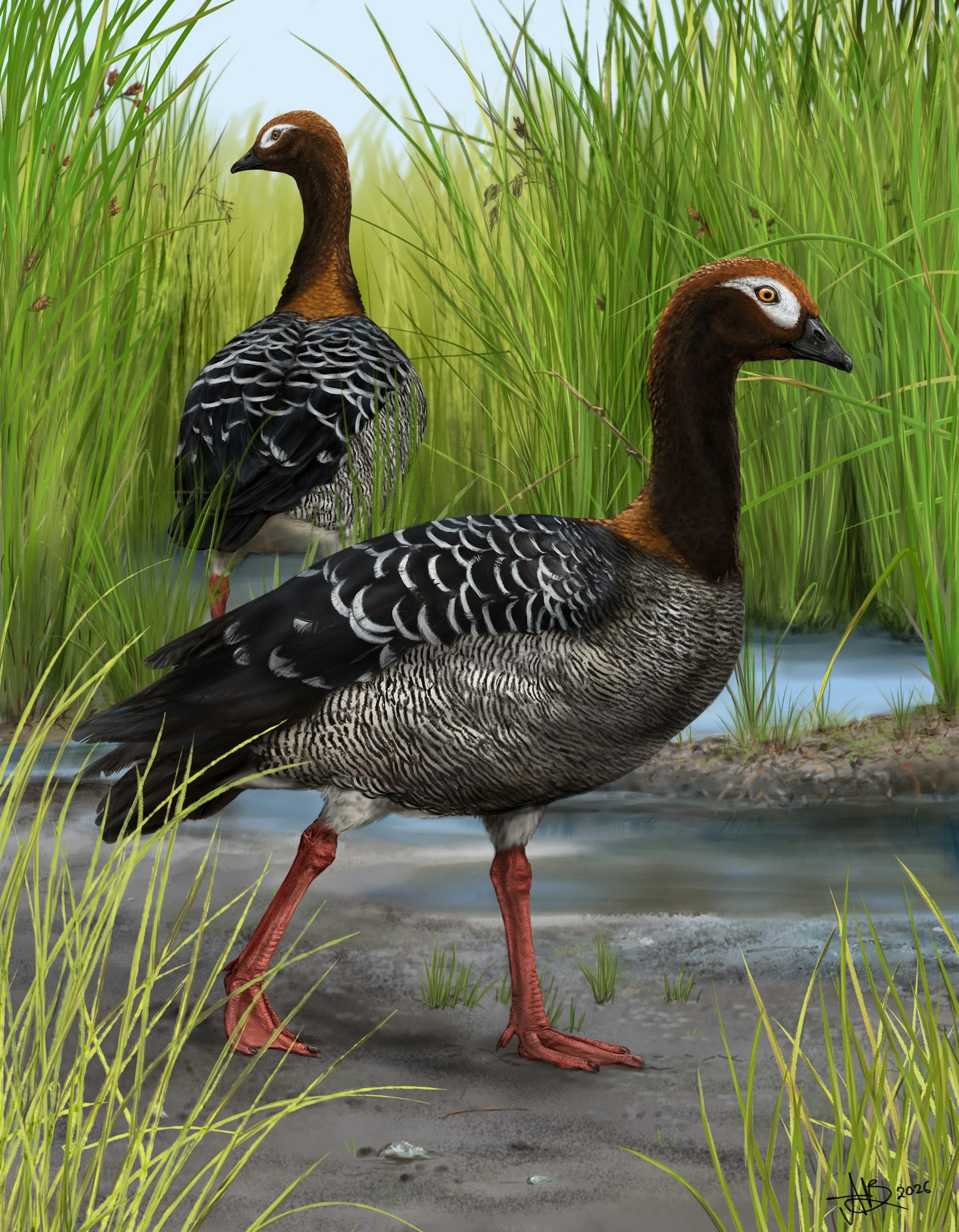
The research team named the St Bathans goose Meterchen luti in reference to the nursery rhyme Old Mother Goose, where, in this case, an ancient goose rises out of the mud of a fossil deposit. Meterchen means “mother goose” in ancient Greek, while luti is Latin for “of the mud”. A reconstruction of the St Bathans goose (Metechen luti).Artwork by Sasha Votyakova, © Te Papa CC BY 4.0
The St Bathans goose is not closely related to the recently-extinct giant flightless New Zealand geese (Cnemiornis species) or their Australian cousin, the Cape Barren goose.
This, along with other recent genetic research, shows the evolutionary origins of New Zealand’s birds is more dynamic than previously thought.
Lead author Alan Tennyson, of Te Papa, says while many species of birds have been arriving throughout geological history, the ancestors of some of our large birds have only arrived here surprisingly recently – in the past four to five million years – including takahē, Forbes' harrier and the giant Haast’s eagle.
An earlier theory argued that the St Bathans goose represented the direct ancestors of giant flightless Cnemiornis geese, implying this lineage had a very long history (of at least 14 million years) in Zealandia. However, this conflicts with genetic evidence suggesting the ancestors of Cnemiornis arrived from Australia only about seven million years ago, which proponents of the earlier theory discarded.
Our rigorous reassessment supports the later arrival theory.
Alan J. D. Tennyson, lead author.
Museum of New Zealand Te Papa Tongarewa
Wellington, New Zealand.
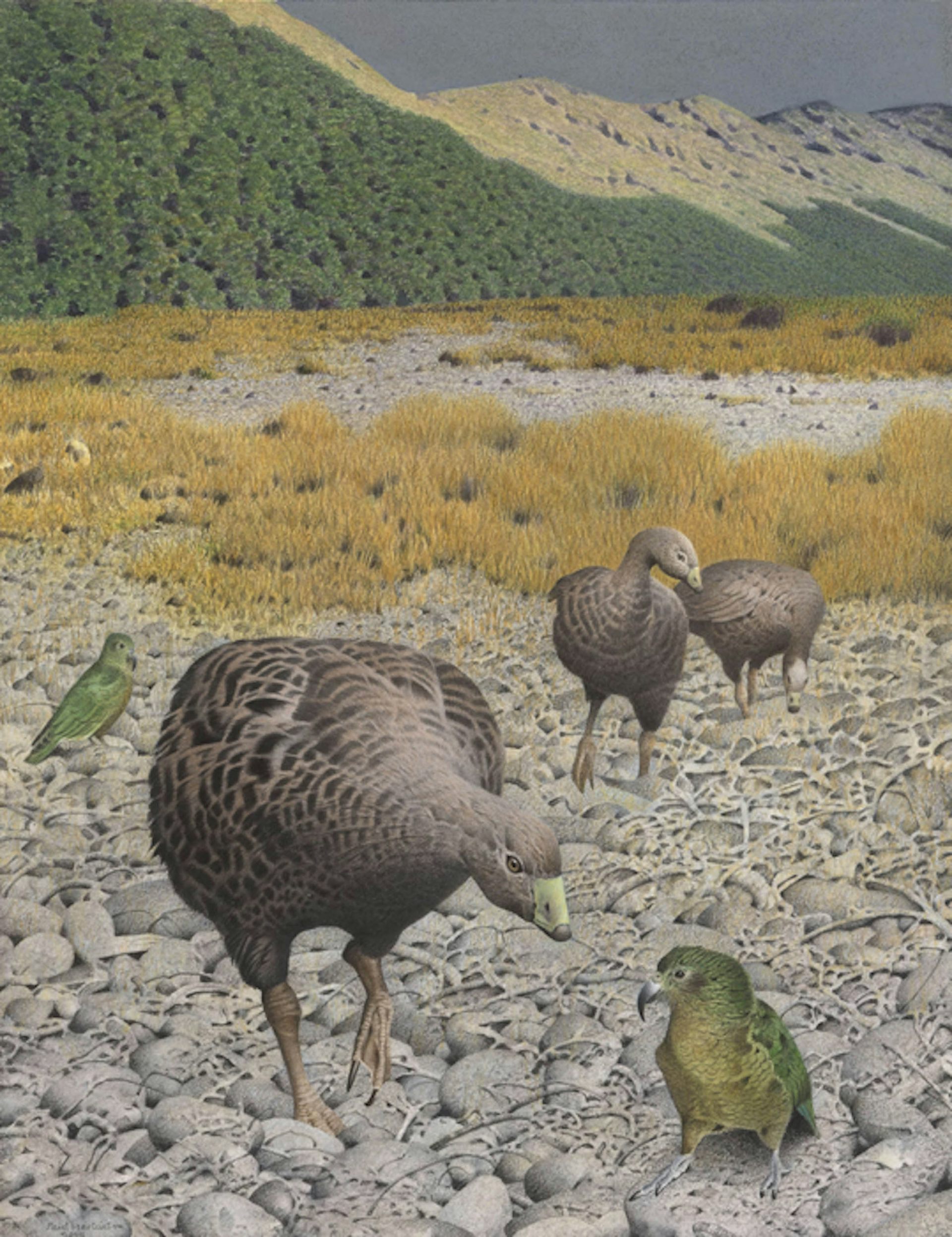
So, while the ancestors of the St Bathans goose arrived in Zealandia prior to 14 million years ago, no descendants survived, Associate Professor Rawlence says.Using all the tools in the toolbox, including DNA and fossils, we can reconstruct how the dynamic geological, climatic and human history of Zealandia has shaped the evolution of Aotearoa fauna in ever more detail. The relatively recent evolution of the giant flightless Cnemiornis geese offers another striking example of rapid morphological change that can occur within a short timeframe on islands. At one metre tall and weighing up to 18kg, these were the largest geese in the world.
Associate Professor Nicholas J. Rawlence.
Publication:
Two of the authors have also published an article in The Conversation. Their article is reprinted here under a Creative Commons license, reformatted for stylistic consistency.

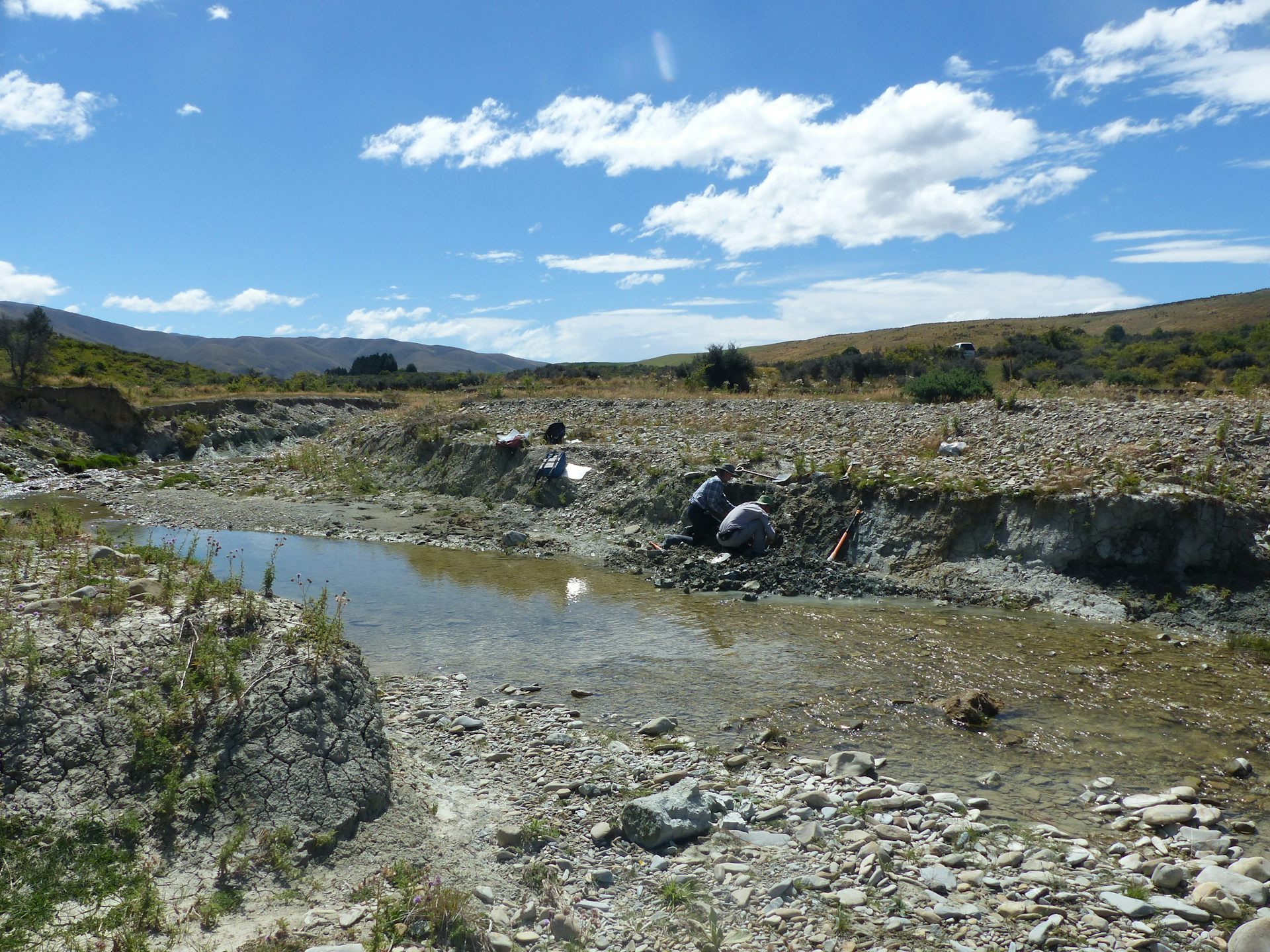
Along the shores of Lake Manuherikia, whose remnants are found near present-day St Bathans, lived crocodilians, turtles, and bowerbirds, as well as early relatives of bats, moa and kiwi, and a rich diversity of waterfowl such as ducks and swans.
This lost ecosystem is known today from the famous St Bathans fossil deposits, which preserve one of the world’s richest records of the Miocene and offer a rare window into Aotearoa’s warmer, more subtropical ancient past.
Our newly published research adds another waterfowl species to this remarkable menagerie. It also sheds important new light on the origins of New Zealand’s recently extinct giant, flightless geese of the genus Cnemiornis.
NZ’s long-lost waterfowl
Spanning 5,600 square kilometres, Lake Manuherikia was ten times the size of New Zealand’s Lake Taupo. It was a dynamic habitat that supported a diverse range of waterfowl, including five stiff-tailed ducks, one swan, two shelducks, one dabbling duck and our new goose.
Our team reexamined the remains of all the bones previously identified as belonging to geese. We then compared them with other large waterfowl bones from the deposits and a broad collection of comparative bird skeletons housed in the Museum of New Zealand Te Papa Tongarewa.
We determined that the bones included an undescribed species the size of a small goose.
We named our new bird the St Bathans goose Meterchen luti, as a play on the nursery rhyme “Old Mother Goose”. In our case, an ancient goose rises up out of the mud of the fossil deposit. Meterchen means “mother goose” in ancient Greek, while luti is Latin for “of the mud”.
Not as ancient as first thought
Our St Bathans goose is only based on fragmentary remains but there is enough preserved to show that it is not a close relative of the giant flightless Cnemiornis geese, nor their Australian cousin, the Cape Barren goose Cereopsis novaehollandiae.
Throughout geological history, many birds arrived in Zealandia, the now-mostly submerged continent that includes New Zealand. But the ancestors of some of our large birds only arrived here surprisingly recently – in the past 4-5 million years – including takahē, the Eyles or Forbes’ harrier and the giant Haast’s eagle.
An earlier theory argued that the St Bathans goose represented the direct ancestors of giant flightless Cnemiornis geese, implying this lineage had been present in Zealandia for at least 14 million years.
However, this conflicts with genetic evidence suggesting the ancestors of Cnemiornis arrived from Australia only 7 million years ago, which proponents of the earlier theory discarded.
Our reassessment, based on a much broader set of comparative bird skeletons, rather than single exemplars, does not support the earlier-arrival hypothesis and instead supports the later arrival.
Turnover and transformation
Increasingly, our multidisciplinary research is showing that there have been considerable levels of biological turnover throughout Zealandia’s history.
While the ancestors of the St Bathans goose no doubt arrived in Zealandia earlier than 14 million years ago, no descendants survived, with the ancestors of the giant Cnemiornis geese colonising much more recently, only for their descendants to go extinct shortly after human arrival due over-hunting and predation.
By using all the scientific tools in the toolbox, we can reconstruct how the dynamic geological, climatic and human history of Zealandia has shaped the evolution of Aotearoa’s fauna in ever more detail.
Each new discovery is a reminder that the story of New Zealand’s birds – and of Zealandia itself – is very much still being written.

Nic Rawlence, Associate Professor in Ancient DNA, University of Otago and Alan Tennyson, Curator of Vertebrates, Museum of New Zealand Te Papa Tongarewa
This article is republished from The Conversation under a Creative Commons license. Read the original article.

What this study shows, then, is not that evolutionary biology has somehow been “wrong”, but that scientists are constantly refining their understanding as new evidence becomes known. Revising the estimated arrival time of the ancestors of Cnemiornis from about 14 million years ago to perhaps around 7 million years ago does nothing to undermine the evolutionary explanation for these birds. On the contrary, it strengthens it by improving the accuracy of the timeline and by reinforcing what evolutionary biology has long predicted — that isolated island environments can drive rapid and dramatic evolutionary change.
This willingness to revise conclusions when better evidence becomes available is one of the defining strengths of science. Scientific knowledge is not a fixed dogma but a continually improving description of reality. Each new discovery helps sharpen that picture, sometimes confirming previous ideas and sometimes refining them. Either way, the process moves steadily closer to the truth.
Creationism, by contrast, cannot accommodate such correction because its conclusions are fixed in advance by ancient religious texts rather than by evidence. Faced with discoveries that contradict their narrative — such as the deep timescales involved in the evolution of New Zealand’s unique fauna — creationists are left with only two options: ignore the evidence or dismiss it without justification. Neither response contributes anything to understanding the natural world.
Studies like this one therefore serve as yet another reminder of the stark difference between science and creationism. Where science advances by testing ideas against evidence and correcting itself when necessary, creationism remains locked into a predetermined story that must be defended regardless of what the evidence shows. And as the evidence continues to accumulate, that story becomes ever harder to sustain.
Advertisement


All titles available in paperback, hardcover, ebook for Kindle and audio format.
Prices correct at time of publication. for current prices.

No comments:
Post a Comment
Obscene, threatening or obnoxious messages, preaching, abuse and spam will be removed, as will anything by known Internet trolls and stalkers, by known sock-puppet accounts and anything not connected with the post,
A claim made without evidence can be dismissed without evidence. Remember: your opinion is not an established fact unless corroborated.