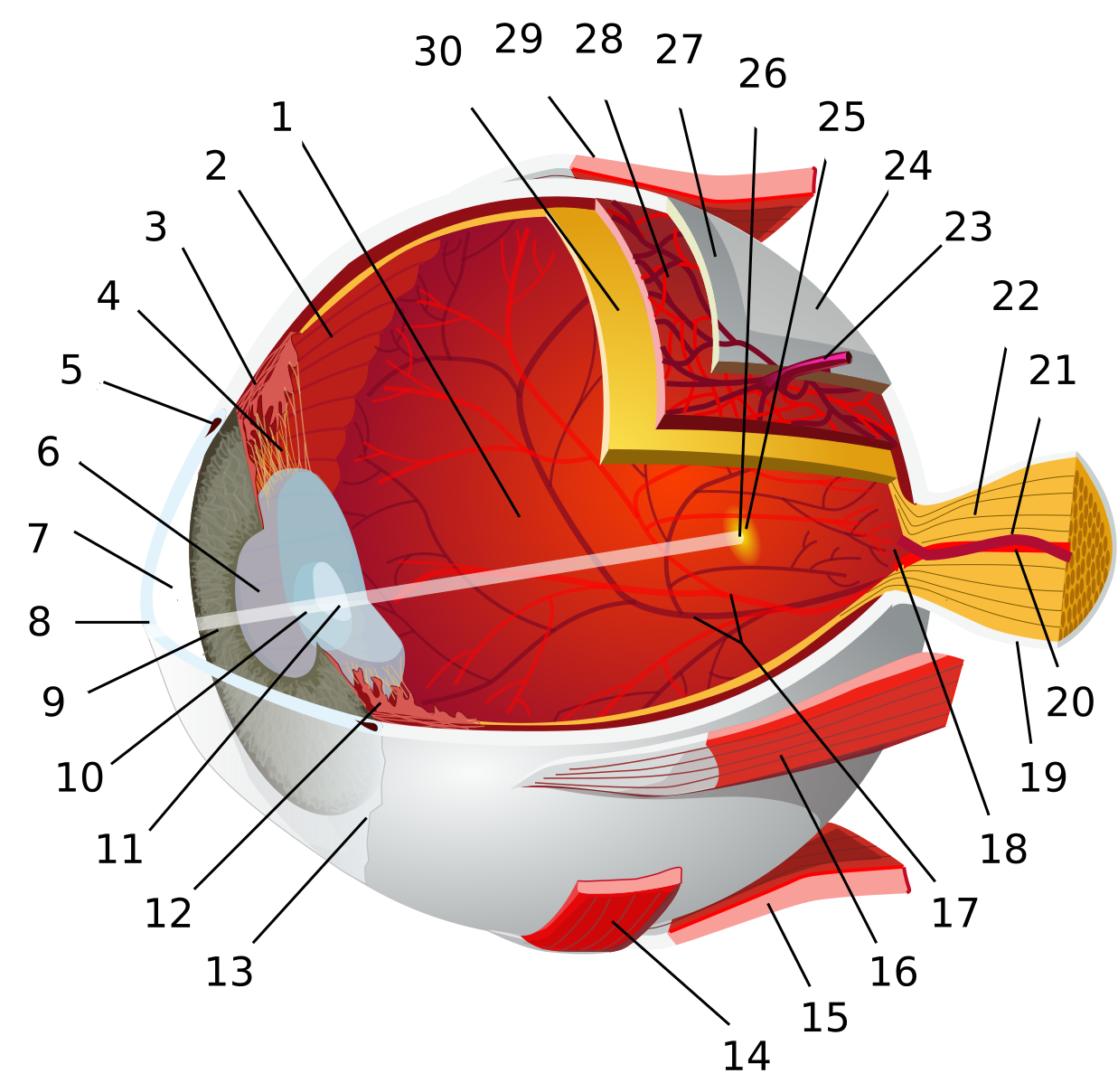
A recently published paper in the Cell Press journal, Current Biology, by four palaeontologists — two from the University of Sussex, UK, and two from Lund University, Sweden — delivers yet another solid rebuttal to creationist misrepresentation. It traces the origin of the vertebrate eye back to a worm-like marine creature that lived around 600 million years ago, neatly demolishing the old creationist claim that something as complex as the eye could never have evolved by natural means.
One of the favourite dishonest tricks in the creationist repertoire is the quote mine: lifting a sentence from an expert, stripping it of context, and presenting it as though it supports the very position the author was arguing against. Few examples are more shameless than their abuse of a passage from Darwin's On the Origin of Species. In typical Darwinian style, he first states what appears to be a serious objection to his theory, then immediately explains why it is not a real objection at all. The part creationists love to quote, from page 100, is this:
To suppose that the eye, with all its inimitable contrivances for adjusting the focus to different distances, for admitting different amounts of light, and for the correction of spherical and chromatic aberration, could have been formed by natural selection, seems, I freely confess, absurd in the highest possible degree.
Presented on its own, this is supposed to fool the unwary into thinking Darwin admitted defeat — as though he had conceded that evolution could not explain the eye and that modern creationists were right all along with their talk of 'irreducible complexity'. But, as usual, the deception depends entirely on stopping before the very next sentence, where Darwin wrote:
AI-Generated Image (ChatGPT Latest)
Yet reason tells me, that if numerous gradations from a perfect and complex eye to one very imperfect and simple, each grade being useful to its possessor, can be shown to exist; if further, the eye does vary ever so slightly, and the variations be inherited, which is certainly the case; and if any variation or modification in the organ be ever useful to an animal under changing conditions of life, then the difficulty of believing that a perfect and complex eye could be formed by natural selection, though insuperable by our imagination, can hardly be considered real.
Charles Darwin, On the Origin of Species By Means of Natural Selection, or, the Preservation of Favoured Races in the Struggle for Life (p. 100). Public Domain Books. Kindle Edition.
So Darwin was not conceding the point at all; he was doing the exact opposite. He was saying that the apparent absurdity disappears once we recognise that useful intermediate stages can and do exist. In other words, the creationist quote mine works only by concealing Darwin's actual argument.
And now, more than 160 years later, the evidence Darwin lacked has arrived in abundance. He could not have known the developmental genetics, the comparative anatomy, the fossil evidence, or the evolutionary history that modern biology has uncovered. Creationists have no such excuse. They are not merely repeating an old objection; they are repeating one that has been answered again and again, and now answered yet again by evidence tracing the deep evolutionary roots of the vertebrate eye itself.
So this discovery matters not simply because it adds another detail to the history of life, but because it exposes the intellectual bankruptcy of the creationist argument. The eye is not a problem for evolution. It is a triumph of evolution — a structure whose history is precisely the sort of gradual, functional modification Darwin predicted. The real problem lies not with evolutionary theory, but with those who continue to misquote Darwin and mislead their audiences in the hope that no one will bother to read past the sentence they have carefully amputated from its context.
An account of how the researchers arrived at their conclusion is given in an article in The Conversation by two of the four scientists involved. Their article is reproduced below under a Creative Commons licence, reformatted for stylistic consistency:
Our modern vision evolved from an ancient one‑eyed worm creature.
It’s easy to take our eyes for granted. But our recent research shows they took an incredible evolutionary journey to reach their current familiar form.
It has long been known that our (vertebrate) eyes differ fundamentally from the ones of our distant relatives (invertebrates), because of their cell composition and how they develop before birth. However, answers to why or how these differences first emerged long remained elusive.
Our study suggests that our eyes descend from a worm-like ancestor that was roaming the oceans 600 million years ago. The same also applies to all bilateral animals, meaning animals whose bodies can be divided into roughly mirror-image left and right halves.
As part of our study, we surveyed 36 major groups of living animals (covering nearly all bilateral animals) to see where their eyes and light-sensing cells are located and what they do.
A pattern emerged. We discovered that eyes and light-sensing cells are consistently found at two separate locations: paired on both sides of the face, and at the midline of the head, on top of the brain. Across the animals we looked at, cells in the paired position are used to steer movements, while their midline counterparts tell day from night and up from down.
We concluded that an ancient worm-like ancestor of all vertebrate animals lost the “steering” pair of eyes when it adopted a mostly stationary lifestyle 600 million years ago, burrowing into the seabed. In becoming a filter feeder with no need to move around, the energetically expensive type of paired eyes was rendered useless and costly.
However, this lifestyle change left the light-sensing cells in the middle of its head unscathed, because the animal still needed to sense the time of day and distinguish between up and down. Although the paired eyes were gone, the light-sensing cells in the midline developed into a small midline eye.
Possibly within a few million years, this animal changed lifestyle again. A return to swimming reintroduced the need to control steering and measure its own body motion for efficient filter-feeding (sifting food out of water) and avoiding predators.
This pushed evolution to develop the midline eye by forming small eye cups on each side. These eye cups later separated from the midline eye, moved out to the sides of the head and formed new paired eyes: our eyes.
The loss and regain of vision happened between 600 and 540 million years ago. Components of the midline eye remained and became the pineal organ in the brain, which produces and releases the sleep hormone melatonin.
In many vertebrates, the pineal organ receives light through a transparent (unpigmented) region in the middle of the head. However, in the mammalian lineage the pineal organ lost its light-sensing capacity – possibly because early mammals were active at night and hid during daytime. So the eyes, which were more sensitive, took over the light detection which drives melatonin release and sleep.
Eyes of all shapes and sizes
Those animals that did not lose the worm-like ancestor’s original paired light-sensing cells comprise most invertebrates around today, since they descended from a branch of the evolutionary tree that never adopted a static lifestyle. Such animals include crustaceans, insects, spiders, octopus, snails and many groups of worms. These animals still have modern versions of the original sets of light-sensing cells.
The paired eyes of insects and crustaceans are compound eyes, with an array of tiny and densely packed lenses per eye. Instead of compound eyes, octopus and snails have camera-type eyes with a single lens.
In fact, octopus and snails independently evolved the same eye design and visual performance as us vertebrates. However, our retina – the light sensitive layer at the back of our eyes – has over 100 types of neurons (mice have even more – 140), compared to a mere handful in octopus and snails. This makes it almost as complex as our cerebral cortex – the outer and largest part of our brain.
Scientists have thought that in the evolution of our eyes, this complexity emerged fairly late. Similarities between light-sensing cells in the brain and paired eyes informed earlier hypotheses about a simple, pineal organ-like eye early in its evolution. In our work, however, we argue that a lot of this complexity predates the retina.
As such, it is likely to have been present already in the “cyclops” ancestor eye. This has broad implications for the origin and wiring of neural circuits in our retina and brain alike.
For us vertebrates, the evolution of our eyes and brain is intimately linked. The emergence of new paired eyes is a fundamental part of this picture, since the eyes allowed for the complex behavior that call for cognition and large brains. Without the eyes, we would not just be humans without eyes; we would not exist at all, nor would any of the other vertebrates.
George Kafetzis, Research Fellow in Neuroscience, University of Sussex and Dan Nilsson, Professor emeritus of Zoology, Lund University
Published by The Conversation. Open access. (CC BY 4.0)
Summary
The vertebrate retina is a uniquely complex and evolutionarily conserved structure, combining ciliary (rod and cone) and rhabdomeric (ganglion, amacrine and horizontal cells) photoreceptor lineages within a multilayered circuit. This arrangement contrasts with the ancestral bilaterian cephalic pattern, where rhabdomeric photoreceptors dominate lateral eyes and ciliary photoreceptors are largely limited to unpigmented, non-visual median positions. Here, we make a case that the vertebrate retina evolved through the lateralization of a complex median photoreceptive organ already containing both photoreceptor types. This shift likely followed the loss of lateral rhabdomeric eyes in a burrowing, suspension-feeding deuterostome ancestor that retained a pool of median photoreceptors. In the early chordates leading to vertebrates, this structure diversified into the pineal/parapineal complex and lateral retinas. Central to this transformation was the emergence of a bipolar cellular identity, linking ciliary and rhabdomeric circuits — an unusual feature in animal nervous systems. We suggest that bipolar cells predate the retina and have dual evolutionary origins: Off bipolar cells deriving from a ciliary ‘effector’ lineage and rod-On bipolar cells deriving from a chimeric sensory cell. This model explains key similarities between the retina and the pineal gland and supports a scenario in which vertebrate vision emerged by integrating and repurposing preexisting circuits. It reframes the retina not as a de novo innovation, but as a modified and lateralized solution to sensory challenges faced by early chordates.
Figure 1 Position and type of photoreceptor cells in the head of bilaterians.
Schematic dorsal view of the head of selected bilaterians. A complete survey, including all bilaterian phyla and subgroups will be published elsewhere — here we only show representative animal groups needed to reconstruct ancestral forms of protostomes, deuterostomes and bilateria (based on the papers cited as references1,7,16,18,30,40,126,161,162,163,164,165,166,167,168,169,170,171,172,173,174,175,176,177,178,179). We indicate the position for photoreceptors in imaging eyes (large circles), simple directional ocelli (small circles) or non-directional clusters (diffuse ellipses). The important distinction is between photoreceptors in paired lateral organs (irrespective if they point sideways or forwards) and median clusters in the brain or close to it. Colours indicate rhabdomeric versus ciliary photoreceptors with their specific opsins and transduction pathways. Reconstruction of ancestral protostome and bilaterian conditions suggest ciliary photoreceptors exclusively as unpigmented (non-directional) median clusters in the brain and rhabdomeric photoreceptors in paired lateral eyes or ocelli, as well as in pigmented median ocelli. Vertebrates stand out as exceptions, with lateral eyes as well as a median pineal/parapineal containing ciliary photoreceptors, pre-synaptically connected to neurons of rhabdomeric origin. Because deuterostomes lack paired lateral eyes/ocelli with primary rhabdomeric photoreceptors, we suggest these were lost in a deuterostome ancestor adopting a burrowing filter-feeding lifestyle19,20 with reduced need for locomotory steering. Vertebrate eyes are then derived from remaining median photoreceptors, explaining their unorthodox components and circuits. The lower right panel suggests typical functional roles for paired lateral versus median photoreceptors. (Silhouettes from PhyloPic.org.)
Figure 2 Repeated lifestyle changes drove the unique evolution of vertebrate eyes.
Cross-section diagrams of likely photoreceptor (PRC) and eye structures in the heads of ancestral bilaterians (top), with presumed ancient lifestyles (bottom). Colour and graphical representations of photoreceptors refer to Figure 1. Approximate times in million years before present are indicated for key evolutionary stages54.
Figure 4 Transcriptomic comparison of zebrafish pineal and retina.
(A,B) A UMAP — Uniform Manifold Approximation and Projection — representation of single-cell transcriptomic data extracted from zebrafish pineal (A) and retina (B) and annotated cell classes (VLMCs, vascular leptomeningeal cells; RPE, retina pigment epithelium; other abbreviations as in the Figure 3 legend). (Modified based on clustering as shown in Zheng et al.69.) For pineal data, see also Shainer et al.74. (C) Correlation matrix of pseudobulk scRNA transcriptomic clusters based on (A,B), comparing pineal and retinal cell clusters. Note molecularly intermediate position of retinal bipolar cells between pineal rods/cones and pineal ‘neurons’. (Adapted from Zheng et al.69 with permission from John Wiley and Sons.)
Figure 5 Two evolutionary origins of retinal bipolar cells?
(A) Molecular relationships of scRNA transcriptomically defined bipolar cell types in lamprey, zebrafish and mouse as indicated. (Trees modified from papers cited as references89,90,91.) Note that rod bipolar cells (RBCs, green) consistently cluster apart from all other bipolar cells. Note also that lamprey cone-bipolar cells are dominated by Off-types (dark red) with a single putative On-type (green lining), and that On- and Off-cone types of zebrafish are molecularly intermingled. We posit that RBCs and Off-cone BCs have distinct evolutionary origins, and that On-cone BCs emerged, possibly more than once, by co-option of mGluR6 and associated molecular machinery from RBCs onto ancestrally Off-types. (B) Suggested sequence of events leading to Off-cone-bipolar cells (left) and rod bipolar cells (right). Retinal off BCs (middle, dark red) may link with pineal ciliary projection neurons that have a Landolt club in place of a photosensitive outer segment. These cells are already postsynaptic to pineal rods and cones, and a connection onto the nearby rhabdomeric ganglion cells (blue) could explain their origin. Preceding pineal circuits, these neurons may link with a motor-ciliary heritage originally in place to stir cerebro-spinal fluids (top left, adapted from Jékely99). By contrast, retinal rod bipolar cells (green) may link with pineal parietopsin photoreceptors, which are already presynaptic to rhabdomeric ganglion cells. Connection of parietopsin cells onto pineal rods and cones, possibly facilitated by mGluR6, may explain their input circuits in the retina. (C) Comparison of phototransduction components across different photoreceptor lineages as indicated. Note the molecularly ‘chimeric’ relationship of rod-bipolar cells compared to ‘modern ciliary’ (Gt, red), ‘ancient ciliary’ (Go, green) and rhabdomeric lineages (Gq, blue).
Figure 6 Evolution of retinal neurons.
(A) Molecular relatedness of retinal neurons computed on mean pseudobulk transcriptomic relatedness of retinal neuron classes based on Hahn et al.88. The dataset was organized into a 176 x 176 two-dimensional matrix of pairwise pseudobulk-transcripomic similarity (0:1) with eleven retinal cell sub-classes (RGCs, ACsGABA, ACsGlycine, ACsAcetylcholine, BCsOff, BCsOn, BCsRod, HCs, Rods, Cones, Müller glia). For simplicity, Müller glia data were excluded. ‘Molecular contrasts’ were then calculated as normalized similarity to pairs of retinal neuron sub-classes: ‘cone’ versus ‘RGC’ (y-axis) and rod BC versus Off BC (x-axis), each anchored to the mean across species. We then computed each entry’s ‘molecular contrast’ position between each pair of anchor cell sub-classes such that the anchors scored 1 or –1, while an equidistant intermediate entry scored 0. Small symbols illustrate individual species, while large symbols denote their corresponding mean. Note that all bipolar cells are molecularly intermediate between rods/cones and RGCs, and On-cone bipolar cells (On BCs) are molecularly intermediate between rod BCs and Off BCs. HCs and different populations of ACs (GABA/Glycine/Acetylcholinergic) all cluster near RGCs; however, note that some are also close to Off cone BCs. (B) As (A) but showing mean pseudo-bulk transcriptomic similarity between each retinal neuron sub-class as labelled. Pairwise molecular similarity summarizes the average transcriptomic similarity between each retinal sub-class as detailed above. Line strength indicates similarity from 1 (identical) to 0 (zero similarity). For clarity, we thresholded this graphical representation at a similarity of 0.45, which approximately corresponds to the ‘baseline’ similarity between retinal neurons and the Müller glia. (C) Proposed evolutionary timeline and likely instances of chimerization between ancient photoreceptor lineages, leading first to a pineal-like organization and eventually to the vertebrate retina. (D) Schematic of mouse retina with neurons colour-coded by their putative ancestral lineage. (E) Overview of ‘modern ciliary’ versus ‘rhabdomeric’ traits found in murine VGlut3 and GluMi cells. BC, bipolar cells; AC, amacrine cell; RGC, retinal ganglion cell.
What this research shows, yet again, is that the supposed “mystery” of the vertebrate eye exists mainly in creationist rhetoric, not in biology. Far from appearing fully formed, without ancestry or intermediate stages, the eye now has an increasingly well-understood evolutionary history reaching back into deep time, with simpler sensory structures being modified, repurposed and refined over hundreds of millions of years. Exactly as Darwin argued, the difficulty vanishes once the intermediate stages are recognised and understood.
And that, of course, is the real problem for creationism. Its advocates still rely on 19th-century quote mines and long-refuted assertions about irreducible complexity, as though modern genetics, developmental biology, comparative anatomy and palaeontology had never happened. But science has moved on, and the evidence has accumulated in precisely the direction Darwin predicted. The vertebrate eye is not an embarrassment for evolution; it is one of its many triumphs.
So, while creationists will no doubt continue repeating the same tired claims to audiences conditioned not to look too closely, the facts tell a very different story. The eye was not conjured into existence by magic, nor does it present some insurmountable obstacle to natural selection. It is, instead, another example of how evolution works with existing structures, modifying them step by step into something more complex and more effective.
In other words, this discovery does not merely add another fascinating detail to the history of life on Earth; it also removes yet another refuge for those who depend on misrepresentation to keep creationist dogma alive. Once again, the evidence supports evolution, vindicates Darwin, and leaves creationism exactly where it so often finds itself — contradicted by the facts.
Advertisement
Amazon
Amazon
Amazon
Amazon
Amazon
Amazon
Amazon
Amazon
Amazon
Amazon
Amazon
Amazon
All titles available in paperback, hardcover, ebook for Kindle and audio format.
Prices correct at time of publication. for current prices.
Obscene, threatening or obnoxious messages, preaching, abuse and spam will be removed, as will anything by known Internet trolls and stalkers, by known sock-puppet accounts and anything not connected with the post,
A claim made without evidence can be dismissed without evidence. Remember: your opinion is not an established fact unless corroborated.







![[1]](http://www.eyedesignbook.com/ch3/fig3-57bBG.jpg)
![[2]](http://www.eyedesignbook.com/ch3/fig3-57cBG.jpg)
![[3]](http://img225.imageshack.us/img225/3433/eye2ka5.png)
No comments:
Post a Comment
Obscene, threatening or obnoxious messages, preaching, abuse and spam will be removed, as will anything by known Internet trolls and stalkers, by known sock-puppet accounts and anything not connected with the post,
A claim made without evidence can be dismissed without evidence. Remember: your opinion is not an established fact unless corroborated.