

Leaving a side the long history of archaic hominins such as the Neanderthals and their ancestors inhabiting Western Eurasia for about 250,000 years before the arrival of large numbers of anatomically modern humans, which itself is deeply problematic for creationists, there is also the archaeological record of the complext history of modern humans going back at least 40,000 years which simply would not be there if the Bible narrative of a recent spontaneous magical origin and a later global genocidal flood were true.
As reported in a paper in Nature last February (2026), the history of Northwest Europe and the Bristic Isles is far mpre complex and interesting that the simple Bronze Age fairy tail in Genesis.
Of course, the arcahaeolgeneticists never set out to disprove the Bible. The facts they revealed did that as a matter of course, because unlike Genesis, the facts record real events.
The contrast could hardly be more stark. Genesis gives us a world populated from a single specially-created human pair, followed by a later repopulation of the world from Noah’s family after a global flood, and then the dispersal of peoples after Babel. That is a story of magical manufacture, catastrophic reset and sudden dispersal. The ancient DNA tells a completely different story: long-lived regional populations, gradual migration, intermarriage, cultural exchange, local ecological adaptation and no global genetic bottleneck compatible with a recent universal flood.
The Leiden University news item reports on a Nature paper showing that the prehistoric populations of the Low Countries — roughly the Netherlands, Belgium and north-western Germany — did not simply follow the same demographic pattern as much of the rest of Neolithic Europe. The research team analysed ancient DNA from 112 individuals dating from about 10,500 to 3,700 years ago, from the Rhine–Meuse region.
Across much of Europe, incoming farmers descended from early Anatolian farming populations mixed with, and in many places largely replaced, local hunter-gatherer ancestry between about 6500 and 4000 BCE. In the wetland, riverine and coastal Low Countries, however, that transformation was delayed. The *Nature* paper describes this region as an exception: a distinctive population with high hunter-gatherer ancestry persisted about 3,000 years longer than in many other European regions.
This was not because the region was isolated from ideas. Farming groups were present in Zuid-Limburg from about 5500 BCE, but their influence further north was limited for a long period. The evidence suggests that the Rhine–Meuse delta remained attractive to hunter-gatherer communities because it was rich in fish, game, fruit, seeds and other resources, so there was less immediate pressure to abandon foraging for farming.
One especially interesting finding is that the limited early farmer ancestry detected in these communities appears mainly through maternal lines. Leiden archaeologist Quentin Bourgeois suggests this may mean that women helped introduce agricultural knowledge into local hunter-gatherer societies, challenging a simple male-centred migration narrative.
The later Corded Ware period also shows that culture and genes do not always move together. In the western Rhine–Meuse region, people adopted new pottery styles and burial customs, yet their genetic profile remained largely local. In other words, ideas, techniques and social practices could spread through contact networks without mass population replacement.
A major genetic shift came only later, around 2500 BCE, with the Bell Beaker phenomenon. At that point, incoming groups from Central Europe mixed with local Rhine–Meuse populations. The resulting population later had a major influence elsewhere, including Britain, where the *Nature* paper says Bell Beaker-associated groups from this broader region were a major source of the 90–100% replacement of local Neolithic ancestry.
This study is exactly the kind of evidence that should not exist if the Biblical narrative were literal history. These people were not the freshly-scattered descendants of a single post-Flood family. They were populations with deep regional continuity, carrying identifiable ancestry from older European hunter-gatherers, later Anatolian-derived farmers, Corded Ware-associated migrants and Bell Beaker groups, all layered through time by ordinary human movement and reproduction.
What emerges is not a creation event but a population history. There is no hint of humans being created fully formed in a garden, no evidence of all humanity being reduced to eight survivors on a boat, and no sudden post-Babel origin of European peoples. Instead, the Low Countries show what real history looks like when read from bones and genomes: messy, regional, gradual, contingent and entirely natural.
Waves of Migration into Northwestern Europe. The peopling of Northwestern Europe was not a single event, and certainly not the sudden appearance of specially-created people in a finished world. It was a long, repeated process of movement, extinction, survival, interbreeding and replacement, shaped by climate, geography, technology and ecology.For a creationist, this is awkward evidence. For science, it is simply another piece of the growing picture of human prehistory: not mythic beginnings, but populations adapting to landscapes, exchanging ideas, marrying across cultural boundaries and leaving their ancestry written in DNA thousands of years before the Bible’s imagined chronology could accommodate them.
- Neanderthal Europe
Before modern humans arrived, Northwestern Europe was inhabited by Neanderthals. They had lived in Europe for hundreds of thousands of years and were well adapted to Ice Age conditions, but they existed in relatively small, scattered populations vulnerable to climatic instability, ecological change and competition.- Early modern human incursions
There is evidence for early Homo sapiens movements into western and central Europe before the final replacement of Neanderthals. Some of these appear to have been short-lived incursions rather than permanent colonisation. The picture is not one of a single triumphant invasion, but of a patchwork of modern human and Neanderthal populations overlapping in time and space.- The Upper Palaeolithic expansion
By about 45,000 years ago, modern humans were present in central and northwestern Europe. These early groups were associated with Upper Palaeolithic technologies, including the Lincombian–Ranisian–Jerzmanowician tradition. Neanderthals disappeared from most of Europe soon afterwards, although their genetic legacy survived because some Neanderthals and modern humans interbred.- Aurignacian and Gravettian hunter-gatherers
After Neanderthals vanished, Europe was occupied by successive modern human hunter-gatherer populations. These were not a single unchanging “Stone Age people”, but shifting communities with changing tool traditions, art, burial practices and genetic profiles. The Aurignacian and later Gravettian cultures represent major phases in this Upper Palaeolithic occupation.- Ice Age retreat and post-glacial recolonisation
During the Last Glacial Maximum, around 25,000–19,000 years ago, much of northern Europe became uninhabitable or only sparsely occupied. Human populations survived mainly in refuges farther south and west. As the climate warmed, groups such as the Magdalenians expanded north-eastwards again, recolonising areas that had been abandoned or thinly populated during the coldest phase.- Mesolithic hunter-gatherers
After the ice sheets retreated, Mesolithic hunter-gatherers occupied the forests, rivers, coasts and wetlands of Northwestern Europe. In Britain, people related to western European hunter-gatherers recolonised the landscape before rising sea levels finally separated Britain from the continent. In the Low Countries, rich wetland and delta environments allowed hunter-gatherer lifeways to persist for unusually long periods.- Neolithic farmers from Anatolia via Europe
From about the seventh to fifth millennia BCE, farming spread into Europe with people ultimately descended from Anatolian and Aegean farming populations. In much of Europe, these farmers largely replaced or absorbed local hunter-gatherers. In Britain, farming arrived around 4000 BCE with incoming continental farmers, while in the Rhine–Meuse region hunter-gatherer ancestry remained unusually strong for thousands of years.- Corded Ware and steppe ancestry
From about 3000 BCE, ancestry ultimately linked with the Pontic–Caspian steppe spread into much of Europe, often associated with the Corded Ware complex. In many areas this was a major demographic change, but the western Rhine–Meuse wetlands were unusual: people there adopted some Corded Ware styles and customs without a matching large-scale influx of steppe ancestry.- Bell Beaker expansion
Around 2500 BCE, the Bell Beaker phenomenon brought a clearer genetic shift into the Lower Rhine–Meuse region, involving migrants with Corded Ware-related ancestry mixing with local forager-descended populations. This mixed population later became highly influential, especially in Britain, where Bell Beaker-associated groups from the continent caused a major replacement of earlier Neolithic ancestry.
The resulting picture is one of deep time, repeated migration and complex population history. Northwestern Europeans were not the descendants of a single couple created a few thousand years ago, nor of one family surviving a global flood. They were the product of many ancient populations, each leaving traces in archaeology, culture and DNA.
DNA study reveals remarkable stability in prehistoric Low Countries populationsIn addition to the news item from Leiden University, two of the authors, Martin B. Richards, Research Professor in Archaeogenetics, and Maria Pala, Senior Lecturer in Molecular Biology, of Sheffield University have written an article in The Conversation. Their article is reprinted here under a Creatiive Commons licene, refirmatted for stylistic consistency:
For thousands of years, the prehistoric communities of the Low Countries followed their own path compared with the rest of Europe. This unique region later played a key role in major European shifts. An international research team has now published these findings in Nature.
While large-scale migrations and rapid genetic changes occurred elsewhere in Europe, the population of what is now the Netherlands, Belgium and north-western Germany remained remarkably stable. The study shows that Europe’s prehistory was far less uniform than often assumed. According to the researchers, landscape, lifestyle and social structures proved decisive. The results were published in Nature on 11 February.
Farming arrived later
The findings are noteworthy because hunter-gatherers and early farmers in other parts of Europe intermixed on a large scale much earlier, explains archaeologist Quentin Bourgeois. This took place between 8500 and 4000 BC, and within just a few centuries, farming ancestry became dominant across much of Europe. According to the study, however, hunter-gatherer DNA remained predominant in the Low Countries until around 3000 bc.
The international team analysed skeletal remains from 112 individuals dating from 10,500 to 3,700 years ago. These individuals lived in the Rhine–Meuse region of the Low Countries – today’s Netherlands, Belgium and north‑western Germany.
Previous archaeological research had already shown that large-scale farming emerged later in the Low Countries. Our genetic research aligns perfectly with the archaeological evidence.
Quentin Bourgeois, co-lead author
Faculty of Archaeology
Leiden University
Leiden, The Netherlands.
Farmers in Zuid-Limburg
Around 5500 BC, small groups of farmers settled in what is now the province of Zuid-Limburg, but their contact with communities further north remained very limited. The DNA analysis confirms that people in the region lived primarily as hunter-gatherers for much longer. The Limburg farmers were descendants of early farmers from the Middle East, people with what is known as an Anatolian genetic profile. Their descendants slowly moved into the Low Countries via Central Europe over a period of roughly 2,000 years, says Bourgeois
Role of women
One of the most striking findings concerns the role of women in these early interactions. The limited amount of farmer DNA that appears early in the Rhine–Meuse region entered primarily through maternal lines.This period is often viewed through a male lens, but DNA evidence now shows that it was probably women who introduced crucial agricultural knowledge into these societies.
Quentin Bourgeois.
Food rich delta A crouched burial of a 40 year old man in Oostwoud, the earliest known Bell Beaker grave identified by the researchers.Source: Provincial Depot for Archaeology Noord-Holland.
Why was the Rhine–Meuse region so exceptional? Part of the answer lies in the landscape, says Leiden emeritus professor Harry Fokkens:
Hunting and gathering remained important for longer because the Rhine-Meuse delta was rich in resources. It offered a wide range of food sources such as game, fish, fruits and seeds, bringing everything together in one place. People could successfully gather their food here. [The region’s many waterways also played a key role in maintaining social networks]. People remained connected along rivers and coastlines. Ideas could spread without entire populations needing to relocate.
Emeritus Professor Harry Fokkens, co-lead author
Faculty of Archaeology
Leiden University
Leiden, The Netherlands.
Corded Ware Culture
Around 3000 BC, the contrast becomes even clearer. Across large parts of Europe, the Corded Ware Culture emerged: in late‑prehistoric societies, people began burying their dead individually and producing pottery decorated with distinctive cord impressions. According to the researchers, this culture is often linked to migration from the Eastern European steppe.
Circulation of Ideas
In the western Rhine–Meuse region, the pattern looked different. Residents adopted new pottery styles and customs, but their genetic profile remained largely local.This shows that cultural innovation was not automatically the result of mass migration. Practices, techniques and styles could spread rapidly through existing networks, without large groups of people moving. Large-scale DNA research is now making it possible to distinguish between cultural and genetic change.
Eveline Altena, co-lead author.
Department of Human Genetics
Leiden University Medical Center
Leiden, The Netherlands.
Bell Beaker Culture
Only around 2500 BC does the picture shift dramatically. With the rise of the Bell Beaker Culture – recognisable from its bell‑shaped pottery and characteristic burial practices – new groups arrived in the Rhine–Meuse region. A clear genetic transition follows, involving both men and women. The local population did not disappear entirely, however: elements of their genetic signature remained present in the new communities. This suggests intermixing between incoming groups from Central Europe and the indigenous population of the Rhine–Meuse region.
Expansion towards United Kingdom
This mixed population later proved highly influential, the team notes. The study shows that communities from the Rhine–Meuse region played a major role in spreading the Bell Beaker Culture further across Europe, including towards what is now the United Kingdom. There, this expansion was accompanied by an almost complete replacement of earlier populations by groups with ancestry in the Rhine–Meuse region.
The Rhine–Meuse region therefore has two faces. For thousands of years it developed along its own trajectory, but ultimately it also became a region with significant influence on developments elsewhere in Europe.
Quentin Bourgeois.
Approximately 50 researchers worked on the study. The Nature publication has five first authors. Leiden archaeologists Quentin Bourgeois and Harry Fokkens were responsible for the archaeological interpretation. LUMC archaeogeneticist Eveline Altena analysed the genetic data. The other first authors are (archeo)geneticist Iñigo Olalde from the University of the Basque Country (Spain) and (archeo) geneticist David Reich from Harvard University (Boston, USA).


When ancient DNA studies began to gain attention, little more than a decade ago, the view took hold among geneticists that everything we thought we knew about the peopling of Europe by modern humans was wrong. The story was simpler than anyone was expecting: Europe was settled in just three massive migrations from the east.
First came the hunter-gatherers, more than 40,000 years ago. Then, after 9,000 years ago, there was an expansion of farming people from Anatolia during the Neolithic age.
Finally, from 5,000 years ago, the Corded Ware people expanded out of the Russian steppe to inaugurate the European bronze age. The Corded Ware were named after the cord-like impressions in their pottery and carried a distinctive genetic signature previously absent from most of Europe. Genetically, most present-day Europeans have some of each.
This was always an over-simplification, however. Our new paper, produced with colleagues from the US and across Europe, has highlighted some of the more complex interactions between ancient populations that took place in north-west Europe.
Our research untangles the origins of prehistoric populations across Belgium and the Netherlands, as well as identifying the source population for a migration into Britain during the late Neolithic that seems to have led to a 90% replacement of Britain’s Neolithic farmers.
Ancient DNA research already suggested a much more nuanced picture. For example, when early Neolithic farmers first moved into Europe, they interacted little with the local hunter-gatherer people. As a result, although they now lived far from their homeland, their genomes still resembled those of their ancestors from Anatolia.
But by 1,000–2,000 years later, they had absorbed significant local ancestry. Their hunter-gatherer ancestry swelled from only 10% to 30–40% in some regions. Clearly the hunter-gatherers had not vanished as the farmers expanded.
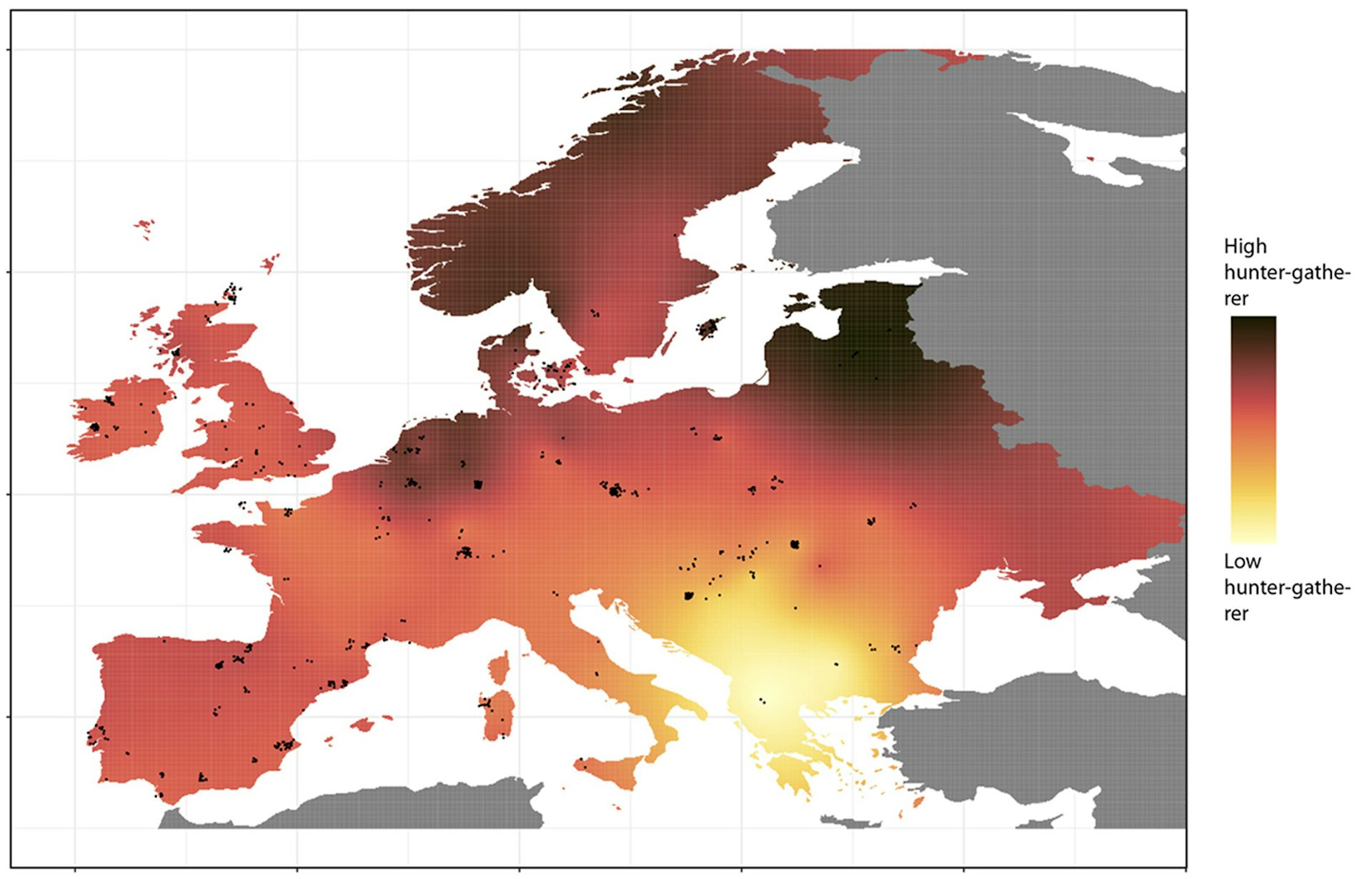
The new research takes us even further from the simple picture. Almost a decade ago, our research group at the University of Huddersfield began a collaboration with palaeoecologist Professor John Stewart from Bournemouth University and archaeologists at the Université de Liège, Belgium. We analysed the genomes of Neolithic human remains excavated along the River Meuse in Belgium, dating to around 5,000 years ago.
This work became part of a larger project, led by Professor David Reich and Dr Iñigo Olalde at Harvard University, involving geneticists and archaeologists from across western Europe. This widened the focus to further sites around the Lower Rhine–Meuse area – wetlands and coastal areas as well as rivers – spanning the late hunter-gatherer cultures to the bronze age.
The fertile soils south of the Rhine-Meuse wetlands had attracted pioneer Neolithic farmer-colonists as early as 5,500BC. However, the rich resources of the northern wetlands were more suited to the lifestyle practised by hunter-gatherers. Even so, the results, generated by our research student, Alessandro Fichera, in collaboration with Harvard, came as a big surprise.
The genomes of people from later Neolithic times in Belgium carried at least 50% local hunter-gatherer ancestry, alongside the expected Anatolian farmer ancestry. Discussing these results with our collaborators led to a “eureka” moment: the same pattern appeared at other sites situated in similarly water-rich environments across the region.
Notably, many of the earlier Neolithic Dutch samples from further north – such as the Swifterbant culture, well-known for maintaining a hunter-gatherer economy alongside some adoption of agriculture – carried close to 100% hunter-gatherer ancestry.
Women’s role in the spread of farming
We then compared the Y-chromosome and mitochondrial DNA, which track the male and female lines of descent, respectively. The Y chromosomes in the Belgian remains were all characteristic of hunter-gatherers, but three-quarters of the mitochondrial DNA lineages had come from Neolithic farmers living further south. The implication was clear: farming know-how had been imported into the “waterworld” hunter-gatherer communities by women.
Our findings support a version of the “frontier mobility” or “availability” model for the spread of the Neolithic, proposed by archaeologists Marek Zvelebil and Peter Rowley-Conwy in the 1980s. They envisioned a contact zone between pioneer farming groups arriving by “leapfrog colonisation” and hunter-gatherer areas.
In the model, the “availability” phase entailed contact and small-scale movements across the frontier, with trading relationships and marriage alliances, for example, forming gradually. This would be followed by a “substitution” phase where farming develops alongside foraging in the hunter-gatherer area, and eventually a “consolidation” phase, when farming predominates.
Our results suggest that the frontier was much more permeable to women than it was to men, and that it may have been marriage of Neolithic women into the forager communities that eventually helped the hunter-gatherers to adopt farming full time. After all, because of the predominance of farming across Europe, the likely alternative long-term was extinction.
Perhaps this kind of model might also apply to other parts of Europe where we lack evidence for how the increased hunter-gatherer ancestry in the later Neolithic came about. In any case, the fact that, here, the “more advanced” farming women married into hunter-gatherer groups, contrary to many archaeologists’ expectations that hunter-gatherer women would “marry up”, suggests that perceptions need to change.
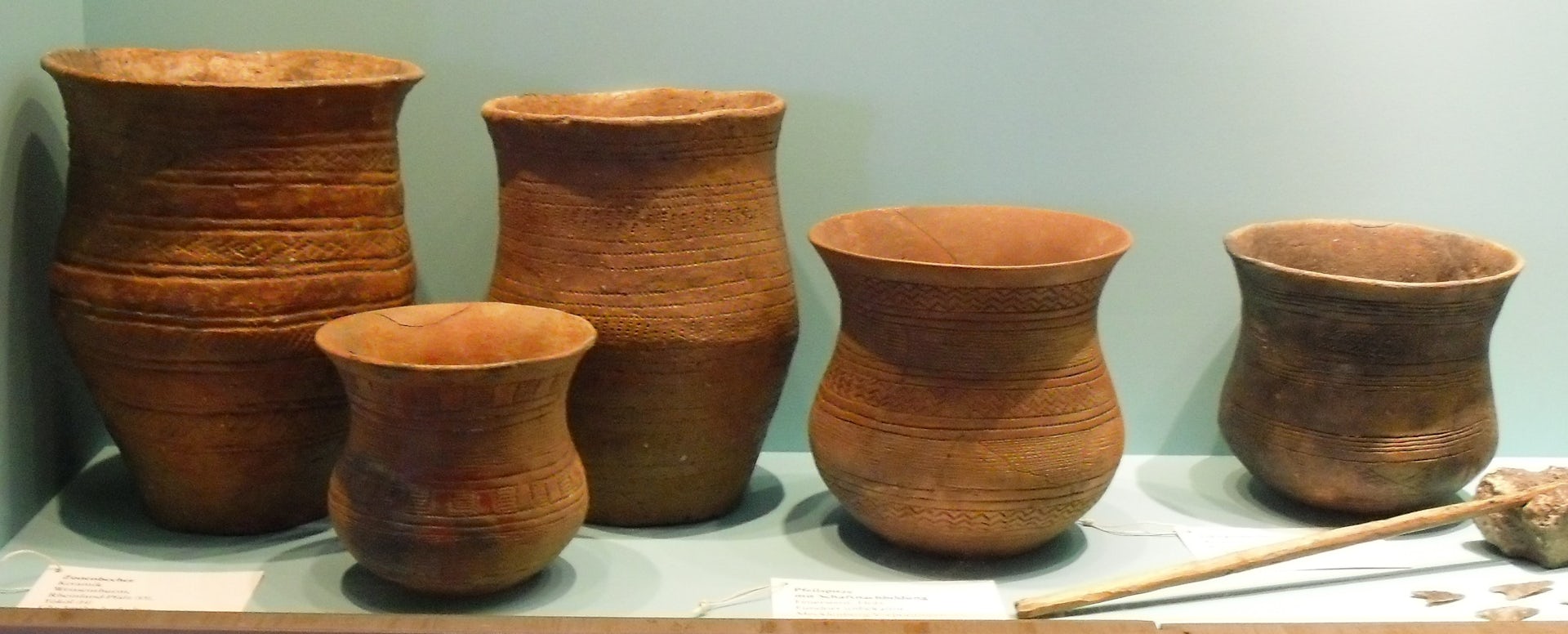
Around 4,600 years ago, though, people were on the move again. A new wave of settlers – pastoralist-farmers hailing ultimately from the Russian steppe – began to infiltrate the Rhine area in the form of the Corded Ware culture. As growing numbers moved in from the east, they were transformed – we still don’t understand exactly how – into what is known as the Bell Beaker culture.
Within a few centuries, the genetic landscape of the Rhine-Meuse region, including the wetlands, was completely reshaped. Our colleagues found that, 4,400 years ago, less than 20% of the ancestry of the people living there traced back to the earlier farmers and hunter-gatherers. At least 80% of their ancestry was now from the steppe.
The Bell Beaker people rapidly expanded and rippled out further in all directions, creating the bronze age of central Europe. And not only central Europe – they also spread across the English Channel and throughout Britain, extending as far north as Orkney.
It looks as if the British farmers who had been building Stonehenge over the preceding centuries all but disappeared – again, for reasons which remain unclear.
But did they actually vanish? Perhaps this rather blunt picture might become more nuanced too, as we learn more fine-grained details of what happened from archaeology and ancient DNA.

Martin B. Richards, Research Professor in Archaeogenetics, Department of Physical and Life Sciences, University of Huddersfield and Maria Pala, Senior Lecturer in Molecular Biology, Department of Physical and Life Sciences, University of Huddersfield
This article is republished from The Conversation under a Creative Commons license. Read the original article.

What this research shows is not a simple tale of one people replacing another in a neat sequence, still less the sudden appearance of humans in a magically-created world. It shows a complex, evidence-rich history of populations moving, mixing, persisting, adapting and sometimes being replaced over many thousands of years. The people of prehistoric Northwestern Europe were not characters in a folk tale; they were real human communities whose lives were shaped by climate, landscape, food resources, technology and contact with neighbouring groups.
That is why studies such as this are so fatal to the Bible creation myth when it is mistaken for history. The genetic evidence does not point to a single founding couple, a recent global flood, or the dispersal of all peoples from one post-Flood family. It points instead to deep ancestry, regional continuity, repeated migration and interbreeding between populations with different histories. The Low Countries, far from fitting a childish story of instant creation and recent repopulation, preserve evidence of a long, slow, natural human story written in DNA.
Creationism has no mechanism with which to explain these patterns, except by denying the evidence or pretending that it somehow means something other than it does. Science, by contrast, can test, refine and correct its account as new evidence is discovered. Ancient DNA does not merely add detail to archaeology; it allows us to see the movement of people, ideas and ancestry through time, revealing a past far richer and more interesting than Bronze Age mythology ever imagined.
And once again, the contrast could hardly be clearer. Reality gives us ancient populations, changing environments, cultural exchange and genetic inheritance. Genesis gives us magic, talking snakes, a boat full of animals and a mythical family tree. One is evidence-based history; the other is theology dressed up as history by people who need the facts not to be true.
Advertisement


All titles available in paperback, hardcover, ebook for Kindle and audio format.
Prices correct at time of publication. for current prices.


No comments:
Post a Comment
Obscene, threatening or obnoxious messages, preaching, abuse and spam will be removed, as will anything by known Internet trolls and stalkers, by known sock-puppet accounts and anything not connected with the post,
A claim made without evidence can be dismissed without evidence. Remember: your opinion is not an established fact unless corroborated.