Egyptian Middle Kingdom princesses at archery practice
AI-generated image (ChatGPT 5.6 Sol)

The writers and editors who composed the Pentateuch clearly possessed some knowledge of Egypt. It was, after all, a powerful neighbouring civilisation with which the peoples of the Levant had interacted for centuries. But a sprinkling of Egyptian names, loanwords and geographical details does not turn a theological story into an accurate historical account. When the biblical narratives are compared with Egyptian records, chronology and archaeology, Egypt often appears less as a real country than as an exotic stage on which the authors could set their morality tales.
The biblical use of the word ‘Pharaoh’ illustrates the problem, although not for the reason sometimes claimed. ‘Pharaoh’ is not a Hebrew expression meaning ‘owner of an estate’. The Hebrew par‘ō was borrowed from the ancient Egyptian pr-ꜥꜣ, meaning ‘Great House’. It originally referred to the royal palace and only during the New Kingdom came to be used for the king himself. Its use as the personal designation of a ruler in Genesis, whose supposed events are conventionally placed centuries earlier, is therefore probably anachronistic.
More revealingly, the biblical authors never identify the rulers in the Joseph or Exodus stories by any of their regnal names. Egyptian kings possessed elaborate formal titles and names, yet the Bible gives us only an anonymous ‘Pharaoh’. This makes it impossible to place either story securely within Egyptian chronology and contrasts sharply with the detailed records left by the Egyptians themselves.
There is likewise no independent evidence for an Exodus on anything resembling the scale described in the Bible. No Egyptian record mentions ten devastating plagues, the death of the firstborn, the destruction of a substantial chariot force or the sudden flight of an enormous enslaved population. Egyptian royal inscriptions were selective and rarely advertised defeats, so their silence alone would not be conclusive. However, there is also no corresponding demographic, economic or archaeological disruption in Egypt, and no material trace in Sinai of the immense population demanded by a strictly literal reading of the story.
The narrative also contains striking internal difficulties. Exodus 9 describes a pestilence affecting the Egyptian livestock in the fields—including horses—and then declares that ‘all the livestock of the Egyptians died’. Yet the same chapter subsequently refers to more Egyptian livestock, while Exodus 14 has Pharaoh assembling 600 chosen chariots, together with his other chariots, all of which would have required teams of surviving horses. Apologists can invent unmentioned groups of sheltered or unaffected animals, but that is an attempt to repair the story, not a literal reading of what it says.
Nor is the geography as straightforward as the familiar Sunday-school version suggests. The Hebrew Yam Suph, traditionally translated as the Red Sea, more probably means the ‘Sea of Reeds’, and its intended location remains uncertain. Moreover, at the dates commonly proposed for an Exodus, Egypt maintained forts, roads and mining operations in Sinai and exercised imperial control over much of Canaan. Even after leaving Egypt proper, the Israelites would not necessarily have escaped Egyptian power.
Exodus 12:37 gives a figure of about 600,000 adult men, besides women and children. Read literally, that implies a total population of perhaps two or three million people, together with their animals. It is absurd to imagine such a population living and travelling in Sinai for 40 years without leaving campsites, hearths, tools, pottery, animal bones, human burials or any other archaeological footprint remotely commensurate with its supposed size.
An even greater problem for biblical literalists is the continuous archaeological record of Egypt itself. Young-Earth creationist chronologies commonly place their global Flood somewhere around the middle of the third millennium BCE, by which time Egypt had already been a unified state for centuries and the great pyramids of the Old Kingdom had been built. Egyptian society certainly underwent political and economic changes, but there is no point at which its entire population disappears and is replaced by descendants of eight survivors from Mesopotamia.
Nor is there a synchronous horizon of catastrophic erosion, inundation, mass death and repopulation throughout Egypt—or anywhere else—that could represent a global Flood. Instead, archaeologists find settlements, tombs, temples, administrative records and evolving cultural traditions extending through and beyond the period in which the Flood supposedly occurred. It is a vast body of mutually consistent evidence that simply could not exist in its present form if the biblical story were literal history.
The latest study does not, by itself, constitute a direct test of the Flood story because the burials it examines date from approximately 1850–1700 BCE, after the date assigned to the Flood by most creationists. Its importance lies instead in the extraordinary detail it adds to Egypt’s continuous and independently reconstructed history—a real history populated by named individuals whose health, relationships and activities can be investigated scientifically, rather than by anonymous characters in an unverifiable tale.
The study is a modern bioarchaeological reassessment of the skeletal remains of King Hor and five royal women—four identified princesses and a fifth woman tentatively identified as Princess Sathathormeryt. The remains were recovered during Jacques de Morgan’s excavations at Dahshur in 1894–1895, but had received little systematic examination using the techniques now available. The researchers combined osteological examination, radiological imaging and chemical analysis of the surviving embalming materials.
From a historical perspective, one of the most intriguing findings concerns the lives of these royal women. Their burials collectively contained bows, arrows, maces, staves and an exquisite dagger, as well as jewellery and other objects associated with their elite status. Such weapons had often been interpreted as purely ceremonial grave goods, symbols of rank or objects intended for use in the afterlife.
The skeletal evidence, however, suggests that at least some of the women had used weapons repeatedly during life. The researchers found unusually robust entheses—the places where muscles and ligaments attach to bone—together with asymmetrical development in the arms and shoulders and modifications to bones of the hands. These patterns are consistent with repetitive, physically demanding activities such as drawing a bow and gripping a dagger or mace.
Princesses Khenmet and Itaweret showed skeletal changes consistent with repeated bow-drawing, while Princess Noub-Hotep’s forearm and hand bones displayed adaptations matching the arrows found in her burial. Princess Ita, who was buried with an elaborately decorated dagger, had strongly developed attachment sites associated with forceful and repeated gripping. The findings therefore suggest that these objects were not merely decorative possessions but implements with which the women had trained.
This does not prove that Egypt maintained a separate class of female combat troops, or that the princesses necessarily fought in battles. Their activities could have included hunting, athletic training or ritualised displays of archery and royal power. Nevertheless, the evidence strongly challenges the traditional assumption that elite Egyptian women were invariably sedentary figures whose weapons served only a symbolic purpose. These princesses appear to have participated in skilled and physically demanding martial or ritual activities.
The reassessment was conducted by Zeinab Hashesh of the University of Beni-Suef, Beni-Suef, Egypt; Ahmed Gabr of the Ministry of Tourism and Antiquities, Cairo, Egypt; and Roxie Walker of the Institute for Bioarcheology, London, United Kingdom. They have published their findings in Frontiers in Environmental Archaeology.
The archaeology and its significance are also discussed in an article in The Conversation by Anna M. Kotarba-Morley, Associate Professor in Archaeology and Heritage at Adelaide University, and Michael Westaway, Professor of Archaeology and Biological Anthropology in the School of Social Science at the University of Queensland. Their article is reprinted below under a Creative Commons licence and reformatted for stylistic consistency:

Warrior princesses of ancient Egypt? Skeletons show women used the weapons buried with them
Sameh Abdel Mohsen / Egyptian Museum
In the opening scene of the 2001 blockbuster film The Mummy Returns, two women of Egypt’s royal court engage in spectacular hand-to-hand combat.
The scene is dramatic rather than historical, but it raises an interesting question: were Egyptian women really trained with weapons, similarly to Viking shieldmaidens?
A new study of royal skeletons, published in Frontiers in Environmental Archaeology, suggests there may be an element of truth to this idea.
The sisters and daughters of pharaoh Amenemhat II, who died around 1900 BC, were buried with bows, maces and in at least one case a dagger. The new research, led by Zaineb Hashesh at Egypt’s University of Beni-Suef, suggests these weren’t just for decoration.
The women behind the treasures
Few Egyptian artefacts are as striking as the dagger buried with Princess Ita almost 4,000 years ago. Its handle, made of lapis lazuli, turquoise and gold, is a masterpiece of Middle Kingdom craftsmanship. Yet the real mystery is the princess who was buried with it.
Princess Ita was one of five royal women interred in richly furnished underground tombs at Dahshur, the royal necropolis south of modern Cairo, as part of the family group associated with Amenemhat II. The pharaoh was buried nearby in the White Pyramid complex, named for its dazzling Tura limestone casing.
These women were members of Egypt’s Twelfth Dynasty, one of the most powerful periods of the Middle Kingdom.
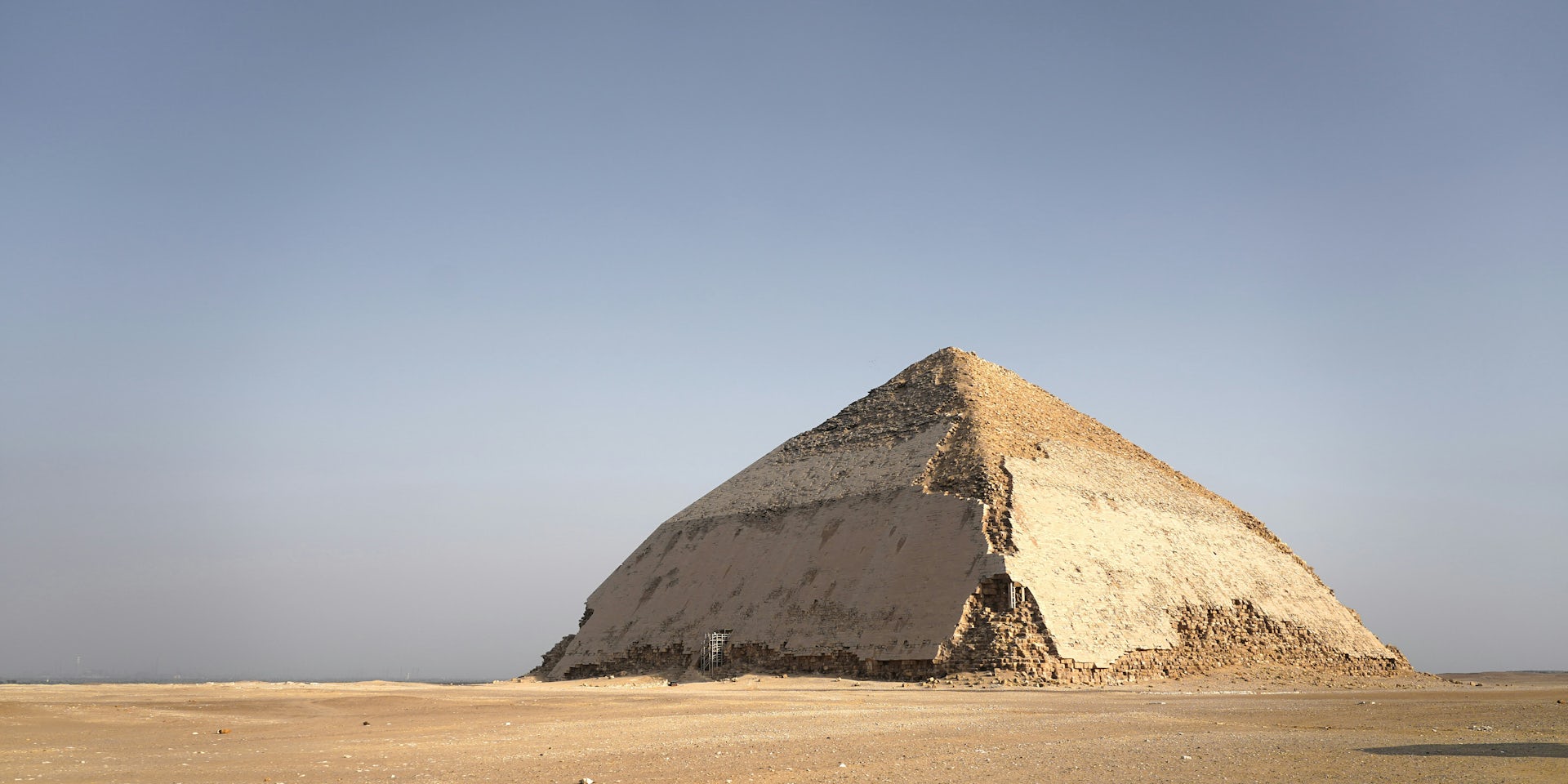
The Bent Pyramid at Dahshur, near where the princesses were found.
This has intrigued Egyptologists for more than a century, as weaponry has traditionally been associated with elite men rather than female burials.
Reading lives written in bones The study of a person’s life through their skeleton is called osteobiography. The combination of burial context, artefacts, historical records and skeletal evidence means osteobiography can be a compelling way to reconstruct ancient lives.
Archaeologists often favour large studies comparing hundreds of skeletons to understand health, diet and lifestyle across a population. Yet individuals from the deep past who have an identity – a name, family relationships, a burial context – are rarer, but scientifically powerful in their own way.
One of the most famous examples is the Viking cemetery at Birka, Sweden. Here, a 10th-century grave containing weapons and a board game was long assumed to belong to a male warrior – until DNA confirmed the skeleton was that of a woman.
Were the Dahshur princesses really archers? The Twelfth Dynasty burials reveal an equally surprising story. Despite careful mummification, most soft tissue has turned to dust over the millennia, and the skulls were lost in the early 1900s.
However, many long bones and muscle attachments survived well enough for modern osteological analysis of the princesses’ physical activity.
The six skeletal remains – King Hor and five princesses, Ita, Khenmet, Itaweret, Nubhetepti-Khered and one unnamed woman – show muscle attachment areas associated with repetitive motions of precision gripping and pulling, consistent with archery.
Bones are remodelled continually in response to biomechanical strain. The repetitive high-intensity gripping needed to stabilise and draw a bow has been shown to leave lasting marks on bone structure. These markers can’t prove a single activity, but they are good indicators of long-term movement patterns.
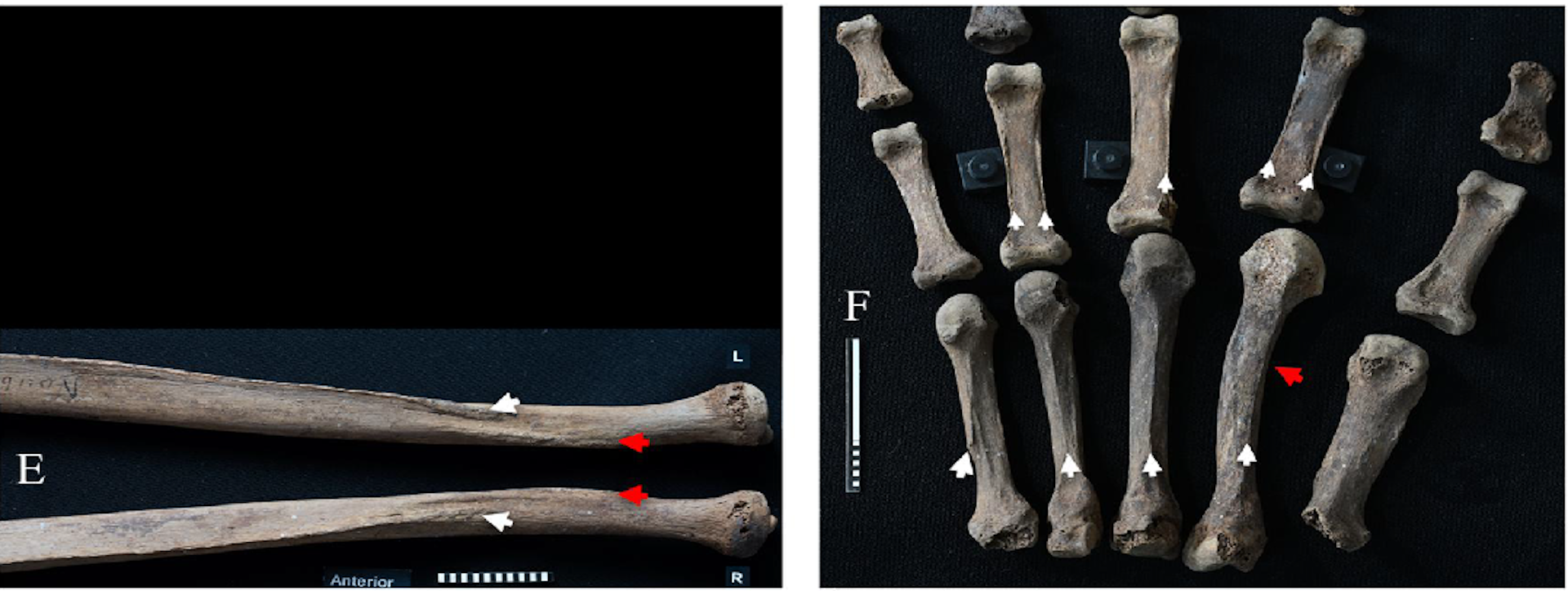
Muscle attachment robustness in Princess Noub Hotep: lower arm bones showing pronounced areas of muscle attachment (left), and bowing of the second metacarpal (hand bone marked with red arrow) and pronounced muscle attachments of the palm and finger bones (right). These are consistent with repetitively stabilising and drawing a bow.
Hashesh et al. / Frontiers in Environmental Archaeology
, CC BY
, CC BY
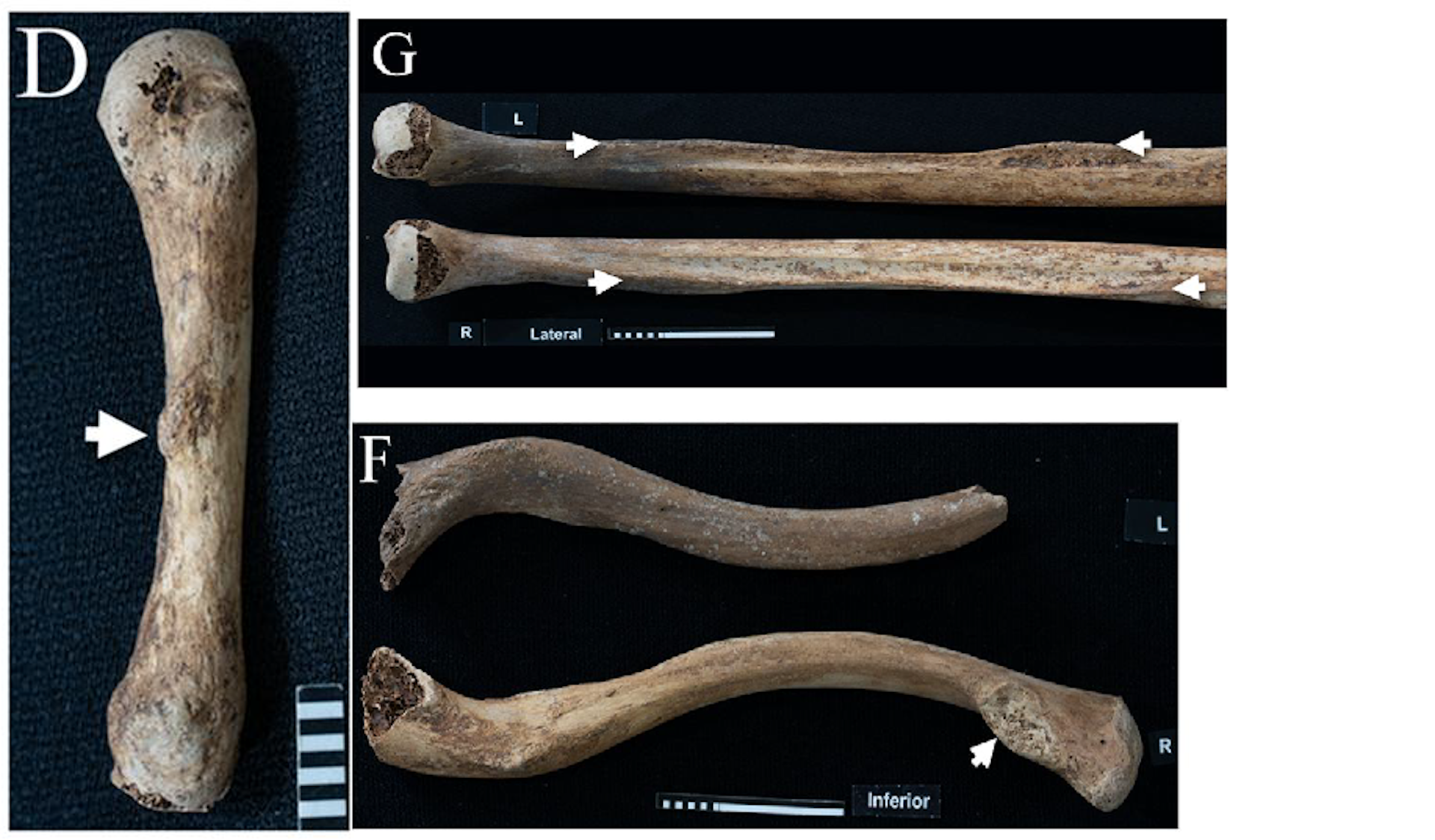
Subtle changes in the bones of Princess Ita reflect repetitive biomechanical strain, and include a pronounced muscle attachment in the left fifth finger (left), robust muscle attachments in the bones of the lower arms (top right), and a robust ligament in the right collarbone (bottom right). These are consistent with habitual gripping of weapons such as daggers or maces.
Hashesh et al. / Frontiers in Environmental Archaeology, CC BY
A royal life may not have been an easy one Fracture patterns in the bones add another dimension. Princess Itaweret shows healed trauma in a rib and foot-bone consistent with a fall or a forceful blow. King Hor has a hand fracture and skull trauma, both healed. This suggests a more physically demanding life than the sedentary existence often imagined for ancient elites.
Elite status didn’t buffer them from other hardships either: the eye sockets of King Hor show potential signs of nutritional stress and infectious disease. The shinbones of Princess Nubhetepti-Khered have features often linked to repetitive activity such as food preparation – but perhaps in this instance tied to ritual or court function.
Where next for the Dahshur royals? The princesses may have been buried decades after their father, as part of a ritual system securing the king’s eternal rebirth. This study is unlikely to be the final word on their lives.
If DNA can ever be recovered from the skeletons, it could clarify family relationships, including for the unnamed woman in her 20s.
Further microscopic analysis (histology) of the bones could reveal how activity changed over a lifetime – whether the strain of drawing a bow declined with age, particularly in the older princesses, Khenmet and Noub-Hotep.
Comparing these elite burials with working-class remains from the same period could also show whether ordinary Egyptians bore similar patterns of biomechanical stress and disease.
Together, these approaches have the potential to transform these remarkable burials from archaeological discoveries into rich, detailed biographies of the people themselves.
Royal women whose stories have often been eclipsed by the reigns of male kings can take their place as actors in Egypt’s history, rather than passive figures in the archaeological record.

Anna M. Kotarba-Morley, Associate Professor in Archaeology and Heritage, Adelaide University and Michael Westaway, Professor of Archaeology and Biological Anthropology, School of Social Science, The University of Queensland
This article is republished from The Conversation under a Creative Commons license. Read the original article.


The significance of this research extends beyond the intriguing possibility that some royal Egyptian women were trained archers. It demonstrates how modern archaeology can recover aspects of individual lives from evidence that has survived for almost 4,000 years. Burial objects, skeletal adaptations, healed injuries and chemical traces of embalming materials can be examined together to reconstruct a picture that is detailed, testable and open to revision as new evidence becomes available.
The interpretation should remain appropriately cautious: the evidence does not prove that these princesses fought in battles or belonged to an organised female warrior class. It does, however, strongly suggest that their bows, arrows and other weapons were more than ceremonial decorations. Their bones bear the marks of repeated, strenuous and highly skilled activity, challenging the traditional assumption that royal Egyptian women lived entirely sedentary and ornamental lives.
For biblical literalists, meanwhile, every such discovery deepens an already insoluble problem. These women belonged to an established royal dynasty embedded in inherited funerary traditions, specialised craftsmanship, organised trade, sophisticated medicine and a complex social hierarchy. Their lives formed part of an Egyptian history that stretches continuously across the supposed date of the global Flood, without any extermination of the population, destruction of the civilisation or repopulation by descendants of Noah.
Archaeology does not reveal the anonymous cardboard Egypt of Genesis and Exodus, populated by nameless pharaohs and interrupted by supernatural catastrophes. It reveals real people with names, families, illnesses, injuries, occupations and physical traces of what they did during their lives. The contrast could hardly be clearer: science patiently reconstructs Egypt’s history from evidence, while creationism demands that the evidence be ignored so that an ancient story can continue to masquerade as history.
Advertisement
Amazon

Amazon

Amazon

Amazon

Amazon

Amazon

Amazon

Amazon

Amazon

Amazon

Amazon

Amazon

All titles available in paperback, hardcover, ebook for Kindle and audio format.
Prices correct at time of publication. for current prices.

No comments:
Post a Comment
Obscene, threatening or obnoxious messages, preaching, abuse and spam will be removed, as will anything by known Internet trolls and stalkers, by known sock-puppet accounts and anything not connected with the post,
A claim made without evidence can be dismissed without evidence. Remember: your opinion is not an established fact unless corroborated.