

Back in December 2024, I published The Body of Evidence: How the Human Body Refutes Intelligent Design as part of my Unintelligent Design series. In it, I argued that:
Looked at objectively, beneath the superficial appearance of design, the human body, with its inefficiencies, vulnerabilities and vestigial features, is best explained through the lens of evolution.
Far from reflecting intelligent design, our anatomy and physiology reveal a history of incremental changes shaped by natural selection and constrained by pre-existing structures. These imperfections underscore the reality of evolution as a tinkering process, producing functional but far-from-perfect outcomes.
In this light, the human body stands as a powerful testament to our evolutionary heritage and tells a story far more impressive than the childish notion of it all being made by magic by a super-intelligent yet invisible and undetectable designer.
It is therefore gratifying to see those conclusions independently reinforced by Lucy E. Hyde, a Lecturer in Anatomy at the University of Bristol. In a recent article in The Conversation, she makes essentially the same case, drawing upon many of the same examples that I used.
This is not because anatomists and evolutionary biologists have agreed upon a preferred story and then set out to make the evidence fit it. It is because people who understand evolution and possess more than a superficial knowledge of human anatomy and physiology can examine the same evidence and independently reach the same broad conclusion: the human body is not the product of foresightful engineering but a historical patchwork of inherited structures, evolutionary compromises and modifications to what already existed.
Evolution explains not only why the human body works as well as it does, but also why it so often fails, why some of its structures follow absurdly circuitous routes, why others are poorly suited to their present functions and why still others persist despite having little or no remaining usefulness. “Intelligent design”, by contrast, explains none of this without retreating into the scientifically worthless claim that an unknowable designer must have wanted things that way.
Lucy Hyde’s article is reproduced below under a Creative Commons licence, with its formatting adapted for consistency with this blog:

The human body isn’t a masterpiece of design – it’s a patchwork of evolutionary compromise
Our bodies are a living archive of evolution.
The human body is often described as a marvel of “perfect design”: elegant, efficient and finely tuned for its purpose. Yet, when we look closer, a rather different picture emerges.
Far from being a flawless machine, the body reads more like a patchwork of compromises shaped by millions of years of evolutionary tinkering. Evolution does not design structures from scratch. Rather, it modifies what already exists.
As a result, many aspects of human anatomy are just “good enough” solutions – functional, but far from perfect. Some of the most familiar medical problems and ailments arise directly from these inherited constraints.
The spine
The human spine tells this story best.
Our vertebral column has evolved little from our four-legged, quadrupedal tree-dwelling ancestors, where it functioned primarily as a flexible beam for smooth movement from branch to branch, while also protecting the spinal cord.
When humans adopted an upright bipedal gait, the spine retained these functions. But it was also repurposed for the additional need of supporting our body weight vertically and maintaining our centre of gravity, while still allowing the flexibility for us to move. These opposing demands creates strain.
The characteristic curves of the human spine helps distribute weight, but it also predisposes us to lower back pain, herniated discs and degenerative changes affecting its most important function – protection the spinal cord and surrounding nerves. These conditions are extraordinarily common, not because the spine is inherently poorly made, but because it’s doing a job it was never originally designed to do.
The neck
Another clear argument against divine design is the recurrent laryngeal nerve, which takes a course that simply makes no sense to invent.
This nerve, which is a branch of the vagus nerve, predominantly controls our organs’ “rest and digest” functions (such as slowing heart rate and breath). The laryngeal nerve also connects the brain and larynx, helping control speech and swallowing.
Logically, one might expect it to use the most direct route to connect brain and larynx. Instead, it descends from the brain into the chest, loops around a major artery, then travels back up to the voice box.
This detour is not a clever design, but a historical leftover from our fish-like ancestors when the nerve took a straightforward path around the gill arches. As necks lengthened over evolutionary time, the nerve was stretched rather than rerouted.
This inefficiency can increase our vulnerability to injury during surgery.
The eyes
Even the eyes reflect evolutionary compromise.
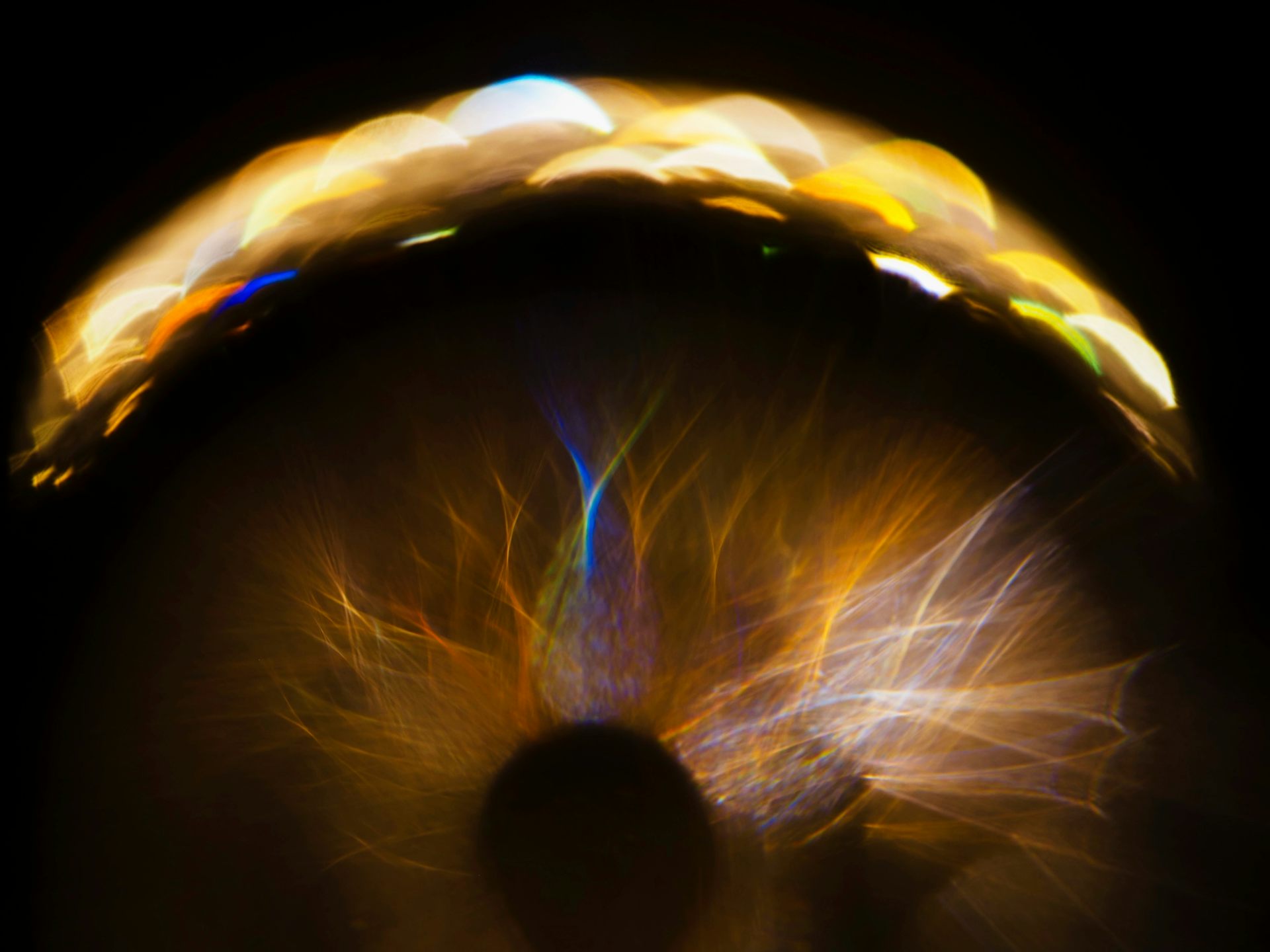
In humans and other vertebrates, the retina (the light-sensitive layer at the back of the eyeball) is wired “backwards.” This means light must pass through layers of nerve fibres before reaching the photoreceptors – specialised cells responsible for detecting light and converting that into a nerve impulse to send to the brain.
The optic nerve then exits through the back of the retina, creating a blind spot just below the horizontal level of the eye where no vision is possible. The brain fills in this gap seamlessly, so we rarely notice it.
Our incredible vision has come with a compromise.
The teeth
Our teeth offer another reminder that evolution prioritises adequacy over durability.
Humans develop two sets of teeth: baby teeth and adult teeth – and that’s all. Once adult teeth are lost, they’re not replaced – unlike sharks, which continually regenerate teeth throughout life.
In mammals, tooth development is tightly regulated and linked to complex jaw growth and feeding strategies. This system worked well for our ancestors, but for modern humans it leaves us vulnerable to decay and tooth loss.
Wisdom teeth provide another example of evolutionary lag. Our ancestors had larger jaws, suited to tougher diets that required heavy chewing. Over time, human diets softened and jaw size decreased. However, the number of teeth did not change as quickly. Many people no longer have space for their third molars – leading to impaction, crowding and often requiring surgical removal.
Wisdom teeth aren’t useless in principle, but they no longer fit comfortably within modern skulls.
The pelvis
Childbirth presents one of the most profound evolutionary compromises. Like the spine, the human pelvis must balance two competing demands: efficient bipedal walking and birthing large-brained infants.
A narrow pelvis improves locomotion, but restricts the birth canal’s size. Meanwhile, human babies have unusually large heads relative to body size, resulting in a difficult and sometimes dangerous birth process – often requiring outside assistance.
This tension between mobility and brain size has shaped not only anatomy but also social behaviour, encouraging cooperative care and cultural adaptations around childbirth.
Evolutionary persistence
Evolution doesn’t necessarily eliminate structures unless they impose a strong disadvantage. So some anatomical features persist despite offering limited benefit.
The appendix, once considered a completely useless evolutionary left-over, is now thought to have minor immune functions. Yet it can become inflamed, causing appendicitis – a potentially life-threatening condition.
Similarly, the sinuses, have unclear functions. They may lighten the skull or influence voice resonance, and we can even use their size and variability for forensic identification. But the sinus’s drainage pathways go direct into the nose, making it prone to regular blockage and infection, a developmental byproduct rather than a purposeful adaptation.
Even tiny muscles around the ears hint at our evolutionary past. In many mammals, tiny ear muscles allow the outer ear (pinna) to swivel, improving directional hearing. Humans have these muscles, but most people cannot use them effectively.
Our bodies are not perfectly designed, but are a living archive of evolution. Anatomy reveals a historical record of adaptation, compromise and contingency. Evolution does not aim for perfection; it works with what is available, modifying structures step by step.
Understanding anatomy through this evolutionary lens can also help us reframe how we see common medical problems. Back pain, difficult childbirth, dental crowding and sinus infections are not random misfortunes. They are, in part, the consequences of our evolutionary history.

Lucy E. Hyde, Lecturer, Anatomy, University of Bristol
This article is republished from The Conversation under a Creative Commons license. Read the original article.

That is precisely what evolutionary theory predicts. It explains why nerves take needless detours, why our backs and knees are prone to failure, why childbirth is so hazardous, why our airways and food passages cross, and why we retain reduced structures inherited from ancestors in which they served different functions. These are not isolated defects in an otherwise perfect design; they are signatures of descent with modification.
Intelligent design, by contrast, offers no testable explanation for any of them. It merely labels whatever exists as the intention of an invisible designer, however inefficient, dangerous or absurd the outcome may be. A theory capable of explaining both perfection and incompetence, foresight and blunder, elegance and needless complexity explains nothing at all.
The deeper anatomists look, the less the human body resembles the work of an unconstrained intelligence and the more clearly it reveals its evolutionary history. Beneath the superficial impression of design lies not a masterpiece of engineering, but a record of modification, compromise and survival — a body assembled by evolution from whatever material history happened to provide.
If the human body was perfectly designed by a perfect designer,
why do we need medical science, hospitals and doctors?
Tweet
why do we need medical science, hospitals and doctors?
Tweet
Advertisement
Amazon

Amazon

Amazon

Amazon

Amazon

Amazon

Amazon

Amazon

Amazon

Amazon

Amazon

Amazon

All titles available in paperback, hardcover, ebook for Kindle and audio format.
Prices correct at time of publication. for current prices.

No comments:
Post a Comment
Obscene, threatening or obnoxious messages, preaching, abuse and spam will be removed, as will anything by known Internet trolls and stalkers, by known sock-puppet accounts and anything not connected with the post,
A claim made without evidence can be dismissed without evidence. Remember: your opinion is not an established fact unless corroborated.