

It is not often that fossilised faeces take centre stage in an explanation of one of the most important episodes in evolutionary history. However, a review published in Trends in Ecology & Evolution suggests that the evolution of digestive systems—and the resulting production of faecal pellets—may have helped to transform the chemistry and ecology of the oceans during the Cambrian radiation.
In The Cambrian fecal revolution: Fueling the Cambrian Radiation, palaeontologists Julien Kimmig and Russell D.C. Bicknell bring together evidence from fossil digestive systems and coprolites—fossilised faeces—from more than 35 deposits around the world. They found that coprolites became progressively more abundant and varied during the Cambrian Period, ranging from microscopic pellets to centimetre-sized masses containing shells and fragments of other animals.
This change coincided with the evolution of increasingly sophisticated digestive systems. Early animals with blind guts had only one opening through which food entered and waste was expelled. The evolution of a through-gut, with a separate mouth and anus, permitted food to move continuously through the body. Animals could feed more frequently, process a greater variety of foods and adopt new ecological roles. Early arthropods, in particular, developed specialised foreguts and digestive glands capable of extracting nutrients from increasingly diverse prey.
According to the authors, the consequences extended far beyond the animals producing the waste. Faecal pellets packaged organic matter and nutrients—including carbon, nitrogen, phosphorus and iron—and transported them through the water column and into deeper environments. In modern oceans, this sinking material forms an important part of the biological pump that carries carbon and nutrients away from surface waters. Kimmig and Bicknell propose that the beginnings of a comparable process during the Cambrian helped to fertilise previously nutrient-poor environments and support more complex food webs.
This could have created a self-reinforcing evolutionary feedback. Larger and more active animals consumed more food and produced larger faecal pellets; those pellets redistributed more nutrients; the resulting increase in biological productivity supported still larger populations, more predators and more complicated ecological relationships. The expansion of animal life was therefore not merely a response to environmental change: evolving animals were themselves changing their environment and creating new ecological opportunities.
As the authors make clear, this “faecal revolution” should not be treated as the single cause of the Cambrian radiation. Increasing oxygen concentrations, changes in ocean chemistry, the evolution of predation, greater mobility, burrowing and the development of mineralised skeletons were also involved. The review proposes an additional component of a network of interacting biological and environmental processes.
Nor is the suggestion that faeces somehow generated new genes or directly produced new animal body plans. Faecal matter altered nutrient availability and the structure of marine ecosystems, providing conditions in which existing evolutionary processes could operate in new ways. Confusing an environmental driver with a genetic mechanism would be a fundamental misunderstanding—or deliberate misrepresentation—of the hypothesis.
The so-called Cambrian “Explosion” was not the instantaneous appearance of fully formed animals, as creationist and intelligent-design propagandists habitually portray it. Animals had already begun evolving during the preceding Ediacaran Period, and the Cambrian diversification unfolded over many millions of years. Fossils preserve changing body sizes, feeding strategies, digestive systems, predator–prey relationships and patterns of nutrient cycling throughout that interval.
What emerges is not evidence of a sudden magical creation event but a recognisably evolutionary process: earlier organisms evolved new anatomical features, those features changed how they interacted with their surroundings, and the resulting environmental changes opened further opportunities for diversification. Even something as unglamorous as animal excrement became part of the accumulating ecological feedback that helped to turn relatively simple late-Ediacaran seas into the complex, animal-dominated ecosystems of the Phanerozoic.
The paper in Trends in Ecology & Evolution was accompanied by a news blog post from Flinders University and the two authors, Julien Kimmig & Russell D.C. Bicknell, have written about their work in an article in The Conversation. Their article is reprinted here under a Creative Commons license, reformatted for stylistic consistency:

On the origin of feces: how animal poo drove Earth’s greatest evolutionary event
Kimmig & Bicknell / Trends in Ecology & Evolution
As all children learn, everyone poos. But when did this begin?
And what evolutionary and environmental changes accompanied the dawn of dung? Going further, is the evolution of excrement the reason we exist?
Our new research suggests the evolution of fecal matter helped fuel one of the most important events in the history of life on Earth: the Cambrian explosion.
And poo really might be the reason animals were such a huge evolutionary success.
A hidden clue to the Cambrian explosion
Around 540 million years ago, the Cambrian explosion transformed life on Earth. During a relatively brief interval in geological time – somewhere between 13 million and 25 million years – most of the major animal groups appeared.
Around the same time, the first marine ecosystems developed and became more complex. Marine food webs began to look like those of modern oceans.
Scientists have long debated what drove this diversification. Rising oxygen levels, evolutionary innovations and increasingly complex predator-prey interactions have all been proposed as factors.
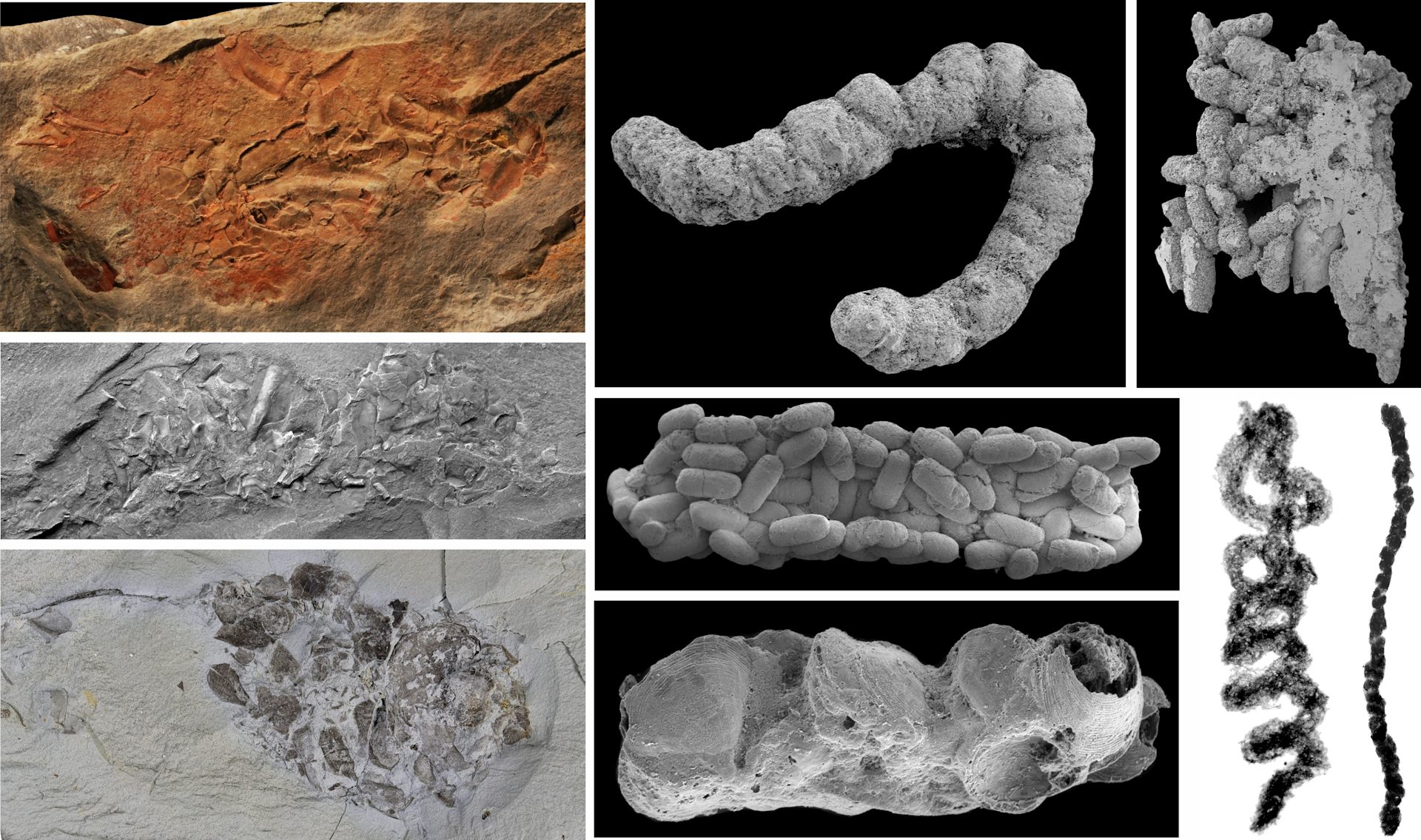
Fossilised fecal matter, or coprolites, came in many shapes and sizes during the Cambrian.
Our study considered these fossils as part of a much bigger picture. We argue they also record the emergence of a fundamental ecological process.
As animals became more abundant and evolved more sophisticated digestive systems, they were able to produce more fecal matter. More feces meant more organic material and nutrients were distributed through the oceans. This in turn sped up the development of ecosystems.
From simple guts to complex ecosystems
The earliest animals appeared around 60 million years before the Cambrian explosion began. However, until the Cambrian there is little or no evidence of complex digestive systems, nor any confirmed coprolites.
The fossil record of guts and coprolites shifts dramatically during the Cambrian. The first fossilised feces appear right at the onset of the Cambrian and become increasingly abundant.
As we move forwards in time, more diverse coprolites appear. Evidence from dozens of deposits across the globe shows an array of different shapes and sizes. The fecal matter ranges from microscopic pellets through to centimetre-scale coprolites containing crushed shells and other animal fragments.
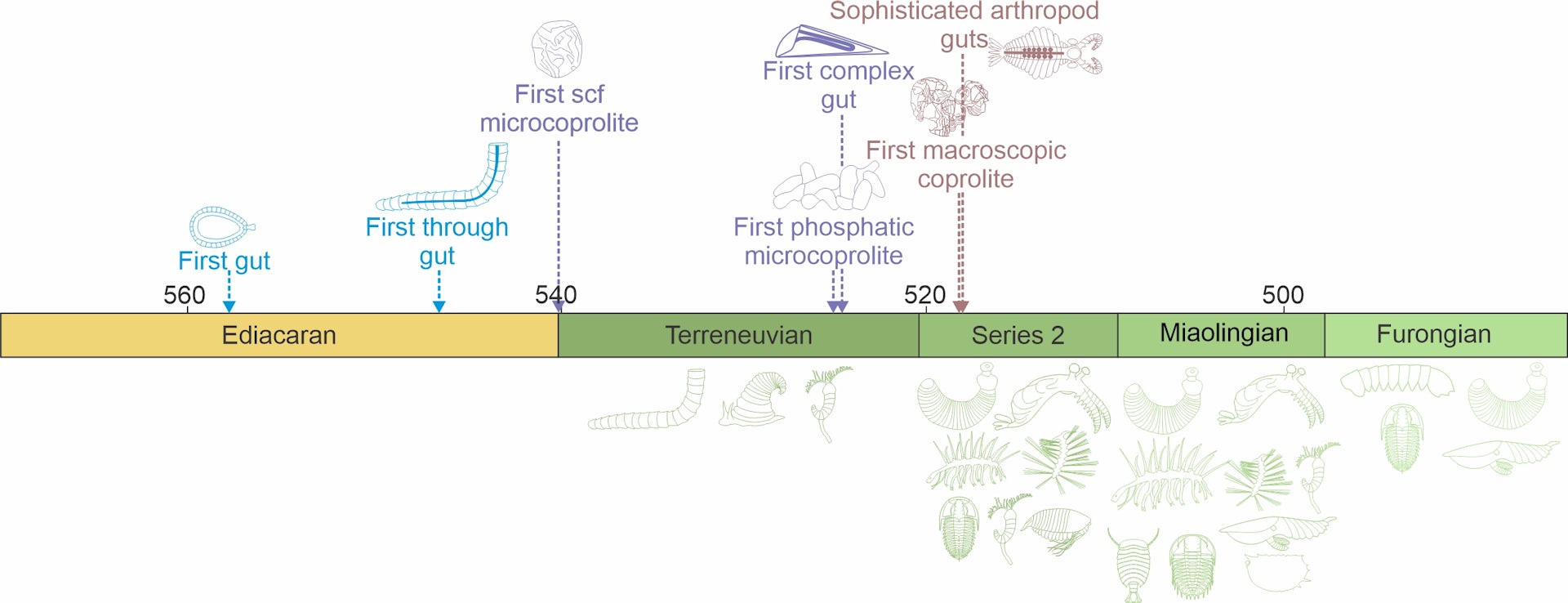
Between roughly 560 million years ago and 500 million years ago, animal guts and the feces they produced underwent some big changes.
Together, these fossils show animals were beginning to process and then redistribute organic matter using entirely novel pipelines.
Nutrient cycling on an evolutionary scale
The ecological significance of this innovation becomes clearer when viewed alongside modern oceans.
Today, fecal pellets are an important component of the biological pump – the process that transports organic carbon and nutrients from surface waters into deeper marine environments. As fecal pellets sink, they carry nutrition to support life well beyond the sunlit surface ocean.
Our research suggests the widespread appearance of fecal matter during the Cambrian may represent the evolutionary origin of this process.
As animal diversity and biomass increased during the Cambrian, so too would have the production of fecal pellets. This would have meant more sources of energy and nutrients sinking to deeper marine habitats, and making food more widely available in shallower waters.
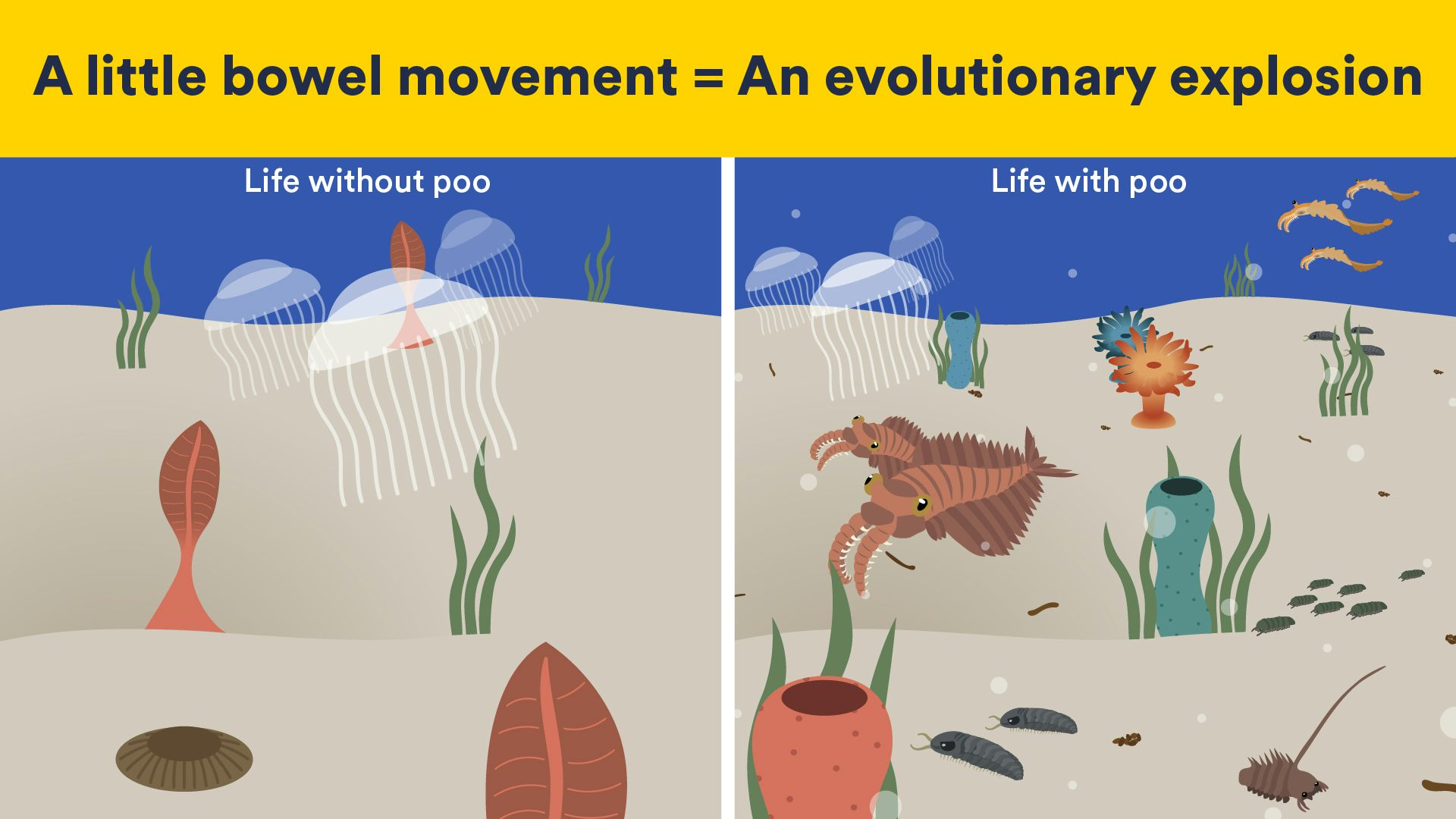
How marine ecosystems looked before and after the Cambrian explosion.
T Klarenbeek, CC BY-SA
The emergence of widespread fecal production had an important ecological feedback. Greater animal diversity resulted in greater production of fecal matter, increasing the redistribution of organic carbon and nutrients through marine ecosystems.
In turn, improved nutrient availability likely supported larger populations, more complex food webs and the colonisation of increasingly diverse marine habitats. Those expanding ecosystems would then have generated even greater biological productivity.
Our observation here complements other hypotheses explaining the Cambrian explosion. Oxygenation, ecological interactions and evolutionary innovations undoubtedly played critical roles as well.

Russell Dean Christopher Bicknell, Post-doctoral researcher in Palaeobiology, Flinders University and Julien Kimmig, Head of Palaeontology Division at the Natural History Museum Karlsruhe
This article is republished from The Conversation under a Creative Commons license. Read the original article.

Creationists will doubtless try to caricature this hypothesis as the claim that “poo caused the Cambrian Explosion”. That would be a convenient straw man, but it is not what Kimmig and Bicknell are proposing. Faecal matter did not manufacture genes or conjure new body plans into existence; it redistributed organic carbon and essential nutrients, altering the environments in which evolution was already occurring and helping to sustain increasingly complex ecosystems.
The fossil record shows a sequence of related developments: animals were already present during the Ediacaran Period; digestive systems became more elaborate; coprolites increased in size, abundance and variety; feeding strategies diversified; and food webs acquired more trophic levels. These changes unfolded over millions of years and affected one another through ecological feedback. That is very different from the creationist portrayal of the Cambrian radiation as the inexplicable, instantaneous appearance of fully formed animal “kinds”.
As a review, this paper does not claim to have proved that faecal production was the sole or even principal cause of the Cambrian radiation. It offers a testable synthesis that can be assessed against the timing, distribution and composition of coprolites, fossil digestive systems and geochemical evidence. It may be strengthened, modified or rejected as further evidence becomes available. That willingness to expose an idea to possible falsification is precisely what distinguishes a scientific hypothesis from a religious assertion protected from contrary evidence.
Creationism, meanwhile, explains none of the observed sequence. It cannot tell us why digestive systems changed, why coprolites became larger and more diverse, why nutrient cycling intensified or why ecological complexity accumulated gradually through the rocks. It merely replaces all those questions with an unobservable act of magic and then declares the mystery solved.
The history of life was not clean, dignified or arranged for human sensibilities. Evolution worked with whatever organisms produced—including their waste—and turned even excrement into part of an ecological feedback that opened opportunities for further change. The Cambrian seas needed no guiding intelligence to become more complex; apparently, they only needed evolving animals, enough time—and somewhere for all that food to go.
Advertisement
Amazon

Amazon

Amazon

Amazon

Amazon

Amazon

Amazon

Amazon

Amazon

Amazon

Amazon

Amazon

All titles available in paperback, hardcover, ebook for Kindle and audio format.
Prices correct at time of publication. for current prices.

No comments:
Post a Comment
Obscene, threatening or obnoxious messages, preaching, abuse and spam will be removed, as will anything by known Internet trolls and stalkers, by known sock-puppet accounts and anything not connected with the post,
A claim made without evidence can be dismissed without evidence. Remember: your opinion is not an established fact unless corroborated.