

Obi-Rakhmat rock shelter
From: Plisson H, et al (2025)
A handful of tiny stone points from a rock shelter in Uzbekistan presents several difficulties for creationism. They come from deposits dated to around 80,000 years ago, placing their manufacture tens of thousands of years before the supposed creation of the Universe according to young-Earth biblical literalism. They belong to an archaeological record that demands an explanation grounded in prolonged human occupation and sediment accumulation. And their publication demonstrates something creationist propagandists routinely deny: scientists can publish evidence that challenges established interpretations of human history.
The research, by Hugues Plisson and an international team, appeared in PLOS One. Examining stone artefacts from the oldest occupation layers at Obi-Rakhmat, the researchers identified damage consistent with their use as projectile tips. Particularly intriguing are tiny triangular points whose dimensions suggest mounting on light, arrow-like shafts. The authors interpret these as possible evidence of archery approximately 80,000 years ago. Their further suggestion—that the technology indicates the presence of *Homo sapiens*—is an inference from archaeological comparisons, rather than a definitive identification of the toolmakers.
For young-Earth creationism, the chronological problem exists regardless of whether that interpretation ultimately prevails. Disagreement about which human population made an ancient weapon does nothing to bring its manufacture within a biblical timescale. Uncertainty about one aspect of the evidence is not uncertainty about everything, however useful that confusion might be to those trying to dismiss an inconvenient past.
The site also raises an awkward question for advocates of a recent, catastrophic global flood. Its archaeological sequence extends through more than ten metres of deposits representing tens of thousands of years. This is evidence of a lengthy local history that any alternative account must explain. It would be too sweeping to claim that no stone artefact could survive a flood; the stronger objection concerns the preservation and formation of the deposits in which those artefacts occur. Invoking a catastrophe that supposedly reshaped the entire Earth does not explain an ordered archaeological sequence merely by adding water to the story. The paper itself does not investigate Noah’s flood, but its findings add to the ancient history that biblical literalists must somehow compress into a few thousand years.
The scientific implications are more interesting still. In their account for The Conversation, also republished by Phys.org, the researchers argue that the finds could help establish an earlier presence of Homo sapiens in Central Asia and illuminate subsequent movements towards Europe. The proposed connection remains open to scrutiny: similar technology alone cannot settle the identity or migration history of its makers.
Here, then, is a challenge to existing interpretations appearing openly in a peer-reviewed scientific journal. Publication does not guarantee that its conclusions are correct; it makes the evidence and arguments available for examination, criticism and further testing. Scientific consensus can change because it is answerable to evidence. A doctrine whose conclusions must remain unchanged, whatever the evidence reveals, has no comparable means of correcting itself.
The article in The Conversation by Hugues Plisson and Andrey I. Krivoshapkin is reproduced here under a Creative Commons license:

Arrowhead points found in Central Asia could prove the presence of ‘Homo sapiens’ 80,000 years ago
Obi-Rakhmat rock shelter in Uzbekistan, micro-point hafting and main game hunted around the site 80,000 years ago.
Artwork courtesy of Malvina Baumann, CC BY
Unretouched triangular microlithic projectile points have been identified from their impact traces in the oldest occupation layers of the Obi-Rakhmat site in Uzbekistan, dating to 80,000 years ago. Their size corresponds to small arrowheads, which are directly comparable to those produced by Homo sapiens during an incursion into Neanderthal territory in the Rhône Valley, 25,000 years later. This new study, published in PLOS One journal, provides a strong argument that could rewrite history on Homo sapiens‘ first settlement in Europe.
The chrono-cultural and anthropological frameworks of prehistory, along with the evolutionary models they inspired, were first created in Western Europe, especially France, in the second half of the 19th century. They were initially linear and Eurocentric: Cro-Magnons (European early modern humans), descending from Neanderthals, laid the foundations for the civilisational superiority claimed by this part of the world at the time. It was not until a century later that the African origin of Homo sapiens, as well as the technological and social features that characterised the Western Upper Palaeolithic (symbolic productions, long-distance networks, and diversified lithic and bone tools and weapons), were recognised.
The earliest evidence of Homo sapiens in Australia, dating back around 65,000 years, predates that found in Europe by 10 millennia, while the ways in which our ancestors initially colonised Western Eurasia over 45,000 years ago remain contentious. The temporal alignment of the earliest European Upper Palaeolithic settlements with those in the Levant, which are considered the closest in terms of typology and technology, is still not satisfactory. This is either because the Levantine data comes from old excavations or because it does not fit into the supposed direct lineage. Despite its geographical proximity to Africa, the origins of the Initial Upper Palaeolithic in the Levant are themselves uncertain. This is why the possibility of a Central Asian origin suggested by archaeologist Ludovic Slimak in 2023 deserves attention.
A site in Central Asia
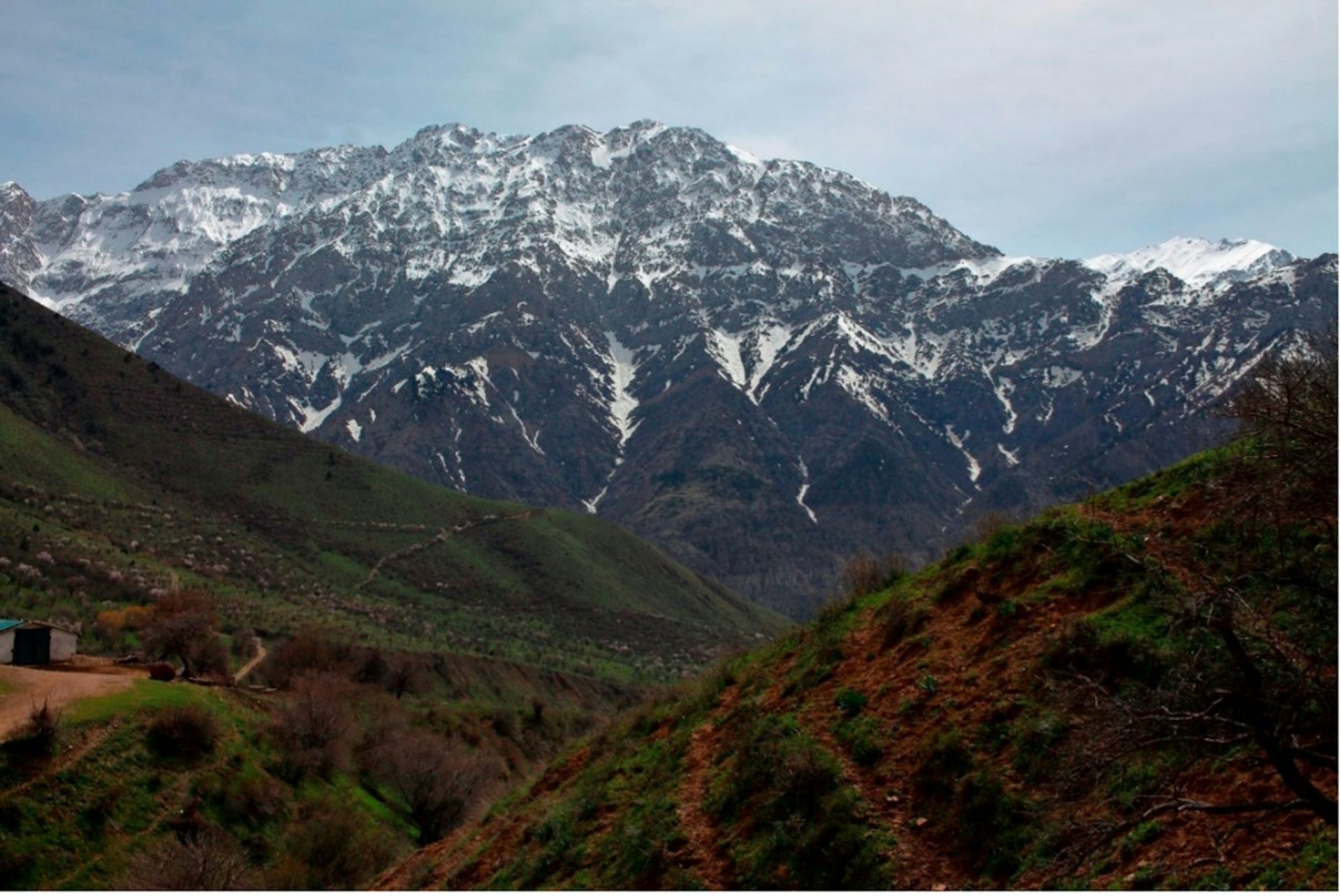
View from the Obi-Rakhmat rock shelter on the end of the Tien Shan.
Hugues Plisson.
(Author provided)
(Author provided)
Among them is the Obi-Rakhmat rock shelter in Uzbekistan, discovered in 1962, whose latest excavation campaigns were led by Andrei Krivoshapkin. At the south-western end of the Talassky Alatau range of the Tien Shan mountains, at an altitude of 1,250 metres, the settlement provides a remarkably consistent lithic industry, comprising points, large blades, and bladelets across a stratigraphic sequence spanning over 10 metres, dating from approximately 80,000 to 40,000 years ago. This industry was initially classified as part of the Initial Upper Palaeolithic but it appears to derive from the Levantine Early Middle Palaeolithic. The early Middle Palaeolithic, associated with archaic Homo sapiens at the Misliya cave, disappeared from the Near East around 100,000 years ago. At Obi-Rakhmat, the skull remains of a child found in a layer dating back ~70,000 years show features considered to be Neanderthal and others to be anatomically modern, a combination that could be the result of hybridisation.
Massive blades but microlithic points
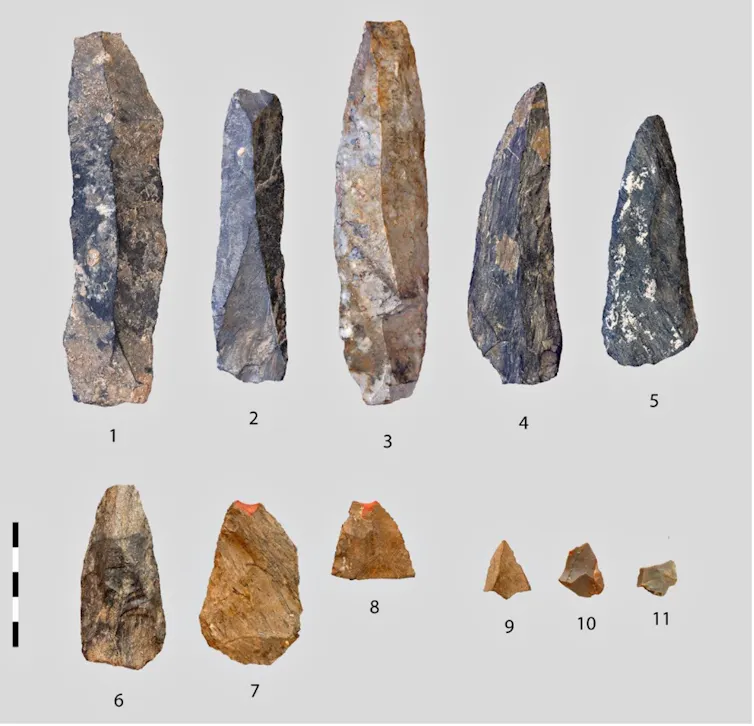
Elements of lithic industry from layer 21 at Obi-Rakhmat: unretouched blades (1-2), large retouched blade (3), pointed retouched blades (4-5, impacted retouched points (6-8), unretouched Levallois micro-point (9), unretouched impacted micro-points (10-11).
Hugues Plisson.
(Author provided)
(Author provided)
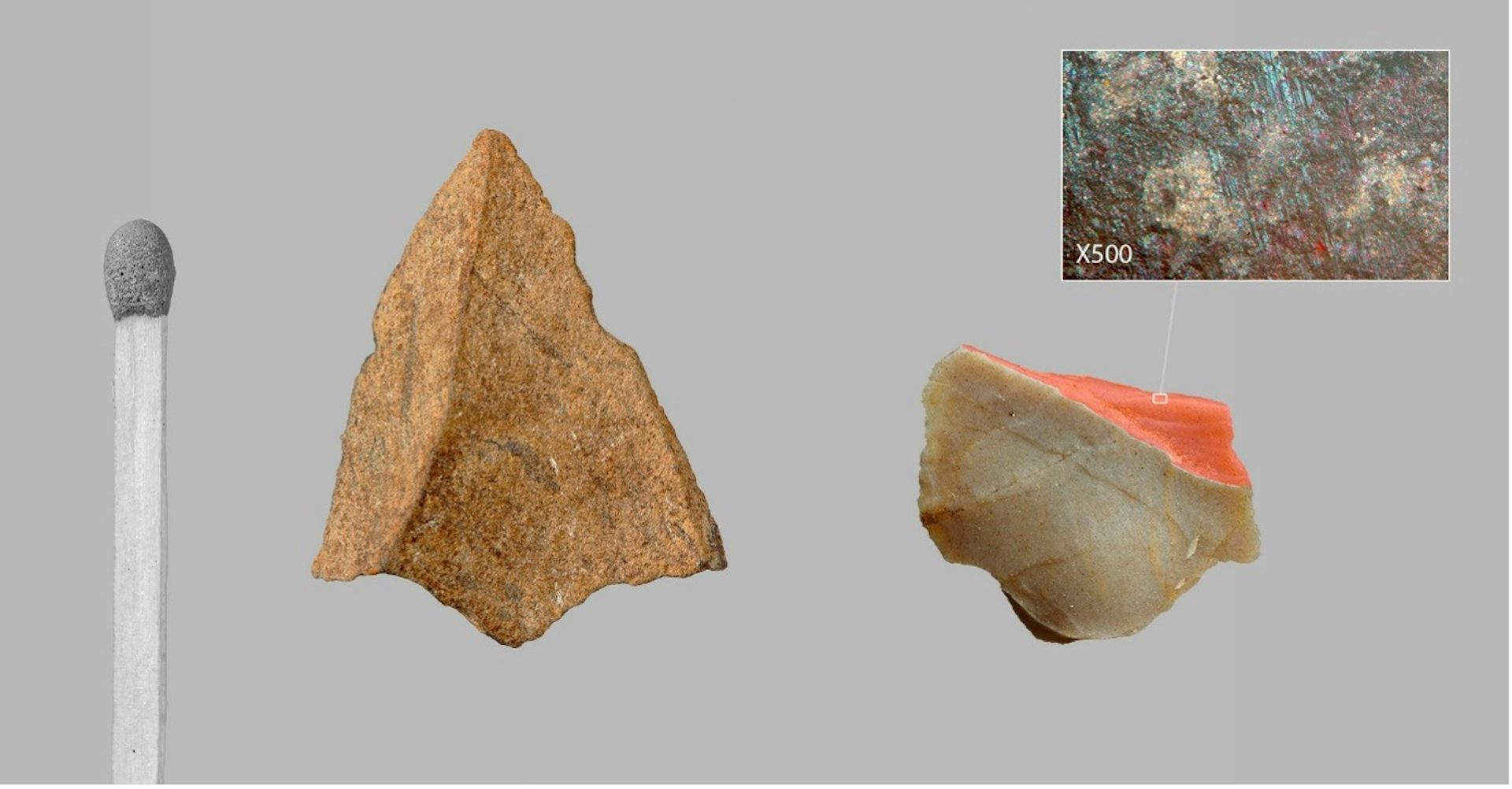
Two unretouched micro-points recovered from layer 21 of Obi-Rakhmat. One is intact, while the other is broken and shows scratches resulting from use as a projectile head. The matchstick illustrates their small size.
(Author provided)
Thrown piercing weapons are complex systems whose components are not interchangeable from one type of weapon to another, as they meet different requirements in terms of intensity and nature of stress.
The significant impact force of spears held or thrown by hand makes the robustness of the weapon an essential parameter, both in terms of effectiveness and the hunter’s survival, with mass ensuring robustness, impact force and penetration. In contrast, the penetration of light projectiles shot from a long distance depends on their sharpness, because their kinetic energy, which is much lower, comes mainly from their speed, which, unlike mass, decreases very rapidly along the trajectory and in the target. As this speed cannot be achieved by the extension of the human arm alone, it necessarily depends on the use of a throwing instrument. Arrowheads and spearheads or javelin heads are therefore not designed according to the same criteria and cannot be mounted on the same shafts, the dimensions and degree of elasticity of which are also essential in terms of ballistics. Thus, as in palaeontology, where the shape of a tooth reveals the type of diet and suggests the mode of locomotion, the characteristics of a point provide clues as to the type of weapon of which it is the wounding element.
Weaponry specific to ‘Sapiens’?
The tiny size of Obi-Rakhmat’s points cannot be regarded as a default choice, not only because there is no shortage of good-quality lithic raw material on site from which large blades were made, but microscopic examination of traces of use also shows that within this same assemblage there are also much more robust retouched points, 15 to 20 times heavier and 3 to 4 times thicker (the size of spearheads or javelin heads), similarly impacted by use as axial projectile points.
Returning to the bibliography and our own work on Middle Palaeolithic tools, we found that the presence in the same assemblage of various types of projectile points and inserts, some of which were microlithic and produced for this purpose, is only known at Homo sapiens sites. The oldest documented occurrences are in South Africa in the Pre-Still Bay (more than 77,000 years old) and later cultural layers of the Sibudu cave. In contrast, lithic points damaged by use as projectile heads are rare in the Neanderthal record. When present, they tend to be large and do not notably differ in size, manufacture or type from points used for activities other than hunting, such as gathering plants or butchery. This difference in the design of tools and weapons takes on anthropological significance.
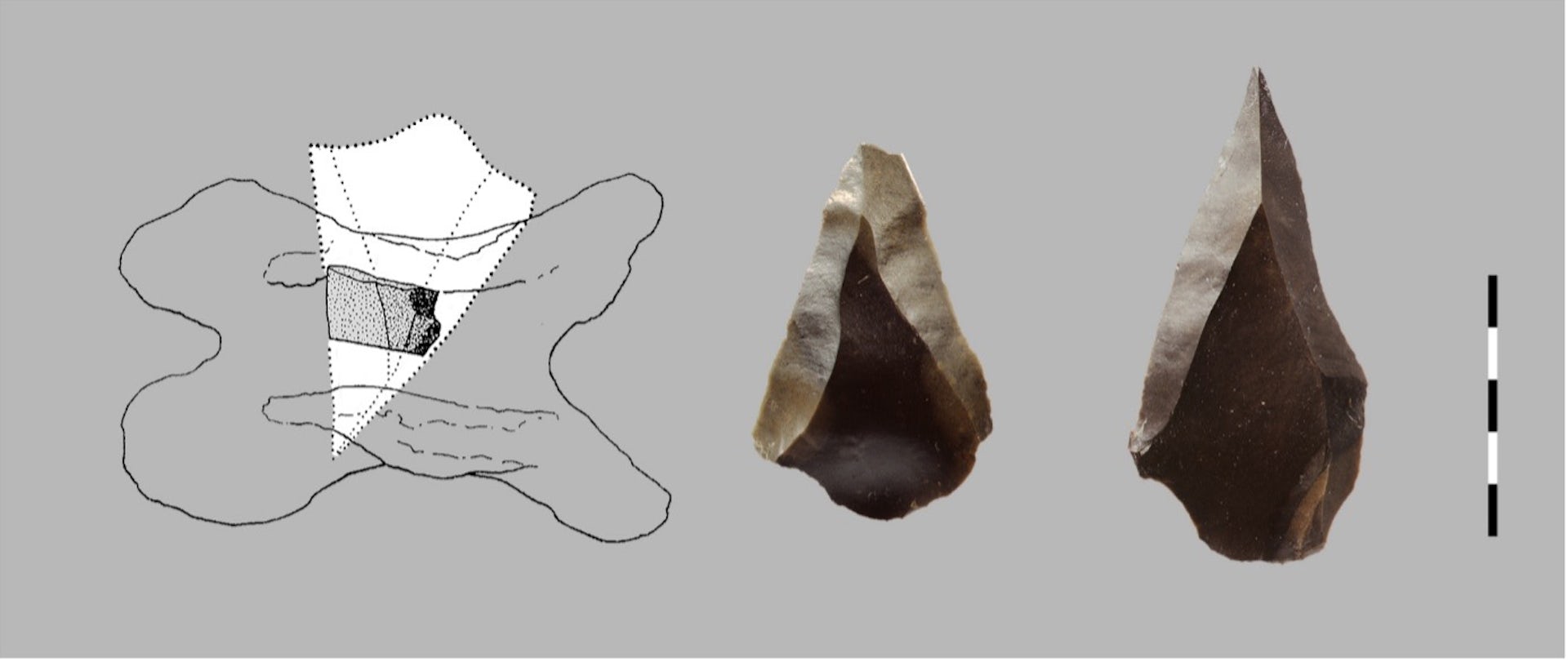
Levallois points from the Um El Tlel site in Syria, from the Late Middle Palaeolithic period in the Levant attributed to Neanderthals. From left to right: graphic reconstruction based on a fragment found embedded in a donkey vertebra, plant knife blade, butcher knife blade. These multipurpose points are 2 to 3 times wider than the micro-points from Obi-Rakhmat.
Hugues Plisson.
(Author provided)
(Author provided)
From the foothills of the Tien Shan to the Rhône Valley 25,000 years later
The micro-points from Obi-Rakhmat have no known equivalents in the Eurasian Middle Palaeolithic, except for identical projectile points identified by Traceology expert Laure Metz at the Mandrin site, in the Rhône Valley, France, in a layer dating to approximately 54,000 years ago – some ten thousand years before the disappearance of local Neanderthals. Notably, a Homo sapiens milk tooth was also recovered from this layer. The similarity between the micro-points from Obi-Rakhmat and Mandrin, despite being separated by more than 6,000 km and 25 millennia, is such that they could be interchanged without any detail other than the stone betraying the substitution.
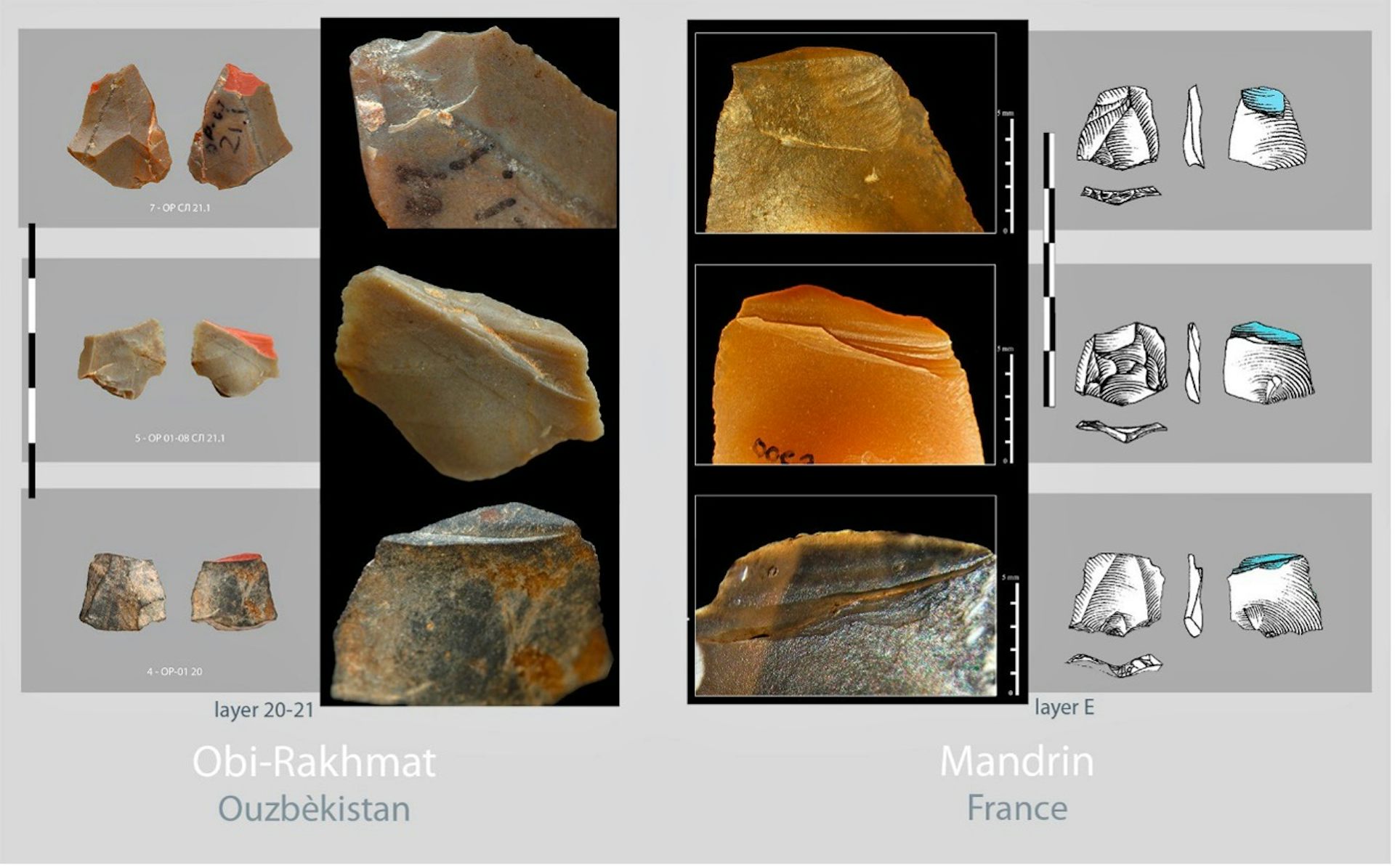
Morphological and functional similarity between the micro-points of Obi-Rakhmat and Mandrin, broken by their use as projectile head. The location and extent of their fracture (highlighted in red and blue and macroscopic detail) are indicative of axial impact.
Hugues Plisson.
(Author provided)
(Author provided)
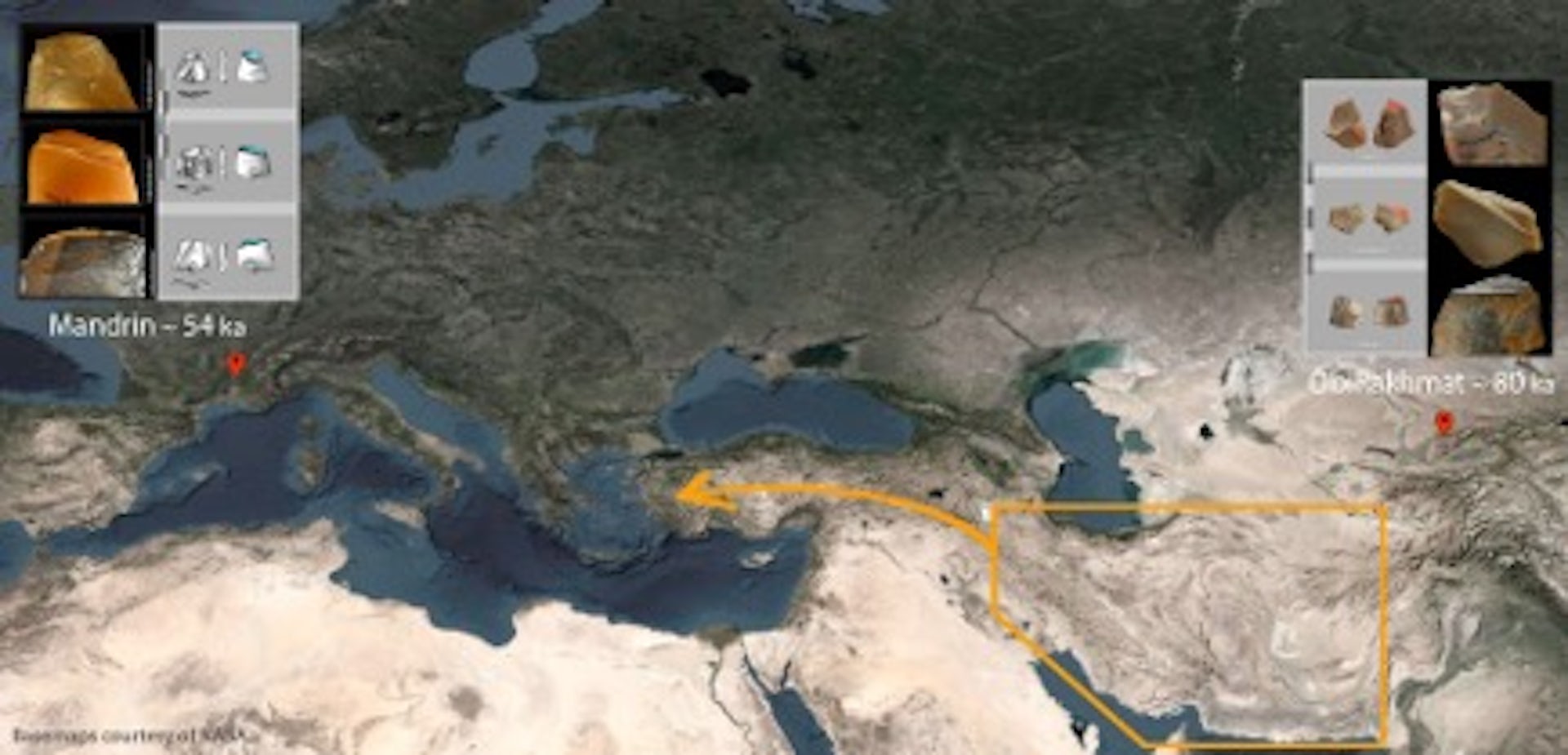
On either side of the Persian plateau (orange box), genetically identified as a refuge area for the concentration and demographic development of first Homo sapiens who left Africa, Obi-Rakhmat and Mandrin share the same micro-projectile points, 25,000 years and 6,000 km apart.
Hugues Plisson.
(Author provided
(Author provided
Premises for a new scenario of the western peopling by ‘Homo sapiens’ This discovery is stimulating in several ways.
It validates the consistency of the research conducted at the Mandrin site, which came to the conclusion that Sapiens armed with bows made a brief incursion into Neanderthal territory. Several elements of this study had been criticised, which is, however, normal in science when a new proposal deviates too far from established knowledge – but its predictive dimension had not been considered at the time.
The similarity between Mandrin and Obi-Rakhmat’s micro-points cannot be a mere coincidence. It is not only their shape that is similar, but also the way they are made, which requires real expertise, as evidenced by the meticulous preparation of their striking platform and their function. One could debate the appropriate instrument for shooting arrows armed with such tiny tips, the bow being in filigree, or whether it is preferable to remain cautious and speak only of shooting, but this already contrasts with what we know about Neanderthal hunting weapons and their design.
Another remarkable aspect, which is still relatively uncommon, is the convergence and complementarity of data from material culture and from our genetic memory, which did not influence each other given the dates of the respective studies and publications. Together, they sketch out a rewriting of the scenario of Homo sapiens’ arrival in Europe: it was thought that he came directly from Africa by the shortest route 45,000 years ago, but we now discover that he had been established in the heart of the Eurasian continent for a long time, well before expanding in search of more territories.

A weekly e-mail in English featuring expertise from scholars and researchers. It provides an introduction to the diversity of research coming out of the continent and considers some of the key issues facing European countries. Get the newsletter!
 Hugues Plisson, archéologue spécialisé en tracéologie (reconstitution de la fonction des outils préhistoriques par l'analyse de leurs usures), Université de Bordeaux and Andrey I. Krivoshapkin, Permanent researcher at Institute of Archaeology & Ethnography, Russian Academy of Sciences
This article is republished from The Conversation under a Creative Commons license. Read the original article.
This article was originally published in French

Whatever further research establishes about the makers of the Obi-Rakhmat points, the difficulty for young-Earth creationism remains. Human populations were making and using sophisticated stone tools tens of thousands of years before biblical literalists claim the Universe existed. Whether these particular hunters were Homo sapiens, another human population, or people with mixed ancestry is an interesting scientific question. None of those possibilities rescues the Genesis chronology.

Nor does invoking Noah’s flood explain the archaeological record. The challenge is to account for the deposits, their chronology and the traces of human activity preserved within them. A recent global catastrophe cannot simply be inserted into that history without evidence of its occurrence or an explanation of how it produced the observed sequence. The flood narrative supplies an assertion where a testable explanation is required.
Perhaps the most instructive aspect, however, is the researchers’ willingness to advance an interpretation that challenges established accounts of human dispersal. Here are scientists publishing potentially disruptive findings, explaining their reasoning and exposing their conclusions to criticism. Their interpretation may be strengthened, modified or rejected as further evidence emerges. That is how science makes progress: even an attractive hypothesis must remain answerable to what can be demonstrated.
Creationist claims that scientists suppress challenges to an unquestionable orthodoxy sit awkwardly beside papers such as this one. The researchers are debating the details of an ancient, evolving humanity, and making those disagreements public. What biblical literalism needs is evidence that this long history never happened. A debate about precisely who was living in Central Asia 80,000 years ago offers it no such comfort.
Advertisement
Amazon

Amazon

Amazon

Amazon

Amazon

Amazon

Amazon

Amazon

Amazon

Amazon

Amazon

Amazon

All titles available in paperback, hardcover, ebook for Kindle and audio format.
Prices correct at time of publication. for current prices.

No comments:
Post a Comment
Obscene, threatening or obnoxious messages, preaching, abuse and spam will be removed, as will anything by known Internet trolls and stalkers, by known sock-puppet accounts and anything not connected with the post,
A claim made without evidence can be dismissed without evidence. Remember: your opinion is not an established fact unless corroborated.