
Reconstruction of Greater Gondwana at ca. 500 Ma or at 550 to 500 Ma compared with conventional paleogeographic interpretations (inset).
From: Tao Wang et al.(2026).
More than half a billion years before the supposed ‘Creation Week’ of biblical literalism, moving continents were reshaping the planet and helping to establish the environmental conditions in which early animals diversified. That is the inconvenient historical setting of new research into Gondwana: a vast continental assembly whose formation, geological activity and subsequent fragmentation belong to a timescale that bears no resemblance to the few thousand years allowed by young-Earth creationism.
A paper in Science Advances , by Tao Wang of the State Key Laboratory of Deep Earth and Mineral Exploration, Institute of Geology, Beijing, China, and colleagues, suggests that Gondwana was substantially larger than conventional reconstructions show. As co-author Bill Collins explains in his accompanying account in The Conversation, isotopic evidence in granites identifies ancient continental material now concealed beneath younger geological formations across much of Asia. Including these overlooked fragments increases Gondwana’s estimated share of Earth’s continental landmass to roughly 80 per cent, making it a supercontinent even under a restrictive definition of that term. This reconstruction concerns the world of approximately 550–500 million years ago.
Its significance extends beyond redrawing an ancient map. The researchers propose that the reorganisation of plate boundaries associated with Gondwana’s assembly established an enormous belt of volcanic activity. Sustained emissions of greenhouse gases could then have helped alter the climate, contributing to conditions favourable to the diversification of Cambrian life. This is a proposed connection between geological and biological change, rather than a demonstration that volcanism alone caused the Cambrian radiation.
One distinction matters here: despite the article’s headline, this concerns the diversification of life, not its original appearance. Life already had a long evolutionary history before the Cambrian, and animals existed before that period began. Nor was the Cambrian ‘explosion’ an instantaneous event resembling a magical creation. The term describes a geologically rapid evolutionary diversification, unfolding over millions of years.
For creationism, therefore, the problem is more substantial than another inconvenient date. Here is a testable account connecting the history of continents with the environmental context of biological evolution. Continents assemble, plate boundaries change, volcanoes influence the atmosphere, and organisms evolve in the resulting conditions. None of this requires foresight or a predetermined destination. It requires physical processes, evolving populations and the immense passage of time.
The precise contribution of Gondwana’s assembly to Cambrian diversification remains a question for further investigation. That uncertainty does nothing to rescue a biblical chronology: debating how events unfolded more than 500 million years ago is not evidence that they happened a few thousand years ago.
In the following article, reproduced from The Conversation under a Creative Commons licence, Collins explains how the team uncovered Gondwana’s hidden extent and why it could matter for understanding this extraordinary chapter in evolutionary history:

Gondwana really was a supercontinent. And it helped kick‑start life on Earth
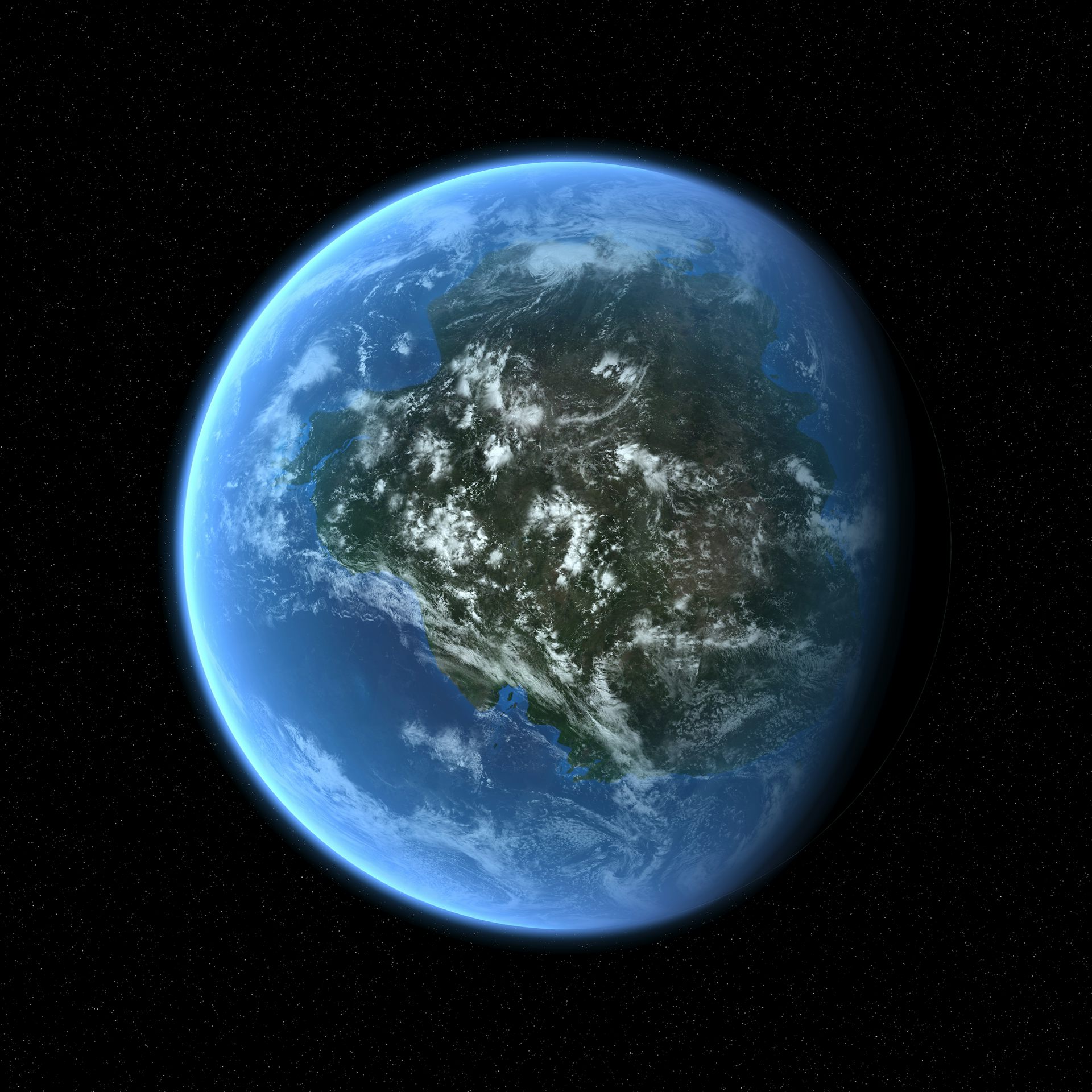
An illustration of the supercontinent Gondwana.
Some 550 million years ago, the Earth looked very different to what it does today. The Southern Hemisphere was dominated by an enormous, single continent known as Gondwana.
This continent was first recognised by Austrian geologist Eduard Seuss in 1885 based on the presence of a unique plant fossil that was first discovered in the Gondwana Province of India. The fossils were then found in Australia, Africa, Antarctica and South America, demonstrating these land masses were once connected.
But whether Gondwana was an actual “supercontinent” has been a subject of intense scientific debate in recent years.
A new paper I coauthored, published today in Science Advances, helps settle the debate. Our team found a previously hidden part of the Gondwanan landmass that’s now buried under mountains, which shows it was much bigger than previously thought.
What exactly is a supercontinent?
The concept of supercontinents and supercontinental cycles came about in the mid-1980s when geologists first recognised cyclic, global-scale sea level changes in the geological record. These cycles dated back at least 2 billion years.
Since the 1980s, at least four supercontinents have been recognised. The youngest is Pangea which formed 300–250 million years ago. Gondwana is the second youngest at 550–500 million years. Rodinia formed about 1 billion years ago and the oldest verified is called Columbia or Nuna, which formed between 2–1.6 billion years ago.
However, the supercontinent status of Gondwana has been questioned in the 21st century. This was because an arbitrary value of 75% of continental landmass was considered necessary to attain supercontinent status and Gondwana was initially measured at 64%.
The initial measurement of Gondwana was based on five core continental fragments: India, South America, Africa, Australia and Antarctica. Subsequent measurements included landmasses extending from the Appalachian mountains in the United States, through southern Europe, to Turkey, Iran and Pakistan, then connecting to India.
Even so, the additional landmass was insufficient to increase the status of Gondwana.
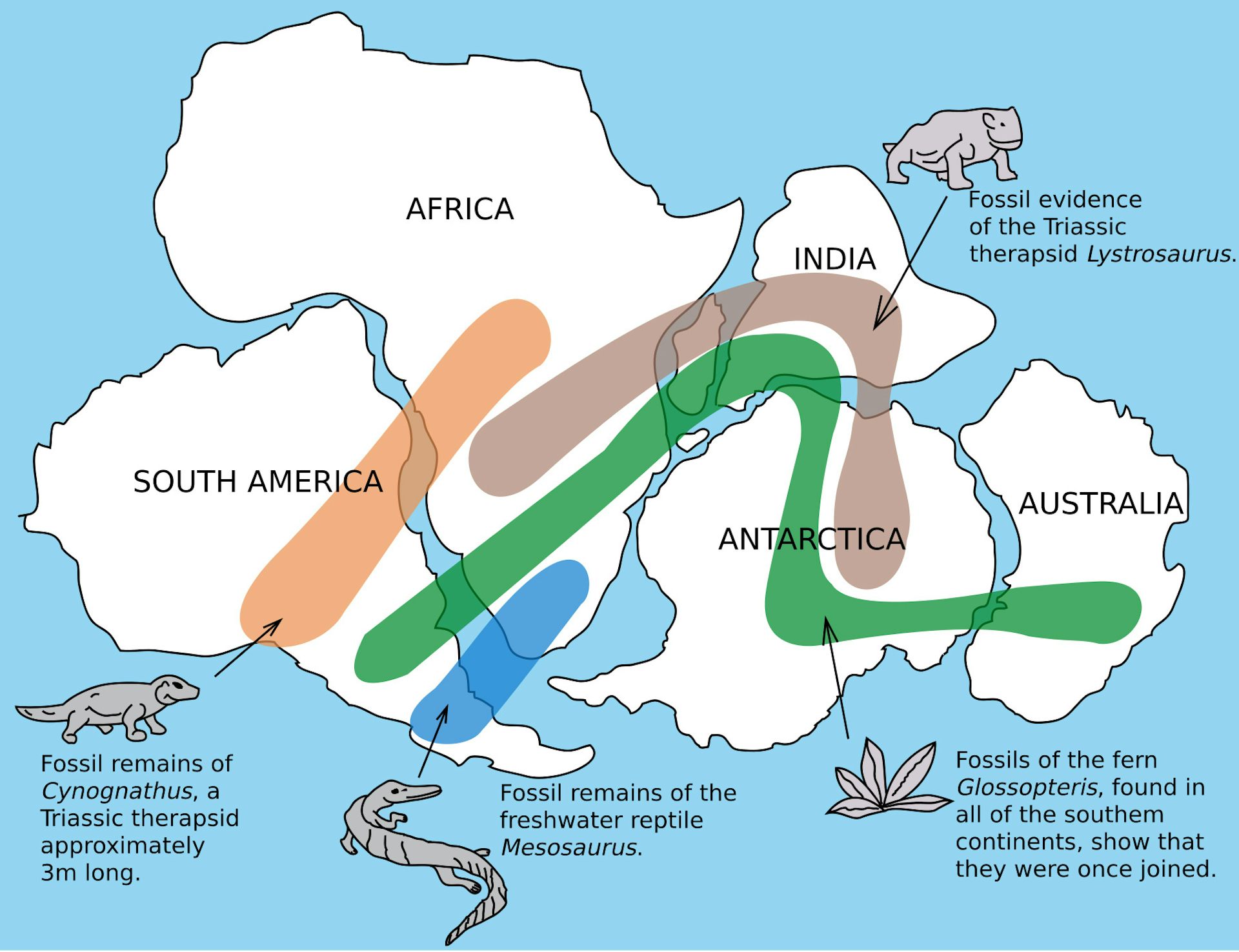
Fossils found in Australia, Africa, Antarctica, India and South America demonstrate these land masses were once connected.
Gondwana’s true scale
As is often the case in science, our team’s discovery of Gondwana’s buried bits was serendipitous.
We were compiling a global dataset of granite samples from around the world to understand how deep crustal processes relate to mineral formation. Part of that deep Earth understanding was to determine the age of the rocks from which the exposed granites – now at surface – came from.
Most granites are formed by melting older continental rocks. We used a special technique which measures the amount of radioactive isotopes in rocks. This technique has existed for several decades, but the individual datapoints from rock samples is rarely plotted at a continental scale. We did this at global-scale to generate an age-map of the deep Earth.
To give an example, even though some granites formed in the Himalayas only 20 million years ago, others formed at 50 million years. Still others formed at 120 million years ago. But our analysis showed that all the Himalayan granites were derived from a common continental block.
That block formed approximately 700–550 million years ago and was part of Gondwana.
We have traced the original Gondwanan fragments from India and southeast Asia, through most of China into Kazakhstan. Previously, much of this region was thought to be ancient ocean floor containing volcanic island chains like in the Pacific Ocean today.
It turns out that most of this region, which is now mountainous and covered by younger rocks, was originally part of Gondwana.
This finding expands Gondwana’s continental landmass to roughly 80%. In other words, it really was a supercontinent.
So what if Gondwana was a supercontinent?
It matters that greater Gondwana was a true supercontinent because the world changed immediately after it formed.
The formation of supercontinents can impact global dynamics, such as global climate and biological change, including the explosion of life on Earth between 550 and 500 million years ago.
Many models have invoked specific environmental effects for the Cambrian explosion, as this event is known. But the profound changes required a global cause-and-effect relation.
Even then, linking global climate, biology and geology is daunting. However, other isotopes found in carbon, oxygen and seawater were recording the same change. So here was a paradox to evaluate with our new information.
When greater Gondwana was forming between 750 and 550 million years ago, Himalayan-sized mountain ranges criss-crossed the supercontinent. Gondwana was an entirely frozen, arid landmass.
However, once the continental fragments amalgamated, Earth had to reconfigure its plate tectonics. A volcanic arc chain formed that encircled the supercontinent, extending from Russia, via China, Australia, Antarctica, South Africa to the Andes of South America.
This volcanic arc around Gondwana was the precursor of today’s Ring of Fire around the Pacific Ocean. It was also similar in length, almost 35,000km.
Like the present day, this ancient ring of fire was associated with constant volcanic eruptions. It released huge amounts of volcanic gases, especially water vapour and carbon dioxide. Present-day gas emissions from volcanoes are estimated at 1–4 million metric tonnes of water vapour and 150–370,000 tonnes of carbon dioxide daily – most coming from the Ring of Fire.
Once the Cambrian ring of fire formed, the huge amount of gas emitted each day over 50 million years helped change Earth’s climate from icehouse to greenhouse. And in doing so, it was the catalyst for life to proliferate for the first time on planet Earth.

Bill Collins, Adjunct Professor, School of Earth and Planetary Sciences, Curtin University
This article is republished from The Conversation under a Creative Commons license. Read the original article.

For young-Earth creationism, Gondwana presents a problem on a continental scale. Its assembly, its influence on the environment and its eventual fragmentation form part of a geological history extending over hundreds of millions of years. These were real events recorded in rocks, not episodes that can be squeezed into a few thousand years by invoking a biblical flood. Revising Gondwana’s reconstructed boundaries does not undermine that history; it adds detail to our understanding of it.


The proposed connection with Cambrian diversification also challenges the creationist habit of presenting the Cambrian ‘explosion’ as an inexplicable act of sudden creation. Here, researchers are investigating how processes deep within Earth could have altered conditions at its surface, helping to shape the circumstances in which animals evolved and diversified. The extent of that influence remains open to investigation, but an unresolved question about the relative importance of natural causes is no evidence for a supernatural one.
There was no need for Gondwana to anticipate the animals that would inhabit its surrounding seas, or for volcanic activity to follow a plan for their evolution. Geological processes changed the environment, and evolution proceeded within the opportunities and constraints those changes produced. What emerges is a history of an ancient, dynamic planet and life evolving without foresight—not a scientific confirmation of the creation myths of people who knew nothing of either.
Advertisement
Amazon

Amazon

Amazon

Amazon

Amazon

Amazon

Amazon

Amazon

Amazon

Amazon

Amazon

Amazon

All titles available in paperback, hardcover, ebook for Kindle and audio format.
Prices correct at time of publication. for current prices.


No comments:
Post a Comment
Obscene, threatening or obnoxious messages, preaching, abuse and spam will be removed, as will anything by known Internet trolls and stalkers, by known sock-puppet accounts and anything not connected with the post,
A claim made without evidence can be dismissed without evidence. Remember: your opinion is not an established fact unless corroborated.