
One of the difficulties creationists face when trying to squeeze human origins into the Genesis story is that the evidence keeps revealing a history far richer than their mythology allows. Instead of a single founding couple appearing a few thousand years ago, we find an extended human family, with populations diverging, migrating and sometimes exchanging genes. Now, ancient proteins preserved in fossil teeth suggest that even Homo erectus may have left a genetic legacy in some people alive today.
In a paper published in Nature, researchers report enamel proteins recovered from six Homo erectus teeth from three Chinese sites, dating to approximately 400,000 years ago. They identified two shared variants in the enamel protein ameloblastin. One distinguishes these specimens from other sampled human lineages; the other also occurs in Denisovans, with its corresponding genetic variant present in some modern humans.
The intriguing possibility is that this variant passed from a population related to these Homo erectus individuals into Denisovans, and subsequently into Homo sapiens. This is a proposed route of inheritance, not a recovered Homo erectus genome or proof of direct mating between Homo erectus and our own species. Further molecular evidence will be needed to clarify the relationship.
Nevertheless, the evolutionary implications are fascinating. Extinction need not mean that every genetic contribution from a population disappears. Where interbreeding occurs, some inherited variants can survive in another population long after their original bearers have vanished as a recognisable group. Human ancestry can therefore involve branching and reconnection — a pattern known as reticulated evolution — rather than a tidy procession in which one species simply replaces another.
For young-Earth creationism, the chronological problem alone is insurmountable without rejecting the scientific dating: these individuals lived roughly 400,000 years ago, long before the supposed creation of the Universe in a literal biblical chronology. Calling them “fully human” does nothing to shorten that timescale. Nor does assigning fossils to convenient creationist categories explain the molecular relationships that researchers can now investigate.
There is also a telling contrast in method. Science can distinguish what has been recovered, what it suggests and what remains uncertain. A proposed evolutionary relationship can be tested and revised as further evidence becomes available. Creationism starts with its required conclusion and demands that the evidence conform. The article from The Conversation, reproduced below, explores this latest glimpse into the complex ancestry of our species.

Ancient tooth proteins suggest Homo erectus may have left a genetic legacy in people today
Replica of a specimen known as ‘Peking Man’.
blickwinkel / Alamy
For most of the 20th century, the model of human origins was a tree: with the trunk dividing into branches, and then twigs. Each species of human relative (hominin) was a neat, single branch.
As an undergraduate, I was taught that Homo sapiens was one of these branches that emerged in Africa, spread across the world, and displaced every archaic human it encountered.
Neanderthals, Homo erectus, and other ancient relatives were evolutionary dead ends – unfortunate cousins who left no descendants. In the 30 years since I left university, those early lessons are now radically revised.
That neat replacement story is now comprehensively wrong, largely thanks to studies like the one published in Nature this week by Qiaomei Fu from the Chinese Academy of Sciences and colleagues. The paper achieves something that would have seemed impossible a decade ago: it recovers meaningful biological information from H. erectus fossils far too old for DNA.
Instead of genetic sequences, the team extracted ancient proteins from the enamel of six teeth from three Chinese sites – Zhoukoudian (which, in the early 20th century, produced fossil remains known as “Peking Man”), Hexian and Sunjiadong – all dating to around 400,000 years ago.
Homo erectus is widely regarded as the first hominin to leave Africa; the evidence suggests this species had moved into Eurasia nearly two million years ago. It remains the most geographically widespread human ancestor that ever lived. The new study indicates that Homo erectus exchanged genes (probably through interbreeding) with Denisovans in East Asia roughly 400,000 years ago.
The study suggests that some of that genetic legacy, it now appears, was passed on to living people in the Philippines, Papua New Guinea, and across south-east Asia.
Tooth enamel is the hardest tissue in the body, and its proteins survive long after DNA has degraded beyond recovery. What the team found in those proteins is striking. All six specimens share a previously unknown amino acid variant – a tiny molecular signature, a single letter changed in the protein sequence, never seen in any other hominin alive or dead.
This variant clusters these east Asian H. erectus into a distinct group, confirming their identity and settling a long-running debate about whether the unusual Hexian fossils were H. erectus at all. A second variant they share, however, is not unique to H. erectus.
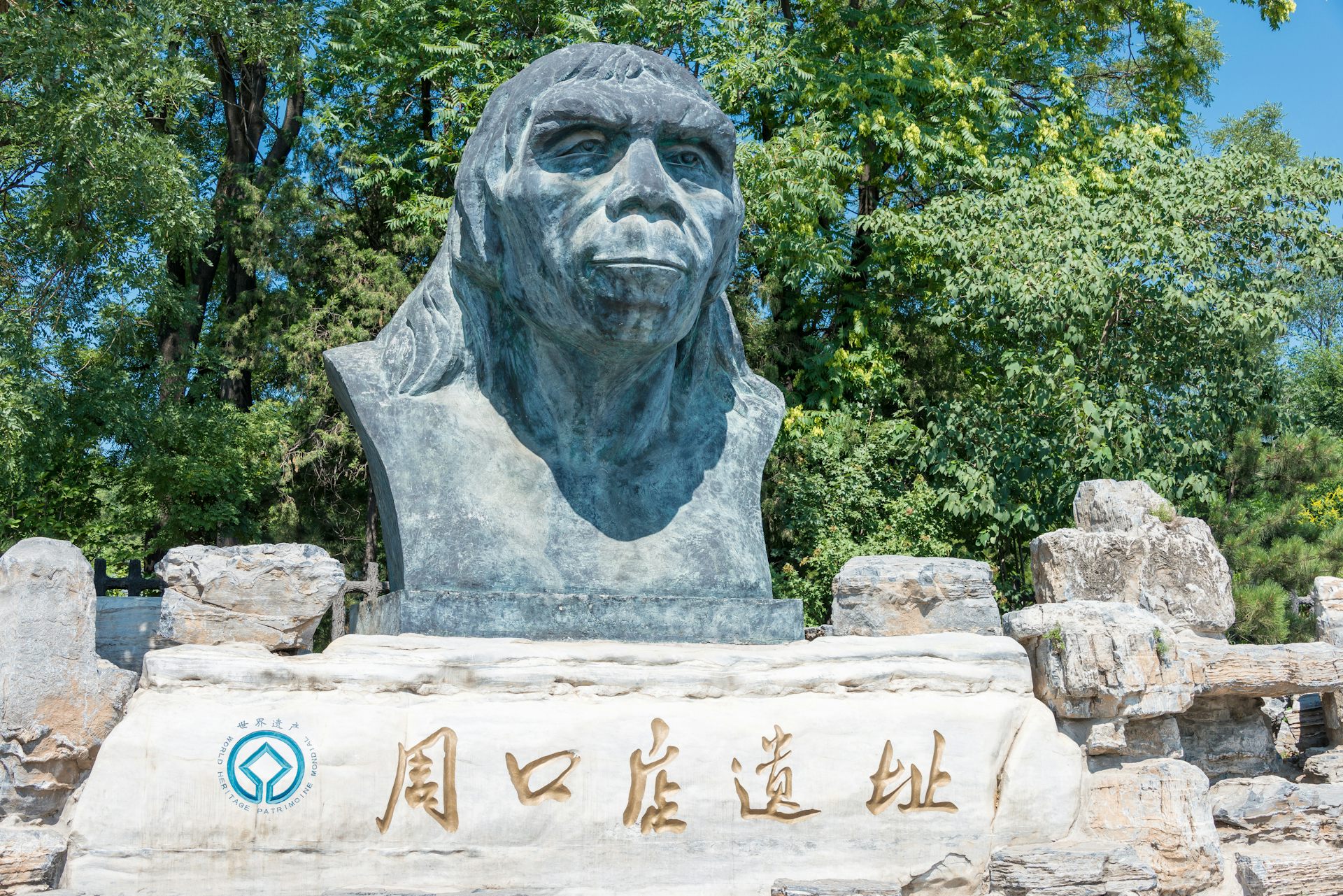
A statue at the Zhoukoudian site, where the Peking Man fossils were discovered.
The most reasonable interpretation is that H. erectus populations in east Asia passed this variant to Denisovans through interbreeding, and Denisovans later passed it on to the ancestors of modern south-east Asians and Oceanians. This transfer of genetic material from one species to another is known as introgression.
The lineage we once thought was a dead end has, it turns out, left a small but detectable trace in living human genomes – a molecular thread connecting a Peking Man tooth to living people in Asia.
A pattern repeated
But the significance of today’s paper extends well beyond the specific variant or the specific populations involved. What it really shows is that interbreeding between archaic human lineages was not exceptional. It was routine.
Every major hominin lineage we have been able to examine genomically shows admixture. Modern humans outside Africa carry roughly 2% Neanderthal DNA. Papuans and Aboriginal Australians carry an additional 2–5% Denisovan ancestry.
West African populations carry genetic signatures from an unidentified archaic lineage. Even Denisovans themselves, as today’s study adds further weight to, received gene flow from something older and more diverged — likely H. erectus.
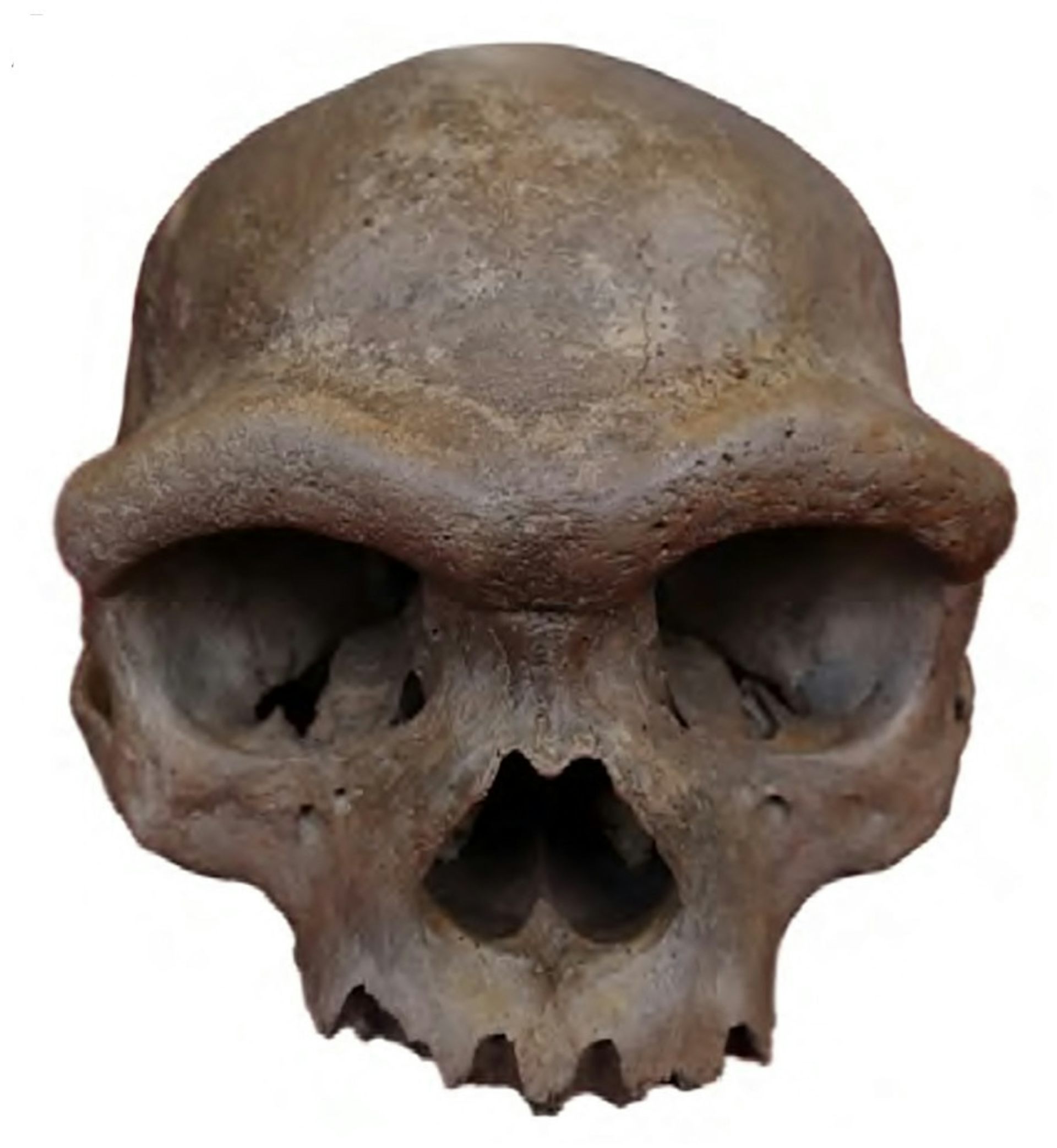
The Harbin skull, discovered in north-east China, was recently identified as a probable Denisovan.
The implications are far-reaching. Our genomes are not the product of a single unbroken lineage emerging from Africa. They are mosaics, assembled from contributions by multiple archaic groups, each adapted to its own regional environment.
Some of the Denisovan-derived variants in Papuan genomes, for instance, appear to influence immune function. The H. erectus-derived variant identified today has unknown functional consequences – that remains an open question – but the precedent from other gene variants that have introgressed (genes that have passed from one species into another) suggests that adaptation to new environments may have been part of the story.
Ghost populations
Perhaps most intriguing is what the new paper implies about all the populations we cannot yet study. H. erectus survived in Indonesia until perhaps 100,000 years ago. Homo floresiensis, the diminutive “hobbit” species, was present on Flores when modern humans arrived. Another human lineage, Homo luzonensis, occupied the Philippines.
None of these populations have yielded DNA, and until today none had yielded any molecular data at all. Were they also absorbed, at least partially, into the human populations that replaced them? The genomic evidence from living people has not, so far, detected their signal clearly – but the tools available until recently were blunt instruments.
The proteomic approach demonstrated in today’s paper offers a way forward. If proteins can be recovered from H. erectus enamel at 400,000 years, the same approach applied to floresiensis or luzonensis material might finally reveal whether those lineages, too, contributed something to the humans who came after them.
The old metaphor of a tree – a single trunk branching into distinct species – has been quietly replaced in the scientific literature. It might be better to consider the process as a braided river, with many channels running partly together and partly apart, exchanging water continuously.
This new study is one more confirmation that when ancient human populations disappeared, they left traces of themselves behind.

Sally Christine Reynolds, Associate Professor in Hominin Palaeoecology, Bournemouth University
This article is republished from The Conversation under a Creative Commons license. Read the original article.

For young-Earth creationism, however, the difficulties do not depend on whether this particular interpretation is ultimately confirmed. The approximately 400,000-year-old teeth already belong to a human history vastly longer than the biblical timetable permits. Reclassifying their owners as either “apes” or “fully human” cannot make that chronology disappear. Those labels also contribute nothing to explaining why particular molecular variants occur in some ancient populations and their possible descendants.
What makes this research especially instructive is the distinction between evidence and interpretation. The researchers recovered ancient proteins and identified variants; they then proposed an evolutionary explanation for the pattern. Further discoveries can strengthen, modify or overturn that explanation. This willingness to expose an interpretation to testing is how science makes progress. A conclusion that must survive regardless of the evidence has no comparable means of correcting itself.
Our origins are becoming more comprehensible as researchers learn to extract information from remains that once seemed capable of telling us little beyond their shape and age. The resulting picture is one of deep ancestry, population diversity and connections across the branches of our family tree. Creationism offers a predetermined story into which humanity must fit; science allows our ancestors to tell their own story through the evidence they left behind.
Advertisement
Amazon

Amazon

Amazon

Amazon

Amazon

Amazon

Amazon

Amazon

Amazon

Amazon

Amazon

Amazon

All titles available in paperback, hardcover, ebook for Kindle and audio format.
Prices correct at time of publication. for current prices.

No comments:
Post a Comment
Obscene, threatening or obnoxious messages, preaching, abuse and spam will be removed, as will anything by known Internet trolls and stalkers, by known sock-puppet accounts and anything not connected with the post,
A claim made without evidence can be dismissed without evidence. Remember: your opinion is not an established fact unless corroborated.