
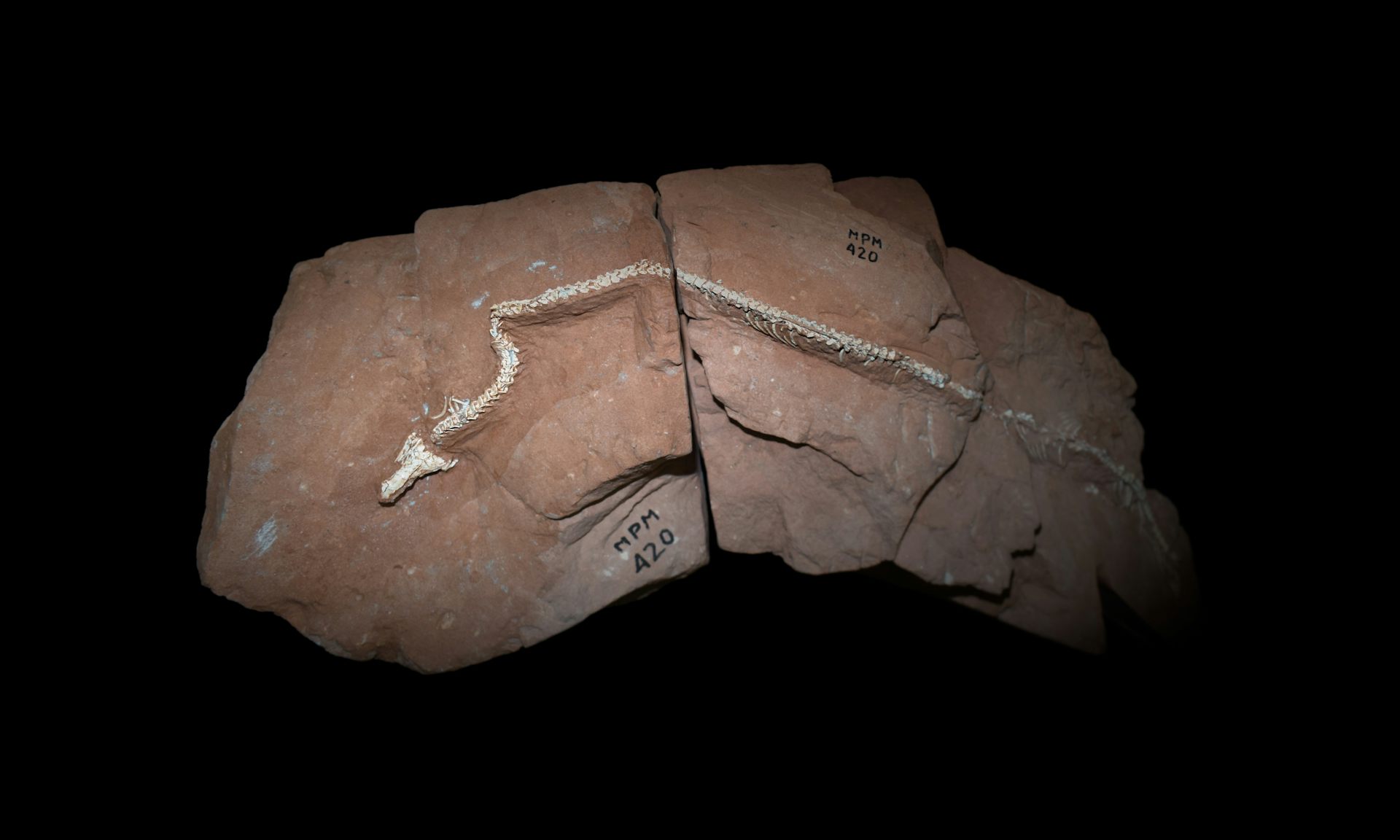
fossil of Tametara mirim
Agustin Martinelli
80-million-year-old snake fossil sheds light on why lizards lost their limbs and started slithering
Of all the primitive ‘just-so’ stories in Genesis, the tale of how the serpent was condemned to crawl on its belly must rank among the most transparently mythological. Having supposedly tempted Eve to eat the forbidden fruit, God curses the serpent to go on its belly and ‘eat dust’ for the rest of its life. Although the story never explicitly says that the serpent previously had legs, the curse plainly implies a change and has traditionally been understood as an explanation for why snakes slither instead of walking.
Like so much of Genesis, it begins with an observation familiar to its authors—snakes have no legs—and invents a magical tale to explain it. It is an ancient example of an etiological myth: folklore devised to explain why something in the natural world appears as it does, long before anyone had the evidence or intellectual framework needed to understand its real history.
Even as mythology, however, the story is strangely incoherent. Genesis itself does not identify the serpent as Satan but introduces it as the most cunning of the wild animals God had made. Nevertheless, this supposedly ordinary animal can speak, reason and somehow knows about a prohibition that God had given to Adam before Eve had even been created. The text makes no attempt to explain how it acquired either this knowledge or the power of speech.
More awkward still for anyone insisting that the story is literally true, the serpent’s predictions prove substantially more accurate than God’s warning. God tells Adam that he will die on the day he eats the fruit. The serpent tells Eve that they will not die, that their eyes will be opened and that they will become like God, knowing good and evil. They eat the fruit, their eyes are opened and they do not die that day. God then confirms that the humans have indeed become ‘like one of us’ in knowing good and evil. According to Genesis itself, Adam goes on to live for another 930 years.
On the most straightforward reading of the story, therefore, the serpent tells Eve the truth while God’s threat to Adam proves false. Later theologians have attempted to rescue the tale by inventing a ‘spiritual death’, or by claiming that Adam merely began to die that day, but neither qualification appears in the text. These are apologetic repairs added by people who can see the problem but cannot admit that the story’s authors created it.
Science, meanwhile, has uncovered a very different account of how snakes acquired their extraordinary bodies—one involving neither talking reptiles nor fruit, curses or human disobedience, but descent with modification over immense periods of geological time. Snakes are highly modified members of the squamate reptile radiation. Their ancestors progressively elongated their bodies, increased the number of vertebrae and reduced their limbs as different lineages adapted to particular ways of life. Their evolutionary history extends back at least to the Middle Jurassic, about 160 million years ago.
Now, a paper published in Nature by an international team led by Tiago R. Simões describes an exceptionally well-preserved early snake from the Late Cretaceous of Brazil. Named Tametara mirim, the animal lived approximately 85–75 million years ago, when non-avian dinosaurs still dominated terrestrial ecosystems. It is the first articulated snake fossil known from Brazil and preserves a three-dimensional skull together with more than 100 connected vertebrae.
The preserved portion of its skeleton appears to have lacked forelimbs. Because the region around the pelvis is missing, the researchers cannot determine whether it retained vestigial hindlimbs, as some other early snakes did. Its skull also combines recognisably snake-like specialisations with ancestral features resembling those of other squamate reptiles—precisely the sort of mosaic of old and new characteristics expected in an evolving lineage, but not from the instantaneous transformation of an animal by a divine curse.
High-resolution micro-CT scanning allowed the researchers to reconstruct details of the skull, brain cavity, cranial nerves and inner ear. The unusually thick and dense skull roof, reduced visual centres and simplified balance organs all point towards a specialised, head-first burrowing lifestyle. Similar combinations of traits have evolved independently in other burrowing squamates because they are useful underground: a reinforced skull withstands the stresses of digging, while vision becomes less important in darkness.
The discovery does not support a simplistic evolutionary story in which one burrowing lizard lost its legs and immediately became a modern snake. Comparison with another early snake, Dinilysia, indicates that it lived above ground and possessed a markedly different brain. Early snakes had already diversified into animals with different habitats and sensory systems. Their history was branching and experimental, with lineages moving between ecological niches rather than marching along a predetermined path towards a fixed goal.
For creationism, the problems are therefore far more extensive than the fossil’s inconvenient age. Here was an already highly modified snake, without detectable forelimbs and adapted to burrowing, living about 80 million years before creationists claim humans and snakes were created together. A punishment supposedly imposed because of something a human did in a garden cannot explain an anatomy that existed tens of millions of years before humans appeared.
Nor can creationists dismiss the animal as merely a modern snake inexplicably buried in ‘Flood’ deposits. Its mixture of ancestral and derived features places it on an early branch of the snake evolutionary tree, while its bones, braincase and sensory anatomy record adaptations to a particular Cretaceous environment. Its position is supported by detailed anatomical comparisons and phylogenetic analysis, not by somebody selecting a vaguely snake-shaped fossil and attaching an arbitrary age to it.
As palaeontologist Roy Ebel explains in The Conversation, Tametara mirim does not provide the final answer to every question about the origin of snakes. Instead, it reveals that their early evolution was more ecologically and neurologically diverse than previously recognised. That is how science advances: new evidence refines an incomplete account. Creationism, by contrast, begins with an incoherent myth and demands that all contrary evidence be ignored so that the myth need never change.
Roy Ebel's article in The Conversation is reprinted here under a Creative Commons license, reformatted for stylistic consistency:

80‑million‑year‑old snake fossil sheds light on why lizards lost their limbs and started slithering
The new fossil of Tametara mirim reframes how we understand snake evolution.
Agustin Martinelli
Snakes are everywhere in our legends and mythology. Yet for most of us, our blood runs cold whenever we encounter these strangely undulating, scaly tubes of muscle slithering through the leaf litter.
The loss of an arm or leg poses a challenge. Yet snakes do perfectly well without all four of them. This makes them suspect. It also leaves us unable to fathom how this radical transition produced one of the most successful vertebrate body plans.
More than 4,000 species of snakes are alive today, on every continent except Antarctica, from thread-thin burrowers to massive pythons, on land and in the sea. We have studied them since antiquity, and still the oldest question about them has no answer: what turned snakes into snakes?
We have long suspected their peculiar, limbless body plan is explained by how the earliest snakes lived. In a new study, published today in Nature, my colleagues and I describe a small, exquisitely preserved fossil that brings us closer to an answer than ever before.
Sea or soil?
Snakes are essentially highly modified lizards. Sometime in the age of dinosaurs, one lizard lineage lost its limbs and stretched out its body. The key question is why.
For more than a century, several ideas have competed with each other.
One says the first snakes colonised the water, with a long, limbless body suited for swimming, much like an eel.
A second says they lived on the surface of the land, among leaf litter and vegetation, where reduced limbs could have eased their movement through dense ground cover.
A third says they went underground, losing their limbs and elongating their bodies to pursue a head-first burrowing lifestyle, much like modern blind snakes.
The trouble is that the evidence has rested on a tiny handful of fossils. Fewer than ten early snake skeletons are known from that era.
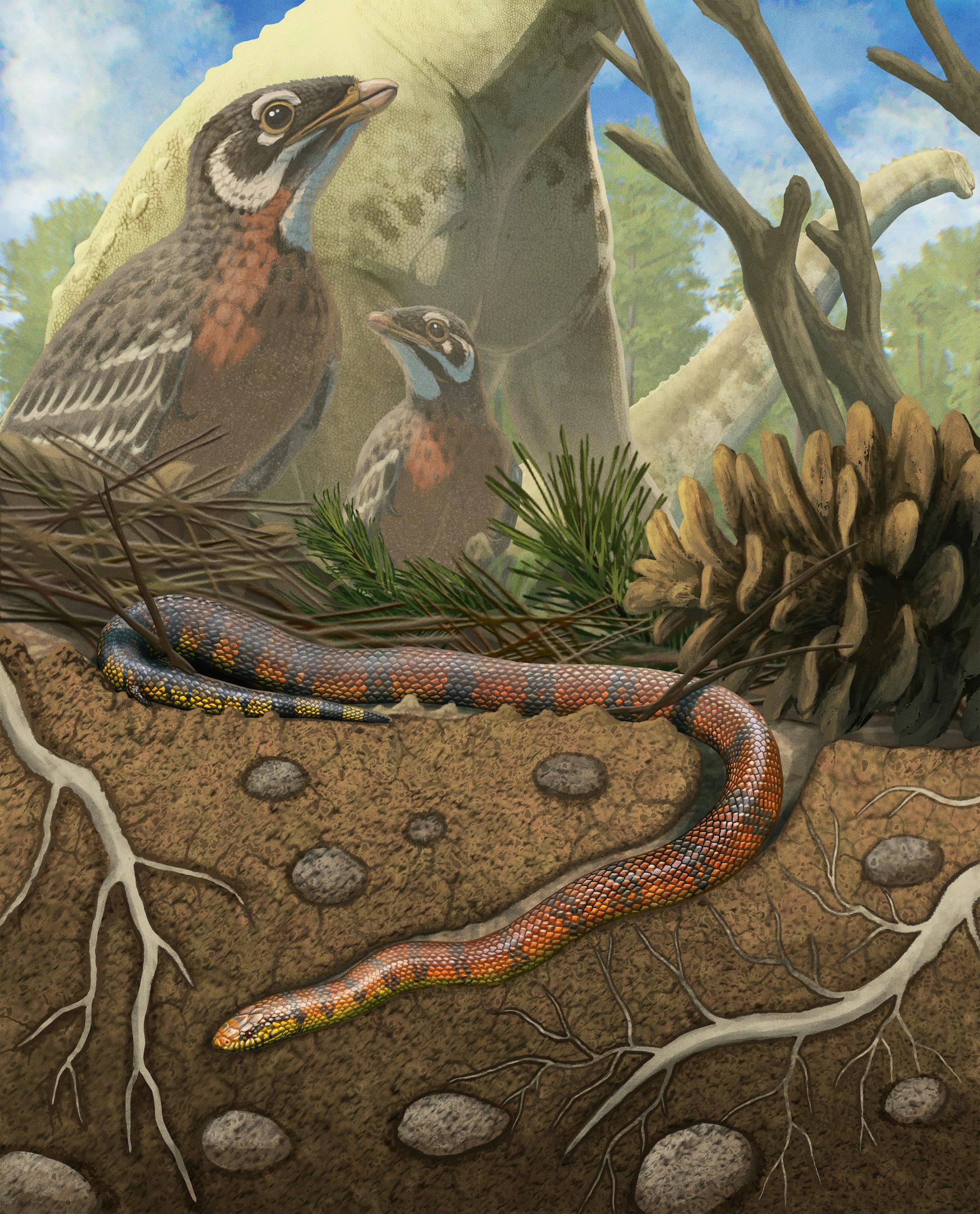
Life reconstruction of the burrowing stem snake Tametara mirim which lived alongside now-extinct stem-birds and sauropod dinosaurs.
Gabriel Ugueto
Our fossil is a rare new witness. It comes from roughly 80-million-year-old rock in São Paulo state, Brazil. We named it Tametara mirim, meaning “adorned” and “small” in the local Indigenous language.
The fossil is one of the best-preserved early snakes found anywhere on Earth. It is also the first articulated snake skeleton from Brazil, with its bones still connected in their original arrangement. We found its lifestyle encoded in its bones – in particular, its skull.
Head-first burrowers build denser, thicker bone in this region. This trait has independently evolved across numerous burrowing lizard lineages. We presume this consolidates the skull against the strain exerted during its use as a digging tool.
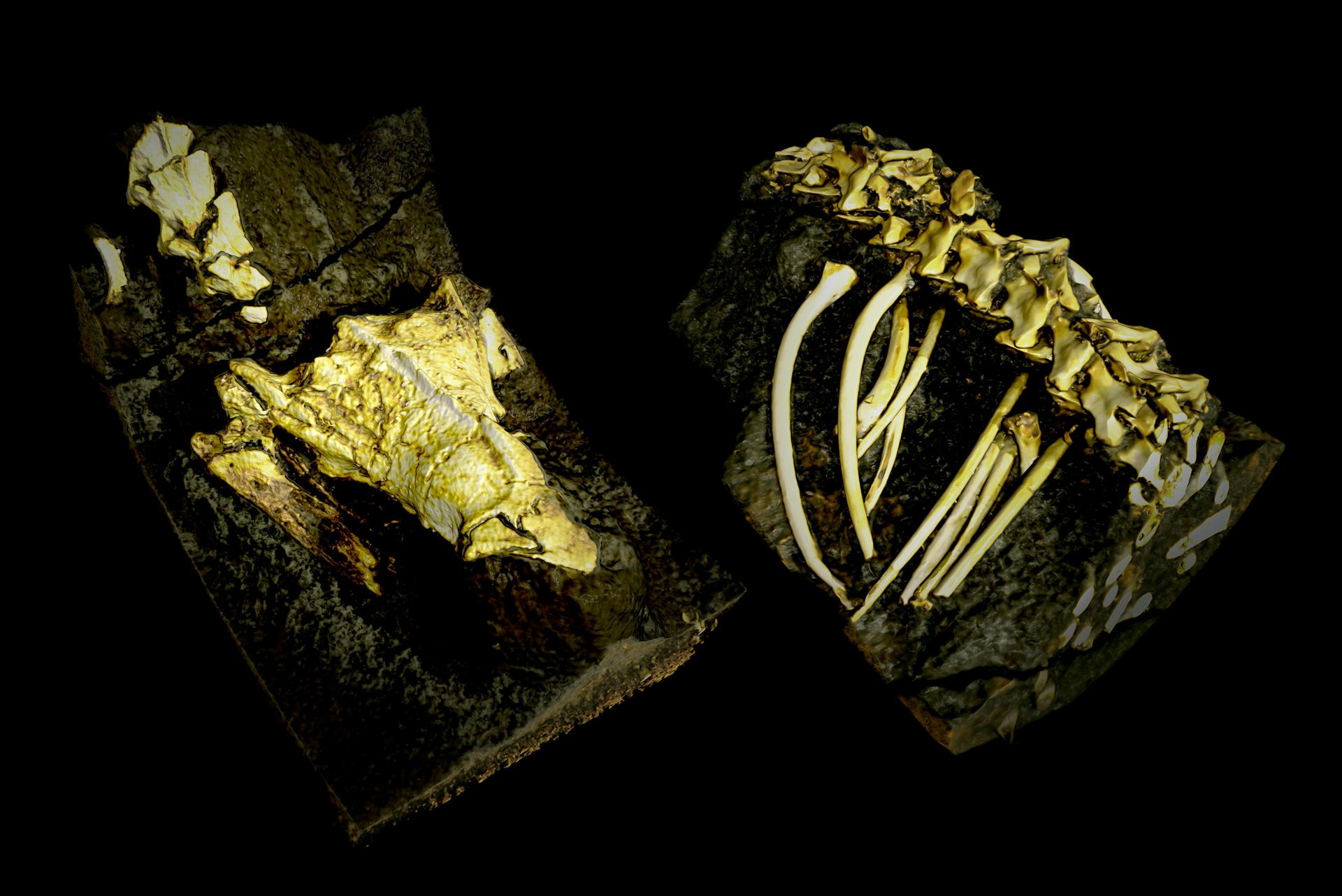
The bones of Tametara show it had the skull of a burrower. CT scan volume-rendered with VGSTUDIO MAX.
Roy Ebel
But the skull roof was not our only line of evidence.
We also digitally rebuilt its brain cavity, the most detailed such reconstruction yet for any early snake. This cavity would have closely matched the shape of the brain in the living animal. The reduced visual centres and simplified forebrain point the same way the bones do: underground.
Tuning their senses
But here is where the story turns.
We ran the same analyses on Dinilysia, a famous early snake from Argentina, and we found something astonishing. The two oldest snakes we can study in this detail had brains more different from each other than most snake lineages alive today. Dinilysia was no burrower. It lived on the surface.
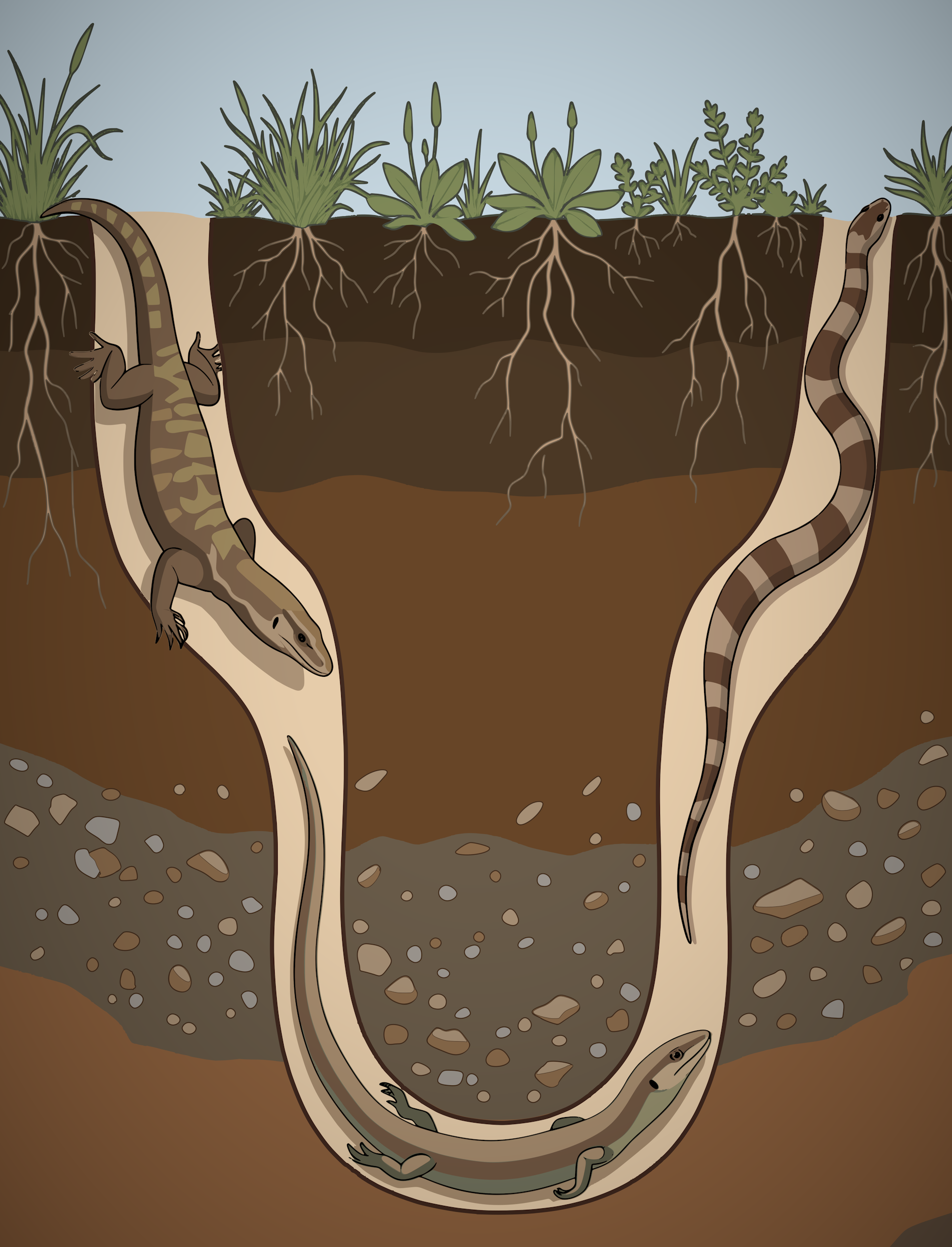
One theory about how snakes evolved suggests lizards went underground, lost their limbs and elongated their bodies.
Roy Ebel
Tametara had the reduced eyesight of a creature that spent its life in the dark. Dinilysia, on the other hand, had senses that were shaped for the open. At the very dawn of their history, snakes were already tuning their senses to very different habitats.
How, then, does this fit with the skull bones, which place the ancestral snake lineage in subterranean space? The truth may lie somewhere in between.
As my colleague Tiago Simões from Princeton University, who led the study, says: “Our findings reframe a long-running debate about how the earliest snakes lived.”
Redrawing the debate
We set out to settle the century-old question of what turned snakes into snakes with the firmest reconstruction yet of how the earliest of these reptiles lived.
Instead, we may need to reframe the question: it was never simply sea or soil.
Indeed, our best-preserved early snake was a committed burrower. But the pathway towards modern snakes branched and meandered. No single fossil, however exquisite, can capture the whole of that journey. Each is only a spotlight thrown across a bigger, more convoluted scene.
Shaped underground or not, the snake sliding through the grass today is the survivor of a long, restless experiment, recorded in the bones and brains of animals that have been dead for 80 million years.
This discovery alone has brought us closer than ever to understanding how evolution gave us these iconic yet feared creatures.

Roy Ebel, Research Officer Herpetology, Museums Victoria Research Institute
This article is republished from The Conversation under a Creative Commons license. Read the original article.

The significance of Tametara mirim is not that it supplies one simple answer to the question of why snakes lost their limbs. On the contrary, it shows that snake evolution was already complex by the Late Cretaceous. Different early lineages occupied different habitats, developed different sensory systems and combined ancestral squamate characteristics with increasingly specialised snake anatomy. Evolution produced not a predetermined march towards the modern snake but a branching history of experimentation, adaptation and extinction.
That history can be reconstructed because it left physical evidence. The density of the skull bones, the shape of the brain cavity, the reduction of the visual centres and the structure of the inner ear independently point towards a burrowing animal. These conclusions are not articles of faith: they are hypotheses derived from measurable anatomy and tested by comparison with living and extinct animals. Another fossil could modify them, but no fossil could make a divine curse into a scientific explanation.
For creationists, the animal’s age is devastating enough. A snake with an elongated body and no detectable forelimbs was already burrowing beneath the feet of dinosaurs some 80 million years before Adam and Eve supposedly committed their horticultural offence. No punishment imposed after the appearance of humans can explain anatomy preserved in rocks tens of millions of years older than humanity. Moving the mythical ‘Fall’ backwards merely destroys the biblical chronology, while denying the age requires rejecting the converging evidence of geology, palaeontology and evolutionary biology.
Even without the fossil record, the Genesis story has little explanatory value. It never explains how an ordinary wild animal could speak, how it knew what God had told Adam, or why every subsequent snake should inherit punishment for the behaviour of one unusually talkative ancestor. Most embarrassingly, the serpent’s predictions come true: the humans do not die that day, their eyes are opened and they acquire the knowledge God had tried to withhold. The supposedly deceitful serpent is vindicated by the story itself.
Creationists are therefore left defending a primitive fable against an articulated skeleton, high-resolution CT scans, comparative anatomy and a coherent evolutionary history extending over more than 100 million years. Tametara mirim did not acquire its snake-like body because a woman ate some forbidden fruit. Its anatomy was inherited from earlier generations and modified by natural selection as its lineage adapted to life underground.
The fossil does not merely predate the Genesis story; it exposes that story for what it is—fossilised folklore masquerading as an explanation.
Advertisement
Amazon

Amazon

Amazon

Amazon

Amazon

Amazon

Amazon

Amazon

Amazon

Amazon

Amazon

Amazon

All titles available in paperback, hardcover, ebook for Kindle and audio format.
Prices correct at time of publication. for current prices.

No comments:
Post a Comment
Obscene, threatening or obnoxious messages, preaching, abuse and spam will be removed, as will anything by known Internet trolls and stalkers, by known sock-puppet accounts and anything not connected with the post,
A claim made without evidence can be dismissed without evidence. Remember: your opinion is not an established fact unless corroborated.