Graphical abstract


Tethyshadros insularis and crocodilians struggle against a violent monsoon storm.
AI-generated image (ChatGPT 5.6 Sol)
Young-Earth creationists are fond of pointing out that a single flood or storm can deposit a layer of sediment very quickly, as though this somehow proves that the entire geological record could have been produced during the mythical year-long flood described in Genesis. But the speed with which an individual layer forms tells us nothing about the intervals between successive layers. When those layers contain regular, measurable cycles produced by processes operating daily, fortnightly and seasonally, they become a record of elapsed time—and that time cannot simply be waved away.
An article in The Conversation by palaeontologist Alfio Alessandro Chiarenza of University College London describes just such a record. It concerns the Villaggio del Pescatore fossil site near Trieste, north-eastern Italy, where dinosaurs, crocodilians, fish, shrimps, plants and other organisms were preserved with exceptional detail about 80 million years ago.
Chiarenza and his colleagues, led jointly with Federico Fanti of the University of Bologna, have published their findings in the journal Global and Planetary Change. Their evidence shows that the site was not, as previously proposed, a quiet lake or sinkhole. It was a tropical tidal flat on the edge of an ancient sea, repeatedly affected by powerful monsoon floods and tropical cyclones.
The fossil-bearing limestone consists of metre-thick packages containing thousands of discrete, paper-thin light and dark layers. These had previously been interpreted as annual deposits, or varves. However, high-resolution synchrotron X-ray scanning, microscopic and geochemical analyses, and statistical analysis of the repeating patterns revealed something still more remarkable: the layers are tidal microcouplets, laid down under a semidiurnal tidal regime—two tidal cycles each day.
Moreover, variations in the thickness of the layers follow the familiar fortnightly alternation between spring and neap tides. The rocks therefore contain not merely a succession of vaguely similar bands, but an ordered astronomical rhythm produced by the interaction of Earth’s rotation with the orbit of the Moon. By counting and analysing those layers, the researchers calculated that the fossil-bearing succession accumulated over approximately 40 years. In other words, the rock preserves an almost day-by-day record extending across four decades.
That presents creationists with a problem that cannot be dismissed by claiming that “floods can deposit sediment rapidly”. Of course they can; that is precisely what some of the layers record. But a single flood cannot manufacture 40 years’ worth of successive twice-daily tidal deposits, arranged in the correct fortnightly spring–neap pattern. Still less can the supposed year-long biblical flood accommodate a geological sequence that records some 40 years of tides within one small part of a vastly larger, 80-million-year-old succession.
The fossils themselves also record repeated events rather than a single catastrophe. Monsoon floods and cyclone-driven storm surges periodically swept sediment, vegetation and animal carcasses onto the tidal flat. Some animals were buried so quickly that outlines of soft tissues survived; another dinosaur carcass had lain exposed on land long enough for its bones to become dried and cracked before a later flood carried it to the site. Microbial mats then stabilised the sediment and promoted its early cementation, sealing the remains before scavengers and decay could destroy them.
So the age of the site is only the beginning of creationism’s difficulties. These rocks preserve the operation of ordinary natural processes—daily tides, fortnightly lunar cycles, recurring storms, carcass exposure and transport, microbial growth and gradual sediment accumulation—over a measurable period many times longer than the entire duration assigned to Noah’s flood. The creationist story does not offer an alternative explanation for this evidence; it simply cannot accommodate the chronological record written into the rock.
Alfio Alessandro Chiarenza's article in The Conversation id reprinted here under a Creative Commons license, refromatted for stylistic consistency:

Storms that built a graveyard: ancient monsoons created a spectacular dinosaur fossil site
AI-generated image (ChatGPT 5.6 Sol)
Alfio Alessandro Chiarenza, UCL
Around 80 million years ago, a stretch of tropical coastline in what is now north-eastern Italy was lashed by monsoon rains and tropical cyclones. Those storms swept dinosaur carcasses, crocodiles, plants and river mud onto a tidal flat, where the tides and a film of microbes sealed everything away with extraordinary preservation.
My colleagues and I have published a new study that reconstructs the violent tropical climate behind the Villaggio del Pescatore Lagerstätte near Trieste and reveals it preserves just four decades of life, recorded almost day by day.
The Villaggio del Pescatore site near Trieste is one of the most important Late Cretaceous fossil localities in the Mediterranean. It is the only known site in the region to preserve large land animals, including dinosaurs such as Tethyshadros insularis, from the final 15 million years or so of the age of dinosaurs.
Tethyshadros insularis was a plant-eating, duck-billed dinosaur that lived in what is now north-eastern Italy around 80 million years ago. It was initially interpreted as a dwarf island species, shaped by the “island rule” – that large animals evolve smaller bodies in environments with limited space and resources.
However, the discovery of larger specimens challenged this idea. Up to 11 individuals are potentially preserved in this succession of rocks, with at least three other fairly complete skeletons still waiting to be extracted from the hard (and expensive to cut) limestone rock. Geological evidence has also revealed that the site was about 10 million years older than previously thought and was not part of a tiny, isolated island. Instead, it lay near a larger landmass connected through the ancient Mediterranean region.
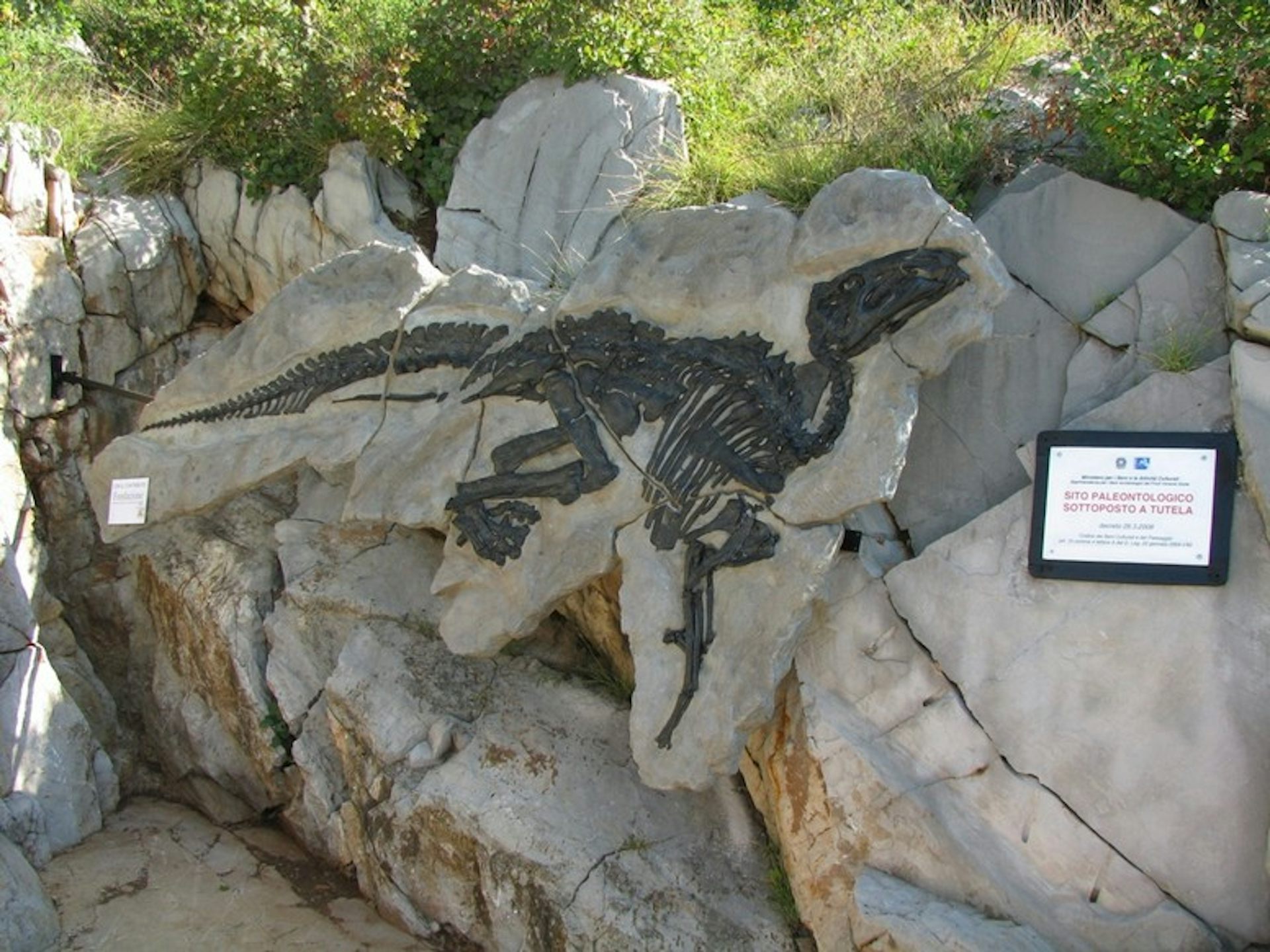
Reconstruction of a Tethyshadros insularis skeleton, nicknamed Antonio, near his finding site.
After years of research, Professor Federico Fanti of the University of Bologna and I led a multidisciplinary team of palaeontologists, physicists and geologists to determine exactly how this fossil treasure trove formed. Our findings overturn decades of competing interpretations.
In a study published in Global and Planetary Change, we show that the site was not a quiet, isolated lake or sinkhole, as previously suggested. Our results suggest it was a storm-battered tidal flatland at the edge of a tropical sea.
Villaggio del Pescatore is not simply a place where fossils happen to be beautifully preserved. It is also a record of the weather that shaped the site. We can identify individual storms and floods in the rocks, almost day by day. Very few fossil sites on Earth allow us to do that.
Reading the rock like a calendar
The fossils at Villaggio del Pescatore are concentrated in a finely layered carbonate rock, marked by thousands of paper-thin light and dark bands. For years these were interpreted as annual layers (like tree rings) laid down season by season.
Our new analysis tells a different story. Using high-resolution X-ray scans at the Elettra Synchrotron in Trieste, alongside detailed geochemical and microscopic analyses, we showed that the bands were not annual but daily. A synchrotron accelerates electrons (particles with a negative charge) to almost the speed of light. This produces powerful X-rays that can penetrate dense materials such as rock. This allowed us to examine structures inside the rocks and bones at a resolution of fractions of a millimetre.
The scans revealed that the layers were deposited by ocean tides, two pairs each day. These tides varied according to the familiar fortnightly cycle of stronger and weaker tides that still happen today. We could count these tidal layers, thanks to this unparalleled resolution.

Microstratigraphic characteristics of VdP laminated rhythmites from Core S3.
Monsoons, cyclones and microbes
To explain why storms were so central to the preservation of the fossils, the team ran climate simulations. The models consistently placed the site at around 29° north, inside a powerful, summer-dominated monsoon belt. This was a tropical regime of intensely wet summers and recurring tropical cyclones, sustained by the greenhouse climate of the age.
Monsoon-driven floods and cyclone surges created pulses of sediment, nutrients, plant debris and animal carcasses onto the tidal flat. The tides trapped this material, and mats of microbes rapidly stabilised it. This encouraged the sediment to harden right after the carcass was deposited, before it started rotting or predators could scavenge its dead tissues. These storms were the main agents behind this preservation.

Depositional model and facies details of the VdP deposits. (A) Reconstructed sequence of events: (Top) High-energy cyclonic events transport terrigenous debris, plant matter, and tetrapod carcasses across undisturbed tidal flats. (Middle) Coarse sediment settles to form a storm layer, rapidly stabilised by microbial mat draping; sinking vertebrate carcasses create impact deformation structures in the soft substrate. (Bottom) Resumption of tidal rhythms immediately buries isolated bones and debris, while articulated carcasses retain soft tissue, progressively buried by onlapping laminae over multiple tidal cycles. (B) Photomicrograph showing the typical fine, undisturbed rhythmic couplets. (C) A photographic detail illustrating an event bed, overlain by distinctive microbial draping structures. (D) A reddish, oxidised plant leaf transported from the hinterland, representing material delivered by flood pulses. Scale bars: 1 mm.
We propose that this combination of “ingredients”, monsoon floods, tidal trapping and microbial sealing, represents a recipe for creating exceptionally preserved fossil sites in hot, tropical greenhouse climates – precisely the kind of setting in which rapid decay would normally destroy organic remains.
The study also offers an ancient perspective on how intensifying monsoons and cyclones can reshape coastlines, ecosystems and what becomes preserved along tropical shores.
Villaggio del Pescatore has been studied for more than four decades, yet it still has new stories to tell. Understanding how extreme storms transformed this ancient coastline may also help us think about how modern coasts could respond to a warmer and more turbulent climate fuelled by high levels of CO₂.

Alfio Alessandro Chiarenza, Royal Society Newton International Fellow in Palaeontology, UCL
This article is republished from The Conversation under a Creative Commons license. Read the original article.

What the researchers have reconstructed at Villaggio del Pescatore is not the aftermath of a single, indiscriminate catastrophe but a succession of ordinary natural events operating in a recognisable coastal ecosystem. Monsoon floods and cyclone surges carried mud, plants and occasional carcasses onto the tidal flat; tides trapped and rearranged the material; and microbial mats stabilised the sediment and promoted its early cementation. Different fossils consequently preserve different histories—some animals were buried rapidly, while others had lain exposed and begun to dry before being transported by a later flood.
The familiar creationist response that fossils can be buried and sediments deposited rapidly therefore misses the point entirely. Geologists have never denied rapid deposition; it is an essential part of the explanation. The issue is not how quickly each individual layer formed, but how much time elapsed while thousands of those layers accumulated. At Villaggio del Pescatore, the rocks themselves provide the answer.
Their alternating microlaminae record twice-daily tides, while variations in their thickness preserve the fortnightly spring–neap cycle produced by the changing alignment of the Earth, Moon and Sun. Counted together, they amount to approximately 40 years of tidal activity. A mythical flood lasting about a year cannot contain four decades of successive daily and fortnightly cycles, however rapidly any one of its layers might have been deposited.
The site’s age of about 80 million years is already irreconcilable with a universe supposedly created only a few thousand years ago. But even if creationists simply denied that age, as they routinely deny any inconvenient measurement, the internal chronology of the deposit would remain. Embedded within this small part of the Cretaceous geological record is a natural calendar that alone exceeds the available Flood chronology many times over.
This is why “Flood geology” is not a competing scientific interpretation. It does not explain the observed evidence; it requires that the evidence should not exist. The rocks have kept the calendar—and Genesis has run out of time.
Advertisement
Amazon

Amazon

Amazon

Amazon

Amazon

Amazon

Amazon

Amazon

Amazon

Amazon

Amazon

Amazon

All titles available in paperback, hardcover, ebook for Kindle and audio format.
Prices correct at time of publication. for current prices.


No comments:
Post a Comment
Obscene, threatening or obnoxious messages, preaching, abuse and spam will be removed, as will anything by known Internet trolls and stalkers, by known sock-puppet accounts and anything not connected with the post,
A claim made without evidence can be dismissed without evidence. Remember: your opinion is not an established fact unless corroborated.