

Schematic cross-section showing a cold subducted slab descending through the mantle transition zone into the deep mantle. The cold, very cold slab and hot geotherms are represented by dashed lines.
Creationists have long been fond of two superficially impressive but scientifically worthless arguments. The first is that tiny amounts of carbon-14 detected when diamonds are placed in an accelerator mass spectrometer somehow show that diamonds—and therefore Earth—are only a few thousand years old. The second is that the discovery of “water” deep inside Earth confirms the biblical “fountains of the great deep” and, when convenient, explains where all the water from Noah’s supposed global flood subsequently disappeared.
A paper recently published in Scientific Reports brings these two favourite misconceptions together in a combination that may prove irresistible to professional misrepresenters of science. It therefore seems prudent to explain what the researchers actually found before the inevitable claims begin circulating.
Carolina Camarda and colleagues examined an irregular diamond, just 3 millimetres long, recovered from the Juína region of Brazil. Super-deep diamonds form at depths greater than about 300 kilometres, rather than at the approximately 150-kilometre depths typical of most diamonds, and can preserve microscopic inclusions of minerals that record conditions far below the surface.
Using synchrotron X-ray tomography, diffraction and spectroscopy, the team mapped more than 100 inclusions inside the diamond. One completely sealed inclusion, only about 35 micrometres across, contained a complex mixture of goethite—an iron oxyhydroxide with the formula FeOOH—together with hematite and magnetite. Another inclusion contained ferropericlase, a mineral characteristic of the deep mantle, supporting the conclusion that the diamond originated far below the crust.
The researchers propose that the goethite originally formed within hydrated oceanic crust or lithosphere. As that crust was carried downwards at a subduction zone, the goethite changed into a high-pressure form capable of surviving within a relatively cold descending slab. At still greater pressures and temperatures it began to decompose into iron oxides, releasing H₂O and oxygen into the surrounding mantle. The diamond then encapsulated part of this mineral assemblage, preserving evidence of the process.
In other words, the discovery concerns the slow transport of surface-derived water downwards through plate subduction. It is not evidence of a primordial subterranean ocean bursting upwards to flood Earth. Nor does it show where the water from an imaginary global flood went afterwards. The “water” carried by goethite is chemically incorporated into its crystal structure, principally as hydroxyl groups; it is not a liquid ocean occupying enormous caverns beneath the crust. It can be liberated as molecular water only when the mineral undergoes chemical reactions under extreme mantle conditions.
The study examined one microscopic inclusion and made no estimate of a hidden ocean, no calculation of the volume of floodwater that could be accommodated, and no suggestion that surface water could disappear hundreds of kilometres into the mantle within a few months. What it describes is part of Earth’s deep-water cycle, driven by plate tectonics and operating over geological time. Indeed, the direction of transport in the authors’ model is exactly the reverse of the “fountains of the great deep”: hydrated rocks are carried from the ocean floor into the mantle, where some of their bound water is eventually released.
Nor did the researchers carbon-date the diamond. The paper contains no radiocarbon measurement at all. Carbon-14 has a half-life of about 5,730 years, making radiocarbon dating useful for formerly living material up to roughly 50,000–55,000 years old under ordinary conditions. It cannot determine whether a diamond formed hundreds of millions or billions of years ago, and mantle carbon does not necessarily begin with the atmospheric carbon-14 ratio required for conventional radiocarbon dating.
At the extreme limit of accelerator mass spectrometry, instruments do not return a perfect zero even when a sample contains no surviving carbon-14. Trace modern carbon, ion-source memory, sample preparation and other instrumental effects produce a small background signal. Indeed, ancient natural diamonds have deliberately been used to measure that background. In one peer-reviewed study, geologically ancient diamonds returned nominal “ages” ranging from about 64,900 to 80,000 years. These were not accepted as the ages of the diamonds: they were measurements of the practical background and detection limit of the equipment.
The much-publicised creationist measurements produced an apparent age of about 55,700 radiocarbon years—not a few thousand—and even creationist writers concede that applying the normal radiocarbon-age calculation to a diamond is meaningless. They nevertheless treat the same meaningless calculation as evidence for a 6,000-year-old Earth. A detailed analysis published in the journal Radiocarbon explains why such minute signals in supposedly carbon-14-free materials represent analytical background, contamination and related effects rather than the ages of the samples.
Consequently, this discovery supplies creationism with neither young diamonds nor Noah’s missing floodwater. It records mineral transformations under immense pressures and temperatures, the recycling of oceanic crust through subduction, and a deep-water cycle operating across geological depths and timescales. Turning that into evidence for Genesis requires converting structurally bound hydroxyl into a subterranean ocean, an instrumental background into a reliable birthday, and slow plate tectonics into a year-long magical catastrophe. None of those transformations occurs anywhere in the research; they take place only in creationist storytelling.
What the study really offers is something much more interesting: a microscopic mineral time capsule showing how hydrated surface rocks may carry water deep into a dynamic planet. Far from rescuing the biblical Flood, it reveals yet another chapter in Earth’s immensely long geological history—one that the authors of Genesis could not possibly have known.
Glossary of technical terms. Earth’s structure and plate tectonicsThe paper in Scientific Reports was accompanied by a somewhat creationist-baiting Agência FAPESP headline about a super-deep diamond and water travelling into Earth’s interior:
Crust: Earth’s thin, outermost rocky layer. Oceanic crust is generally 5–10 kilometres thick, while continental crust is usually much thicker.
Lithosphere: The rigid outer part of Earth, comprising the crust and the uppermost mantle. It is divided into the moving tectonic plates.
Mantle: The thick layer of hot rock between Earth’s crust and core. Although mostly solid, mantle rock can deform and flow very slowly over geological time.
Upper mantle: The part of the mantle extending from beneath the crust to a depth of about 660 kilometres.
Mantle transition zone: The region between approximately 410 and 660 kilometres below the surface, where increasing pressure changes the crystal structures of mantle minerals.
Lower mantle: The region extending from about 660 kilometres below the surface to the boundary with Earth’s core, approximately 2,900 kilometres deep.
Plate tectonics: The scientific theory describing the movement and interaction of Earth’s rigid lithospheric plates.
Subduction: The process by which one tectonic plate sinks beneath another and descends into the mantle.
Subducting slab: The portion of a tectonic plate that is descending into the mantle. A relatively cold slab can carry some minerals much deeper than they would survive under normal mantle temperatures.
Deep-water cycle: The long-term circulation of water between Earth’s surface and interior. Water is carried down in subducting rocks and can later be released into the mantle, magma, volcanoes and atmosphere.
Diamonds and minerals
Super-deep diamond: A diamond formed at depths greater than about 300 kilometres, beneath the region in which most diamonds originate. Mineral inclusions inside such diamonds provide rare samples of the deep mantle.
Mineral inclusion: A microscopic fragment of another mineral trapped inside a crystal while that crystal was forming. A completely sealed inclusion can preserve evidence of the conditions under which it originated.
Crystal structure: The ordered three-dimensional arrangement of atoms within a mineral.
Hydrous mineral: A mineral containing hydrogen and oxygen within its crystal structure. It does not necessarily contain pockets of liquid water.
Hydroxyl group (OH⁻): A chemically bound combination of one oxygen atom and one hydrogen atom. Much of the “water” stored in mantle minerals occurs as hydroxyl groups rather than as liquid H₂O.
Iron oxyhydroxide: A mineral containing iron, oxygen and hydroxyl groups. Goethite, with the chemical formula FeOOH, is an example.
Goethite (α-FeOOH): A common brown iron oxyhydroxide found in soils, sediments and altered oceanic rocks. It incorporates hydroxyl into its crystal structure and can therefore carry water-equivalent material.
ε-FeOOH: A high-pressure form of iron oxyhydroxide into which ordinary goethite may transform as it descends into the mantle.
Hematite (Fe₂O₃): A common iron oxide, often reddish-brown, that can form when goethite loses water.
Magnetite (Fe₃O₄): A magnetic iron oxide containing iron in two different oxidation states.
Ferropericlase: A magnesium-and-iron oxide, (Mg,Fe)O, that is abundant in the lower mantle. Its presence in a diamond can help indicate a super-deep origin.
Polymorph: One of two or more minerals with the same chemical composition but different crystal structures. Changes in pressure and temperature can transform one polymorph into another.
Dehydration reaction: A chemical reaction in which a mineral loses hydrogen and oxygen from its structure, potentially releasing them as H₂O.
Retrograde phase: A mineral formed when a high-pressure mineral changes during cooling and decompression. Such products can preserve indirect evidence of the original deep-mantle mineral.
Epigenetic inclusion: Material that entered or formed inside a diamond after the diamond itself formed, commonly through a crack. The researchers concluded that the studied inclusion was not epigenetic because it was completely sealed from the diamond’s surface.
Volatiles: Chemical substances, including water and carbon dioxide, that can readily enter fluids or gases under suitable conditions.
Oxidation state: A measure of how electrons are distributed around an atom. Changes in the oxidation states of iron can transform one iron-bearing mineral into another.
Redox reaction: A chemical reaction involving the transfer of electrons and corresponding changes in oxidation state. “Redox” is an abbreviation of reduction–oxidation.
Gigapascal (GPa): A unit of pressure equal to one billion pascals. Pressures of tens of gigapascals occur hundreds or thousands of kilometres inside Earth.
Analytical methods
Synchrotron: A particle accelerator that produces extremely intense beams of electromagnetic radiation, including X-rays. These beams allow scientists to examine microscopic structures and determine their composition without destroying them.
X-ray microtomography (micro-CT): A technique resembling a highly detailed medical CT scan. It uses X-rays to construct a three-dimensional image of microscopic structures inside an object.
X-ray diffraction (XRD): A method used to identify minerals from the characteristic pattern produced when X-rays interact with their crystal structures.
X-ray spectroscopy: A group of techniques used to identify the chemical elements in a sample and investigate how their atoms are bonded.
XANES: Short for X-ray Absorption Near-Edge Structure. This technique provides information about an element’s oxidation state and its chemical environment within a mineral.
Radiocarbon terminology
Isotope: One of several forms of an element whose atoms contain the same number of protons but different numbers of neutrons.
Carbon-14 (¹⁴C): A radioactive isotope of carbon produced mainly by interactions between cosmic rays and nitrogen in the atmosphere. Living organisms continually acquire it while exchanging carbon with their environment.
Radiocarbon dating: A method for estimating when formerly living material ceased exchanging carbon with the environment. It is generally useful only for the past 50,000–55,000 years and is not an appropriate method for determining the geological age of a diamond.
Half-life: The time required for half the atoms of a radioactive isotope to decay. Carbon-14 has a half-life of approximately 5,730 years.
Accelerator mass spectrometry (AMS): A highly sensitive technique that counts rare isotopes such as carbon-14 relative to more abundant isotopes. It can detect extremely small quantities but cannot eliminate instrumental background completely.
Percent modern carbon (pMC): A way of expressing the amount of carbon-14 in a sample relative to a modern reference material. Extremely small pMC values approach the practical limits of radiocarbon measurement.
Analytical background: A small signal produced by the instrument, sample holder, preparation process, residual material from previous samples or trace contamination. Even a genuinely carbon-14-free sample will not necessarily produce a reading of exactly zero.
Process blank: Material known to contain no measurable carbon-14 that is taken through the same preparation and measurement procedures as an unknown sample. Its reading reveals how much background has been introduced by those procedures.
Detection limit: The smallest signal that can be distinguished reliably from analytical background. Measurements close to this limit cannot simply be treated as accurate dates.
Apparent radiocarbon age: The age obtained when a measured carbon-14 signal is inserted into the standard decay equation. If the signal comes predominantly from analytical background, or if the sample never possessed the assumed initial carbon-14 concentration, the calculated figure is not the sample’s real age.
Analysis of a super-deep diamond reveals how water travels to the Earth’s interior
Stone studied at the Sirius particle accelerator reinforces the hypothesis that the mineral goethite can transport water from the planet’s surface to rocks in the lower mantle.
By Igor Zolnerkevic | Agência FAPESP – A team of Brazilian researchers discovered the first direct evidence that goethite – the mineral responsible for the brown color of soils – can withstand extreme pressures and temperatures all the way to the planet’s interior inside a diamond just 3 millimeters long, within a microscopic impurity. Goethite forms in soil and on the ocean floor from iron-rich minerals in the presence of water. It incorporates some of these water molecules into its mineral structure. The study suggests that goethite may transport and release water into a region known as the lower mantle.
Previous studies have confirmed that water from the Earth’s crust, the outermost layer of rock 20 to 80 kilometers thick on continents and 5 to 10 kilometers thick in oceans, can reach the denser rock region just below it, the upper mantle, to depths of up to 660 kilometers. The lower mantle begins there and consists of rocks with a similar chemical composition to the upper mantle but with different crystalline structures due to increased temperature and pressure at greater depths, extending to 2,900 km below the surface.
The study was published in May in the journal Scientific Reports. It was conducted at Sirius, the particle accelerator at the Brazilian Synchrotron Light Laboratory (LNLS), which is part of the Brazilian Center for Research in Energy and Materials (CNPEM) in Campinas in the state of São Paulo. The study is based on geologist Carolina Camarda’s master’s thesis and was supervised by geologist Tiago Jalowitzki of the University of Brasília (UnB) and physicist Hélio Tolentino of the LNLS. It was funded by the Coordination for the Improvement of Higher Education Personnel (CAPES), which is affiliated with the Brazilian Ministry of Education. Camarda conducted the research in collaboration with Fernanda Gervasoni, a geologist at the Federal University of Pelotas (UFPel) in Rio Grande do Sul state. Gervasoni is currently completing a postdoctoral fellowship at the LNLS with funding from FAPESP under the supervision of Tolentino.
In July 2018, Gervasoni and Jalowitzki visited a gold miners’ cooperative in the Chapadão region of the municipality of Juína in the state of Mato Grosso and received a donation of ultra-deep diamonds. These diamonds are found in only a few places in the world and form at depths greater than 300 km. Most diamonds originate about 150 km below the surface. In both cases, they are brought to the surface by magma that fuels volcanic eruptions.
Many super-deep diamonds have little value as jewelry because of their irregular appearance and the presence of small dark fragments of other materials trapped within the stone during its formation, known as mineral inclusions. For geologists, these inclusions are more valuable than the diamond itself, because they act as time capsules, preserving evidence of the conditions inside the Earth where these stones formed hundreds of millions of years ago.
Made in Brazil
The super-deep diamonds from Juína were discovered in the late 1980s, and since then, they have been the source of numerous scientific discoveries. Until now, these studies had been carried out only by groups led by foreign researchers. “Ours is the first study conducted entirely by a Brazilian team using Brazilian instruments,” Gervasoni points out.
The study is also the first in the world to analyze a super-deep diamond using synchrotron light techniques from start to finish. One of the Juína stones was chosen at random and was among the first materials analyzed at the Mogno and Carnaúba beamlines at Sirius, even during the commissioning phase of the new LNLS equipment, prior to their official inauguration in 2023 and 2021, respectively.
Synchrotron light is extremely bright electromagnetic radiation emitted by electrons traveling around a particle accelerator at speeds close to the speed of light. The beamlines direct specific bands of this radiation to research stations for material analysis.
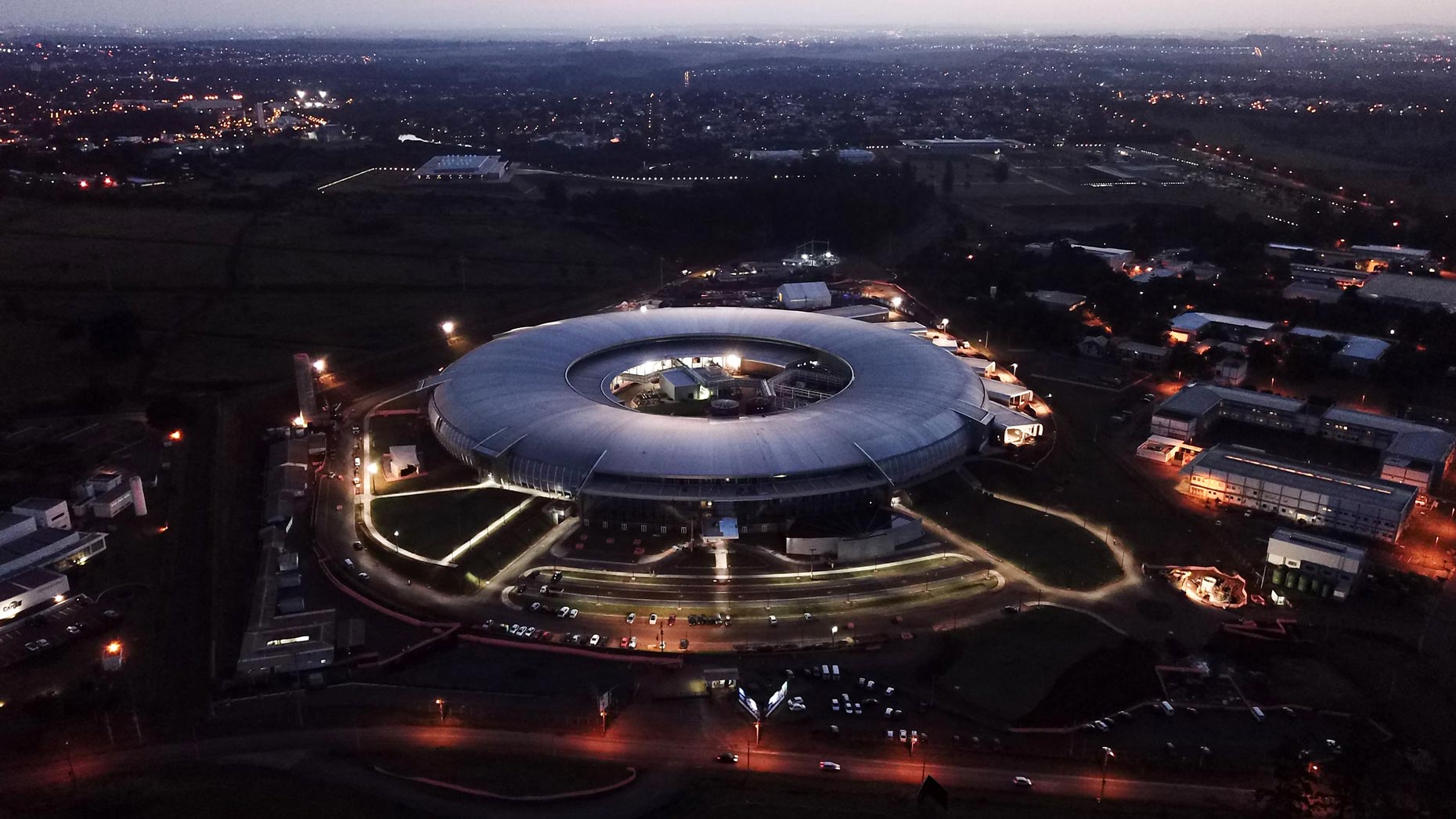 This research is the first in the world to analyze a super-deep diamond using synchrotron light techniques from start to finish. One of the Juína diamonds, chosen at random, was among the first materials analyzed at two beamlines of the Sirius particle accelerator.Photo: press release/LNLS-CNPEM)
At the Mogno beamline, high-resolution X-ray microtomography mapped approximately one hundred mineral inclusions within the diamond. Next, the Carnaúba beamline used X-ray spectroscopy to determine the chemical composition of the inclusions.
One of them caught the team’s attention because it appeared to contain iron hydroxide, which is a very rare occurrence in the deep mantle because there are few hydrated minerals and most rocks do not support oxidation reactions. “When researchers find iron hydroxides, they usually dismiss the inclusion, assuming that some microscopic fracture in the diamond caused oxidation through contact with air,” explains Camarda, a Ph.D. candidate at the European XFEL laboratory in Germany. “Since tomography proved the inclusion had no connection to the outside, we decided to investigate.”
The team then used the Ema beamline at the Sirius facility to characterize all the minerals in the inclusion. Surprisingly, the X-ray diffraction technique identified the iron oxyhydroxide goethite (FeOOH) and the iron oxides hematite (Fe₂O₃) and magnetite (Fe₃O₄). While these minerals are common in soil and on the ocean floor, their coexistence within a microscopic inclusion is considered impossible under the temperature and pressure conditions on the planet’s surface.
Journey to the Earth’s interior
Until a few years ago, researchers generally agreed that goethite could not withstand the subduction process, in which an oceanic plate sinks beneath another tectonic plate of the Earth’s crust toward the mantle. This process occurs today off the west coast of South America, where the Pacific Ocean crust subducts beneath the continent. The result is the volcanic and tectonic activity that formed (and continues to form) the Andes mountain range. Early in the process, temperatures above 200 °C would rapidly transform goethite into hematite and water.
However, Camarda and his colleagues noted that the diffraction results from Sirius were very similar to those obtained in a shock wave compression experiment conducted at Sichuan University in China in 2021. This experiment showed that goethite can withstand pressures between 35 and 57 gigapascals (GPa) – equivalent to about 500 times the pressure at the deepest point in the ocean – and temperatures between 877 and 1,827 °C. These conditions occur in the lower mantle, at depths between 900 and 1,250 kilometers.
Many researchers are skeptical of these results, as shock experiments do not exactly replicate the physical conditions of the lower and upper mantle. In 2021, however, a team led by researchers at the University of Bayreuth in Germany demonstrated that goethite withstood similar pressure and temperature conditions in a compression experiment using diamond anvil cells. These cells are capable of more accurately simulating the mantle environment. Other diamond anvil experiments have tested the resistance of this mineral but suggested its dehydration at shallower depths.
Therefore, Camarda’s team proposes that goethite can survive subduction when sheltered within deep fissures in relatively cool oceanic plates reaching depths greater than 400 km. There, it would begin to transform into hematite and water, or into magnetite, oxygen, and water. This process could extend all the way to the lower mantle.
The diamond that encapsulated these minerals may have formed from the crystallization of carbon found in mantle minerals or the oceanic plate itself. The Earth’s mantle is relatively low in carbon and consists mainly of magnesium-, iron-, and silicon-rich minerals. In another inclusion within the same diamond, the team identified one of these minerals: ferropericlase ((Mg, Fe)O), which is abundant in the lower mantle. This is further evidence of the depth at which this diamond formed.
The release of water lowers the melting point of these rocks, potentially generating small amounts of magma that tend to rise slowly to the surface. Some theories suggest that volcanic rocks that bring super-deep diamonds to the surface form near the transition zone between the upper and lower mantle, around 400 km deep.
Fernanda Gervasoni, corresponding author.
Brazilian Synchrotron Light Laboratory
Brazilian Center for Research in Energy and Materials (LNLS/CNPEM)
Campinas, Brazil.
In 2014, an international team published a study in the journal Nature reporting the discovery of ringwoodite (Mg₂SiO₄), a mineral abundant in the transition zone that can absorb water, in a Juína diamond. The upper mantle appears to harbor large quantities of water originating from the surface. In contrast, most minerals in the lower mantle have little capacity to store water.
In addition to Camarda, Gervasoni, Jalowitzki, and Tolentino, 11 other researchers affiliated with the CNPEM, UnB, and UFRGS participated in the study. Funding for the research was provided by the National Council for Scientific and Technological Development (CNPq), which is affiliated with the Brazilian Ministry of Science, Technology, and Innovation; the National Institute of Science and Technology for Tectonic Studies; the Serrapilheira Institute; and the Women in Research program at the University of Münster in Germany.
Publication:


This tiny inclusion in a diamond is therefore evidence of a dynamic, ancient Earth. It records minerals being carried hundreds of kilometres downwards in a subducting tectonic plate, transformed by enormous pressures and temperatures, and preserved inside a diamond before eventually being returned to the surface by volcanic activity. Every stage belongs to the well-supported geological history of a planet operating over immense spans of time, not to a supernatural catastrophe during a single year.
The “water” in this process is not a subterranean ocean waiting to burst through the crust. It is hydrogen and oxygen chemically bound within minerals and dispersed through vast volumes of rock. The researchers’ model has this material travelling from the oceanic crust into the mantle through subduction—the reverse of water erupting from the biblical “great deep”. Nor does the study provide a mechanism by which enough water to cover every mountain could have drained hundreds of kilometres into solid rock within a few months. It does not even attempt to do so, because Noah’s Flood has no place in the science.
The diamond itself offers no comfort to young-Earth creationism either. It was not carbon-dated in this research, and radiocarbon dating is incapable of establishing the geological age of a diamond. The minute carbon-14 readings promoted by creationists occur at the limits of accelerator mass spectrometry, where analytical background can produce a nominal finite “age” even from material known to be vastly older. Calling such a number a measurement does not make it the diamond’s birthday.
The creationist argument consequently depends upon equivocation at every stage: chemically bound hydroxyl becomes floodwater; Earth’s mantle becomes the biblical “great deep”; a background instrument signal becomes a reliable date; and the gradual subduction of oceanic crust becomes the rapid disposal of a global flood. The argument sounds impressive only while those distinctions are concealed.
Once the terminology is understood, the supposed support for Genesis disappears. The diamond is not young, its microscopic inclusion is not Noah’s missing floodwater, and the mantle is not a storage tank for a recently drained ocean. What the diamond really preserves is evidence of deep pressure, deep tectonic recycling and, most inconveniently for creationism, deep time.
Advertisement
Amazon

Amazon

Amazon

Amazon

Amazon

Amazon

Amazon

Amazon

Amazon

Amazon

Amazon

Amazon

All titles available in paperback, hardcover, ebook for Kindle and audio format.
Prices correct at time of publication. for current prices.



No comments :
Post a Comment
Obscene, threatening or obnoxious messages, preaching, abuse and spam will be removed, as will anything by known Internet trolls and stalkers, by known sock-puppet accounts and anything not connected with the post,
A claim made without evidence can be dismissed without evidence. Remember: your opinion is not an established fact unless corroborated.