

Llangorse Lake and key Late Palaeolithic sites and other palaeoenvironmental records referred to in the text within the British land mass (green) and the ice sheet extent (white) at 16 ka (ref. 2).
I've posted a few examples recently showing how scientists, unlike creationists, can and do change their minds when the evidence changes. Far from being a weakness, this is one of science’s great strengths. It is creationism, with its fixed conclusions and evidence-proof dogma, that has the fundamental problem.
This post, and my next one, will look at two more such examples. Neither will bring any comfort to creationists hoping to show that science is unreliable, or that scientists simply invent data to protect some preconceived orthodoxy.
The first concerns a revised estimate of when humans returned to what are now the British Isles after the Last Glacial Maximum. The next will look at how new evidence has required a revision of the accepted view of the origins of the population of the Japanese Archipelago. Both, of course, sit very awkwardly with the Bible-based narrative that requires belief in a magical creation without ancestry, followed by a population reset in which all modern humans supposedly descend from eight survivors of a genocidal flood, radiating out from the Middle East only a few thousand years ago.
Firstly, then, the repopulation of the British Isles. It had long been assumed that people moved back into Britain from north-western Europe around 14,700 years ago, as the climate warmed at the end of the last ice age. That estimate has now been pushed back by about 500 years, to around 15,200 years ago. In turn, this has forced scientists to reassess the timing and pattern of the climatic changes that made such a return possible.
The revision arose from improved geochronology and the recalibration of radiocarbon dates. Once the earliest known post-glacial human evidence in Britain was placed at about 15,200–15,000 years ago, there was an obvious problem: the existing climate models suggested that Britain should still have been too cold, not only for people, but also for the grazing animals they depended on, such as reindeer and horses.
Rather than ignore the discrepancy, or force the evidence to fit the old model, scientists did what scientists are supposed to do: they re-examined the data. A reassessment of lake-bed cores, especially from Llangorse Lake in South Wales, showed that parts of southern Britain had indeed experienced an earlier period of summer warming. This would have created the conditions for grassland expansion, the northward movement of prey species, and the return of human hunter-gatherers.
The study was conducted by a team led by Ian P. Matthews and Adrian P. Palmer of the Department of Geography, Royal Holloway, University of London, who published their findings in Nature Ecology & Evolution.
Adrian Palmer has also written an article in The Conversation, in which he explains their findings and why the discovery of earlier human remains made it necessary to reassess the timetable of climate change. His article is reproduced here, under a Creative Commons licence, reformatted for stylistic consistency:

Humans returned to British Isles earlier than previously thought at the end of the last ice age
Llangorse Lake
The return of humans to the British Isles after the end of the last ice sheet, which covered much of the northern hemisphere, happened around 15,200 years ago – nearly 500 years earlier than previous estimates.
This movement of people coincided with a sharp rise in summer temperatures in southern Britain, research by our group shows.
These environmental conditions allowed humans to migrate back up into Britain – then still connected to the European mainland. They were hunting herds of reindeer and horses, which were migrating northwards into ecosystems that supported their preferred food for grazing.
After the end of the last ice age, the climate in north-west Europe shifted from cold to warm conditions on at least two occasions, with changes in temperature thought to have occurred over decades.
Our latest research addresses the first of these transitions in the Late Upper Palaeolithic period (14,000 to 11,000 years ago). In areas such as north-west Europe, including where the British Isles are today, humans successively abandoned and then returned to areas at the abrupt transitions between cold and warm periods.
Broadly, evidence of humans from fossil records showed them migrating to where the environmental conditions supported their survival.
Reasons for repopulation
The repopulation of the British Isles after the last ice age is an excellent period to explore the relationships between climate and environment, and the reappearance of humans in this region.
In previous studies, the evidence has been somewhat difficult to read due to uncertainty of the dating methods and incomplete records of environmental and climate conditions. The traditional view had been that the north-west European climate warmed from ice-age temperatures around 14,700 years ago, and humans reoccupied Britain at that time.
However, revised preparation techniques in the early 2000s for the dating of human remains and associated artefacts showed the earliest appearance of humans occurred prior to the warming of 14,700 years ago.
This finding was difficult to understand, as it coincided with what were then considered cold glacial climates that would have been unlikely to support the resources people needed to survive in Britain.
Summer climate record from Llangorse Lake, Wales
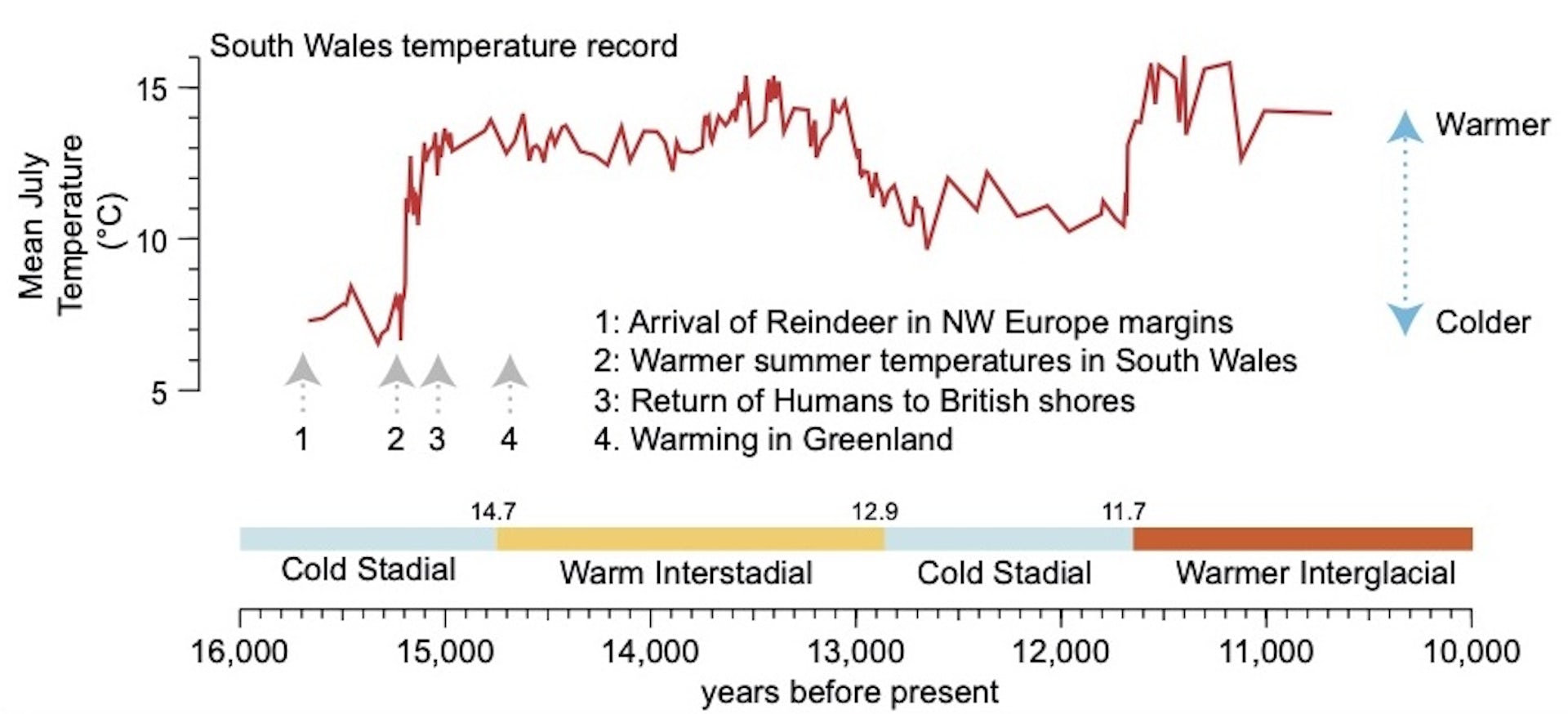
Graph shows the timing of returns to British Isles of reindeer and humans after the last ice age, and related temperatures in Llangorse Lake.
Author's own illustration
Clearer insight came from Llangorse Lake (Lake Syffadan) in south Wales, where the lake sediments spanning the last 19,000 years record the abrupt climate change in detail. In addition, the lake’s location lies close to the cave in the Wye Valley where the earliest British evidence for human remains after the ice age were found.
By extracting fossil pollen, chironomids (non-biting midges) and chemical analysis of the lake sediments, an unexpected picture of the climate emerged – one that showed previous climate reconstructions for the region were incorrect.
The chironomids were used to reconstruct summer temperature, and this showed the climate warmed in a different pattern than has been identified in other parts of north-west Europe and Greenland. An abrupt temperature shift from 5–7°C to 10–14°C occurred at 15,200 years in Britain – 500 years earlier than previous evidence had suggested.
Just prior to this climate warming, the presence of human prey, such as reindeer and horses, is more consistently detected in southern Britain around 15,500 years ago. These animals were exploiting the newly available grazing grounds, with people tracking the herds northwards and enduring the moderately warmer summer climatic conditions.
Examining archaeological records along with environmental and climatic archives allows more precise reconstructions of when humans were able to repopulate previously inhospitable regions. This is helped by re-evaluating old radiocarbon dates of human evidence in the landscape, and by generating more precise environmental records from the time – including more precise timings of the transitions from cold to warm periods.
This provided us with a fuller picture of human responses to changes in temperature (and their impact on the environment) in the Late Upper Palaeolithic period. Human survival was the driver of these movements, and following prey into new areas was important. But only a relatively small change in summer temperatures was required to enable this migration.
Our research provides better understanding of human behaviour and resilience to climate change after the last ice age around 15,000 years ago. But understanding these environmental triggers from the past helps create new perspectives on human responses to them even now.
These basic factors have not gone away. The response observed in this study might provide clues on future human behaviour as our polar regions warm and glaciers melt, showing how the potential for human migration could be increased.

Adrian Palmer, Senior Lecturer, Geography, Royal Holloway, University of London
This article is republished from The Conversation under a Creative Commons license. Read the original article.

Publication:

This is how science progresses: not by defending a sacred text, but by allowing evidence to correct earlier conclusions. The earlier model was not abandoned because scientists had been careless or dishonest, but because better dating and better environmental evidence made a more precise reconstruction possible. That is not a failure of science; it is science doing exactly what it is designed to do.
Creationism has no equivalent mechanism for self-correction. Its conclusion is fixed in advance, so inconvenient evidence must either be ignored, misrepresented, or explained away with ever more elaborate excuses. By contrast, when archaeologists, geologists and climate scientists find that a date no longer fits the existing model, they do not declare the evidence impossible; they ask what the evidence is telling them, then revise the model accordingly.
In this case, the revised timetable does not merely move the return of humans to Britain back by a few centuries. It also gives us a more detailed picture of the world those people entered: a cold but changing landscape, warming earlier than previously thought, with expanding habitats able to support the animals on which hunter-gatherers depended. Human history, climate history and ecological history all have to fit together, and the new research shows how they did.
And once again, the result is a picture that is utterly at odds with creationist mythology. There is no trace here of a recent magical creation, a global flood, or a sudden dispersal from the Middle East by the descendants of a single family. Instead, there is the familiar scientific picture of deep time, changing climates, migrating populations, and humans responding intelligently and opportunistically to the environments available to them.
The lesson for creationists is the one they never seem willing to learn: science changes because it follows the evidence. Creationism does not change because it begins with the answer and works backwards. That is why science discovers things, while creationism merely denies them.
Advertisement
Amazon

Amazon

Amazon

Amazon

Amazon

Amazon

Amazon

Amazon

Amazon

Amazon

Amazon

Amazon

All titles available in paperback, hardcover, ebook for Kindle and audio format.
Prices correct at time of publication. for current prices.



No comments :
Post a Comment
Obscene, threatening or obnoxious messages, preaching, abuse and spam will be removed, as will anything by known Internet trolls and stalkers, by known sock-puppet accounts and anything not connected with the post,
A claim made without evidence can be dismissed without evidence. Remember: your opinion is not an established fact unless corroborated.