
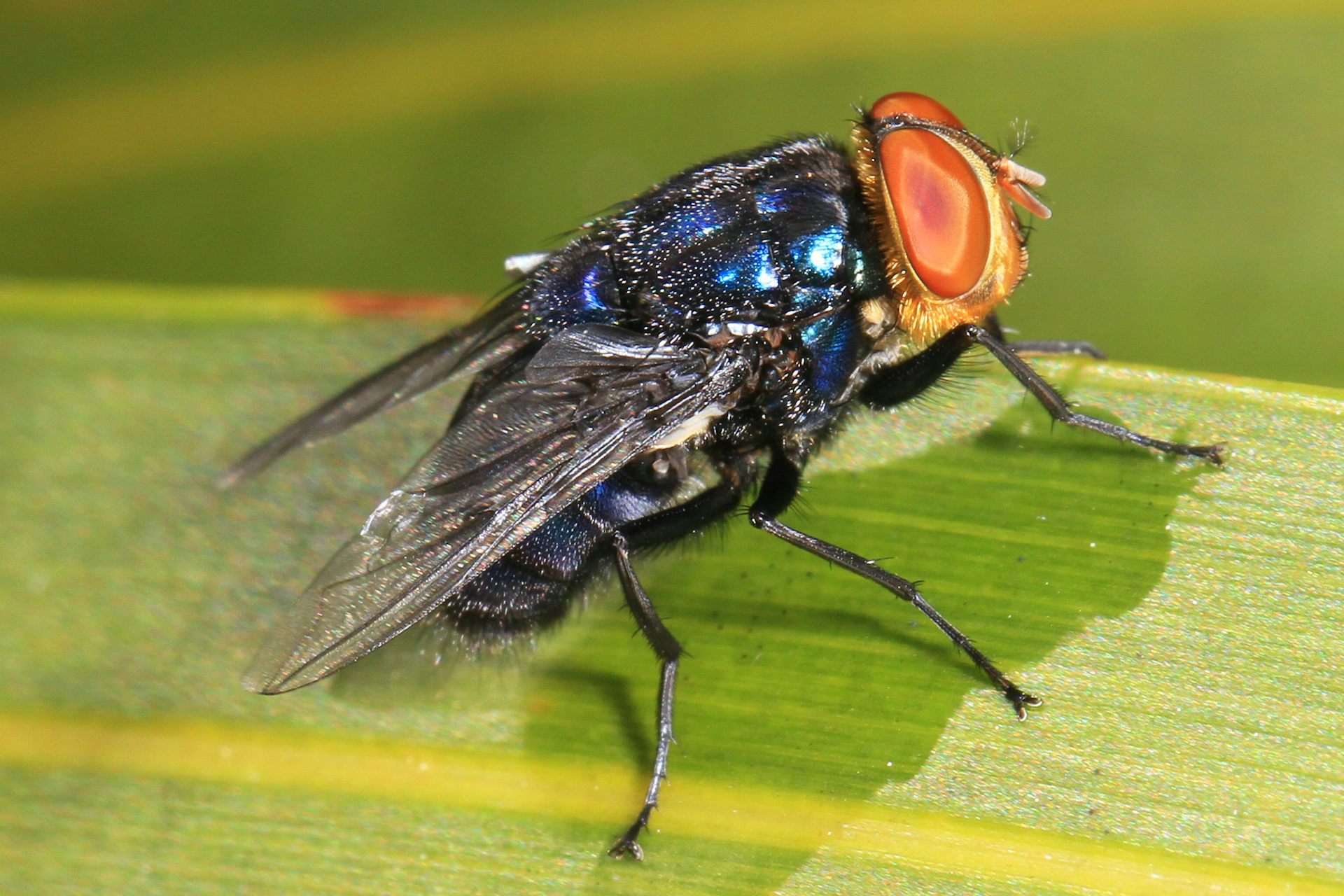
The New World screwworm, Cochliomyia hominivorax.
The Discovery Institute and its fellows, with their reliance on notions such as irreducible complexity and complex specified genetic information, have taken creationism to a point where the only escape lies in three almost equally unacceptable options:
- They can abandon the very arguments they present as proof of intelligent design, and so admit that they have no proof at all.
- They can accept that the designer god they traditionally equate with the god of the Bible and Qur'an is in fact an evil god, relentlessly designing ever more ingenious ways to increase suffering in the world.
- Or they can retreat into theology and Bible-literalist fundamentalism, abandoning any pretence that intelligent design is genuine science rather than simply rebranded creationism, by blaming everything on 'The Fall'. But in doing so they must also admit the existence of some other creative force with powers sufficient to rival their creator god—one to which their god is either powerless or indifferent. That, of course, destroys the basic principle of Judeo-Christian monotheism: a single omnipotent ruling deity. Ironically, the Discovery Institute was established for the very purpose of persuading US legislators and state education officials that intelligent design is real science.
This problem for creationism arises because the notions of irreducible complexity and complex specified genetic information apply just as well—if not better—to parasites and pathogens as they do to those aspects of nature that creationists like to present as evidence of their god's existence and benevolence; in other words, anything that happens to benefit them.
Professor Wall's article concerns a parasitic fly, the New World screwworm, Cochliomyia hominivorax, whose larvae feed on open wounds in cattle and sometimes humans, often with fatal consequences. The fly is currently extending its range northwards through Mexico and has now reached states bordering Texas. His article is reproduced here under a Creative Commons licence, reformatted for stylistic consistency:

A flesh‑eating fly is advancing towards the US border – can it be stopped?
The New World screwworm (Cochliomyia hominivorax) has now reached a Mexican state that borders on Texas.
A flesh eating parasitic fly has spread north through Mexico to within a few hundred miles of the US southern border.
The New World screwworm (Cochliomyia hominivorax) lays its eggs in open wounds and in the orifices of live, warm-blooded animals – including, occasionally, humans. The maggots then devour the animal’s flesh, causing devastating lesions that can quickly kill the infested host.
Before the 1950s, it was found in the southern states of the US, where cattle infestations caused heavy financial losses for beef producers. But, during the second half of the 20th century, eradication efforts pushed it out of North and Central America.
In the past few years, however, screwworm control has unravelled, with cases spiking across Central America. The fly has now spread north through Mexico, reaching two Mexican states – Tamaulipas and Nuevo Leon – that share a border with Texas.
The method that was used to eradicate the fly is known as the sterile insect technique (SIT). This involves breeding vast numbers of a target species, sterilising them, usually with radiation, and then releasing the males.
The sterile males mate with wild females, which then produce no offspring. By continuously swamping the wild population with sterile males, the wild groups go extinct. However, SIT alone may not be enough to control the current outbreaks.
To be effective, SIT has a number of critical requirements. One of the most important is that the immigration of fertile females into areas where outbreaks are already under control must be very limited (and ideally zero). If fertile females are allowed to reinvade, the population will reestablish.
The technique therefore works best on isolated or island populations. In other circumstances, barriers and continuous surveillance need to be maintained to prevent immigration and immediately stamp out any incursions.
SIT has been used many times on a vast number of pests over the past 80 years – with mixed results. The eradication of screwworm from the US, Mexico and central America was its greatest success.
Screwworm larva. Tusklike mandibles protruding from the screwworm larva's mouth rasp the flesh of living warm-blooded animals. A wound may contain hundreds of such larvae.
By John Kucharski - Transferred from en.wikipedia to Commons. Original uploader was Ellmist from http://www.ars.usda.gov/is/graphics/photos/k7576-1.htmImage Number K7576-1, Public Domain, Link target="_blank"
Historically, its effects were devastating. In 1935, during a screwworm epidemic, there were approximately 230,000 cases in livestock and 55 in humans in the state of Texas. Female screwworm lay batches of 200-300 eggs in open wounds and orifices. The catastrophic lesions caused as the maggots feed are known as myiasis.
Large-scale SIT for New World screwworm started in Florida in 1957-59 and was gradually rolled out to the west. Effective control by the US was achieved in 1966.
Subsequently, using rearing facilities in Mexico, the fly was pushed back through Central America and was held at a barrier at the Darien Gap in Panama using continuous release and surveillance.
Occasional incursions in the US have still occurred. In the summer of 2016, screwworm infestation was identified in deer in the Florida Keys. Such incursions clearly demonstrated that any relaxation of the control and surveillance effort could allow the return of this devastating parasite.
The recent breakdown of screwworm control has seen thousands of cases confirmed in animals and humans across Panama, Costa Rica, Nicaragua, Honduras and Mexico.
The insect’s continuing northward spread now raises the risk of a costly US reinvasion. The US Department of Agriculture estimates that an outbreak in Texas could cost livestock producers more than US$700 million (£526 million) per year.
There are several probable reasons for the breakdown of screwworm control. Maintaining barriers, rearing facilities and surveillance operations are expensive. US federal budget cuts, along with reduced foreign aid, hit screwworm control programmes in Central America and weakened surveillance.
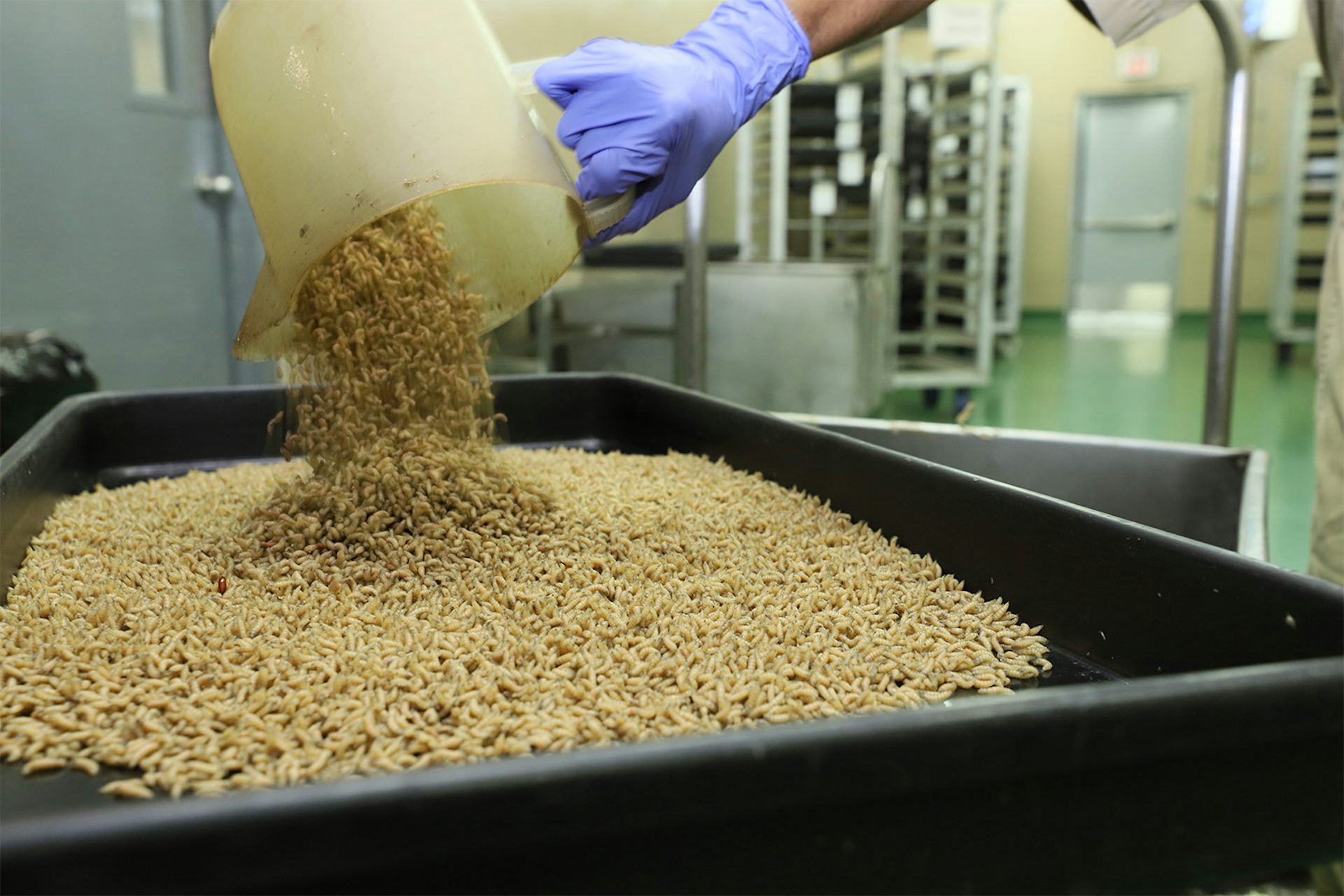
Since the 1990s, a facility in Panama has produced sterile flies in order to maintain a biological barrier at the Darien Gap, on the country’s border with Colombia.
Loss of control over the illegal movement of cattle, lacking veterinary inspections, may also have been a contributing factor. Alongside this, in many countries there has been an ongoing loss of expertise as experienced veterinary entomologists have retired and not been replaced.
Traditional applied entomology has been viewed as dated in the face of, for example, modern molecular and genetic approaches to the identification of species. The retired entomologists have taken with them a generation of experience of screwworm control and insect pest management in general – the essential underlying knowledge on which other approaches often depend.
As a result, considerable efforts are now required to resume control of this pest and prepare for future outbreaks. Significant new US federal funding for screwworm control has just been announced. But given that the pest is now re-entrenched in Central America, it may be too late to quickly reestablish regional control using SIT. As such, a fall back on insecticides seems like the only fix for immediate problems.
The rearing facilities for sterile insects in Mexico were shut down after screwworm was pushed out of North and Central America in the latter half of the 20th century. However, refurbishment is currently underway to allow them to restart producing sterile flies by summer 2026.
A new facility at Moore Airbase in Edinburg, Texas, close to the southern border, is being built. However, the suggestion that it is Mexico’s responsibility to prevent flies entering the US seems fanciful.
There are several important lessons that emerge from this history. The first is that insects don’t respect borders. International cooperation is required for management at a geographically relevant scale. Unwillingness to support the efforts of less economically robust neighbours, or international organisations such as the FAO, may well come back to bite.
The cost of maintaining the barrier in Panama was almost certainly significantly less than the costs of what will now be needed to achieve preparedness, or what will be incurred by US livestock producers if there is a persistent outbreak.
Finally, new pests and parasites (even some of the ones that seem to be under control) are an ever-present threat, particularly given greater global travel and the effects of climate change. Ignoring them, deprioritising research and control, failing to train the next generation of veterinary entomologists and hoping for the best, is not a viable strategy.

Richard Wall, Emeritus Professor, School of Biological Sciences, University of Bristol
This article is republished from The Conversation under a Creative Commons license. Read the original article.

And that is where the theological difficulty begins. Creationists and intelligent design proponents like to point to complexity, information-rich biology and intricate adaptation as signs of a wise and loving designer. But the screwworm is also complex, information-rich and exquisitely adapted. Its life cycle is not evidence of benevolence; it is evidence that natural selection can produce horrific efficiency without the slightest concern for suffering. If design arguments are applied consistently, then parasites such as Cochliomyia hominivorax must be counted among the designer’s achievements too.
So, if creationists understood the implications of cases like this, they would see the trap their own arguments have set for them. Either they abandon irreducible complexity and “specified information” as evidence for design, or they accept that their designer also designed flesh-eating larvae to exploit wounds in living animals, or they retreat into theology and blame some post-Creation corruption of nature. But that last move simply concedes the central point: intelligent design was never science in the first place, only creationist theology in a lab coat.
Advertisement
Amazon

Amazon

Amazon

Amazon

Amazon

Amazon

Amazon

Amazon

Amazon

Amazon

Amazon

Amazon

All titles available in paperback, hardcover, ebook for Kindle and audio format.
Prices correct at time of publication. for current prices.



No comments :
Post a Comment
Obscene, threatening or obnoxious messages, preaching, abuse and spam will be removed, as will anything by known Internet trolls and stalkers, by known sock-puppet accounts and anything not connected with the post,
A claim made without evidence can be dismissed without evidence. Remember: your opinion is not an established fact unless corroborated.