
Some 550 million years ago, long before the world existed according to a literal reading of Genesis, an early animal may already have been exploiting the biochemical abilities of bacteria. New research on the Ediacaran tubular fossil Conotubus suggests that animal–microbe partnerships have a history extending back towards the beginnings of animal life. For creationism, the inconvenience is twofold: the immense timescale, and a biological arrangement that makes excellent evolutionary sense but raises awkward questions about supposedly intelligent design.
The study, led by Zhenfei Wang and Yongbo Peng of Nanjing University and published in PNAS, examined sulphur and molybdenum isotope signatures in fossils from southern China. These suggest an association with sulphur-oxidising bacteria, potentially supplying nutrition and helping the animal tolerate toxic, sulphide-rich conditions. This is a geochemical inference, rather than the discovery of preserved bacterial partners. If the interpretation is correct, however, it extends the fossil evidence for animal–microbe symbiosis backwards by roughly 100 million years, as co-author Peter Crockford explains in his account of the research in an article in The Conversation.
Creationists often present such interdependence as evidence of design, as though two organisms benefiting from one another could only be the result of someone planning the arrangement. But this overlooks an obvious question: why would an omniscient designer make an animal dependent on another organism for a useful biochemical function? Why not equip the animal itself with the necessary machinery? A partnership introduces additional requirements: the organisms must encounter one another or maintain their association across generations, exchange useful substances, and sustain conditions in which both can function. Each dependency creates something else that can fail.
There is a qualification here. Giving an animal bacterial capabilities would not necessarily be as simple as inserting a few genes into its genome. Genes operate within cellular systems; useful metabolism also requires appropriate regulation, enzymes, transport mechanisms and chemical conditions. Division of labour between organisms can therefore be highly effective. Nevertheless, these are constraints facing organisms produced by evolution. An allegedly omnipotent designer, able to specify the entire system from the outset, cannot readily be excused by invoking the limitations of inherited cellular machinery. Complexity alone is no evidence of intelligent planning, especially when it includes dependence on a separate organism to supply an essential service.
As I argued in The Unintelligent Designer: Refuting the Intelligent Design Hoax complexity is not the evidence for intelligent design that creationists like to think since the hallmark of good, intelligent design is minimal complexity. Complexity is evidence of evolved systems where suboptimal solutions to problems often need additional layers of complexity to mitigate failures.
Evolution requires neither a plan nor the simplest conceivable solution. Bacteria already possessing useful chemistry can provide an immediate advantage to an animal that associates with them. If that association improves survival and reproduction, natural selection can favour traits that establish, maintain or strengthen it. There is no need for the animal first to evolve an entire biochemical pathway independently, and no foresight is required. What matters is whether an available variation works better under the prevailing conditions.
Symbiotic relationships are a predictable outcome of 'selfish' genes because, as Richard Dawkins argued in The Selfish Gene, it is often in the self-interest of genes or organisms to form mutually-beneficial alliances.
That is what makes this possible Ediacaran partnership so interesting. It suggests that some early animals expanded their ecological opportunities by making use of microbial capabilities that already existed. The resulting interdependence is understandable as a product of history, opportunity and selection. Calling it “intelligent design” supplies no comparable explanation for either the elaborate arrangement or the hundreds of millions of years through which such relationships have evolved.
Symbiotic alliances^ evolution through living together. In biology, symbiosis means a close, sustained association between organisms of different species. It is not necessarily beneficial to both: the broad definition includes parasitism. Where both partners benefit, the relationship is called mutualism. When one partner lives inside the other, it is an endosymbiosis.Assistant Professor Peter Crockford's article in The Conversation is reprinted here under a Creative Commons License, reformatted for stylistic consistency:
Such partnerships allow organisms to exploit biochemical abilities that have already evolved in another species. The benefits can include food, shelter, protection or access to otherwise inhospitable environments.
When a partner becomes part of the cell
Partnership What each partner contributes Giant tubeworms and sulphur-oxidising bacteria Adult Riftia pachyptila, found around deep-sea hydrothermal vents, lack a digestive system. Bacteria housed in a specialised organ use energy from sulphur oxidation to manufacture organic nutrients from inorganic carbon. The worm supplies the bacteria with the chemicals they need and a protected habitat. This provides a living comparison with the proposed partnership in Conotubus, without implying that the two animals were closely related. Research on Riftia. Aphids and Buchnera bacteria Plant sap supplies abundant sugar but an inadequate balance of essential amino acids. Buchnera, living inside specialised aphid cells, helps supply the missing nutrients, while the aphid provides accommodation and metabolic ingredients. Some amino-acid production pathways involve contributions from both partners, requiring substances to pass between them. Research on shared metabolic pathways. Reef-building corals and microscopic algae Many shallow-water corals house photosynthetic algae within their tissues. The algae provide organic nutrients; the coral supplies shelter and resources for photosynthesis. This productive association also creates vulnerability: environmental stress can disrupt it, causing bleaching and, if prolonged, starvation and death. Natural History Museum account. Lichen-forming fungi and photosynthetic partners A lichen consists principally of a fungus associated with a green alga, a cyanobacterium, or both. The fungus provides the main structure and a protected microenvironment, while its photosynthetic partners supply organic carbon. Lichens can also contain additional fungi and bacteria, making the familiar “two-organism partnership” an incomplete description of their communities. Wellcome Sanger Institute overview.
Mitochondria and chloroplasts represent a much deeper level of integration. They descend from bacteria that became incorporated into ancestral cells: mitochondria from a bacterial lineage associated with the alphaproteobacteria, and chloroplasts from cyanobacteria. Over evolutionary time, many genes were lost or transferred to the host’s nuclear genome. These former partners became organelles, dependent on proteins produced under nuclear genetic control. Review of endosymbiotic origins.
Gene transfer therefore really can bring a symbiont’s capabilities under host control. But transferring DNA is only part of the process: the resulting proteins must be produced, regulated and delivered to the correct cellular locations. Mitochondria and chloroplasts retain their own reduced genomes and specialised membranes. Their integration reflects extensive evolutionary modification, rather than a simple transfer of an intact biochemical capability.
How dependence can evolve
A mutually useful association need not begin with either organism unable to survive alone. Dependence can develop later. Once a partner reliably supplies a substance, selection to retain an independent means of producing it may weaken. Loss of that capacity can then make the partnership essential. In the aphid–Buchnera association, complementary metabolic capabilities illustrate how intimately the partners’ biology can become connected. Aphid–symbiont metabolic cooperation.
Present-day dependence consequently does not establish that both partners had to be created together. Nor does an elaborate exchange system demonstrate foresight. Symbiosis can produce effective biological arrangements through successive advantages, while also generating additional dependencies and opportunities for failure. That combination of usefulness, historical constraint and vulnerability is entirely intelligible in evolutionary terms.

Ancient fossil from China reveals animal‑microbe partnerships dating back 550 million years
The Conotubus fossil is a small tube-shaped organism that lived around 550 million years ago. Most likely it was a soft-bodied animal resembling a worm.
(PNAS), CC BY
Incredibly, about half of the cells in the human body are actually microbial inhabitants. Scientific attention to the microbiome has helped us understand how many of them support our health; for example, by helping us digest food or by supporting our immune system.
Elsewhere in the animal kingdom, microbes forge even more remarkable partnerships with their hosts. They help generate energy for coral and deep sea tube worms, and break down stubborn molecules like cellulose and lignin within animals as varied as cows and termites.
They even help squid camouflage themselves.
But how long have such partnerships existed? New research led by Zhenfei Wang and Yongbo Peng from Nanjing University, on which I was a co-author, has now found evidence of these close relationships between animals and microbes in a 550 million-year-old fossil from southern China.
Prior to this, the earliest evidence of symbiosis was documented in fossils 100 million years younger.
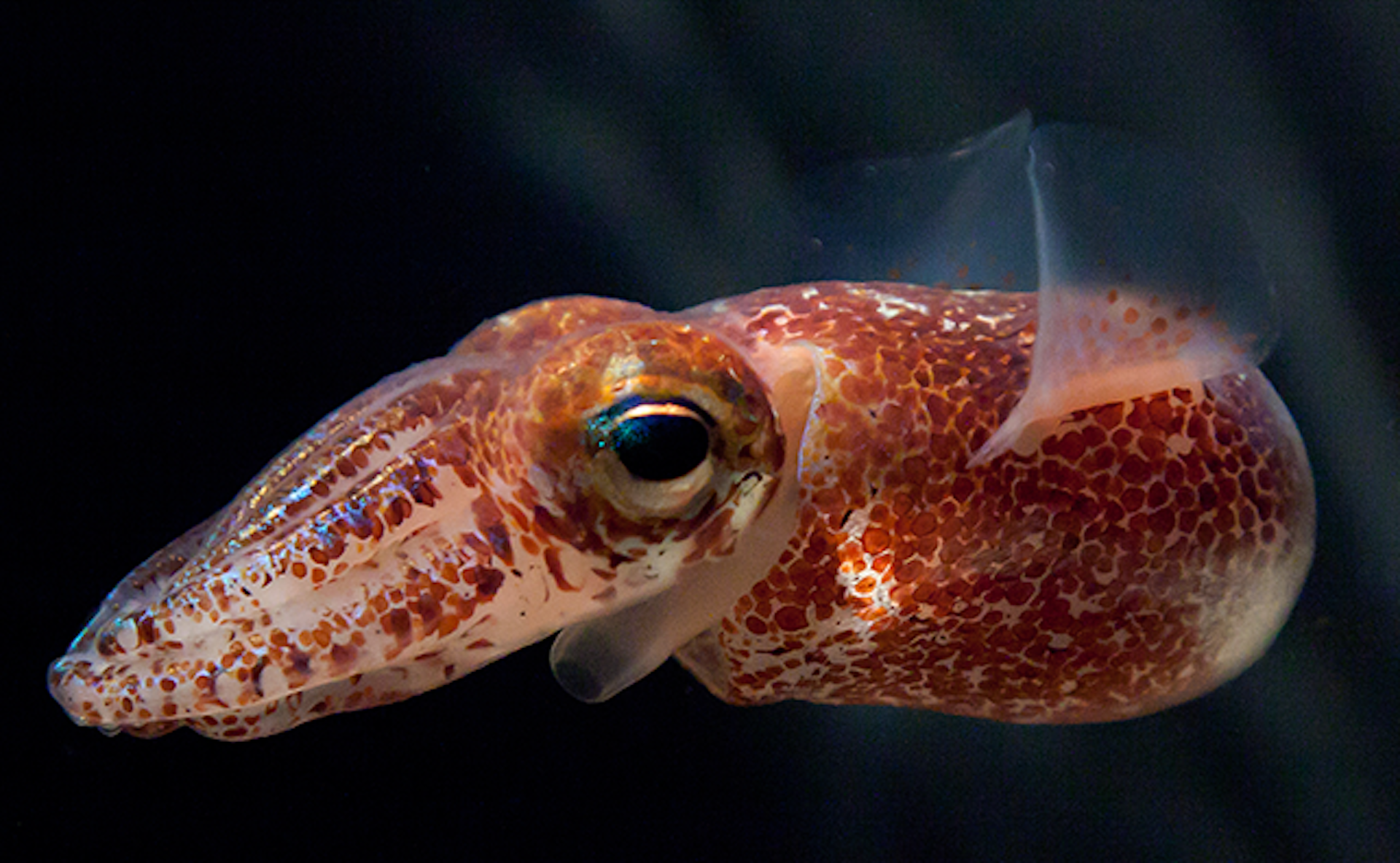
The Hawaiian bobtail squid uses the light produced by its luminous bacterial symbiont, Vibrio fischeri, as a camouflage.
Tracing animal-microbe symbiotic relationships back hundreds of millions of years is extremely challenging. The fossil record is altered, incomplete and biased toward organisms and environments that preserve well.
Even exceptionally preserved fossils rarely retain evidence of the microbes that once lived within an animal. This fact makes ancient symbiotic relationships very difficult to identify.
Given these challenges, our international research team sought to explore geochemical fingerprints of past microbe-animal interactions. We specifically focused on the tubular fossil conotubus that lived during the Ediacaran period, which extends from approximately 635 million to 541 million years ago.
Occurrences of Ediacaran-aged fossils like the conotubus are rare.
Extremes temperatures on Earth
Sedimentary rocks deposited during the Ediacaran period showcase the first large animal fossils that one can see with the naked human eye.
This period of Earth’s past also covers a critical time. It begins in the wake of global Snowball Earth glaciations — when the surface of the Earth was entirely, or almost entirely, covered in ice — and transitions to possibly the hottest temperatures experienced by the planet in the past two billion years.
Technician Calla Carbone discusses the evolution of animals during the Ediacaran age, in a lecture at the Royal Tyrrell Museum of Palaeontology, in Drumheller, Alta.
A key feature of this period was that oxygen levels were much lower than they are today. In certain marine environments, this allowed hydrogen sulfide to build up to levels highly toxic to animals.
Comparing chemical fingerprints
In our research, we analyzed sulfur and molybdenum isotopes in remarkably well-preserved fossils from southern China. Isotopes act like chemical fingerprints. They can reveal not only what elements are present, but also how biological or other processes alter specific isotopic ratios.
To interpret these fingerprints, we compared ancient signatures from conotubus with those produced by organisms and environments today.
Our results suggest that conotubus lived in partnership with bacteria that could use hydrogen sulfide as an energy source.
Hydrogen sulfide produces the familiar smell of rotten eggs. At high concentrations, however, it is extremely toxic to animals. Ancient oceans that were low in oxygen would have had regions rich in hydrogen sulfide, and these would have been extremely challenging environments for animals to survive in.
A symbiotic relationship with a sulfur-oxidizing bacteria may therefore have turned a hostile environment into an ecological opportunity for conotubus — providing nutrition while helping the animal tolerate the sulfide-rich waters.
Survival, where other struggled
The evolution of Earth’s biosphere is perhaps one of the most captivating stories that we have uncovered from the fossil record.
We usually tell the story of early animal evolution through innovations in animals themselves. We focus on new body plans, movement, feeding strategies and skeletons.
Our findings add another character to that evolutionary story: microbes. By the end of the Ediacaran, microbial partnerships were already helping some early animals exploit challenging environments. For conotubus, partnering with microbes may have opened a frontier where other animals struggled to survive.
More than 550 million years later, animals still rely on microbes to do things they cannot do alone. Our fossils suggest this partnership reaches remarkably deep into animal evolutionary history.

Peter Crockford, Assistant Professor, Earth Sciences, Carleton University
This article is republished from The Conversation under a Creative Commons license. Read the original article.

For young-Earth creationism, the first difficulty is the chronology. These organisms lived approximately 550 million years ago, in a world with an evolutionary and environmental history that bears no resemblance to the Genesis creation narrative. Whether the proposed bacterial partnership is ultimately confirmed or revised, the fossils’ antiquity remains a separate problem for any claim that animal life began just a few thousand years ago.
If the symbiosis interpretation is correct, it also reveals an early example of evolution exploiting an existing opportunity. Bacteria already possessed biochemical capabilities that could benefit an animal living in sulphide-rich conditions. An association that improved survival and reproduction could therefore be favoured by natural selection, without either partner anticipating the outcome. Subsequent adaptations could strengthen that association and eventually turn an advantage into a dependency. No foresight is needed at any stage.
The intelligent-design argument gains nothing simply by pointing to the resulting complexity. A partnership requires mechanisms for maintaining the association, exchanging substances and accommodating the needs of two different organisms. Such arrangements can be highly effective, but their effectiveness does not explain why an unconstrained designer would choose these dependencies over equipping the animal with the necessary capabilities directly. Evolution, by contrast, works with existing organisms and available variations. It can favour a useful association without producing the simplest imaginable system.
There is also a revealing difference in how the competing explanations handle uncertainty. The researchers infer a possible partnership from geochemical evidence and leave that interpretation open to further testing. The proposed symbiosis is a scientific explanation to investigate, not a conclusion that the evidence must be made to support. Whatever further research reveals about Conotubus, that willingness to test and revise an explanation is precisely what distinguishes science from a creation narrative whose answer was fixed before the investigation began.
Advertisement
Amazon

Amazon

Amazon

Amazon

Amazon

Amazon

Amazon

Amazon

Amazon

Amazon

Amazon

Amazon

All titles available in paperback, hardcover, ebook for Kindle and audio format.
Prices correct at time of publication. for current prices.



No comments :
Post a Comment
Obscene, threatening or obnoxious messages, preaching, abuse and spam will be removed, as will anything by known Internet trolls and stalkers, by known sock-puppet accounts and anything not connected with the post,
A claim made without evidence can be dismissed without evidence. Remember: your opinion is not an established fact unless corroborated.