
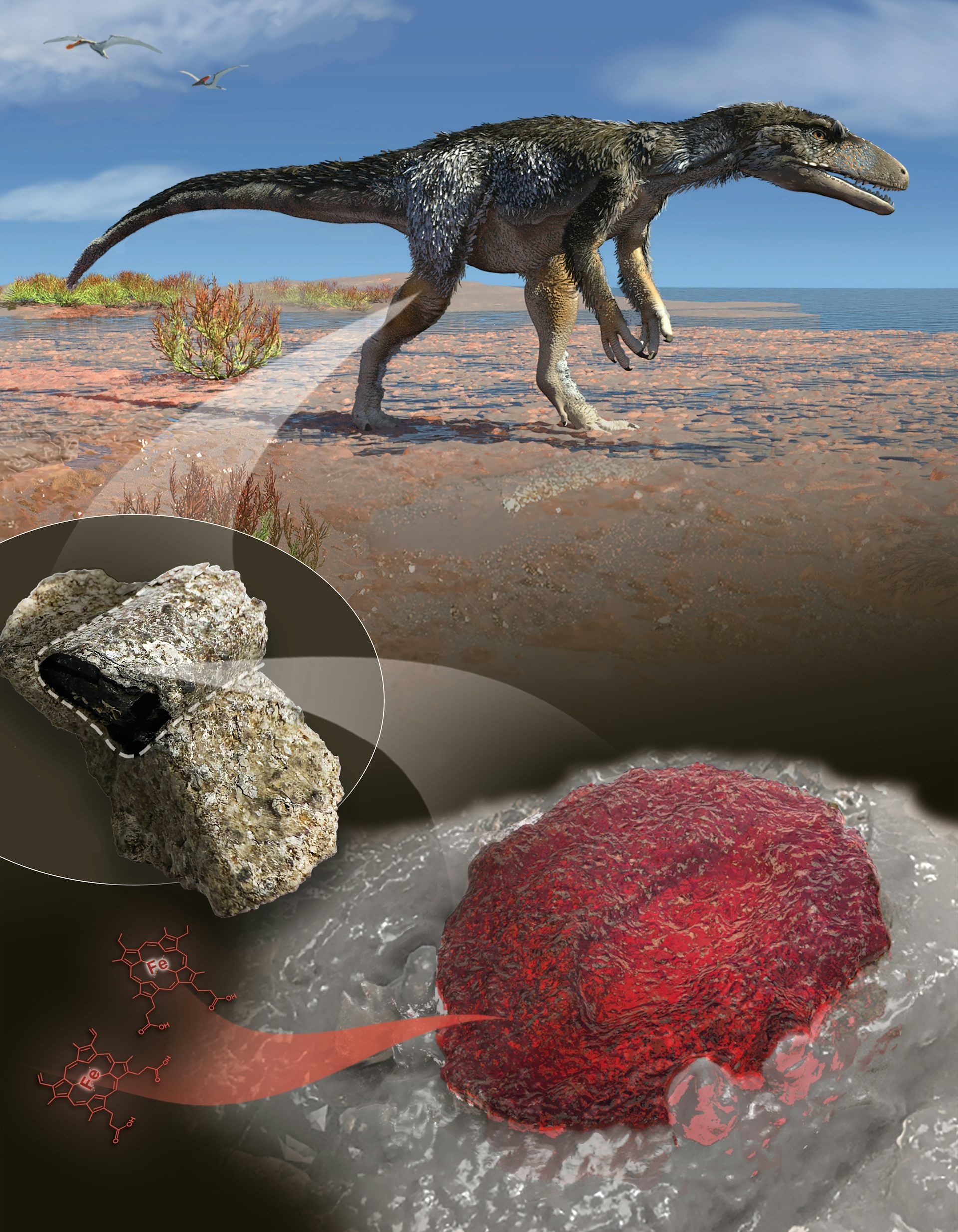
A limb bone from the theropod dinosaur Aratasaurus preserved red blood cells containing haem and haem breakdown products.
Victor O. Leshyk
Discovering traces of dinosaur blood in a 115-million-year-old fossil is remarkable enough without pretending that someone has found fresh blood in a recently deceased dinosaur. Yet that distinction — between ancient biological material preserved through exceptional chemistry and ordinary tissue awaiting decay — is precisely what creationist propaganda has repeatedly obscured. A new discovery provides an opportunity both to explore the extraordinary information fossils can retain and to revisit the misrepresentations surrounding Mary Schweitzer’s earlier research.
The new paper in Proceedings of the National Academy of Sciences, by an international team led by Curtin University’s Professor Kliti Grice, reports haem-derived molecules and microscopic structures interpreted as mineralised red blood cells in limb bones of Aratasaurus museunacionali, a theropod dinosaur from Brazil. Haem is the iron-containing component of haemoglobin involved in oxygen transport. Finding its chemical signatures associated with cell-like structures inside the bone’s vascular canals offers a potentially revealing glimpse of ancient biology. It does not establish that fresh blood, functioning blood cells or dinosaur DNA have survived.
There is a familiar creationist sleight of hand here. When Schweitzer and her colleagues reported exceptionally preserved soft tissues in Tyrannosaurus rex bones in 2005, young-Earth creationists seized upon the discovery as supposed evidence that dinosaurs had lived only a few thousand years ago. The argument depended on treating “soft tissue” as though it necessarily meant fresh, chemically unaltered tissue, then assuming that its survival invalidated the geological evidence for the fossil’s age. Neither conclusion followed from the research.
Schweitzer herself has objected to this misuse of her work. In an interview discussing the controversy, she described creationists as having “misquoted me and misrepresented the data”. Presenting her discoveries as scientific confirmation of a young Earth misrepresents both the evidence and the scientist responsible for uncovering it. Repeating that claim while withholding her corrections perpetuates a falsehood, not an alternative scientific explanation.
The scientific response was to investigate preservation. Schweitzer’s subsequent experimental research on iron and oxygen chemistry showed how reactions involving haemoglobin could stabilise tissues, including through chemical cross-linking. Such experiments do not reproduce millions of years in a laboratory, but they demonstrate why decay rates measured under one set of conditions cannot simply be imposed on every fossil. The question is what happened chemically to the material after death, not how long an untreated piece of meat would last on a kitchen worktop.
In the new study, the researchers propose that exceptional burial conditions and mineralisation helped preserve the structures and their associated molecular signatures. The manganese mineral hausmannite is implicated in that preservation. This is a history of chemical change and stabilisation over geological time, rather than a claim that ordinary blood remained untouched for 115 million years.
There is also an important distinction between detecting ancient biological molecules and establishing that particular microscopic shapes are fossilised red blood cells. The latter interpretation remains contested. Schweitzer herself has questioned whether the new evidence establishes the identity of the structures, while expressing no objection to the presence of haem and collagen in the bone. That is science doing what it should: examining the strength of each claim separately, rather than accepting or rejecting an entire discovery according to whether it supports a preferred story.
Below, Professor Grice explains the discovery and the team’s interpretation in an article originally published by The Conversation, reproduced here under its Creative Commons licence, reformatted for stylistic consistency. The interest lies in what these ancient chemical traces may reveal about dinosaurs and fossilisation. Turning them into evidence for a recent creation requires ignoring the very processes the researchers are investigating.

Traces of dinosaur blood found in world‑first discovery
Curtin University
A 115-million-year-old fossil dinosaur bone encased in a dense mat of microbes found in Brazil contains tiny structures resembling red blood cells, and molecular traces of blood.
Along with colleagues from Brazil, Japan and the United States, we’re reporting the discovery today in the Proceedings of the National Academy of Sciences.
This is the first direct molecular evidence of compounds from dinosaur blood preserved within structures that look like red blood cells. The find offers an unprecedented window into the biology of extinct animals.
It also expands what we thought possible: that fossils can preserve soft tissues and biomolecules such as blood over millions of years.
A remarkable fossil from Brazil
We studied a fossil specimen of a small dinosaur called Aratasaurus museunacionali, found in the Romualdo Formation in northeast Brazil.
The Romualdo Formation is renowned for its exquisitely preserved fish, turtles, crocodile relatives and pterosaurs. It also contains rare dinosaur material. The site’s unique geochemical conditions have preserved fossils with fine anatomical detail rarely seen elsewhere.
Currently housed at a palaeontology museum in northeast Brazil, the dinosaur fossil consists of an exceptionally well-preserved partial hind limb.
The specimen was in Brazil’s National Museum until a catastrophic fire destroyed much of the museum’s irreplaceable collection in 2018. However, the building holding this fossil was not affected by the fire.
Its name reflects this extraordinary history. Aratasaurus combines the Tupi (an Indigenous Brazilian language) words ara (“born”) and atá (“fire”) with the Greek sauros (“lizard”). The species name museunacionali honours the museum itself.
Together, the name means “the dinosaur born from the National Museum fire”.
What we discovered inside the bone
A key question was whether the structures we saw were really biological remnants – that is, actual blood – or something that may have happened to the fossil later as the tissues were turning to stone.
Some of the most compelling evidence comes from the precise anatomical location of the structures. They are exclusively within vascular canals inside the bone – where red blood cells are found in living vertebrates.
At the same time, the sediment that surrounded the fossil didn’t have any of these structures. This makes it even less likely they came from some sort of external contamination.
We evaluated and ruled out several alternative explanations for the structures. In the end, we believe they’re most likely authentic fossilised red blood cell remains.
Chemical fingerprints of ancient blood
To further strengthen the claim, we also found two chemical “fingerprints” of blood. These had the structure of heme molecules – a key component of haemoglobin, the protein in blood which carries oxygen.
There was a dramatic difference when we analysed the chemistry of the sediment that surrounded the fossil, and the chemistry inside it. The sediment mostly contained compounds from plant and bacterial sources. The fossil bone contained a distinct signature dominated by the heme molecules.
Together, this evidence points to the conclusion that we’re seeing real preserved compounds derived from blood.
Other analysis techniques confirmed the presence of molecules from heme, as well as elements including iron, carbon and nitrogen. We also discovered amino acids associated with collagen, which is found in connective tissue.
How could this be preserved for 115 million years?
The dinosaur was rapidly buried in a low-oxygen environment which slowed down its decay. The blood did not remain fresh or unchanged. Instead, microscopic red blood cells turned into minerals during fossilisation.
Another crucial factor may be the presence of minerals such as hausmannite, which can act a bit like antioxidants. They could stabilise sensitive organic molecules and slow their breakdown.
Together, these conditions preserved biological information at a molecular level – blood and collagen – for far longer than expected.
Illustration shows a limb bone from the theropod dinosaur Aratasaurus preserved red blood cells containing heme and heme breakdown products.
Victor O. Leshyk
The fossil red blood cell-like structures appear a bit larger and more rounded than the cells found in modern birds and crocodilians.
This difference may be because they were deformed as the bone fossilised. Alternatively, it could suggest the red blood cells of dinosaurs not related to birds were shaped differently than those of birds, their modern relatives.
We’ll need further research to resolve this question. However, the discovery opens intriguing new possibilities for understanding dinosaurs’ bodies at a cellular level.
How sure are we it’s really blood?
Evidence from microscopy, mineralogy, spectroscopy and molecular geochemistry all points toward the same conclusion. We are convinced these are fossilised red blood cell structures containing traces of heme molecules.
Our discovery shows that blood-derived molecules can survive for more than 110 million years under the right conditions. It also provides a plausible explanation of how it happened.
Fundamentally, it suggests soft tissues in fossils are more likely to withstand time than researchers previously thought.
Perhaps the most exciting implication is that museums around the world already hold an enormous, largely untapped scientific resource. Many fossils are not spectacular display specimens. Even so, they may preserve remarkable molecular, chemical and environmental information.
Using modern analytical techniques, we can revisit specimens collected decades ago and ask completely new questions about ancient life.
The fossil was collected and curated through the efforts of researchers including Renan Bantim and Antônio Saraiva of the Regional University of Cariri, along with Juliana Sayão and Alexander Kellner from Brazil’s National Museum and the Federal University of Rio de Janeiro, who also contributed to the research and facilitated access to the specimen. Other collaborators include Yuta Isaji, Calum Fox, Nana Ogawa and Noa Ohkouchi from the Japan Agency for Marine-Earth Science and Technology and Jasmina Wiemann from Johns Hopkins University in the US.

Kliti Grice, Founding Director of WA-Organic & Isotope Geochemistry Centre, School of Earth and Planetary Sciences, Curtin University
This article is republished from The Conversation under a Creative Commons license. Read the original article.

The significance of this discovery lies in the possibility that dinosaur fossils preserve more information about their original biology than we once thought recoverable. Chemical traces associated with mineralised structures may help researchers investigate ancient tissues, physiology and the processes of fossilisation. Whether every proposed identification survives further scrutiny remains to be seen, but none of this amounts to finding fresh dinosaur blood or demonstrating that dinosaurs lived a few thousand years ago.
The creationist argument rests on a false premise: that biological material must decay at the same rate regardless of its chemical surroundings, burial conditions or subsequent alteration. From that assumption comes the equally unwarranted conclusion that unexpected preservation overturns the fossil’s geological age. Yet an incomplete understanding of preservation is a reason to investigate preservation. It is not a licence to discard independent evidence for deep time and substitute a chronology derived from Genesis.
Mary Schweitzer’s response to this new research (ABC Science report of 3 November) illustrates the difference particularly well. A scientist whose own discoveries challenged expectations about fossil preservation is nevertheless prepared to question whether another team has demonstrated its interpretation convincingly. Accepting that ancient molecules can survive does not oblige her to accept every identification of a fossilised cell. Scientific conclusions must earn their support claim by claim, through evidence that other researchers can examine and test.
Creationist misrepresentations of Schweitzer’s work reverse that process: the preferred conclusion comes first, and selected fragments of scientific research are recruited to defend it. Her objections and the research into preservation mechanisms then become inconvenient details to omit. The result is a story that remains unchanged even as the science moves on. These fossils offer an opportunity to learn more about a world that existed long before humans; reducing them to a misleading slogan about “fresh dinosaur blood” merely prevents that learning.
Advertisement
Amazon

Amazon

Amazon

Amazon

Amazon

Amazon

Amazon

Amazon

Amazon

Amazon

Amazon

Amazon

All titles available in paperback, hardcover, ebook for Kindle and audio format.
Prices correct at time of publication. for current prices.



No comments :
Post a Comment
Obscene, threatening or obnoxious messages, preaching, abuse and spam will be removed, as will anything by known Internet trolls and stalkers, by known sock-puppet accounts and anything not connected with the post,
A claim made without evidence can be dismissed without evidence. Remember: your opinion is not an established fact unless corroborated.