
Life reconstruction of Teilhardina
Ai-generated image (ChatGPT 5.5 Thinking)
At times, it seems almost cruel to keep reminding creationists that another day, another week and another month have passed, and still there is no hint that biomedical scientists are about to abandon evidence-based evolutionary biology and adopt magic-based creationism as a better explanation of the facts. And yet here we are again: another paper, another article, and another example of evolution providing the rational framework for interpreting the evidence.
And, to rub salt into creationist wounds, the evidence deals with events around 56 million years before creationists’ mythical “Creation Week”. As though to refute yet another creationist myth — that scientists are only allowed to publish papers that confirm mainstream scientific orthodoxy — the findings, published by Jorge Avaria-Llautureo of the University of Reading and colleagues in the mainstream journal Proceedings of the National Academy of Sciences of the USA (PNAS), challenge the long-standing assumption that the primate lineage originated in warm tropical forests.
The study maps the likely geographic origins of our primate ancestors and reconstructs the historical climate at those locations. Its conclusion is surprising: early primates appear to have lived, dispersed and diversified through cold, arid and temperate regions, not primarily in the tropics. Their later colonisation of tropical regions took several million years and seems to have been driven more by local changes between dry and wet climates than by global warming itself.
One useful example is the tiny early primate Teilhardina, a small, tree-dwelling mammal known from fossils around 56 million years old — roughly 10 million years after the extinction of the non-avian dinosaurs. Fossil evidence suggests that Teilhardina had nails rather than claws, helping it grasp branches and handle food, a characteristic associated with primates. Species of this early primate group appear in the fossil record of North America and then dispersed rapidly across what are now Europe and China.
An article explaining the finding and its significance for understanding our evolutionary origins was published in The Conversation by Jason Gilchrist, a lecturer in the School of Applied Sciences at Edinburgh Napier University. His article is reprinted here under a Creative Commons licence, reformatted for stylistic consistency:

Our primate ancestors evolved in the cold – not the tropics
Japan’s famous snow macaques are an exception among primates today. But our early ancestors often lived through weather like this.
Source: R7 Photo / shutterstock
Most people imagine our early primate ancestors swinging through lush tropical forests. But new research shows that they were braving the cold.
As an ecologist who has studied chimpanzees and lemurs in the field in Uganda and Madagascar, I am fascinated by the environments that shaped our primate ancestors. These new findings overturn decades of assumptions about how – and where – our lineage began.
The question of our own evolution is of fundamental importance to understanding who we are. The same forces that shaped our ancestors also shape us, and will shape our future.
The climate has always been a major factor driving ecological and evolutionary change: which species survive, which adapt and which disappear. And as the planet warms, lessons from the past are more relevant than ever.
The cold truth
The new scientific study, by Jorge Avaria-Llautureo of the University of Reading and other researchers, maps the geographic origins of our primate ancestors and the historical climate at those locations. The results are surprising: rather than evolving in warm tropical environments as scientists previously thought, it seems early primates lived in cold and dry regions.
These environmental challenges are likely to have been crucial in pushing our ancestors to adapt, evolve and spread to other regions. It took millions of years before primates colonised the tropics, the study shows. Warmer global temperatures don’t seem to have sped up the spread or evolution of primates into new species. However, rapid changes between dry and wet climates did drive evolutionary change.

The first primates were about the size of a mouse lemur: tiny.
Source: Jason Gilchrist
Fossils suggest Teilhardina differed from other mammals of the time as it had fingernails rather than claws, which helped it grasp branches and handle food – a key characteristic of primates to this day. Teilhardina appeared around 56 million years ago (about 10 million years after the extinction of the dinosaurs) and species dispersed rapidly from their origin in North America across Europe and China.
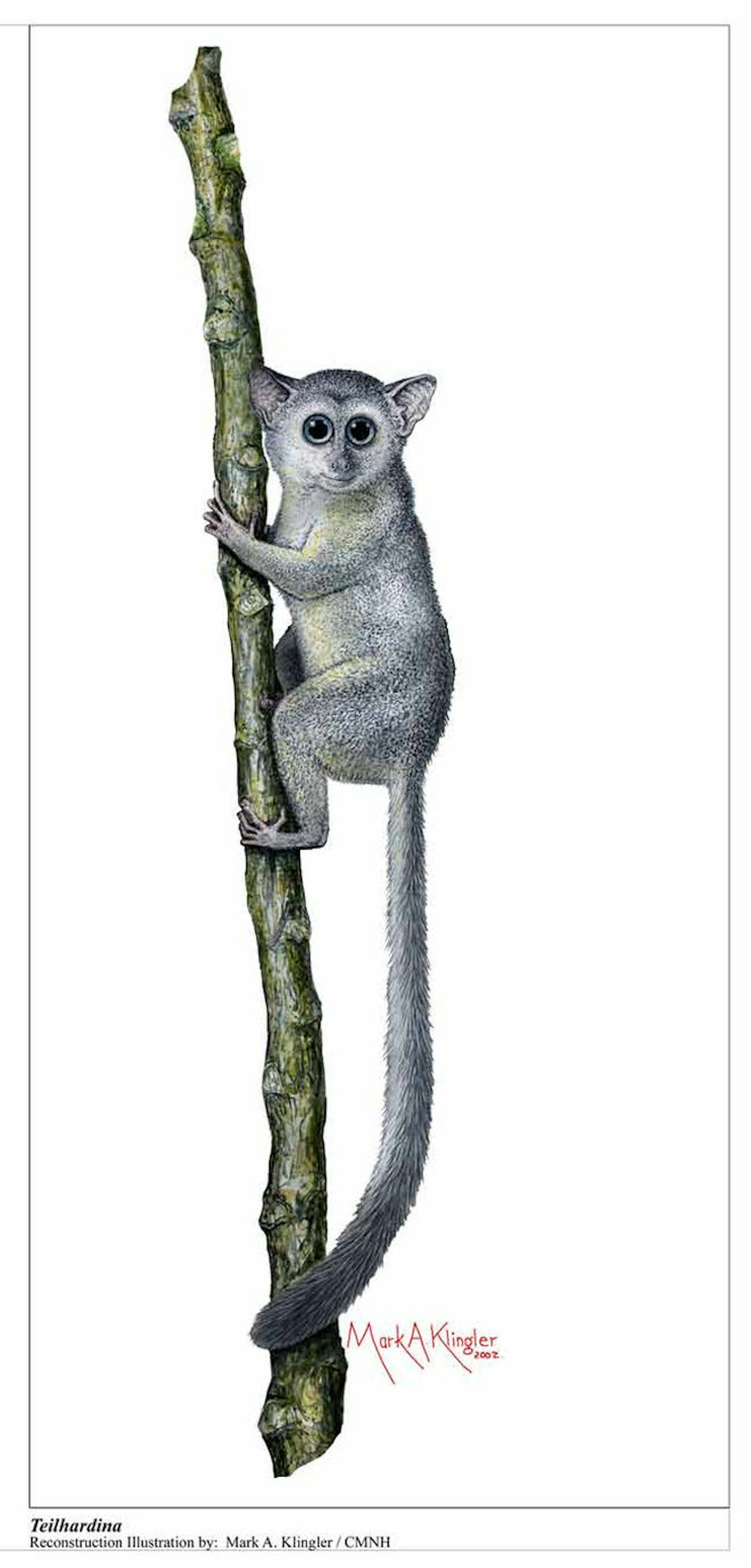
Teilhardina was one of the first primates.
Source: Courtesy of Mark Klingler, Carnegie Museum of Natural History
But when the scientists behind the new study used fossil spore and pollen data from early primate fossil environs to predict the climate, they discovered that the locations were not tropical at the time. Primates actually originated in North America (again, going against what scientists had once believed, partly as there are no primates in North America today).
Some primates even colonised Arctic regions. These early primates may have survived seasonally cold temperatures and a consequent lack of food by living much like species of mouse lemur and dwarf lemur do today: by slowing down their metabolism and even hibernating.
Challenging and changeable conditions are likely to have favoured primates that moved around a lot in search of food and better habitat. The primate species that are with us today are descended from these highly mobile ancestors. Those less able to move didn’t leave any descendants alive today.
From past to future

Over 56 million years, primates have evolved into all sorts of shapes and sizes.
Source: Monkeys: Our Primate Family exhibition at the National Museum of Scotland. Jason Gilchrist
When their habitats are lost, often through deforestation, primates are prevented from moving freely. With smaller populations, restricted to smaller and less diverse areas, today’s primates lack the genetic diversity to adapt to changing environments.
But we need more than knowledge and understanding to save the world’s primate species, we need political action and individual behaviour change, to tackle bushmeat consumption – the main reason primates are hunted by humans – and reverse habitat loss and climate change. Otherwise, all primates are at risk of extinction, ourselves included.
To learn more about primate diversity, behaviour, and threats to their survival, see Monkeys: Our Primate Family, as the exhibition ends its international tour with a return to the National Museum of Scotland in Edinburgh.

Jason Gilchrist, Lecturer in the School of Applied Sciences, Edinburgh Napier University
This article is republished from The Conversation under a Creative Commons license. Read the original article.

What this study shows, yet again, is how science progresses: not by protecting dogma, but by testing assumptions against the evidence. If the long-standing view that primates began in warm tropical forests is wrong, or at least incomplete, then scientists will revise it. That is not a weakness in science; it is precisely why science works. It is self-correcting because reality, not doctrine, is the final arbiter.

For creationists, however, the problem is more fundamental. The evidence does not merely place early primates tens of millions of years before any biblical chronology can accommodate; it shows them changing, dispersing and adapting through different environments over deep evolutionary time. There is no sudden creation of fixed “kinds”, no specially-created human lineage waiting fully formed in the wings, and no hint of a magical intervention. There is only the slow, branching, contingent history of life responding to climate, geography and opportunity.
Nor is there any sign that scientists are afraid of challenging scientific orthodoxy. Here is a mainstream paper in a mainstream scientific journal, using mainstream evolutionary methods, challenging a mainstream assumption about primate origins. The difference, of course, is that science challenges its own ideas with evidence; creationism merely protects its inherited myths from evidence.
So, another day passes, another paper is published, and “Darwinism” remains stubbornly uncollapsed. Worse still for creationists, the evidence continues to make sense only in the light of evolution — not as a belief system, not as an ideology, but as the only coherent explanation for what the fossils, the climate record, geography and genetics are all telling us. Our ancestry was not written in a Bronze Age creation myth; it was written in rocks, bones, changing climates and millions of years of evolution.
Advertisement
Amazon

Amazon

Amazon

Amazon

Amazon

Amazon

Amazon

Amazon

Amazon

Amazon

Amazon

Amazon

All titles available in paperback, hardcover, ebook for Kindle and audio format.
Prices correct at time of publication. for current prices.



No comments :
Post a Comment
Obscene, threatening or obnoxious messages, preaching, abuse and spam will be removed, as will anything by known Internet trolls and stalkers, by known sock-puppet accounts and anything not connected with the post,
A claim made without evidence can be dismissed without evidence. Remember: your opinion is not an established fact unless corroborated.