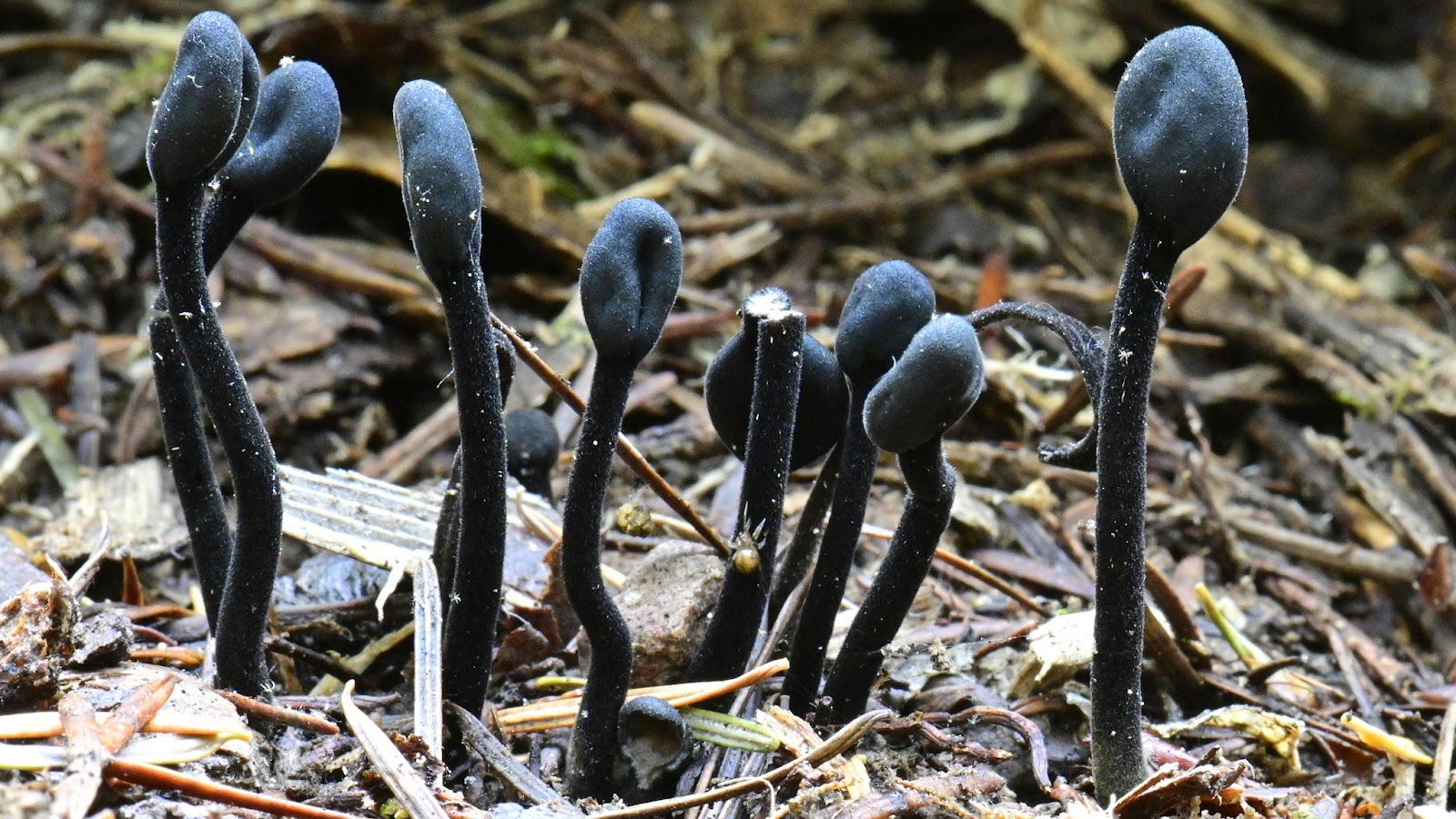
Scientists discover ‘D-rex’, a giant fungus from Chinese forests whose unique lineage dates back 65 million years | EurekAlert!
Another newly described species has brought with it an evolutionary history that refuses to fit into creationism’s abbreviated chronology. This time it is a giant fungus from China’s Yunnan Province, named Dianjunus rex, whose family lineage is estimated to have diverged about 65 million years ago — almost 65 million years before the supposed ‘Creation Week’ of young-Earth creationism. Apparently, this fungus’s ancestors failed to wait for the universe to be created.
Described in a new paper in Frontiers in Fungal Biology, the fungus produces imposing reproductive structures reaching 50 centimetres high and weighing up to 2.2 kilograms. Its anatomy and genetic relationships justified the recognition of not merely a new species and genus, but a new family: Dianjunaceae.
The date needs a little care. The researchers are not claiming that today’s species has remained unchanged for 65 million years. Their evolutionary analysis estimates when its family lineage separated from its closest relatives, with a reported range of approximately 50–80 million years. That uncertainty is scientifically significant, but offers no refuge for biblical literalism: even the youngest end of the range is vastly older than the entire history permitted by a young-Earth reading of Genesis.
There is a further irony here. Genesis offers no recognition of fungi as a distinct group of organisms. Although biblical passages refer to conditions translated as mould or mildew, these are hardly an account of fungal biology or evolutionary relationships. We cannot know that the authors simply assumed mushrooms were plants, but we can say that their creation narrative supplies none of the distinctions needed to understand this discovery. That is unsurprising in an ancient religious text; it becomes a problem only when that text is presented as authoritative natural history.
Religion, Creationism, evolution, science and politics from a centre-left atheist humanist. The blog religious frauds tell lies about.
Showing posts with label Mycology. Show all posts
Wednesday, 14 October 2026
Sunday, 14 June 2026
Refuting Creationism - A Vast Global Fungal Plant-Support System - Unintelligently 'Designed' Over 480 Million Years [Updated]
Mycorrhizal fungi under the microscope at AMOLF biophysics institute in Amsterdam. The circular structures are spores. Color is altered for legibility.
Credit: Tomás Munita
An international team of researchers, led by ecologist Justin Stewart of Vrije Universiteit Amsterdam, has announced the creation of the first global map of the vast underground infrastructure formed by arbuscular mycorrhizal fungi. The team has published its findings in Science.
These are not fungi in the familiar sense of mushrooms, but microscopic, thread-like filaments, or hyphae, which form intimate partnerships with plant roots. The figures involved are astonishing. The researchers estimate that the upper layer of the world’s soils contains about 110 quadrillion kilometres of these fungal filaments — enough to stretch from Earth to the sun nearly three-quarters of a billion times, or there and back about 368 million times. The networks also transport roughly 4 billion tonnes of CO2-equivalent into soils each year, about 11% of annual human-caused CO2 emissions.
This is not a new evolutionary phenomenon. Arbuscular mycorrhizal fungi are part of an ancient plant-fungal symbiosis that appears to date back roughly 475–480 million years, close to the origin of the first land plants. That does not mean, of course, that the individual fungal filaments mapped today are hundreds of millions of years old, but that this type of mutualistic relationship has been evolving since the early colonisation of land by plants.
One sure way to tell that biological systems are not intelligently designed is not simply that they are complex, but that they are historically contingent. They carry the marks of accumulated compromises, improvised workarounds and layered dependencies. Evolution can only modify what already exists; it cannot scrap an imperfect arrangement and begin again with a clean sheet. Its only test is whether a change works well enough, in a particular environment, to leave more descendants than the alternatives.
None of these constraints would apply to an intelligent designer, still less to the omnipotent, omniscient, perfect designer imagined — though rarely named explicitly — by creationists trying to disguise fundamentalist creationism as science. A designed global life-support system would not be expected to emerge through countless local bargains between plants and fungi, mediated by nutrient stress, carbon demand, soil chemistry, competition, disturbance and natural selection.
So we can be as sure as it is possible to be that this vast, intricate and globally important biological infrastructure was not intelligently designed. It evolved because both partners gained from the exchange: plants provided carbon fixed by photosynthesis; fungi extended the reach of plant roots, supplying water and mineral nutrients, especially phosphorus and nitrogen. Over deep time, those local mutual advantages became part of the living fabric of terrestrial ecosystems.
The paper in Science is accompanied by a news release from Vrije Universiteit Amsterdam, which includes a link to an interactive map of this global fungal infrastructure.
Labels:
Botany
,
Evolution
,
Mycology
,
Refuting Creationism
,
Science
,
Symbiosis
,
Unintelligent Design
Friday, 29 May 2026
Malevolent Design - How Honey Bees And A Parasitic Fungus Have Teamed Up
“Invasional Mutualism” Between Honey Bees and Myrtle Rust Pathogen | Blog
Figure 1.
Foraging of urediniospores by bees on plants infected with myrtle rust. a. Honey bee forager collecting Austropuccinia psidii urediniospores from leaves of broadleaf paperbark [Melaleuca quinquenervia (Myrtales, Myrtaceae)], Bungawalbin, New South Wales, Australia; b. A. psidii urediniospores in the opening of a Geraldton wax [Chamelaucium uncinatum (Myrtales, Myrtaceae)] flower bud in Brisbane, Queensland, Australia.
Photographs by Geoff Pegg.
A paper published in March 2026 in NeoBiota is entirely unsurprising to an evolutionary biologist, but deeply awkward for anyone trying to present nature as the intelligent design of an omnibenevolent creator. It reports what appears to be a mutually beneficial relationship between the introduced Western honey bee, Apis mellifera, and the invasive fungal plant pathogen myrtle rust, Austropuccinia psidii. It is a neat example of how evolution has no foresight, no moral purpose and no long-term plan. Symbiotic alliances can arise naturally between different species when there is an immediate benefit to both, even when the longer-term consequences for one or both partners — and for the wider ecosystem — may be destructive.
Myrtle rust, Austropuccinia psidii, is an invasive rust fungus in Australia. It infects more than 500 species in the Myrtaceae family, which includes many of Australia’s culturally, ecologically and economically important native plants, including eucalypts, paperbarks and related species. In Australia, the pathogen is regarded as a serious threat to native ecosystems, with around 17% of endemic vegetation considered at risk. The other partner in this apparent mutualism is also an introduced species: the Western honey bee, Apis mellifera.
The basis of this relationship is an exquisite example of the sort of functional complexity creationists routinely try to claim as evidence for intelligent design. That, of course, raises the obvious question: why would an omnibenevolent designer design a fungal pathogen capable of damaging so much of Australia’s native vegetation, and then provide it with a convenient pollinator-assisted dispersal system?
The mechanism is ingenious, but only in the blind, short-term sense in which natural selection can be ingenious. The bright yellow urediniospores of myrtle rust are collected by honey bees much as pollen is collected. The bees pack the spores into their pollen baskets and carry them back to the hive. For the fungus, this provides a potential route for dispersal beyond simple wind movement. For the bees, the spores are not just inert particles accidentally mistaken for pollen; they have real nutritional value. The researchers found that myrtle rust spores contained more than 22% protein and all ten amino acids regarded as essential for honey bee nutrition, making them comparable with high-quality pollen.
Laboratory feeding trials also showed that honey bee larvae could develop normally on a diet based on myrtle rust spores, with survival, development time and body weight similar to larvae reared on a high-quality pollen diet. Even more concerning from a biosecurity point of view, the spores remained viable inside honey bee colonies for at least nine days, meaning that hives could potentially act as reservoirs and transport systems for the pathogen.
So, the fungus gains a mobile vector, while the bees gain an alternative protein source. But what benefits both in the short term could be damaging in the longer term. As myrtle rust damages Myrtaceae-rich habitats, it can reduce the availability of flowers and pollen. That, in turn, could encourage honey bees to rely more heavily on fungal spores or other alternative foods, while the fungus benefits from the continued movement of bees and managed hives. The result could be a damaging ecological feedback loop, with plant-pollinator networks and forest regeneration placed under increasing pressure.
This is precisely the kind of outcome that any omniscient, intelligent designer should have foreseen and avoided. It is also precisely the kind of outcome that a mindless evolutionary process can produce without difficulty. Natural selection rewards immediate reproductive or nutritional advantage; it does not plan for ecological stability, protect biodiversity, or ensure that mutually beneficial relationships remain harmless in the long term.
Labels:
Biology
,
Botany
,
Creationism Refuted
,
Ecology
,
Evolution
,
Mutualism
,
Mycology
,
Parasitism
,
Science
Monday, 26 August 2024
Refuting Creationism - How New Zealand's Fungi Evolved
Scarlet Pouch Fungus
Leratiomyces erythrocephalus
Colourful fruit-like fungi and forests ‘haunted by species loss’ – how we resolved a 30-year evolutionary mystery
Fungi, like some primitive plants such as ferns and mosses reproduce with spores - tiny packages that contain the entire genome of the parent which have the capacity to grow and develop into a new adult able to produce spores of its own. The key to success is getting those spores dispersed and how a fungus manages that will depend on the environment in which it lives and reproduces.
Most fungi use wind dispersal, their spores being light enough to be carried considerable distances but where they land is a matter of chance, so must wind-dispersed fungi produce millions of spores to give them a good chance of just one or two landing in a suitable place.
A few others have evolved a different, more targeted strategy such as being eaten by animals and excreted in their faeces. This increases the chance of being deposited in the same environment in which the parent fungi lived as the dispersing animal also lives in that environment. This is the method adopted by truffles which produce their fruiting body (where the spores are produced) underground and emit a scent which is attractive to the target animal (pigs, dogs, etc.) which dig up the fruiting body and eventually disperse the spores. This is probably the reason that humans like the taste of truffles, although we lack the ability to sniff them out for ourselves, but possibly an early ancestral species could.
But what happens to these fungi if there are no mammals, other than bats, as was the case with New Zealand before humans brought their commensal species with them? This is the subject of an article in The Conversation by three experts: Jamie Wood, Senior Lecturer in Ecology and Evolution, University of Adelaide, Australia, and Amy Martin, Post-Doctoral Researcher in Evolutionary Ecology and Anne Gaskett, Associate Professor of Biology, both of the University of Auckland, Waipapa Taumata Rau, New Zealand.
Their article is reproduced here under a Creative Commons license, reformatted for stylistic consistency:
Thursday, 7 March 2024
Creationism in Crisis - Evolution of Porcini Fungus
Porcini mushrooms Boletus Edulis
A tale of terroir: Porcinis evolved to the local environment – @theU

This illustration is a little misleading because mycelia are often much larger than any of their mushrooms that appear on the surface of the soil or tree stumps. Fungi can grow up to a half a mile of the thread-like hyphae a day. In fact, the largest known organism on the planet is the Humongous Fungus (Armillaria ostoyae) in The Malheur National Forest, Oregon, measuring 2,385 acres (3.72 square miles) in area. It is estimated to be between 1900 and 8650 years old.
Photo credit: FoodPrint.org
Creationists should note here that the scientists who produced the report see this 'problem' entirely within the Theory of Evolution by Natural Selection (TOE). The strangeness is not a problem for the theory but an example of how a fundamental principle of the theory - environmental selection - operates in North America.
The 'problem' is that while Boletus edulis exists in North America as a number of different varieties and genetically distinct populations, probably caused not so much by geographical isolation as environmental adaptation, albeit with regular ingress from surrounding populations, In Eurasia, a single genetic lineage dominates from Spain to Georgia to Scandinavia, so the interesting question is why does is the species genetically continuous in Eurasia but fragmented in North America; what is the difference between the two landmasses that causes this difference.
The Eurasian and North American populations are believed to have become separated during a period of climatic change and the onset of glaciation, 1.62–2.66 years ago. Attempts to segregate populations of Boletus edulis into distinct species based on phenotype have foundered on the genetic evidence, illustrating how small genetic differences can give large phenotypic differences and how a species in the process of speciating passes through a stage at which the diverging populations have not diverged sufficiently to qualify as new taxons because the practice of taxonomy tries to fit a continuous process into a series of distinct events.
The 'problem' is the subject of a free access paper in the journal New Phytologist by Keaton Tremble and Bryn T. M. Dentinger from Utah University, Utah, USA. together with J. I. Hoffman from Bielefeld University, Germany, and was described in a University of Utah press release:
Labels:
Biodiversity
,
Biology
,
Creationism in Crisis
,
Evolution
,
Mycology
,
Science
Friday, 25 November 2022
Creationism in Crisis - Genetics Confirms Common Ancestry of 'Oddball' Fungi
Genome studies uncover a new branch in fungal evolution | Folio
In a stunning example of the power of the Theory of Evolution (TOE) to explain otherwise puzzling observations, a team of scientists led by principal investigator, Toby Spribille an associate professor in Alberta University's Department of Biological Sciences, has shown how some 600 'oddball' fungi share a common ancestor that lived about 300 million years ago.
The problem was that the usual Linnaean method of classification, using the appearance of organisms, some 600 strange fungi were difficult to fit into any single taxon.
In addition to this obvious confirmation that the TOE is the basis of biology, confirmed by genetics, there is the additional embarrassment for Creationists in the finding that the diversity of this group is due to a loss of genetic information, made possible by a symbiotic existence, where the co-symbiont has taken on some of the basic functions. That a loss of information is always detrimental and evolution requires an increase in information is now a central dogma of Creationism that flies in the face of evidence such as this.
The Alberta University news release explain the research:

The earth tongue is one of 600 “oddball” fungi that were found to share a common ancestor dating back 300 million years, according to University of Alberta researchers.
Photo: Alan Rockefeller, (CC-BY-SA-4.0)
In a stunning example of the power of the Theory of Evolution (TOE) to explain otherwise puzzling observations, a team of scientists led by principal investigator, Toby Spribille an associate professor in Alberta University's Department of Biological Sciences, has shown how some 600 'oddball' fungi share a common ancestor that lived about 300 million years ago.
The problem was that the usual Linnaean method of classification, using the appearance of organisms, some 600 strange fungi were difficult to fit into any single taxon.
In addition to this obvious confirmation that the TOE is the basis of biology, confirmed by genetics, there is the additional embarrassment for Creationists in the finding that the diversity of this group is due to a loss of genetic information, made possible by a symbiotic existence, where the co-symbiont has taken on some of the basic functions. That a loss of information is always detrimental and evolution requires an increase in information is now a central dogma of Creationism that flies in the face of evidence such as this.
The Alberta University news release explain the research:
Saturday, 8 October 2022
Biodiversity News - How Trees and Fungi Need Each Other and We Need Both
The ancient, intimate relationship between trees and fungi, from fairy toadstools to technicolour mushrooms
One of the most important symbiotic relationships on the planet is that between trees and fungi, without which we would have no trees, no forests, no timber, less oxygen and according to climatologists, very different weather patterns.
We would also not have all the species that depend on trees and forests which support one of the most diverse biota on the planet.
Trees themselves are an example of unintelligent design, as I explain in my book, The Unintelligent Designer: Refuting the Intelligent Design Hoax because their trunks and branches are the result of a massively wasteful arms race, as each tree competes with its neighbours to get its leaves above the canopy and into the sunlight. The result is a massive waste of energy and resource to build a structure which would have been unnecessary, had the ancestors of today's trees all being intelligently designed to stay at ground level and not compete for resources.
As a result of this unnecessary and wasteful complexity, another layer of complexity in the form of this symbiotic relationship between trees and fungi, which makes this possible, has evolved. Without it, trees could not obtain the nutrients they need or pump the water the leaves need to the top of the structure. So, from the perspective of the notion of intelligent [sic] design, we have massive waste and needless complexity to solve problems of the designer’s own incompetent making. So this relationship between fungi and trees represents one of the most glaring examples of the lack of foresight, planning and intelligence in whatever the design process behind it was.
From an evolutionary perspective, however, there is no need to explain bad design since there is no design process, as any intelligent person would understand it, involved. The result put the evolution of life on Earth on a trajectory that resulted in what we see today, and on which thousands of species are now dependent having evolved specialisations fitting them to live and survive in those niches by a process of co-evolving co-dependency - a predictable consequence of the process of evolution by natural selection.
The symbiotic relationship is between the roots of trees and the fungal hyphae in the soil, known as mycorrhizas. It is a lovely example of how Richard Dawkin's 'selfish genes' will form mutually beneficial alliances with the genomes of two or more organisms behaving like a single genome, albeit stored in different cells, co-evolving an every closer relationship, not of wasteful competition but of the more efficient cooperation, because cooperation benefits both organisms.
In another of the The Conversation series, 'Photos from the Field', Doctor Gregory Moore of The University of Melbourne and Associate Professor Mark Brundrett of the School of Biological Sciences, The University of Western Australia, explain this relationship, its evolutionary origins and why it is so important to the ecology of the planet. The open access article is reproduced here under a Creative Commons licence, reformatted for stylistic consistency. The original article can be read here:

Gregory Moore, The University of Melbourne and Mark Brundrett, The University of Western Australia
Environmental scientists see flora, fauna and phenomena the rest of us rarely do. In this series, we’ve invited them to share their unique photos from the field.
You may be familiar with the red toadstool with white spots, which are often the homes of fairies in children’s stories. These toadstools are also a small part of grander magical story: they are striking examples of mycorrhizas.
Mycorrhizas (pronounced my-cor-rye-zas) is the name for fungi associated with the root systems of many plants including trees, shrubs, groundcovers and grasses. These relationships are mutually symbiotic, which means both members benefit.
Fungi have a deeply ancient evolutionary origin, and colonised land with the first plants around 500 million years ago to form these partnerships. We humans often underestimate their importance to the ecosystems that have shaped life on earth.
So let’s take a closer look at how this relationship works and why it’s so important for Australian ecosystems.
An intimate relationship
Fungi come in a beautiful diversity of shapes, sizes and colours. The following photos by my co-author Mark Brundrett are just a few examples of those growing in southwest Australia.
Mycorrhizas are not to be confused with fungi that decompose dead plant matter (saprophytes) or those that cause disease (pathogens).
Saprophytes are fungi that recycle nutrients, and these can also be large and impressive. They can create tree hollows, which provide shelter for nesting birds and other animals such as possums.
The ethereal ghost fungus, for example, is a saprophyte. It famously glows green in the dark, and recycles nutrients in ecosystems by breaking down dead wood.
The primary role of mycorrhizas, on the other hand, is to provide resources such as phosphorus and nitrogen to flowering plants. They also effectively increase the absorptive surface area of the plant’s root system, allowing plants to take up much-needed water and nutrients so they grow better and more quickly.
In return, the plants provide carbohydrates, a product of photosynthesis, which mycorrhizas require to grow.
There are five different types of mycorrhizas, and two of these are particularly important in Australian ecosystems. One type is called “ectomycorrhiza”, where fungi wrap their hyphae (long, very fine hair-like structures that contact the soil) around the plant roots underground but don’t penetrate the root cells.
The other, called “endomycorrhiza”, is where fungi grow into the plant root, penetrating and branching within the root cells to form what look like little, microscopic trees. This is about as intimate a relationship between different types of organisms as you can get!
Mushrooms as big as dinner plates
We often become aware of the presence of mycorrhizas only when conditions for reproduction are right, and a mushroom or toadstool emerges from the ground. Such conditions may only occur every five to ten years. For some species, there may be centuries between reproductive events.
For many of us, our experience with mycorrhizal fungi begins in very early childhood when we first catch sight of those spotty red and white toadstools, called the fly agaric or Amanita muscaria.
These fungi are often depicted in children’s book illustrations, such as Little Red Riding Hood, Jack and the Beanstalk, and a number of Enid Blyton’s tales. I recall conifers, such as pine trees, often growing nearby in the background of these pictures. This was no coincidence, Amanita muscaria forms mycorrhizal associations with many conifers, as well as oaks.
The mycorrhizal fungi associated with eucalypts can be less showy, with many being 75-100 millimetres across and a creamy, light tan in colour. They quite often pop up in home gardens, frequently in lawns, where they’re very obvious and usually within 4 to 5 metres of a tree trunk.
Others are spectacular, including the bright purple, orange or green Cortinarius species shown in the photos below. In fact, the beauty and diversity of our fungi now supports a new ecotourism industry in Australia, particularly in Tasmania.
Some fungi are most impressive in the spring following bushfires, such as the abundant orange cup fungus shown below that stabilises ash beds.
Indeed, most plants form mycorrhizal associations. Those that don’t include plants from the common vegetable families Brassicaceae (think broccoli, cauliflower, kale) and Chenopodiaceae (spinach, beetroot, and quinoa). Neither do members of the Proteaceae family, such as native banksias and grevilleas. These plants invest in very complex roots rather than fungal associations.
Who’s really in control?
Because we are so familiar with many of the plants in our environment, we are inclined to think it’s them that control their relationship with mycorrhizal fungi.
But it is possible mycorrhizal fungi exercise much more control. Or perhaps, the relationship is a perfect mutualistic symbiosis where partners share everything, including control, equally. We just don’t know yet.
Members of the fungus kingdom work in synchrony with the plant kingdom to support all terrestrial life, including animals such as ourselves. We may not think about fungi very often, but we cannot survive without them.
One of the surprise elements of Douglas Adam’s Hitchhiker’s Guide to the Galaxy, was that the Earth and its inhabitants existed as part of an experiment designed and controlled by white laboratory mice.
I sometimes wonder if the fate of the Earth’s terrestrial ecosystems rests on mycorrhizal fungi. If so, perhaps we need to show them greater respect.
Gregory Moore, Doctor of Botany, The University of Melbourne and Mark Brundrett, Adjunct Associate Professor, School of Biological Sciences, The University of Western Australia
One of the most important symbiotic relationships on the planet is that between trees and fungi, without which we would have no trees, no forests, no timber, less oxygen and according to climatologists, very different weather patterns.
We would also not have all the species that depend on trees and forests which support one of the most diverse biota on the planet.
Trees themselves are an example of unintelligent design, as I explain in my book, The Unintelligent Designer: Refuting the Intelligent Design Hoax because their trunks and branches are the result of a massively wasteful arms race, as each tree competes with its neighbours to get its leaves above the canopy and into the sunlight. The result is a massive waste of energy and resource to build a structure which would have been unnecessary, had the ancestors of today's trees all being intelligently designed to stay at ground level and not compete for resources.
As a result of this unnecessary and wasteful complexity, another layer of complexity in the form of this symbiotic relationship between trees and fungi, which makes this possible, has evolved. Without it, trees could not obtain the nutrients they need or pump the water the leaves need to the top of the structure. So, from the perspective of the notion of intelligent [sic] design, we have massive waste and needless complexity to solve problems of the designer’s own incompetent making. So this relationship between fungi and trees represents one of the most glaring examples of the lack of foresight, planning and intelligence in whatever the design process behind it was.
From an evolutionary perspective, however, there is no need to explain bad design since there is no design process, as any intelligent person would understand it, involved. The result put the evolution of life on Earth on a trajectory that resulted in what we see today, and on which thousands of species are now dependent having evolved specialisations fitting them to live and survive in those niches by a process of co-evolving co-dependency - a predictable consequence of the process of evolution by natural selection.
The symbiotic relationship is between the roots of trees and the fungal hyphae in the soil, known as mycorrhizas. It is a lovely example of how Richard Dawkin's 'selfish genes' will form mutually beneficial alliances with the genomes of two or more organisms behaving like a single genome, albeit stored in different cells, co-evolving an every closer relationship, not of wasteful competition but of the more efficient cooperation, because cooperation benefits both organisms.
In another of the The Conversation series, 'Photos from the Field', Doctor Gregory Moore of The University of Melbourne and Associate Professor Mark Brundrett of the School of Biological Sciences, The University of Western Australia, explain this relationship, its evolutionary origins and why it is so important to the ecology of the planet. The open access article is reproduced here under a Creative Commons licence, reformatted for stylistic consistency. The original article can be read here:
The ancient, intimate relationship between trees and fungi, from fairy toadstools to technicolour mushrooms
Cortinarius kula
Credit: Mark Brundrett, Author provided
Environmental scientists see flora, fauna and phenomena the rest of us rarely do. In this series, we’ve invited them to share their unique photos from the field.
You may be familiar with the red toadstool with white spots, which are often the homes of fairies in children’s stories. These toadstools are also a small part of grander magical story: they are striking examples of mycorrhizas.
Mycorrhizas (pronounced my-cor-rye-zas) is the name for fungi associated with the root systems of many plants including trees, shrubs, groundcovers and grasses. These relationships are mutually symbiotic, which means both members benefit.
Fungi have a deeply ancient evolutionary origin, and colonised land with the first plants around 500 million years ago to form these partnerships. We humans often underestimate their importance to the ecosystems that have shaped life on earth.
So let’s take a closer look at how this relationship works and why it’s so important for Australian ecosystems.
An intimate relationship
Fungi come in a beautiful diversity of shapes, sizes and colours. The following photos by my co-author Mark Brundrett are just a few examples of those growing in southwest Australia.
Mycorrhizas are not to be confused with fungi that decompose dead plant matter (saprophytes) or those that cause disease (pathogens).
Saprophytes are fungi that recycle nutrients, and these can also be large and impressive. They can create tree hollows, which provide shelter for nesting birds and other animals such as possums.
The ethereal ghost fungus, for example, is a saprophyte. It famously glows green in the dark, and recycles nutrients in ecosystems by breaking down dead wood.
The primary role of mycorrhizas, on the other hand, is to provide resources such as phosphorus and nitrogen to flowering plants. They also effectively increase the absorptive surface area of the plant’s root system, allowing plants to take up much-needed water and nutrients so they grow better and more quickly.
In return, the plants provide carbohydrates, a product of photosynthesis, which mycorrhizas require to grow.

The yellow navel fungus Lichenomphalia chromacea forms a protective crust on soils in association with lichen fungi and algae.
Credit: Mark Brundrett, Author provided

Cortinarius vinaceolamellatus is a beautiful fungus that supports the growth of of tall eucalyptus forests.
Credit: Mark Brundrett, Author provided

This saprophyte is a relative of the common mushroom sold in shops (a species of Agaricus). Australian fungi can be toxic so leave them where they grow.
Credit: Mark Brundrett, Author provided
The other, called “endomycorrhiza”, is where fungi grow into the plant root, penetrating and branching within the root cells to form what look like little, microscopic trees. This is about as intimate a relationship between different types of organisms as you can get!

Microscopic cross-sectional view of an ectomycorrhizal pine tree root about 0.5 millimetres wide. This revels a labyrinth of black stained fungus hyphae surrounding root cells to form a nutrient exchange zone.
Credit: Mark Brundrett, Author provided

Arbuscular mycorrhizas are tiny tree-like growths inside the root cell where materials are exchanged with the host plant.
Credit: Mark Brundrett, Author provided
We often become aware of the presence of mycorrhizas only when conditions for reproduction are right, and a mushroom or toadstool emerges from the ground. Such conditions may only occur every five to ten years. For some species, there may be centuries between reproductive events.
For many of us, our experience with mycorrhizal fungi begins in very early childhood when we first catch sight of those spotty red and white toadstools, called the fly agaric or Amanita muscaria.
These fungi are often depicted in children’s book illustrations, such as Little Red Riding Hood, Jack and the Beanstalk, and a number of Enid Blyton’s tales. I recall conifers, such as pine trees, often growing nearby in the background of these pictures. This was no coincidence, Amanita muscaria forms mycorrhizal associations with many conifers, as well as oaks.

The fly agaric or Amanita muscaria is a striking fungus often seen in children’s books.
Credit: Mark Brundrett, Author provided

The fame of Amanita muscaria also arises from the hallucinogenic properties it sometimes has, but this fungus is most likely to have toxic consequences for those who eat it. It was also used as a natural insect killer.
Credit: Mark Brundrett, Author provided
Others are spectacular, including the bright purple, orange or green Cortinarius species shown in the photos below. In fact, the beauty and diversity of our fungi now supports a new ecotourism industry in Australia, particularly in Tasmania.

The bright green mushroom Cortinarius austroveneta is found in tall eucalypt forests.
Credit: Mark Brundrett, Author provided

Cortinarius erythrocephalus is another brilliantly coloured mycorrhizal forest mushroom.
Credit: Mark Brundrett, Author provided

Cortinarius rotundisporus, also known as the elegant blue webcap, can be found in southern Australia.
Credit: Mark Brundrett, Author provided

The orange cup fungus Anthrocobya muelleri is found briefly after severe fires.
Credit: Mark Brundrett, Author provided
This is a species of Ramaria, a mycorrhizal genus comprising approximately 200 species of coral fungi.
Credit: Mark Brundrett
Phlebopus marginatus is possibly Australia’s largest terrestrial mushroom, with one found in Victoria weighing in at 29 kilograms.
Credit: Mark Brundrett, Author provided
Because we are so familiar with many of the plants in our environment, we are inclined to think it’s them that control their relationship with mycorrhizal fungi.
But it is possible mycorrhizal fungi exercise much more control. Or perhaps, the relationship is a perfect mutualistic symbiosis where partners share everything, including control, equally. We just don’t know yet.
Members of the fungus kingdom work in synchrony with the plant kingdom to support all terrestrial life, including animals such as ourselves. We may not think about fungi very often, but we cannot survive without them.
One of the surprise elements of Douglas Adam’s Hitchhiker’s Guide to the Galaxy, was that the Earth and its inhabitants existed as part of an experiment designed and controlled by white laboratory mice.
I sometimes wonder if the fate of the Earth’s terrestrial ecosystems rests on mycorrhizal fungi. If so, perhaps we need to show them greater respect.
Subscribe to:
Posts
(
Atom
)