
AI-generated reconstruction of an early mekosuchine crocodilian beside a lakeshore nest in Eocene Australia.
ChatGPT-6 Astra
A major problem for young-Earth creationists is that so much of Earth’s history occurred millions or billions of years before their biblical chronology allows the planet to have existed. Fossils repeatedly confront them with evidence of animals living, reproducing and evolving in worlds that supposedly never existed. Dismissing this evidence as scientific incompetence or dishonesty does nothing to explain it. Nor does accusing researchers of manipulating dates become an acceptable substitute for evidence simply because the accusation is made in defence of the Bible.
The latest addition to this inconvenient record comes from approximately 55-million-year-old crocodilian eggshells found at Murgon in south-eastern Queensland, Australia. These animals were laying eggs more than 5,000 times further back in time than even a generous 10,000-year creationist chronology permits. The fragments are described in a paper in the Journal of Vertebrate Paleontology by an international team including Michael Stein of the University of New South Wales.
The oldest known crocodilian eggshells from Australia, they are attributed to the mekosuchines, an extinct group with a long evolutionary history in the region. These crocodilians belonged to a different branch of the family tree from Australia’s living saltwater and freshwater crocodiles. Their significance therefore extends beyond their inconvenient age: they help document an ancient crocodilian fauna that cannot simply be equated with the species inhabiting Australia today.
Eggshells also preserve information that bones and teeth alone cannot provide. Their microscopic structure offers clues to reproduction and nesting conditions; in this case, the researchers interpret the evidence as indicating nesting around the margins of an ancient lake. These tiny fragments therefore add another dimension to our understanding of how extinct crocodilians lived and interacted with their environment.
The broader evolutionary picture is one of branching lineages, ecological diversity and eventual extinction over immense spans of time. The eggshells contribute to that picture without, by themselves, revealing every evolutionary relationship or the precise identity of the animal that laid them. That distinction matters: science builds its explanations from what the evidence supports, while leaving room for further discoveries. None of that uncertainty reduces 55 million years to a few thousand.
Michael David Stein, a research associate in UNSW’s School of Biological, Earth and Environmental Sciences and a co-author of the paper, describes the discovery and its significance in an article in The Conversation, reprinted below under a Creative Commons licence and reformatted for stylistic consistency:

55 million years: Australia’s oldest crocodile eggshells found in Queensland
Michael David Stein, UNSW
In southeast Queensland, roughly 250 kilometres from Brisbane, lies the tiny town of Murgon. Located on Wakka Wakka Country, it’s home to about 2,000 people – and one of the most important fossil sites in the world.
From the 55 million-year-old clays there, palaeontologists have unearthed a range of precious fossils over several decades. These include the world’s oldest fossil songbirds, the only known fossils of salamanders in Australia and the oldest fossil marsupial remains in Australia.
And the site continues to serve up ancient treasures. In a new study, published today in the Journal of Vertebrate Paleontology, my colleagues and I report the discovery of the oldest crocodilian eggshells ever found in Australia.
These eggshells now serve as the basis for a new eggshell type, Wakkaoolithus godthelpi. They belong to the oldest known member of a now extinct group of crocodiles known as mekosuchines. And they offer a new look into not just their evolution – but also the forest-lined wetlands they lived in.
Tree-climbing crocodiles
Mekosuchines were Australia’s own unique, local branch of the crocodile family. They dominated inland waters of the continent 55 million years ago. They were part of the group of species that includes alligators, true crocodiles, gharials and caiman.
But they represent a much older branch than the saltwater and freshwater crocs found in Australia today. These modern species made their way to the continent much later, as it came into contact with southeast Asia about five million years ago.
In the 1980s, fossil finds began to take off at sites such as Murgon and the Riversleigh World Heritage Area in Queensland, and Alcoota in the Northern Territory. Since then, palaeontologists have been able to piece together a good picture of the diversity of mekosuchines. This was much higher than what we see today, with ten extinct genera now accounted for.
These fossil finds preserve a vigorous evolutionary history, and in particular a trend towards land-based hunting by about 33 million years ago.
This diversity includes the likes of Quinkana, a large land-based crocodile with narrow jaws, and dwarf species such as Trilophosuchus which may have been in a position to fill the niche of a tree-climbing hunter – a kind of “drop croc”.
The latter case was originally suggested by palaeontologist Paul Willis on the basis of the unusual musculature at the back of Trilophosuchus’s skull. Although hotly debated, Willis suggested this would allow Trilophosuchus to hold its head aloft and scan through the three dimensional environment of the canopy.

A Kambara skull at the Melbourne Museum.
The new study, however, takes a look at one of the oldest genera of Mekosuchines, Kambara. It grew up to two metres long and is thought to have fed on fish and softshell turtles.
At Murgon, University of New South Wales researchers led by Henk Godthelp and Michael Archer uncovered fragments of eggshell, a comparatively rare find. Surprisingly little work has been done in the area of analysing crocodile eggshells.
Xavier Panadès I Blas from the Institut Català de Paleontologia at the University of Barcelona took up the challenge to explore the shell’s preserved microstructure with high-resolution microscopy.
What he found was intriguing. The eggshells of Kambara have their own unique micro-structural features, still preserved after 55 million years.
These features differ from what we know of the microstructures that have evolved among modern crocodiles and alligators. However, it will take a lot more work to put things formally into context.
Still, these eggshells may provide a valuable new avenue for understanding how mekosuchines fit into the big picture of evolution that spans Australia, Asia, Africa and the Americas.
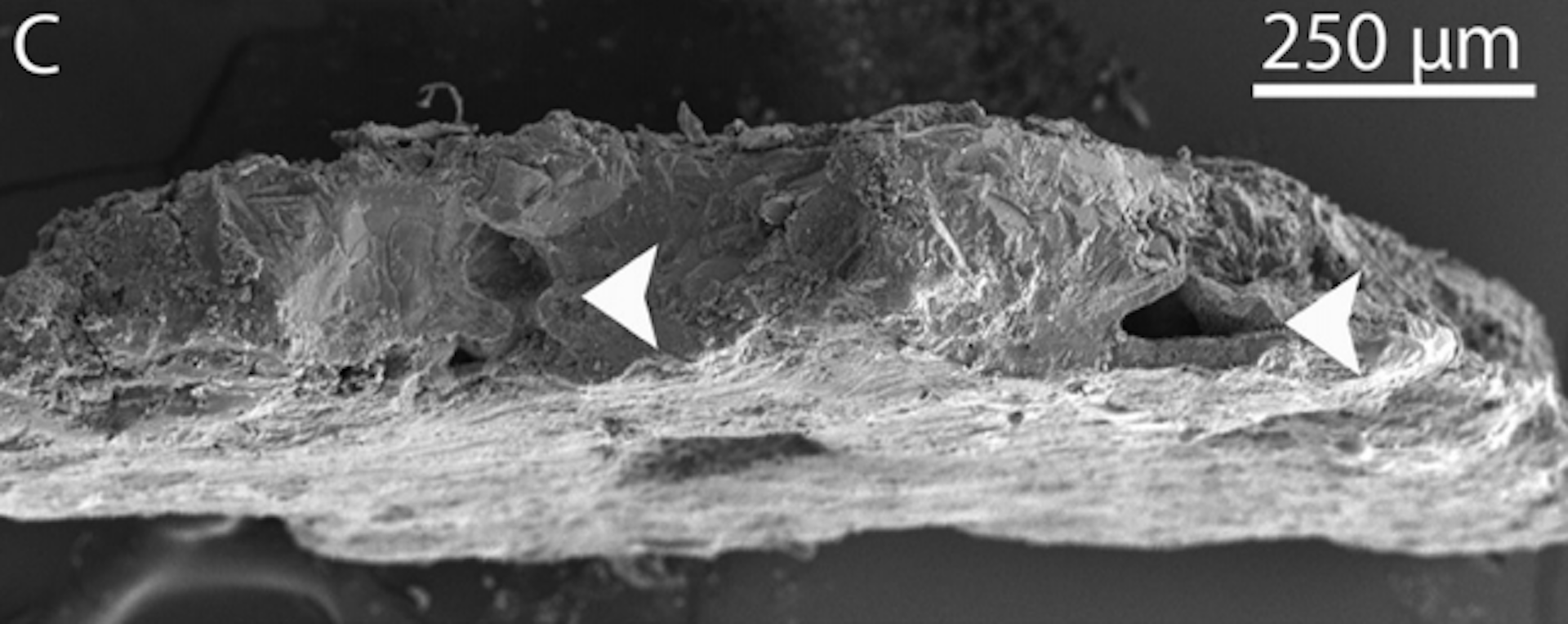
One of the new eggshell fragments under high focus microscopy.
Xavier Panadès I Blas.
Beyond evolution, these eggshells are an insight into the environment that existed at Murgon 55 million years ago. Crocodile reproduction is intimately tied to their local environment and modern species display a complex mix of nesting strategies in response.
In the case of the eggshell of Kambara, there is little sign of degradation from bacteria.
This suggests the nest may have experienced periods of dryness due to the ephemeral nature of the surrounding wetlands at Murgon.
While mekosuchines enjoyed a much larger range of territories compared to our modern crocodiles, they eventually experienced a considerable contraction as the continent became increasingly arid.
Between this and the decline of large prey, mekosuchines eventually went extinct on the Australian continent.

Michael David Stein, Research Associate, School of Biological, Earth & Environmental Sciences, UNSW
This article is republished from The Conversation under a Creative Commons license. Read the original article.

These fragments of eggshell present young-Earth creationism with a problem far larger than their size suggests. Some 55 million years ago, crocodilians were reproducing beside an Australian lake, leaving traces that scientists can still examine today. Within the biblical chronology promoted by young-Earth creationists, neither that lake nor the continent, nor even the planet itself, should have existed. Dismissing the dates does not resolve the contradiction; it merely avoids the evidence that creates it.
Their evolutionary significance is equally revealing. Australia’s crocodilian history includes extinct branches of the family tree, with the mekosuchines forming part of a diversity that its two living crocodile species scarcely hint at. The eggshells add evidence about reproduction and nesting to the anatomical information preserved in bones and teeth. A superficially familiar crocodilian appearance does not mean that evolution stood still: recognising an animal as a crocodilian tells us about its ancestry, not that its lineage has remained unchanged.
There are, of course, questions still to answer about the animals that laid these eggs and the circumstances in which they nested. Scientists acknowledge those uncertainties and investigate them. They do not require every detail to be settled before recognising the overwhelming difference between a history extending across tens of millions of years and a creation story confined to a few thousand. Even a handful of broken eggshells can illuminate that ancient history—and expose how much of reality biblical literalism requires its followers to disregard.
Advertisement
Amazon

Amazon

Amazon

Amazon

Amazon

Amazon

Amazon

Amazon

Amazon

Amazon

Amazon

Amazon

All titles available in paperback, hardcover, ebook for Kindle and audio format.
Prices correct at time of publication. for current prices.



No comments :
Post a Comment
Obscene, threatening or obnoxious messages, preaching, abuse and spam will be removed, as will anything by known Internet trolls and stalkers, by known sock-puppet accounts and anything not connected with the post,
A claim made without evidence can be dismissed without evidence. Remember: your opinion is not an established fact unless corroborated.