Religion, Creationism, evolution, science and politics from a centre-left atheist humanist. The blog religious frauds tell lies about.
Saturday, 24 September 2011
Science vs Religion - The Lesson from CERN
A couple of days ago, scientists working at CERN published a paper with data which seems to question one of the very fundamental principles upon which modern physics is built - that nothing can travel faster than the velocity of light in a vacuum (c). They appear to have discovered that a fundamental particle - the neutrino - does, by a very small, but significant margin.
They have asked the scientific community to scrutinise and criticise their data and methodology, in short, to pull it apart and find fault with it. To crawl all over it, to shoot it down in flames whilst blowing it out of the water (mixed metaphor intended).
They have applied the basic principle of scientific honesty and integrity which understands that extraordinary claims require extraordinary evidence and they have submitted their findings to peer review.
Labels:
Creationism
,
Science
Friday, 23 September 2011
15 Answers for Creationists.
Written in reply to 15 Questions for Evolutionists.
This list of questions is depressing, not because they are difficult - any intermediate level biology student should be able to answer them with no more than a moment's thought - but because they reveal the depths of ignorance, dishonesty and credulous stupidity on which Creationism relies. The questioner, apparently in all seriousness, believes these are difficult, killer knock-down questions which will challenge even the best of evolutionary biologists. Either that, or he imagines his target audience is that dishonest, ignorant and credulously stupid.
It would be funny, if it weren't so representative of so many semi-literate and wilfully ignorant, yet politically active and dangerous individuals. These questions tell us a great deal about the cavalier approach of creationists to truth and honesty.
No doubt they will not want to read these answers, preferring, as they do, to remain stoically and proudly ignorant of anything which might shake their 'unshakeable' faith.
Q1. How did life originate?
A1. The origin of replicators is not a question for Evolutionists since the Theory of Evolution (TOE) deals with how living organisms develop and diversify, not how they originated. However, this question can be, and is being, addressed by science. There are several theories which can be found by a search on Google.
The disingenuous nature of this question can be gauged from the following quote:
“Nobody knows how a mixture of lifeless chemicals spontaneously organized themselves into the first living cell.”
Of course, as the questioner probably knows, no serious TOE hypothesises this. The question is asked to mislead the credulous and gullible. The entire basis of any TOE is that organisms evolve slowly, over time, by a series of natural selection from amongst a population containing variations on a basic theme. Variation comes about by randomly imperfect replication. Evolution always occurs in a population, not in individuals. There was never any spontaneous self-organisation.
Most theories of the origin of replicator assume that RNA became involved early on in the process and self-replicating examples of RNA are known.
In fact, this is just another form of the God of the Gaps fallacy. The questioner is implying that, if science doesn't know the answer now, a natural answer will never be known, and that the only possible explanation is a supernatural one. This fallacy also depends on the parochial ignorance of its target to assume that the only possible supernatural explanation is the one the questioner is pushing.
So, from the first question, we can see plainly how the questions are intended to mislead rather than to inform, and the contempt the questioner has for his target audience.
Maybe it gets better...
Labels:
Creationism
,
Evolution
,
Science
Thursday, 22 September 2011
Have You Found Jesus?
If you're looking for Jesus you should be able to find him in the Bible... shouldn't you?
- How did Mary and Joseph know Mary was Expecting God’s son?
- Joseph was told about it in a dream, so he decides not to divorce pregnant Mary. (Matthew 1:18-20)
- An angel told Mary. (Luke 1:26-31)
- When was Jesus born?
- When Quirinius was Governor of Syria (6-12 AD) (Luke 2:2)
- When Herod the Great was King (37-4 BC) (Matthew 2:1)
- Where was Jesus born?
- In the house in Bethlehem where Joseph and Mary live (Matt 1:18 – 2:23)
- In a stable in Bethlehem to where Joseph and Mary have travelled to take part in a census (Luke 1:4 – 2:40)
- Who came to see Jesus when he was born?
- Unspecified number of 'wise men' from the East (Matthew 2:1)
- Unspecified number of shepherds (Luke 2:8)
- When did Jesus become God’s son?
- When he was resurrected (Acts 13:32-33)
- When he was baptised (Luke 3:22)
- When Mary conceived him (Luke 1:35)
- When did Jesus cleanse the Temple?
- The week before he died (Mark 11:15)
- Right at the beginning of his three-year ministry (John 2:14-16 )
- How many ‘signs’ did Jesus do in Jerusalem?
- Water into wine – the ‘first sign’ (John 2:11)
- Many more signs follow (John 2:23)
- Then he heals a centurion’s son – the ‘second sign’ (John 4:54)
- When was Jesus crucified?
- The day before Passover at about noon (John 19:14)
- On the day of Passover at 09:00 (Mark 15:25)
- Who asked Jesus where he was going at the ‘Last Supper’?
- Peter – “Lord, where are you going?” (John 13:36)
- Thomas – “Lord, we do not know where you are going.” (John 14:5)
- Jesus – “... none of you asks me where I am going.” (John 16:5)
- What were Jesus’ last words on the cross?
- “Father, into your hands I commend my spirit.” (Luke 23:46)
- “Eloi, Eloi, lama sabachthani?” in Aramaic. (My god, my god, why have you forsaken me?) (Mark 15:34)
- When was the land cast into darkness and the curtain in the Temple ripped?
- At the moment of Jesus’ death (Mark 15:38)
- When Jesus was still alive (Luke 23:45)
Which leaves us with... precisely nowhere, because no contemporaneous historians noticed anything worth writing about, apparently.
Jesus Interrupted: Revealing the Hidden Contradictions in the Bible (and Why We Don't Know About Them) by Bart D Ehrlman
Ten Reasons To Lose Faith: And Why You Are Better Off Without It
This book explains why faith is a fallacy and serves no useful purpose other than providing an excuse for pretending to know things that are unknown. It also explains how losing faith liberates former sufferers from fear, delusion and the control of others, freeing them to see the world in a different light, to recognise the injustices that religions cause and to accept people for who they are, not which group they happened to be born in. A society based on atheist, Humanist principles would be a less divided, more inclusive, more peaceful society and one more appreciative of the one opportunity that life gives us to enjoy and wonder at the world we live in.
Available in Hardcover, Paperback or ebook for Kindle
Labels:
Apologetics
,
Atheism
,
Christianity
Tuesday, 20 September 2011
Teach evolution, not creationism! | Joint statement on creationism and evolution in schools
British Humanist Association Campaign:
Labels:
Creationism
,
Evolution
Sunday, 18 September 2011
The Curious Case of Giant Pacific Tube Worms
The giant tubeworm, Riftia pachyptila.
Photo: Monika Bright, University of Vienna, Austria.
The Giant Pacific Tube Worm (Riftia pachyptila) were discovered in the late 1970s in the eastern Pacific Ocean at depths of around 8000 feet. It is an ‘extremophile’, living as it does around the rim of volcanic hydrothermal vents - so-called ‘black smokers’ because of the colour of the sulphur-rich water welling up from them. The temperatures can reach 360 degrees Celsius and the pressure at that depth is around 150 times that at sea level – enough to crush an ordinary submarine hull.
No sunlight reaches these depths, so, unlike normal ecosystems which depend on sunlight as the source of energy, the entire system depends on bacteria which manufacture nutrients from the chemicals welling up from the vents. The energy source is heat and hydrogen sulphide. Hydrogen sulphide is highly toxic in a normal environment.
<br
Labels:
Bible
,
Creationism
,
Evolution
Thursday, 15 September 2011
Beyond Belief - The Ten Plagues of Egypt.
Why did an omniscient, omnipotent god need ten tries to convince Pharaoh?
- All the water turned into blood. The Egyptians never recorded this. Nothing happened.
- Frogs. Millions of frogs! The Egyptians didn't notice them either, so nothing happened.
- Lice. Nothing.
- Flies. Still Nothing.
- Pestilence to kill all the livestock. Nothing.
- Boils. Even the livestock... er... see 5 above.
- Thunder and hail. [Shrug]
- Locusts. Now this is just being silly. Still nothing.
- Make it dark for 3 days. You've guessed it. Nothing. Not even a marginal note in the official records.
- Kill all the ‘first born’. Even the ‘maidservant behind the mill’ (what did she do?), and the livestock, yet again. (And the Hebrews find lambs to sacrifice... even though they all died in the fifth plague).
Phew! After only ten tries!
But even then Pharaoh changed his mind again and sent the army after the Hebrews ... riding in chariots pulled by horses ... er... that had all been killed in the fifth plague.
Amazing how inept an omniscient god can be when the story requires one.
Wednesday, 14 September 2011
Beyond Belief.
How many chances does the Judeo-Christian god need for goodness sake?
First it goes to all the trouble to create a vast universe out of nothing just so it can have a tiny speck of dust on which to create humans, complete with all the plants, animals, air, water, etc., they need.
Sunday, 11 September 2011
Religion's Misguided Missiles - Richard Dawkins - The Guardian - RichardDawkins.net
Written 4 days after 9/11.
Worth reading 10 years on.
Religion's Misguided Missiles - Richard Dawkins - The Guardian - RichardDawkins.net:
'via Blog this'
Worth reading 10 years on.
Religion's Misguided Missiles - Richard Dawkins - The Guardian - RichardDawkins.net:
'via Blog this'
Labels:
Delusion
Saturday, 10 September 2011
Science vs Religion
In the search for truth it seems many people believe science and religion are either opposites or at least alternative means to an end.Let's take a look:
As scientific observation improves and greater understanding is achieved, so interpretation of evidence leads to a closer and closer approximation to the truth. This is a fundamental of science. The 'truth' is assumed to be out there waiting to be discovered.
Science has inbuilt mechanisms for removing bias, including submission to peer-review and, even though some scientists may get away with false results due to bias or dishonesty, other scientists will eventually discover these errors and correct them. There is no surer way to fame and respect in science than in overthrowing an established school of thought. This way leads to Nobel Prizes. There is no surer way to ignominy and disgrace than to be found to have deliberately falsified results or allowed bias due to religious, political or cultural prejudice or for financial gain.
Science is thus self-correcting over time, all the while driven towards discovering objective, culturally neutral truth.Different researchers working independently can, and often do, come up with the same conclusions. Scientists working in different cultures will still arrive at very similar conclusions and resolution of differences is normally free from cultural bias. Whether working in Japan, Europe or USA scientists will produce results regarded as equally valid by each other. During the Cold War, Western Bloc and Eastern Bloc scientists produced results regarded as no less valid by their opposite numbers in the other bloc on the grounds that they were from the 'wrong' political system.
Christian, Atheist, Muslim, Buddhist, Hindu or Taoist scientists will all, using the same methodology, produce equally valid results. Science is blind to culture, race, creed or politics. The only test is whether the observations are valid and the conclusions flow logically from them.Because science is entirely based on observation of evidence and facts are neutral, freed from interference from religion or politics, science tends to converge on the same theories.
For this reason we can be sure that, if in some way we could scrap an entire body of science, say, the Theory of Evolution or the Theory of Gravity, and start again, science would in time come up with identical theories.
Rational theories which flow naturally and inevitably from the neutral facts.
But with religion, things are quite different.
We have many examples of religions being started afresh, just as though the existing 'theory' has been scrapped and started again. They are ALL different.
There are no examples of different religions in different parts of the world converging on a common form or explanation for the universe or life on earth or indeed any of the other answers all religions purport to provide.
![]() |
| Science puts people on the moon. Religion flies planes into buildings. |
As a means for discovering truth, religions are about as useful as random guesses or examining the entrails of chickens.
This is because there are no neutral facts in religion, no rational interpretation of those facts, no attempts to measure the evidence more and more accurately or to resolve differences between different groups of researchers or between cultures. Indeed, if religions proceeded this way they would be science and no 'faith' would be required.
Religions are about enforcing unquestioned conformity to dogma and often the notional guesses of technologically backward remote ancestors.
In the search for truth, science wins because science can demonstrate the truth of its claims. (Tweet this)
Thursday, 8 September 2011
The Kalâm Cosmological Fallacy
The Kalâm Cosmological Argument (KCA) has its origins in medieval Islam of the Kalâm tradition but it has been adopted by Christian apologists, notably William Lane Craig, who appear to believe it proves only the Christian god of the New Testament, ignoring the fact that it was originally formulated to ‘prove’ the Islamic god of the Qur’an.
- Everything that has a beginning of its existence has a cause.
- The universe had a beginning.
- Therefore the universe had a cause.
- That cause must be God.
In essence, the KCA is arguing that:
- There can be no natural cause for the universe.
- Therefore the cause must be supernatural.
- The only possible supernatural cause must be whichever god the argument is being used to promote.
Clearly, we only need to refute 1 for the entire argument to collapse since this is the premise from which the rest is assumed to flow. We only need to show that a natural cause is possible to refute the KCA. The onus of proof lies with those using the KCA to prove their implicit claim that the cause MUST be supernatural, so the onus is upon them to refute our possible natural cause AND show that there are no other possible natural explanations.
Unless they are able to do so, reliance on the KCA is dishonest and disingenuous.
Everything that has a beginning of its existence has a cause.
Friday, 26 August 2011
A History of Ireland - 9. The Troubles
Part 9 of A History of Ireland
So what changed?
In 1963, Captain Terence O’Neill, a loyal Ulster Orangeman and former Guards Officer, became Prime Minister of Northern Ireland. In a curious historical twist, he was a direct descendant of Hugh O’Neill, Earl of Tyrone, one of the ‘flown earls’ and last of the native Gaelic chieftains whose confiscated land had formed the basis for the Ulster Plantation some 300 years earlier, and of the Ui Niall, High Kings of Tara. He was the first Northern Ireland MP not to have been closely connected with the founding of the northern state and was a reformer by nature. He recognised that Ulster had to adjust to modern times in which the educated children of the earlier Nationalists were achieving adulthood and were beginning to see the larger world through the window of television. He met Sean Lemass, Eire’s Prime Minister in 1965, the first such meeting since the founding of the two states. He also visited a Catholic girl’s grammar school, an almost revolutionary thing for an Orange Ulster PM to do.
This began to stir the deep suspicions of the Protestant mind to the extent that Ian Paisley, a young fire-and-brimstone Presbyterian mister and orator with ambitions, was able to raise a mob of militant supporters. They staged a demonstration at Ballymena when O’neill visited a Catholic convent school there. They had marched behind him with banners proclaiming “O’Neill Arch Traitor”.
Paisley had first come to prominence when he led a campaign to resist the sailing on a Sunday of a ferry because it violated the Sabbath. He had also founded his own Protestant Unionist Party and was building a strong personal following with vehemently anti-Catholic orations condemning everything as a Popish Plot and the result of machinations of the ‘Whore of Babylon’. He was a throwback to the independent, anti-establishment Presbyterian radicals of earlier centuries. He also had links to an American right-wing fundamentalist Christian college, Bob Jones University, from which he had bought a ‘doctorate’ which he used to give himself an undeserved academic respectability. As events were to show, Ian Paisley was temperamentally incapable of being anything other than the leader of any organisation of which he was a member.
Ulster Protestants were polarising on socio-economic line, with working class Protestants following Paisley and the establishment and landed gentry sticking with the Ulster Unionists of O’Neill, but only into opposing Protestant Unionist factions. There was no sense of commonality of interest between Catholics and Protestants from the same social class. The Protestants’ main concern was still how to keep what they had and to prevent Catholics getting any of it. The division was over the best way of achieving this, and O’Neill’s tentative moves towards reform (and they were no more than that) and Protestant insecurities were driving the process.
However, O’Neill’s perceptions were right. Catholics were beginning to make their voices heard and they were voices that were to rise to shouting pitch as the demand for reform and the perception that this was perhaps achievable grew. Inspired by the Civil Rights movement of Martin Luther King in America, at a meeting at Maghera, County Down, in 1966, a decision to form a similar movement in Northern Ireland was made. It would be non-violent, using the tactics of marching and civil disobedience, appealing to the world at large and occupying the moral high ground. Catholics had also taken heart from the election of two Nationalists MPs for the Westminster Parliament in the General Elections of 1964 and 1966 (Gerry Fitt and John Hume). They represented a social democratic and pacifist strand of Nationalism that believed change could best be brought about by working within the system and playing a full part in the political process. The Northern Ireland Civil Rights Association was formed in 1967. The IRA, who had waged an ineffectual campaign from 1956-62 and had lost most of its support in the process, played no part in its formation. It was described as ‘middle-aged, middle-class, and middle-of-the-road’.
Despite the declares non-violence of the NICRA, William Craig, Home Affairs Minister at Stormont, had banned a demonstration planned for 5 October 1968 in Londonderry. It went ahead none-the-less and was brutally broken up by the RUC. Ulster’s response to legitimate Catholic grievance had been met with gratuitous brutality by the state’s police force. This event began to change Catholic perceptions but worse was to come.
On 1 January, 1969, a radical faction of the NICRA called People’s Democracy, which was attempting to broaden the appeal to include non-Catholics in a general class-based campaign for political reforms, began a march across Ulster from Belfast to Londonderry. Marchers carried banners demanding ‘One Man, one vote’. It had not been banned and had minimal police protection. The march arrived at Burntolett Bridge, seven miles from Derry, where it was attacked by a Protestant mob. Television news film showed RUC officers amongst the mob but doing little or nothing to prevent the attack. None of the attackers were arrested but instead the RUC arrested about eighty of the marchers they were supposed to be protecting. Later that evening, the RUC moved into Derry’s Catholic Bogside estate and indulged in a night of gratuitous violence and destruction, subjecting Catholics to sectarian abuse.
A pattern of increasing Catholic impatience, as their non-violent campaign was met with violence by the state, and increasing Protestant resistance to change, was to continue for the rest of the year. Ulster, rather than moving into the modern word as O’Neill intended was retreating into an earlier age.
O’Neill resigned in April to be replaced by the well-meaning but ineffectual James Chichester-Clarke, his cousin. Rioting took place in Dungannon in April and in Belfast and Derry in August. In these latter riots, the ‘B’ Specials of the RUC became indistinguishable from the Protestant mob as they attacked Civil Rights marchers with sub-machine guns and tear gas grenades. In two nights, six people were killed and 300 homes were burned. British troops intervened in Derry on 14 August and in Belfast on 16 August 1969, to protect Catholics from the RUC!
Where was the IRA in all this?
They were almost non-existent. ‘IRA = I Ran Away’ became a popular slogan amongst the Catholic youth of the time. The IRA, following its failed campaign of 1956-62, had become a victim of its own irrelevance again, as it did in the Free State after 1922. It had fractured into divergent red revolutionary socialist factions and had lost much of its simple green patriotic republicanism. Now, it has a purpose once again as Catholics were being attacked by the state and British troops were on the streets of Belfast and Derry – albeit drinking tea and eating cakes made for them by ordinary Catholic families grateful for their protection. In late 1969, it split into a revolutionary Marxist ‘Official’ group and a traditionalist ‘Provisional’ faction, deliberately named after the declaration of a Provisional Government by Patrick Pearce from the Dublin Post Office during the Easter Rising of 1916. The Provisionals were harking back to the days of the Black and Tans and the campaign of Michael Collins, et al. It was to be a prophetic change of name.
Events soon followed a similar pattern to the events of the late 1910s and early 20s. Clumsy and occasionally brutal actions by British troops increasingly drove the Catholics to follow the only leadership available to then, the NICRA having been played out. This allowed the ‘Provos’ to gain increasing control of the Catholic estates of Derry and Belfast, which had become ghettos during the 1969 riots. A few alternative leaders tried to take control of the situation for a while but they were mostly young radical intellectuals like Bernadette Devlin and Eamon McCann who lacked the skill and the relevance to do so.
Bernadette Devlin scored a spectacular success by being elected as Westminster MP for mid-Ulster and becoming the youngest person elected to Westminster in so doing. However, her ‘Socialist Unity Party’, which was trying to appeal across cultural divisions, failed to divert the vast majority from gathering into two sectarian camps. It was simply impossible, given the times, for Protestants to follow a Catholic Nationalist radical and it was equally impossible for Catholics to have any confidence in the democratic process that has worked against them in the recent past. Indeed, the lesson they learned was that ‘democracy’ would be tolerated unless they demanded an equal access to it. If they dared to do so, however, the full and brutal force of the Protestant State for a Protestant People would be unleashed upon them. Rule Britannia! Britannia waives the rules! It was in this atmosphere that the Provisional IRA gained the dominance which was to last for thirty years.
It has to be said that Westminster, reacting to events, rather than controlling them, did not exactly help matters. In an attempt to minimise the effectiveness of the IRA, internment without trial was introduced in 1971 and even this was handled badly with detainees being tortures and Britain being convicted of torture in the Court of Human Rights. A demonstration against internment, during which Catholic youths began throwing stones at soldiers, was dispersed with gunfire when the Parachute Regiment shot thirteen unarmed Catholics in a panicky response to an assumed gunshot. Some of the dead were shot in the back and there was evidence that some were fatally shot whilst lying wounded on the ground. No charges were brought against any soldiers and a new enquirey into the events of Bloody Sunday (The Saville Report) has now reported. The British Government has formally apologised to the families of those affected by the killings.
Internment bred further resentment in the Nationalist community as fathers, brothers and uncles were held without trial by the British, and this new generation proved a fertile recruiting ground for the IRA. Prisoners staged hunger strikes claiming the status of political prisoners and the right to wear civilian clothes. This in turn gave Nationalists new martyrs, and one of them, Bobby Sands, was elected to Westminster in a by-election just days before he died. His election demonstrated how polarised Northern Ireland had become, since he was the only Nationalist candidate and Catholics, when forced to choose between a militant PIRA man and a Unionist, voted overwhelmingly for the Nationalist. Northern Ireland was back where the rest of Ireland had been in 1920.
Westminster, in exasperation at Stormont’s inability to reform the province, suspended the Northern Ireland parliament indefinitely in March 1973, imposed direct rule from Westminster, and introduced the reforms it had been demanding of Stormont. Full adult suffrage in local elections, based on one man, one vote, was introduced; the Londonderry Corporation was dissolved; the RUC was disarmed and the ‘B’ Specials were disbanded.
In a last ditch attempt to re-introduce devolved government in Northern Ireland, the Unionist Party under Brian Faulkner and the Social Democratic and Labour Party under John Hume and Gerry Fitt met at Suningdale in Surrey. There they signed the ‘Suningdale Agreement’ which would provide the basis of a power-sharing executive based at Stormont. A Council of Ireland, which included representatives of the Dail, was established to give an Irish dimension, as allowed for in the Government of Ireland Act of 1920.
Ulster Protestants would have none of it. They were not going to share power with Catholic Nationalists and that was that. They brought Northern Ireland to a standstill with the political Ulster Workers strike of 1974 and the power-sharing government collapsed.
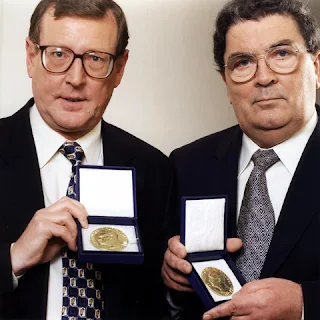
Twenty-five years later in 1999, when I first wrote this brief history, Northern Ireland was still ruled directly from Westminster. Unionists and Nationalists were continuing to argue over details of an agreement which, following a PIRA cease-fire was intended to put Ulster on a new, tolerant, democratic and above all peaceful path to the twenty-first century. The Good Friday Agreement (GFA) was endorsed by referenda in both Northern Ireland and the Republic, with the greatest support coming from Northern Ireland’s Catholic community. The two Northern Ireland politicians who lead the two sides in the talks, John Hume for the SDLP and David Trimble for the Official Unionist Party, then the main political representatives of the two communities were jointly awarded the Nobel Peace Prize in 1998.
In thirty years of the armed struggle, as Gerry Adams, President of Sinn Fein, with close ties to the PIRA said, 3000 people had died through both Nationalist and Loyalist paramilitary attacks and not an inch of territory had been gained; almost no political concessions had been won. Britain’s official policy is still little different to that stated in the Government of Ireland Act of 1920 – Northern Ireland will remain part of Britain until the Government of Northern Ireland decides otherwise. This was restated in the Good Friday Agreement as ‘until the majority of the people living there decide otherwise’.
Nationalist politicians involved in the talks now included members of Sinn Fein, the political wing of the Provisional IRA, who had agreed to a cease-fire, embraced democratic methods, as did Eamon de Valera three generations earlier in the south. In 1999 the IRA remained an armed force, albeit under cease-fire.
Since then the IRA has disarmed as provided for under the Good Friday Agreement and as verified by an independent Commission led by the Canadian, General John de Chastelain. Protestant Paramilitaries too have disarmed and accepted the GFA.
Ironically perhaps, as the political process took over from the armed struggle, the moderates in both communities were replaced by the former militants and the Official Unionists, once unchallenged as the political party of Protestant Loyalism, has virtually disappeared to be replaced by the Paisleyite Democratic Unionist Party (DUP) with its links to the Loyalist paramilitary Ulster Defence Association (UDA) and Ulster Volunteer Force (UVF). Similarly, the SDLP of John Hume and Gerry Fitt has been replaced by Sinn Fein led by Gerry Adams and Martin McGuinness, former second in command of the Derry Brigade of the IRA at the time of the Bloody Sunday massacre.
To many observers of Northern Ireland politics through the Troubles, perhaps the most astonishing development was the coming together of Ian Paisley, former fire-brand arch-enemy of Popery in all it manifestations, the fire-and brimstone implacable opponent of Terrance O’Neill’s gesture towards the Nationalist community by visiting a Catholic girls’ school, shaking hands with Martin McGuinness, former IRA Chief of Staff and now his Deputy First Minister in the Northern Ireland Assembly which Paisley now led. The two men, at least in public, displayed what looked like a genuine affection for each other. The lion had lain down with the... well, the other lion.
“Never! Never! Never! Never!” had become, “Well okay, so long as I can be leader”. Maybe it needed leaders with impeccable credential of implacable opposition to gain support of the two communities sufficient for them to co-operate for a better future for Ulster and not to be seen as self-serving and too prepared to compromise.
Maybe Paisley, having achieved his ambition to be the political leader of Ulster Protestants had nothing left to achieve and decided he would like to be remembered by history as the man who finally did the Christian thing, forgave his enemies and and made peace. Paisley has now retired from active politics and has handed power to his DUP deputy Peter Robinson who became DUP leader in his place.
As politics and democracy are increasingly accepted as the natural and proper means to express aspirations, just as in most of the United Kingdom, religion is becoming less relevant in both the north and the south of the island of Ireland. In a recent opinion poll a large majority of Ulster’s Catholics indicated that they wish to remain in Northern Ireland and for Northern Ireland to remain in the United Kingdom, and this in stark contrast to the increasingly separatist communities in Scotland and Wales.
In the Republic, the Catholic Church is being increasingly marginalised following a series of scandals. Nuns of the Magdalene Laundries were revealed to have physically and sexually abused abandoned and orphaned girls for whom they had care, and the Catholic Church at the most senior level has been found to have conspired to cover up a series of child abuses including the rape of young boys by Catholic priests.
The Catholic Church is currently finding it difficult to recruit new priests and people are leaving it in increasing numbers, many now openly describing themselves as having no religion. So low has it sunk in public esteem that Enda Kenny, leader of Fine Gael and Taoiseach of the Dail, recently launched an astonishingly frank attack on the Catholic Church, following publication of the Cloyne Report, an enquiry into child abuse by clerics, and received wide public acclaim for it. The Vatican promptly recalled the Papal Legate from Dublin. This is the Church which was formerly able to demand its special place in Ireland be written into the constitution and which was able, with a few edicts, to kill off the first tentative moves towards an Irish National Health Service in the 1940s.
On 27th June 2012, Martin McGuinness, Deputy First Minister of the Northern Ireland Assembly and former IRA Chief of Staff in Derry, shook hands with Queen Elizabeth II in Belfast during a visit to celebrate her diamond jubilee.
Ian Paisley died on 12 September, 2014.
The Troubles
So what changed?
![]() |
| Captain Terence O'Neill |
This began to stir the deep suspicions of the Protestant mind to the extent that Ian Paisley, a young fire-and-brimstone Presbyterian mister and orator with ambitions, was able to raise a mob of militant supporters. They staged a demonstration at Ballymena when O’neill visited a Catholic convent school there. They had marched behind him with banners proclaiming “O’Neill Arch Traitor”.
![]() |
| Ian Paisley 1969 |
Ulster Protestants were polarising on socio-economic line, with working class Protestants following Paisley and the establishment and landed gentry sticking with the Ulster Unionists of O’Neill, but only into opposing Protestant Unionist factions. There was no sense of commonality of interest between Catholics and Protestants from the same social class. The Protestants’ main concern was still how to keep what they had and to prevent Catholics getting any of it. The division was over the best way of achieving this, and O’Neill’s tentative moves towards reform (and they were no more than that) and Protestant insecurities were driving the process.
However, O’Neill’s perceptions were right. Catholics were beginning to make their voices heard and they were voices that were to rise to shouting pitch as the demand for reform and the perception that this was perhaps achievable grew. Inspired by the Civil Rights movement of Martin Luther King in America, at a meeting at Maghera, County Down, in 1966, a decision to form a similar movement in Northern Ireland was made. It would be non-violent, using the tactics of marching and civil disobedience, appealing to the world at large and occupying the moral high ground. Catholics had also taken heart from the election of two Nationalists MPs for the Westminster Parliament in the General Elections of 1964 and 1966 (Gerry Fitt and John Hume). They represented a social democratic and pacifist strand of Nationalism that believed change could best be brought about by working within the system and playing a full part in the political process. The Northern Ireland Civil Rights Association was formed in 1967. The IRA, who had waged an ineffectual campaign from 1956-62 and had lost most of its support in the process, played no part in its formation. It was described as ‘middle-aged, middle-class, and middle-of-the-road’.
Despite the declares non-violence of the NICRA, William Craig, Home Affairs Minister at Stormont, had banned a demonstration planned for 5 October 1968 in Londonderry. It went ahead none-the-less and was brutally broken up by the RUC. Ulster’s response to legitimate Catholic grievance had been met with gratuitous brutality by the state’s police force. This event began to change Catholic perceptions but worse was to come.On 1 January, 1969, a radical faction of the NICRA called People’s Democracy, which was attempting to broaden the appeal to include non-Catholics in a general class-based campaign for political reforms, began a march across Ulster from Belfast to Londonderry. Marchers carried banners demanding ‘One Man, one vote’. It had not been banned and had minimal police protection. The march arrived at Burntolett Bridge, seven miles from Derry, where it was attacked by a Protestant mob. Television news film showed RUC officers amongst the mob but doing little or nothing to prevent the attack. None of the attackers were arrested but instead the RUC arrested about eighty of the marchers they were supposed to be protecting. Later that evening, the RUC moved into Derry’s Catholic Bogside estate and indulged in a night of gratuitous violence and destruction, subjecting Catholics to sectarian abuse.
![]() |
| RUC Join in an attack on a peaceful Civil Rights March Burntolett Bridge, near Derry |
![]() |
| Loyalists and RUC attack the Catholic Bogside Estate Londonderry, 1969. |
Where was the IRA in all this?
They were almost non-existent. ‘IRA = I Ran Away’ became a popular slogan amongst the Catholic youth of the time. The IRA, following its failed campaign of 1956-62, had become a victim of its own irrelevance again, as it did in the Free State after 1922. It had fractured into divergent red revolutionary socialist factions and had lost much of its simple green patriotic republicanism. Now, it has a purpose once again as Catholics were being attacked by the state and British troops were on the streets of Belfast and Derry – albeit drinking tea and eating cakes made for them by ordinary Catholic families grateful for their protection. In late 1969, it split into a revolutionary Marxist ‘Official’ group and a traditionalist ‘Provisional’ faction, deliberately named after the declaration of a Provisional Government by Patrick Pearce from the Dublin Post Office during the Easter Rising of 1916. The Provisionals were harking back to the days of the Black and Tans and the campaign of Michael Collins, et al. It was to be a prophetic change of name.
![]() |
| Bernadette Devlin, MP |
It has to be said that Westminster, reacting to events, rather than controlling them, did not exactly help matters. In an attempt to minimise the effectiveness of the IRA, internment without trial was introduced in 1971 and even this was handled badly with detainees being tortures and Britain being convicted of torture in the Court of Human Rights. A demonstration against internment, during which Catholic youths began throwing stones at soldiers, was dispersed with gunfire when the Parachute Regiment shot thirteen unarmed Catholics in a panicky response to an assumed gunshot. Some of the dead were shot in the back and there was evidence that some were fatally shot whilst lying wounded on the ground. No charges were brought against any soldiers and a new enquirey into the events of Bloody Sunday (The Saville Report) has now reported. The British Government has formally apologised to the families of those affected by the killings.
![]() |
| Bobby Sands, MP |
Westminster, in exasperation at Stormont’s inability to reform the province, suspended the Northern Ireland parliament indefinitely in March 1973, imposed direct rule from Westminster, and introduced the reforms it had been demanding of Stormont. Full adult suffrage in local elections, based on one man, one vote, was introduced; the Londonderry Corporation was dissolved; the RUC was disarmed and the ‘B’ Specials were disbanded.
In a last ditch attempt to re-introduce devolved government in Northern Ireland, the Unionist Party under Brian Faulkner and the Social Democratic and Labour Party under John Hume and Gerry Fitt met at Suningdale in Surrey. There they signed the ‘Suningdale Agreement’ which would provide the basis of a power-sharing executive based at Stormont. A Council of Ireland, which included representatives of the Dail, was established to give an Irish dimension, as allowed for in the Government of Ireland Act of 1920.
Ulster Protestants would have none of it. They were not going to share power with Catholic Nationalists and that was that. They brought Northern Ireland to a standstill with the political Ulster Workers strike of 1974 and the power-sharing government collapsed.
![]() |
| David Trimble and John Hume With their Nobel Peace Medals |
In thirty years of the armed struggle, as Gerry Adams, President of Sinn Fein, with close ties to the PIRA said, 3000 people had died through both Nationalist and Loyalist paramilitary attacks and not an inch of territory had been gained; almost no political concessions had been won. Britain’s official policy is still little different to that stated in the Government of Ireland Act of 1920 – Northern Ireland will remain part of Britain until the Government of Northern Ireland decides otherwise. This was restated in the Good Friday Agreement as ‘until the majority of the people living there decide otherwise’.
Nationalist politicians involved in the talks now included members of Sinn Fein, the political wing of the Provisional IRA, who had agreed to a cease-fire, embraced democratic methods, as did Eamon de Valera three generations earlier in the south. In 1999 the IRA remained an armed force, albeit under cease-fire.
Since then the IRA has disarmed as provided for under the Good Friday Agreement and as verified by an independent Commission led by the Canadian, General John de Chastelain. Protestant Paramilitaries too have disarmed and accepted the GFA.
![]() |
| Gerry Adams, President of Sinn Fein |
![]() |
| Martin McGuinness, former IRA Chief of Staff Now Deputy First Minister in the Northern Ireland Assembly |
![]() |
| Ian Paisley and Martin McGuinness |
Maybe Paisley, having achieved his ambition to be the political leader of Ulster Protestants had nothing left to achieve and decided he would like to be remembered by history as the man who finally did the Christian thing, forgave his enemies and and made peace. Paisley has now retired from active politics and has handed power to his DUP deputy Peter Robinson who became DUP leader in his place.
As politics and democracy are increasingly accepted as the natural and proper means to express aspirations, just as in most of the United Kingdom, religion is becoming less relevant in both the north and the south of the island of Ireland. In a recent opinion poll a large majority of Ulster’s Catholics indicated that they wish to remain in Northern Ireland and for Northern Ireland to remain in the United Kingdom, and this in stark contrast to the increasingly separatist communities in Scotland and Wales.
In the Republic, the Catholic Church is being increasingly marginalised following a series of scandals. Nuns of the Magdalene Laundries were revealed to have physically and sexually abused abandoned and orphaned girls for whom they had care, and the Catholic Church at the most senior level has been found to have conspired to cover up a series of child abuses including the rape of young boys by Catholic priests.
![]() |
| Ian Paisley, First Minister of Northern Ireland Martin McGuinness, Deputy First Minister |
On 27th June 2012, Martin McGuinness, Deputy First Minister of the Northern Ireland Assembly and former IRA Chief of Staff in Derry, shook hands with Queen Elizabeth II in Belfast during a visit to celebrate her diamond jubilee.
Ian Paisley died on 12 September, 2014.
Labels:
History
A History of Ireland - 4. Suppression & Starvation
Part 4 of A History of Ireland
Catholic Suppression.
![]() |
| Anti-Catholic Penal Laws |
![]() |
| Mass Under the Penal Laws, St Mullins, Co. Carlow |
In fact, the penal laws as they related to the clergy, were widely flouted. Priests continued to be ordained by friars who stayed in Ireland. Local officials turned a blind eye, or were bribed to ignore them. It was simply impracticable to enforce the law in a country so overwhelmingly Catholic, so the church continued. Masses were said in the open or in ruined churches over makeshift altars. Being excluded from just about every other institution Catholics turned increasingly to the Church for identity and to secret societies such as he Whiteboys, an agrarian movement.
Early Nationalism.
Today, Irish Nationalism and Roman Catholicism seem inextricably interwoven. Generally speaking, Catholics are Republican and Nationalist and Protestants are Royalist and Unionist. Of course this is something of an over-simplification and many communities can be found, and may examples of people from both communities who are neither one nor the other. None-the-less, the association is strong. Certainly, no one would seriously doubt that Irish Nationalism is strongly Catholic.
![]() |
| Jonathan Swift |
It was not always so.
Irish Nationalism had its beginnings, not amongst the downtrodden, dispossessed and desperately poor Gaelic Irish, but amongst the emergent, affluent, and mostly Protestant, Irish middle class. It was predominantly inspired by the same sentiments that motivated the descendants of the original colonist of America to seek independence from the old country. It was the belief that they had come of age and were ready to determine their own destiny; to become a nation state in their own right. These new Irish rebels were the product of a society that had prospered and built the splendid buildings of Dublin and had produced a unique culture as expressed in the literature of Swift, Sherridan, Goldsmith and Burke. They were the new Irishmen.
So it was, that early in the eighteenth century, the Protestant Dean of St. Patrick’s Cathedral in Dublin, Jonathan Swift, had urged his fellow Irishmen to burn everything English except English coal. The theory was developing that in fact the English parliament had no legal right to legislate on Irish affairs; that the was the prerogative of an Irish parliament.
![]() |
| Henry Grattan (towards the left in red) addressing the Irish Parliament |
Then, in 1789, the French Revolution shook Europe. The Idea that the will of the people could shape nations made the established order tremble and the ordinary man to sit up and take note. It found fertile ground in Ireland, particularly in the anti-establishment minds of Ulster Presbyterians. In what was at first sight seems a remarkable paradox when seen against today’s circumstances, a group of Belfast Presbyterians formed the Society of United Irishmen to promote the twin goals of parliamentary reform and unification of the Catholic and Protestant nations into one. Such was the impact of the ‘New Order’ in France. New times, new direction. The time for the common man to come together in brotherhood. The Dublin-born Protestant, Wofe Tone, adopted the idea with enthusiasm.
![]() |
| United Irishmen |
In the rest of Ireland however, the United Irishmen were still organised and beginning to make links with the Catholic secret society, the Defenders, which was beginning to develop nationalist political thinking. Before long though, informants in high positions devastated the movement. Almost the entire leadership was arrested in one swoop in March 1798. The government again acted with characteristic brutality. In order to extract information the army used flogging as a torture. The standard punishment for a soldier was between 500 and 999 lashes and for civilians it was even worse. It mattered not whether the victim was guilty. If he had information, or only if he might have had information, the method was the same. He was tied to a wooden triangle and publicly flogged until he told what he knew. One eyewitness account says:
There was no ceremony used in choosing victims, the first to hand done well enough. ... They were stripped naked, tied to a triangle and their flesh cut through without mercy. And though some stood the torture to the last gasp sooner than become informers, others did not and one single informer in the town was enough to destroy all the United Irishmen in it.
![]() |
| Half Hanging |
It was against this backdrop of a systematic campaign of torture, and probably as a panicky reaction to it, that the first Catholic uprising occurred in support of the United Irismen’s cause at Wexford in 1798. Wexford had not been an especially troublesome area and had been lightly garrisoned, but the government got wind of an expected French landing and sent reinforcements with orders to search for arms. They set about the task with zeal and began flogging the Catholics with relish. What began as a localised resistance grew into a rebellion, but it was a rebellion that lacked direction, strategy, and leadership and which soon degenerated into atrocities. It culminated in the slaughter of 200 Protestant men, women and children prisoners who had been held in a barn at a farm known as Scullabogue. The barn was set on fire and those not burned to death were shot or piked to death. Finally, less than a month after the rebellion broke out the rebels were driven out of their main encampment at Vinager Hill.
![]() |
| Vinegar Hill Massacre |
![]() |
| Last Meeting of the Irish Parliament. |
Famine.
One event that perhaps stands out more than any other in the long tale of the Irish Gaelic suffering and humiliation, was the Great Famine of 1845-9. It has had a lasting influence on Irish Catholic psychology. Its impact has been likened to that of the Holocaust on the Jews. It is seen, rightly or wrongly, as a form of genocide perpetrated by the English on the Irish. The important thing, as with the 1642 massacre of Protestants at Porterdown Bridge, is not what actually happened, but what is believed to have happened.
![]() |
| Potato Famine |
Coupled with this was a huge population increase, almost doubling from four and a half million in 1800 to eight million by 1841. Population pressure resulted in more and more people living on smaller and smaller patches of land and concentrating more and more on the potato. The poorest had to hire out their labour, not for wages but for a small plot of land. With hindsight, disaster was inevitable should the potato crop fail. In fact, it did not need hindsight. The government was aware of the consequences, there having been a famine with thousands dead in 1817.
In 1845, it happened. On 20 August 1845, the Freeman’s Journal reported:
DISEASE IN THE POTATO CROP
We regret to have to state that we have had communications from more than one well-informed correspondent announcing the fact of what is called ‘cholera’ in potatoes in Ireland, especially in the North. In one instance the party has been digging potatoes – the finest he had ever seen – from a particular field, and a particular ridge of that field up to Monday last; and on digging in the same field on Tuesday he found the tubers all blasted, and unfit for the use of man or beast.Potato blight had struck.
By the middle of October, there were extensive reports of potato crop failures and they were most widespread in the west. By February 1846, three quarters of the potato crop had been lost, there were outbreaks of typhus in Cork and Kilkenny and, by March, it had been recorded in twenty-five of the thirty-two counties.
![]() |
| An eviction during the Great Famine |
Food had to be paid for at the market rate. This, of course, completely failed to take account of the fact that the poor Irish could not afford to buy food, which is why they depended almost wholly on the potato in the first place. It would have mattered not how low the price was since they had no money. For very many Catholics, rural Ireland was a cashless economy.
The Prime Minister, Sir Robert Walpole, instigated a three-point plan:
- Repeal of the Corn Law, which was an essentially protectionist measure to keep the price of imported corn high, so reducing the price of bread.
- Introduce a system of public works to provide employment.
- Import supplies of maize (Indian corn).
The first of these measures, though, for Walpole the most imaginative and politically difficult, was almost completely irrelevant to the starving Irish since they could not afford to buy bread no matter how cheap it became.
The second had some success but, because of bureaucratic obstacles, was slow. It was usually too little and too late. Many people who found work building roads were simply too weakened by hunger to work and very many died on the job. Additionally, the money was so slow in being released that many people went unpaid, often for several weeks. One such was Jeremiah Hegarty, whose body had been found on the road outside Skibbereen. The coroner’s jury found that death was due to ‘want of sufficient sustenance for many days previous to his decease, and that this want of sustenance was occasioned by his not having been paid his wages on the public works... for eight days prior to the time of his death.
The third, though perhaps, at first sight a humanitarian measure, was in fact nothing more than a limited and timid attempt to influence the market for food. There had not been a market at all for maize, or Indian corn, as it was then known in Ireland, so it was considered safe to allow it to be sent there since there was no sacred market to damage. However, the plan was not simply to give it to the starving Irish. It was to be stored in the Government depot in Cork to be used judiciously as an economic lever when the general price of food rose too high. The first shipment of Indian corn in January 1846 but was not released until April that year. Then a near riot broke out.
Almost unbelievably, Ireland was not short of food. It was exporting vast quantities. Crops of other food were excellent; they were just not available to the starving poor. People were starving in the midst of plenty. In the autumn of 1848, just as news that the potato crop had failed again, the export of food from Cork on a single day, 14 November 1848 was:
147 bales of bacon 120 casks and 135 barrels of pork 5 casks of hams 149 casks miscellaneous provisions 1,996 sacks, and 950 barrels of oats 300 bags of flour 300 head of cattle 239 sheep 9398 firkins of butter 542 boxes of eggs |
Trevelyan’s chief concern was that the market forces were being interfered with. People in Ireland normally suffered distress at this time of the year. It was natural and part of the economic cycle. He wrote:
Indiscriminate sales have brought the whole country on the depots, and, without denying the existence of real and extensive distress, the number are beyond the power of the depots to cope with. They must therefore be closed down as soon as possible.
![]() |
| Population Change During the Great Famine |
It was the most appalling sight I ever witnessed: women, young and old, running to and fro with small portions of their property to save it from the wreck – the screaming of the children, and wild wailings of the mothers driven from home and shelter... In the first instance the roofs and portions of the wall only were thrown down. But that Friday night the wretched creatures pitched a few poles slant-wise against the walls covering them with thatch in order to produce shelter for the night. When this was perceived the next day the bailiffs were dispatched with orders to pull down all the walls and root up the foundations in order to prevent the poor people from daring to take shelter amid the ruins”.
So the famine dragged on. A Catholic priest wrote:
![]() |
| Potato Famine Memorial |
... funerals passing and re-passing in every direction, the congregation on Sunday reduced by half, the churchyard like fields lately tilled, without a green spot, constantly visited by processions of a few gaunt figures, carrying with difficulty the remains of some more fortunate relative or friend... From the sad effects of the calamity all classes have suffered severely, but most of all those on the public works, and especially the old and decrepit of both sexes who were exposed without food or clothing to the piercing cold of winter. Indeed, almost all of these are dead. Being secretary to the relief committee of the district I have had a good opportunity of witnessing the dreadful effects of the system... on these poor creatures and could at this moment refer to many casesof persons who attended the committee for weeks before they could be admitted on the books, and, when admitted a few days later, had scarcely time to earn themselves the price of a coffin.
The population of Ireland in 1841 had been 8,175,124. At normal rates of increase, it would have been 9,018,799 by 1851 but a census in that year shows it to have been 6,552,285. Given that about 1,500,000 emigrated between 1845 and 1849 this still leaves about 1,000,000 unaccounted for. Modern Irish historians put the actual death from famine at about 800,000. They died in a nation that had plenty, the victims of official indifference and doctrinaire free-market economics. They were just as much the victims of religious zealotry as the victims at Porterdown Bridge and Drogheda, though on a vastly larger scale.
Labels:
History
Subscribe to:
Comments
(
Atom
)