

Forget sci-fi wormholes — physicists now think Einstein’s mysterious “bridge” may connect two directions of time itself.
Credit: AI/ScienceDaily.com
A paper published open access in January 2026 in the journal Classical and Quantum Gravity should, if creationists could understand it, shoot one of their favourite foxes: the supposed killer question, "What came before the Big Bang?"
Only a creationist could believe the absurd notion that once literally nothing existed as a state of being, and that a god — presumably also made of nothing, because there was nothing to make it from — simultaneously existed and created everything out of that nothing by casting a magic spell, spoken in a language there was no-one else to communicate with in. The first intuitive mistake in that convoluted nonsense is the assumption that the default state of existence is non-existence.
Creationists, however, hypocritically try to hold science to a much higher standard than they apply to their own nonsensical superstitions. While demanding answers to what they imagine are "Gotcha!" questions of science, they routinely dismiss any answer with a wave of the hand. One favourite "Gotcha!" is: what was there before the Big Bang? The usual response is that, in the simplest version of standard cosmology, the question may be meaningless, because time and space themselves are part of the universe being described. If time does not extend through t = 0, then there is no "before" in the ordinary sense. But to a teleologically minded creationist, the answer that there was no "before" at the Big Bang sounds like a cop-out — a way of avoiding the question.
But what if there was a "before", not in the naive sense of empty time waiting around for a universe to be inserted into it, but in the deeper sense that what we call the Big Bang may have been a transition between two time-related phases of a larger physical system?
That this is at least a theoretical possibility comes from the work of three theoretical physicists, Enrique Gaztañaga and K. Sravan Kumar of the Institute of Cosmology & Gravitation, University of Portsmouth, UK, and João Marto of the Departamento de Física, Centro de Matemática e Aplicações (CMA-UBI), Universidade da Beira Interior, Portugal. They have revisited the work of Albert Einstein and Nathan Rosen, whose 1935 paper led to the idea of Einstein–Rosen bridges. These were later popularly interpreted as "wormholes" connecting different regions of spacetime, although that was not the original purpose of the idea.
Using a quantum-field-theoretic approach, Gaztañaga, Kumar and Marto argue that Einstein–Rosen bridges may not be space-travel tunnels at all, but mathematical bridges connecting two complementary components of a quantum state — two microscopic arrows of time. In one component, time flows in the direction we experience; in the other, it is mirrored in the opposite direction. Near black holes, or in expanding and collapsing universes, both components may be needed for a complete quantum description.
This offers a possible route through the black hole information paradox: the puzzle of how information can be preserved when matter crosses an event horizon and a black hole eventually evaporates. In the authors’ interpretation, information is not destroyed; it continues to evolve through the time-reversed, mirror component of the quantum state. That would preserve the quantum requirement that information is not simply lost, without requiring science-fiction wormholes, time machines or supernatural intervention.
The idea also opens the possibility that what we call the Big Bang was not an absolute beginning, but a bounce — a quantum transition from a preceding phase of cosmic evolution. In that scenario, our universe could even be the interior of a black hole formed in an earlier, parent cosmos, where collapse on one side becomes expansion on the other. The Big Bang, in other words, would not be a magical creation event, but a natural physical gateway.
That possibility also recalls an earlier speculative but serious scientific idea proposed by Lee Smolin in 1992, known as cosmological natural selection. Smolin suggested that black holes might give rise to new universes, with the physical constants of each descendant universe varying slightly from those of its parent. Universes whose laws favour the formation of many black holes would therefore tend to leave more descendant universes, rather as organisms that leave more offspring become over-represented in a biological population.
This is not evolution by genes, of course, and it is not established fact. It is a speculative cosmological hypothesis. But it is scientific speculation of the proper kind: naturalistic, mathematically framed, open to criticism and, in principle, vulnerable to observational evidence. It stands in stark contrast to creationism, which answers the same question with nothing more substantial than magic, asserted certainty and Bronze Age mythology.
One of the authors of the paper, Enrique Gaztanaga, also wrote an article in The Conversation, explaining their idea for a lay readership. His article is reprinted here under a Creative Commons licence, reformatted for stylistic consistency:

Wormholes may not exist – we’ve found they reveal something deeper about time and the universe
Enrique Gaztanaga, University of Portsmouth
Wormholes are often imagined as tunnels through space or time — shortcuts across the universe. But this image rests on a misunderstanding of work by physicists Albert Einstein and Nathan Rosen.
In 1935, while studying the behaviour of particles in regions of extreme gravity, Einstein and Rosen introduced what they called a “bridge”: a mathematical link between two perfectly symmetrical copies of spacetime. It was not intended as a passage for travel, but as a way to maintain consistency between gravity and quantum physics. Only later did Einstein–Rosen bridges become associated with wormholes, despite having little to do with the original idea.
But in new research, my colleagues and I show that the original Einstein–Rosen bridge points to something far stranger — and more fundamental — than a wormhole.
The puzzle Einstein and Rosen were addressing was never about space travel, but about how quantum fields behave in curved spacetime. Interpreted this way, the Einstein–Rosen bridge acts as a mirror in spacetime: a connection between two microscopic arrows of time.
Quantum mechanics governs nature at the smallest scales such as particles, while Einstein’s theory of general relativity applies to gravity and spacetime. Reconciling the two remains one of physics’ deepest challenges. And excitingly, our reinterpretation may offer a path to doing this.
A misunderstood legacy
The “wormhole” interpretation emerged decades after Einstein and Rosen’s work, when physicists speculated about crossing from one side of spacetime to the other, most notably in the late-1980s research.
But those same analyses also made clear how speculative the idea was: within general relativity, such a journey is forbidden. The bridge pinches off faster than light could traverse it, rendering it non-traversable. Einstein–Rosen bridges are therefore unstable and unobservable — mathematical structures, not portals.
Nevertheless, the wormhole metaphor flourished in popular culture and speculative theoretical physics. The idea that black holes might connect distant regions of the cosmos — or even act as time machines — inspired countless papers, books and films.
Yet there is no observational evidence for macroscopic wormholes, nor any compelling theoretical reason to expect them within Einstein’s theory. While speculative extensions of physics — such as exotic forms of matter or modifications of general relativity — have been proposed to support such structures, they remain untested and highly conjectural.
Two arrows of time
Our recent work revisits the Einstein–Rosen bridge puzzle using a modern quantum interpretation of time, building on ideas developed by Sravan Kumar and João Marto.
Most fundamental laws of physics do not distinguish between past and future, or between left and right. If time or space is reversed in their equations, the laws remain valid. Taking these symmetries seriously leads to a different interpretation of the Einstein–Rosen bridge.
Rather than a tunnel through space, it can be understood as two complementary components of a quantum state. In one, time flows forward; in the other, it flows backward from its mirror-reflected position.
This symmetry is not a philosophical preference. Once infinities are excluded, quantum evolution must remain complete and reversible at the microscopic level — even in the presence of gravity.
The “bridge” expresses the fact that both time components are needed to describe a complete physical system. In ordinary situations, physicists ignore the time-reversed component by choosing a single arrow of time.
But near black holes, or in expanding and collapsing universes, both directions must be included for a consistent quantum description. It is here that Einstein–Rosen bridges naturally arise.
Solving the information paradox
At the microscopic level, the bridge allows information to pass across what appears to us as an event horizon – a point of no return. Information does not vanish; it continues evolving, but along the opposite, mirror temporal direction.
This framework offers a natural resolution to the famous black hole information paradox. In 1974, Stephen Hawking showed that black holes radiate heat and can eventually evaporate, apparently erasing all information about what fell into them — contradicting the quantum principle that evolution must preserve information.
The paradox arises only if we insist on describing horizons using a single, one-sided arrow of time extrapolated to infinity — an assumption quantum mechanics itself does not require.
If the full quantum description includes both time directions, nothing is truly lost. Information leaves our time direction and re-emerges along the reversed one. Completeness and causality are preserved, without invoking exotic new physics.
These ideas are difficult to grasp because we are macroscopic beings who experience only one direction of time. On everyday scales, disorder — or entropy — tends to increase. A highly ordered state naturally evolves into a disordered one, never the reverse. This gives us an arrow of time.
But quantum mechanics allows more subtle behaviour. Intriguingly, evidence for this hidden structure may already exist. The cosmic microwave background — the afterglow of the Big Bang — shows a small but persistent asymmetry: a preference for one spatial orientation over its mirror image.
This anomaly has puzzled cosmologists for two decades. Standard models assign it extremely low probability — unless mirror quantum components are included.
Echoes of a prior universe?
This picture connects naturally to a deeper possibility. What we call the “Big Bang” may not have been the absolute beginning, but a bounce — a quantum transition between two time-reversed phases of cosmic evolution.
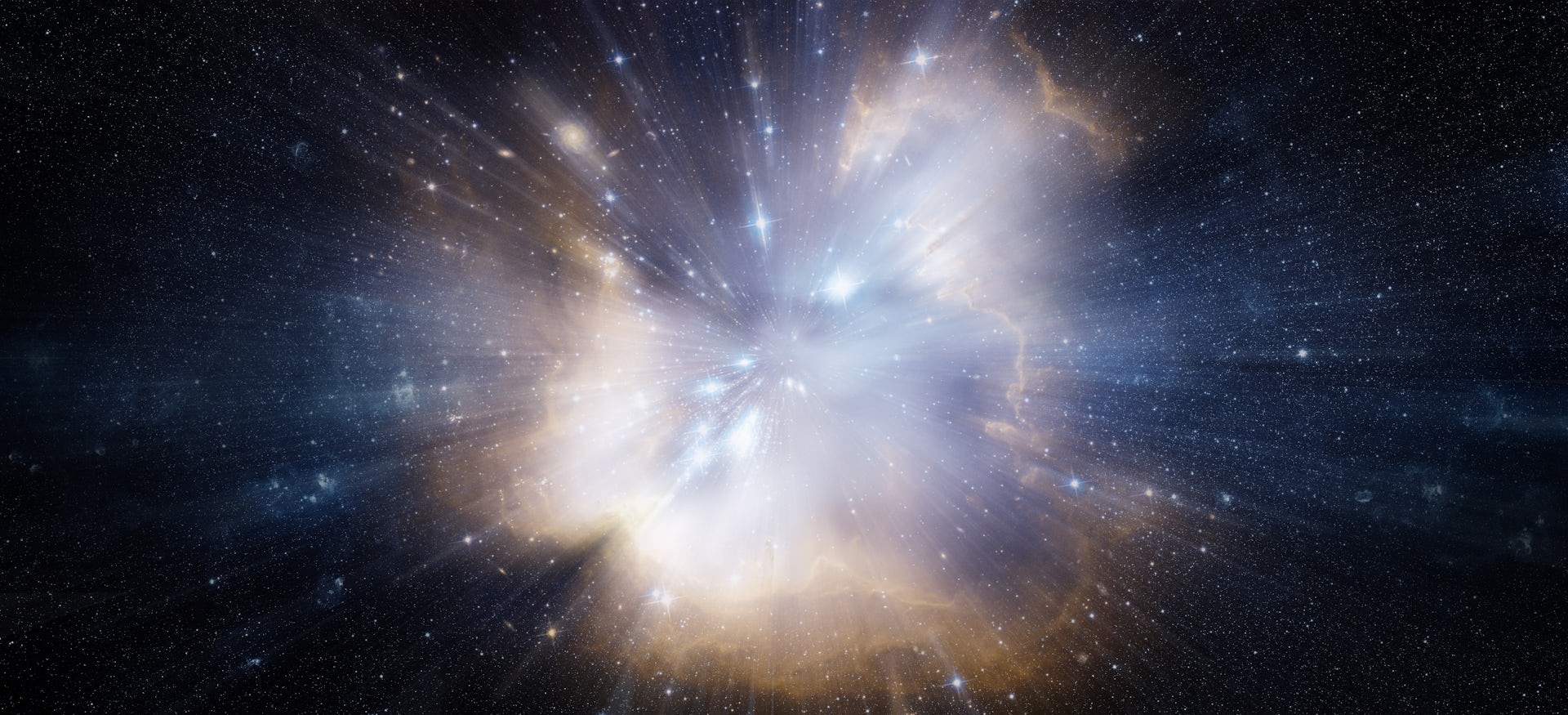
Was the big bang really the beginning?
If this picture is correct, it also offers a way for observations to decide. Relics from the pre-bounce phase — such as smaller black holes — could survive the transition and reappear in our expanding universe. Some of the unseen matter we attribute to dark matter could, in fact, be made of such relics.
In this view, the Big Bang evolved from conditions in a preceding contraction. Wormholes aren’t necessary: the bridge is temporal, not spatial — and the Big Bang becomes a gateway, not a beginning.
This reinterpretation of Einstein–Rosen bridges offers no shortcuts across galaxies, no time travel and no science-fiction wormholes or hyperspace. What it offers is far deeper. It offers a consistent quantum picture of gravity in which spacetime embodies a balance between opposite directions of time — and where our universe may have had a history before the Big Bang.
It does not overthrow Einstein’s relativity or quantum physics — it completes them. The next revolution in physics may not take us faster than light — but it could reveal that time, deep down in the microscopic world and in a bouncing universe, flows both ways.

Enrique Gaztanaga, Professor of Astrophysics at Institute of Cosmology and Gravitation, University of Portsmouth
This article is republished from The Conversation under a Creative Commons license. Read the original article.

The important point here is not that this hypothesis has been proved, nor that cosmologists have now definitively answered what, if anything, preceded the Big Bang. The point is that science can ask such questions without retreating into magic. It can frame possibilities in mathematics, test them for internal consistency, compare them with what is already known, and discard or modify them if they fail. That is how knowledge advances.
Creationism, by contrast, has no such mechanism for self-correction. It begins with the answer it wants — a magic creator — then tries to force every gap in current knowledge into service as evidence for that conclusion. But a gap in scientific knowledge is not evidence for a god; it is merely an invitation to investigate further. Time and again, where creationists once parked their god, science has found natural processes.
Whether Gaztañaga and colleagues are right or wrong in detail, their work illustrates the enormous difference between science and superstition. Here is a naturalistic proposal that treats the Big Bang not as an inexplicable supernatural conjuring trick, but as a possible physical transition in a wider cosmic structure. It may turn out to be correct, partly correct, or wrong — but it is the sort of wrong that can teach us something, because it is grounded in physics rather than faith.
And that is the real problem for creationism. It offers no comparable research programme, no equations, no predictions, no observations that could prove it wrong, and no reason to prefer it over any other creation myth. Its answer to "What came before the Big Bang?" is simply, "Our preferred god did it", which explains nothing because it merely replaces one mystery with a bigger, unevidenced one.
Science does not need to know everything to be superior to creationism. It only needs to keep doing what creationism cannot do: ask honest questions, follow the evidence, revise its models, and look for natural explanations. If the universe had a "before", science is the only method likely to discover it. If it did not, science is still the only method capable of explaining why that question may be meaningless. Either way, magic is redundant.
Advertisement
Amazon

Amazon

Amazon

Amazon

Amazon

Amazon

Amazon

Amazon

Amazon

Amazon

Amazon

Amazon

All titles available in paperback, hardcover, ebook for Kindle and audio format.
Prices correct at time of publication. for current prices.



No comments :
Post a Comment
Obscene, threatening or obnoxious messages, preaching, abuse and spam will be removed, as will anything by known Internet trolls and stalkers, by known sock-puppet accounts and anything not connected with the post,
A claim made without evidence can be dismissed without evidence. Remember: your opinion is not an established fact unless corroborated.