
Impression of Protemnodon tumbuna
AI-generated image (ChatGPT 5.5 Thinking)
It is probably fair to say that no branch of science is a friend of creationism. That is presumably why creationists devote so much time and effort to trying to discredit science—often without the slightest appreciation of the irony of using computers and the Internet, both products of science and engineering, to tell the world that science does not work. Yet their attitude towards science is not merely hostile but opportunistic: whenever they encounter a scientific finding that they think can be misrepresented as supporting creationism, they suddenly become jubilant champions of ‘the evidence’.
Archaeology is one of the most persistent threats to literalist creationism. Far from confirming the biblical narrative, it repeatedly uncovers evidence of human cultures, environmental changes and extinct animals extending far beyond the few thousand years permitted by Young Earth Creationism. Nor does archaeology stand alone. Its findings repeatedly converge with those of genetics, palaeontology, geology and climatology to produce the same coherent history—a history in which neither a recent magical creation nor a global genocidal flood leaves the slightest trace.
True to form, a recently published paper in the journal npj Biodiversity, by an Australian-based team of archaeologists and palaeontologists, presents evidence from New Guinea that simply could not exist if the biblical narratives of a magical creation a few thousand years ago, followed by a global flood about 4,300 years ago, bore any resemblance to reality. The evidence indicates that a large extinct kangaroo relative—probably Protemnodon tumbuna—survived on the northern coast of New Guinea until the Middle Holocene, perhaps as recently as about 6,500 years ago.
This was tens of thousands of years after every known species of Protemnodon had disappeared from Australia, where the genus is thought to have become extinct by about 41,000 years ago, along with most of the continent’s other megafauna.
Protemnodon tumbuna was a stocky, muscular forest-dwelling kangaroo weighing an estimated 50–90 kilograms—roughly comparable in size to a modern red kangaroo. Unlike modern large kangaroos, however, it was probably predominantly quadrupedal, using its powerful forelimbs to move through dense forest and hopping only inefficiently and for short distances, if at all. It was one of seven currently recognised species of Protemnodon known collectively from Australia and New Guinea.
The evidence from Taora consists of a single manual phalanx—a finger bone—recovered from a densely packed archaeological deposit containing discarded animal bones, marine shells and stone artefacts, together with hundreds of small bone points that probably tipped fishing spears or arrows. Marine waters had occupied the shelter during a Middle Holocene highstand, but after they receded about 6,800 years ago, people began using the site intensively. Over the following 1,500 years, they accumulated more than a metre of cultural material.
The researchers compared the shape and measurements of the Taora bone with those of numerous living and extinct kangaroos and wallabies. It was far larger than the corresponding bones of any macropodid now living in New Guinea and most closely resembled members of the genus Protemnodon. Its robust structure was also consistent with the weight-bearing forelimb expected in a large, predominantly quadrupedal forest kangaroo.
Because no directly comparable finger bones of P. tumbuna have yet been discovered, the identification cannot be regarded as absolutely conclusive. The researchers acknowledge that it could conceivably belong to another extinct New Guinean kangaroo, Nombe nombe. However, the combined anatomical, ecological, geographical and palaeontological evidence makes a species of Protemnodon—most probably P. tumbuna—the more likely identification.
The three researchers have now explained their findings in an article in The Conversation. Their article is reproduced below under a Creative Commons licence, with its formatting adjusted for stylistic consistency:

Giant kangaroos survived until 6,500 years ago on the New Guinea coast
Artist’s impression of Protemnodon tumbuna from Nombe Rockshelter.
Peter Schouten
Roughly 50,000 years ago, a kangaroo unlike any alive today lived in the mountain rainforests of New Guinea.
First discovered by Western science in 1983, Protemnodon tumbuna was roughly the size of a modern red kangaroo but much more stocky and muscular. Most peculiarly, it hopped little, if at all. It moved mostly on all fours, with long, strong forelimbs providing support for agile bounding through complex and steep terrain.
This strange animal was one of many megafauna that once roamed Australia and New Guinea. It is thought to have gone extinct some 20,000 to 50,000 years ago.
However, our new study, published in the journal npj Biodiversity, suggests Protemnodon tumbuna survived until as late as 6,000 years ago in northern New Guinea.
This constitutes solid evidence the Australian and New Guinean megafauna did not all go extinct at the same time, but that some hung on for much longer than others. It also contributes to a more complex image than conventional arguments about what drove the extinction of megafauna.
Clues from Papua New Guinea
All seven Protemnodon species had gone extinct in Australia by 41,000 years ago, along with nearly all other megafauna species. Whether the final extinctions in this process were driven primarily by climate change or human overhunting remains heavily debated.
But in New Guinea, the evidence is mounting towards a rather different story.
At the Nombe rockshelter, in the highlands of eastern Papua New Guinea, fossils of Protemnodon tumbuna show it lived locally until 22,000 to 27,000 years ago, during the last ice age.
More evidence of late-surviving Protemnodon tumbuna in New Guinea came in 2024 with the discovery of a single tooth from Lachitu cave, located in the foothills of the Oenake Range, on the northwest coast of Papua New Guinea.
The tooth had come from a limestone deposit dated 18,000 years old or younger, although it’s unclear whether the tooth itself was also that recent.
In 2004, archaeological excavations at Taora – a rockshelter just west of Lachitu – produced a large collection of well-preserved animal remains.
After maximum sea levels receded 6,800 years ago, Taora was used intensely by people exploiting nearby marine and rainforest resources. Over the next 1,500 years, they rapidly built up a dense deposit of discarded bones and shells, and hundreds of small bone points that likely tipped fishing spears or arrows.
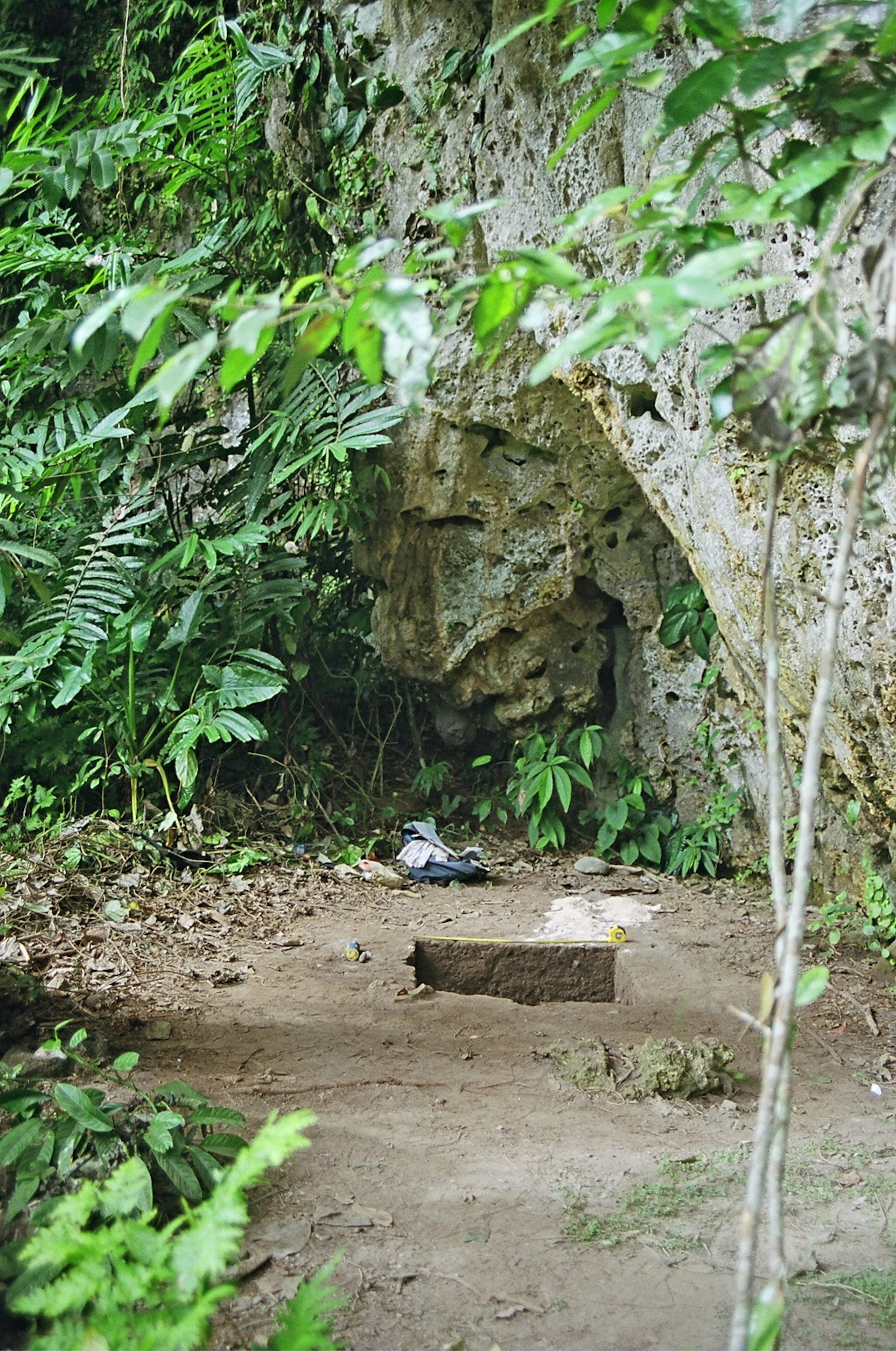
Archaeological excavation at Taora rockshelter in 2004 which found the megafauna fossil.
Anthony Barham
While examining this rich collection to understand how ancient people had lived in the dense coastal rainforest, one bone stood out to us.
It was from the finger of a macropodid – a member of the kangaroo family – but one much larger than any species of marsupial found in New Guinea today.
Suspecting it represented an unrecorded species, we compared the specimen’s shape and size to as many extant and extinct macropodids as possible to determine which one it likely belonged to.
The Taora fossil is clearly different to all currently living macropodids. It’s most similar to members of Protemnodon – specifically, the New Guinean species Protemnondon otibandus.
This species is thought to be the ancient ancestor of Protemnodon tumbuna, for which no fossils of the finger bones are known.
The fossil has some unique traits that distinguish it from other Protemnodon species, including very prominent projections above the area where this middle finger bone joins to the claw.
But on the whole, it closely resembles many species in the genus. And since we know Protemnodon tumbuna was present in the local area (a few kilometres away), perhaps as recently as 18,000 years ago, the fossil from Taora most likely belongs to it.
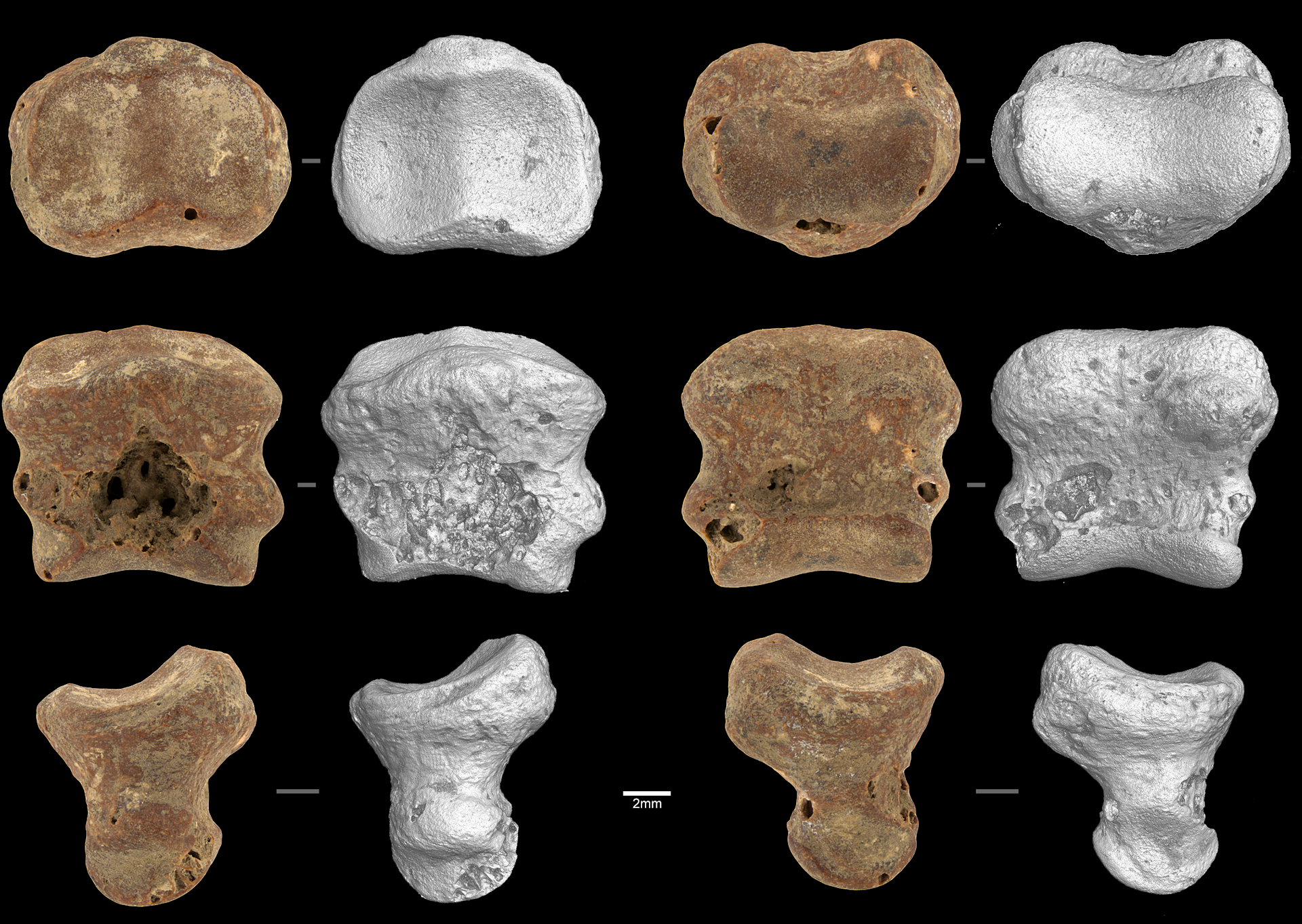
The giant kangaroo fossil from Taora, a finger bone which probably belongs to Protemnodon tumbuna.
Loukas Koungoulos
Read together with the existing evidence from Nombe and Lachitu, the Taora fossil shows people must have co-existed with some species of megafauna for tens of thousands of years. They would have done so while also developing agriculture and village-dwelling societies in New Guinea.
That’s a far cry from the “overkill” model, which suggests the earliest First Nations people of Australia and New Guinea rapidly hunted all remaining megafauna to extinction.
This doesn’t mean people couldn’t have contributed somehow to the extinctions. But it does point to a complex scenario and the key role of each species’ unique biology and ecology in how they fared against human hunting and finer-scale habitat change.
On the north coast of New Guinea, both factors were likely at play.
Studies of Protemnodon teeth from Mount Etna in central eastern Queensland have found these kangaroos had small home ranges. They didn’t move far in order to forage or migrate, a tendency that would leave them extremely vulnerable to habitat loss.
Drying climates over the past few hundred thousand years steadily shrank their highland rainforest habitat in New Guinea – and stimulated the rapid growth of nearby human populations. Eventually, the habitat became so small it couldn’t support a viable population of these ancient kangaroos.
Trapped and unable to reach their increasingly distant home, the last giant kangaroos of New Guinea’s north coast would have quickly succumbed to even light hunting pressure, joining other rare marsupials that disappeared from this region at the same time in the face of post-glacial environmental changes.
As we continue to uncover the fossil secrets of this remote section of New Guinea, there may yet be more twists in the story of Australia and New Guinea’s shared palaeohistory.

Loukas Koungoulos, Laureate Research Fellow, School of Social Sciences, The University of Western Australia; Isaac A. R. Kerr, Research Assistant at Flinders University Palaeontology Laboratory, Flinders University, and Sue O'Connor, Distinguished Professor, School of Culture, History & Language, Australian National University
This article is republished from The Conversation under a Creative Commons license. Read the original article.


Whatever the precise species represented by the Taora finger bone, its significance is difficult to dismiss. It belonged to a giant kangaroo-like animal that survived in northern New Guinea until the Middle Holocene, long after its relatives had disappeared from Australia. The archaeological layer in which it was found was deposited thousands of years before the supposed date of Noah’s flood and preserves a detailed record of people exploiting a coastal environment that had developed gradually as sea levels changed.
That is not what we should expect to find if the history of the world consisted of a recent magical creation followed by a planet-wide inundation that destroyed almost every terrestrial animal and reduced humanity to a single family. Instead, we find continuity: changing shorelines, established human communities, local extinctions and isolated animal populations surviving for different lengths of time in different places. It is the untidy, contingent history predicted by evolution, ecology and geology—not the abrupt supernatural drama described in Genesis.
Creationists may try to focus on the uncertainty over whether the bone belonged specifically to Protemnodon tumbuna, as though normal scientific caution invalidated the entire discovery. It does not. Science distinguishes carefully between what is firmly established and what remains provisional. The date and archaeological context are secure; the animal was a large extinct macropodid; and Protemnodon is the most plausible identification. Refining the species name would alter none of the implications for Young Earth Creationism.
Once again, archaeology has not uncovered evidence of creation or a global flood. It has uncovered another fragment of a complex prehistoric world that existed long before the biblical chronology allows. And once again, creationism survives not by explaining the evidence, but by ensuring that its followers never look at it too closely.
Advertisement
Amazon

Amazon

Amazon

Amazon

Amazon

Amazon

Amazon

Amazon

Amazon

Amazon

Amazon

Amazon

All titles available in paperback, hardcover, ebook for Kindle and audio format.
Prices correct at time of publication. for current prices.



No comments :
Post a Comment
Obscene, threatening or obnoxious messages, preaching, abuse and spam will be removed, as will anything by known Internet trolls and stalkers, by known sock-puppet accounts and anything not connected with the post,
A claim made without evidence can be dismissed without evidence. Remember: your opinion is not an established fact unless corroborated.