56 million years ago, the Earth suddenly heated up – and many plants stopped working properly


The cause of this, the Palaeocene–Eocene Thermal Maximum (PETM), lay in the disruption of one of Earth’s major feedback systems. Plants sequester carbon through photosynthesis and lock it into their tissues, but that system was pushed out of balance until a new equilibrium eventually formed. It took some 70,000–100,000 years for the planet to recover.
The problem was that higher temperatures caused many plants to fail because they had evolved for cooler conditions, and evolution proceeds far too slowly to cope with rapid environmental change. As plant productivity collapsed, less carbon was sequestered, which in turn drove temperatures higher — a classic positive feedback loop, triggered by a relatively small initial shift.
The worrying parallel today is that the current rate of anthropogenic warming is around ten times greater than at the onset of the PETM.
How we know this — and how the PETM reshaped climate and the terrestrial biosphere — is explored in a paper by an international team of scientists, published open access (in unedited form) in Nature Communications.
Two of the authors have also written a summary of their research in The Conversation. Their article is republished here under a Creative Commons licence, with formatting adjusted for consistency.

56 million years ago, the Earth suddenly heated up – and many plants stopped working properly
Forest life in the Paleocene-Eocene Thermal Maximum
AI-Generated image (ChatGPT 5.1)
Vera Korasidis, The University of Melbourne and Julian Rogger, University of Bristol
Around 56 million years ago, Earth suddenly got much hotter. Over about 5,000 years, the amount of carbon in the atmosphere drastically increased and global temperatures shot up by some 6°C.
As we show in new research published in Nature Communications, one consequence was that many of the world’s plants could no longer thrive. As a result, they soaked up less carbon from the atmosphere, which may have contributed to another interesting thing about this prehistoric planetary heatwave: it lasted more than 100,000 years.
Today Earth is warming around ten times faster than it did 56 million years ago, which may make it even harder for modern plants to adapt.
Rewinding 56 million years
Plants can help regulate the climate through a process known as carbon sequestration. This involves capturing carbon dioxide from the atmosphere via photosynthesis and storing it in their leaves, wood and roots.
However, abrupt global warming may temporarily impact this regulating function.
Investigating how Earth’s vegetation responded to the rapid global warming event around 56 million years ago – known formally as the Paleocene-Eocene Thermal Maximum (or PETM) – isn’t easy.
To do so, we developed a computer model simulating plant evolution, dispersal, and carbon cycling. We compared model outputs to fossil pollen and plant trait data from three sites to reconstruct vegetation changes such as height, leaf mass, and deciduousness across the warming event.
The three sites include: the Bighorn Basin in the United States, the North Sea and the Arctic Circle.
We focused our research on fossil pollen due to many unique properties.
First, pollen is produced in copious amounts. Second, it travels extensively via air and water currents. Third, it possesses a resilient structure that withstands decay, allowing for its excellent preservation in ancient geological formations.
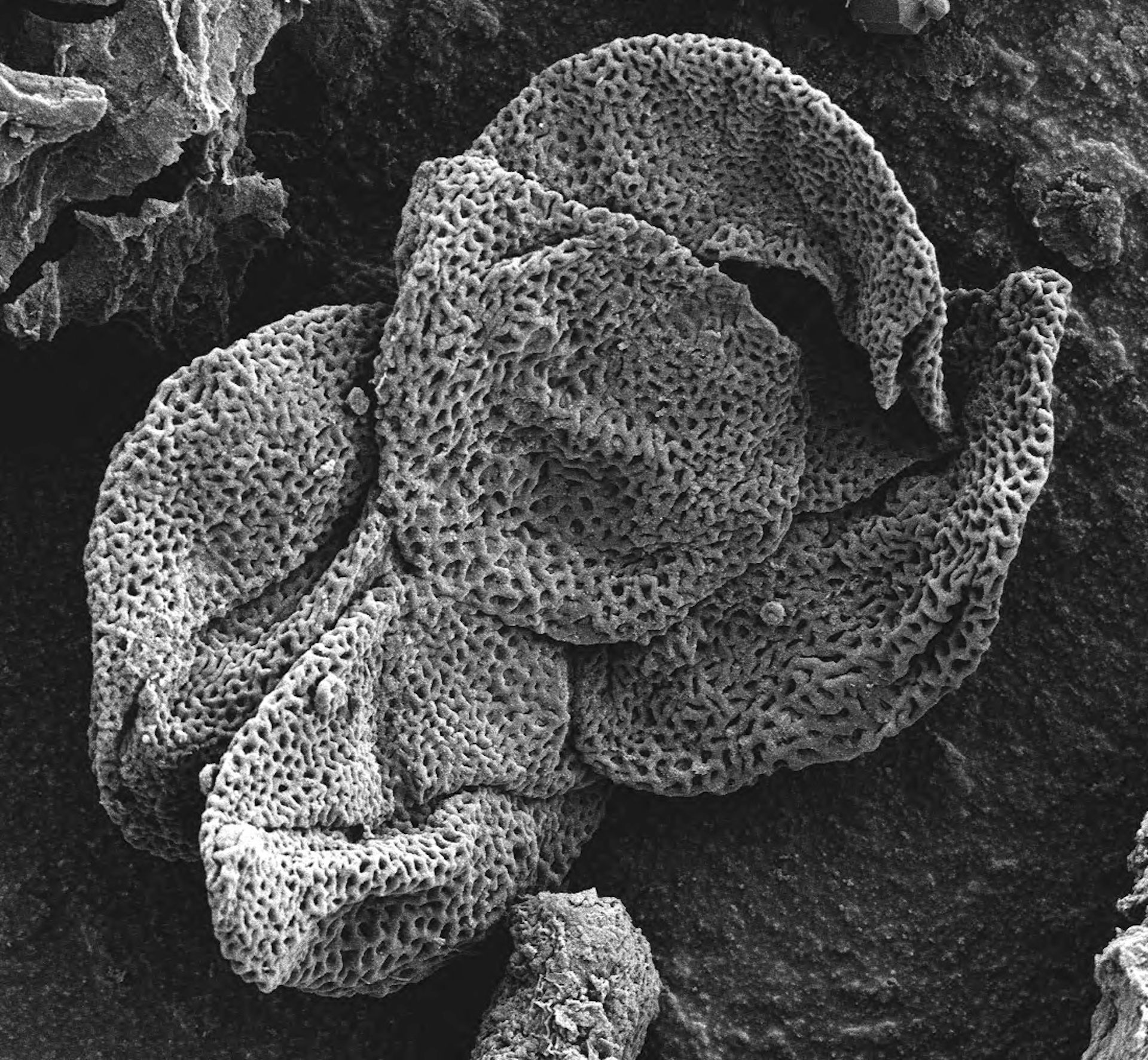
56-million-year-old fossilised palm pollen from the Bighorn Basin, Wyoming, United States.
Vera Korasidis
In the mid-latitude sites, including the Bighorn Basin – a deep and wide valley amidst the northern Rocky Mountains – evidence indicates vegetation had a reduced ability to regulate the climate.
Pollen data shows a shift to smaller plants such as palms and ferns. Leaf mass per area (a measure of leaf density and thickness) also increased as deciduous trees declined. Fossil soils indicate reduced soil organic carbon levels.
The data suggest smaller, drought-resistant plants including palms thrived in the landscape because they could keep pace with warming. They were, however, associated with a reduced capacity to store carbon in biomass and soils.
In contrast, the high-latitude Arctic site showed increased vegetation height and biomass following warming. The pollen data show replacement of conifer forests by broad-leaved swamp taxa and the persistence of some subtropical plants such as palms.
The model and data indicate high-latitude regions could adapt and even increase productivity (that is, capture and store carbon dioxide) under the warmer climate.
A glimpse into the future
The vegetation disruption during the PETM may have reduced terrestrial carbon sequestration for 70,000-100,000 years due to the reduced ability of vegetation and soils to capture and store carbon.
Our research suggests vegetation that is more able to regulate the climate took a long time to regrow, and this contributed to the length of the warming event.
Global warming of more than 4°C exceeded mid-latitude vegetation’s ability to adapt during the PETM. Human-made warming is occurring ten times faster, further limiting the time for adaptation.
What happened on Earth 56 million years ago highlights the need to understand biological systems’ capacity to keep pace with rapid climate changes and maintain efficient carbon sequestration.

Vera Korasidis, Lecturer in Environmental Geoscience, The University of Melbourne and Julian Rogger, Senior Research Associate, School of Geographical Sciences, University of Bristol
This article is republished from The Conversation under a Creative Commons license. Read the original article.
Abstract
The Paleocene–Eocene Thermal Maximum (PETM) around 56 million years ago was a 5–6°C global warming event that lasted for approximately 200 kyr. A warming-induced loss and a 70–100 kyr lagged recovery of biospheric carbon stocks was suggested to have contributed to the long duration of the climate perturbation. Here, we use a trait-based, eco-evolutionary vegetation model to test whether the PETM warming exceeded the adaptation capacity of vegetation systems, impacting the efficiency of terrestrial organic carbon sequestration and silicate weathering. Combined model simulations and vegetation reconstructions using PETM palynofloras suggest that warming-induced migration and evolutionary adaptation of vegetation were insufficient to prevent a widespread loss of productivity. We conclude that global warming of the magnitude as during the PETM could exceed the response capacity of vegetation systems and cause a long-lasting decline in the efficiency of vegetation-mediated climate regulation mechanisms.
Rogger, J., Korasidis, V.A., Bowen, G.J. et al.
Loss of vegetation functions during the Paleocene–Eocene Thermal Maximum.
Nat Commun (2025). https://doi.org/10.1038/s41467-025-66390-8
Copyright: © 2025 The authors.
Published by Springer Nature Ltd. Open access.
Reprinted under a Creative Commons Attribution 4.0 International license (CC BY 4.0)
Events like the PETM expose the fragility of the systems that sustain life and demonstrate how easily they can be tipped into new and often hostile states. Far from being the work of an infallible designer fine-tuning a planet for a single favoured species, Earth’s history shows a world continually shaped by feedback loops, chance events and the slow, directionless process of evolution. When those systems are pushed too far or too fast, life suffers — and it takes tens of thousands of years for the planet to recover.
What makes the comparison with today so stark is the rate at which we are forcing change. The PETM was a natural carbon-cycle disturbance that unfolded over millennia. Our own contribution has taken place in a geological instant, yet it is already driving shifts comparable in magnitude to that ancient warming pulse. If slow change overwhelmed ecosystems then, the acceleration humanity has produced is even more concerning.
Understanding the PETM is not simply an academic exercise. It is a reminder, written in deep time, that there are limits to what living systems can endure and that “business as usual” can push Earth into states incompatible with the world we inherited. The past cannot tell us exactly what will happen next, but it does show that the consequences of inaction are neither abstract nor remote. The warning signs are etched in the rocks; whether we heed them is up to us.
One thing we know is that there is no watching sky daddy who's going to come and rescue us from our folly.
Advertisement
Amazon

Amazon

Amazon

Amazon

Amazon

Amazon

Amazon

Amazon

Amazon

Amazon

Amazon

Amazon

All titles available in paperback, hardcover, ebook for Kindle and audio format.
Prices correct at time of publication. for current prices.



No comments :
Post a Comment
Obscene, threatening or obnoxious messages, preaching, abuse and spam will be removed, as will anything by known Internet trolls and stalkers, by known sock-puppet accounts and anything not connected with the post,
A claim made without evidence can be dismissed without evidence. Remember: your opinion is not an established fact unless corroborated.