
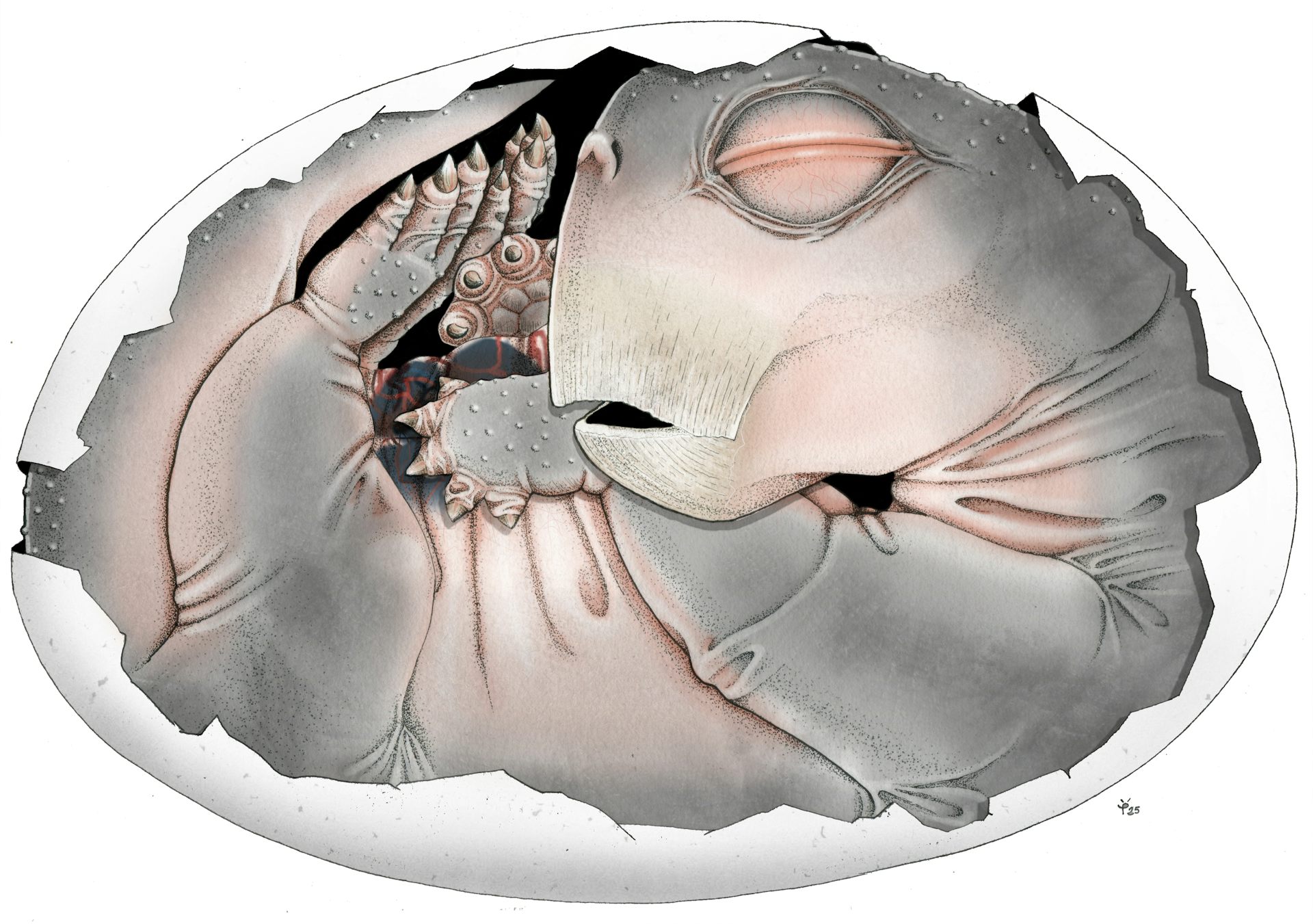
Lystrosaurus embryo within its partially preserved shell, reconstruction of the animal
Pictures - Professor Julien Benoit Drawing - Sophie Vrard.
It is well established in evolutionary biology that mammals arose from within the synapsid lineage, the ancient group that includes the therapsids - stem-mammals that long predate true mammals. What had remained uncertain, however, was whether those early synapsids still reproduced by laying eggs, as modern monotremes such as the platypus and echidnas do, or whether live birth had evolved much earlier in the mammalian line.
That gap in our knowledge has now been narrowed dramatically and, no doubt to the acute discomfort of creationists, the evidence shows that about 250 million years ago - roughly 244 million years before young-Earth creationists believe the Earth was created - a therapsid was still reproducing by laying eggs. The evidence comes from a fossil embryo discovered in South Africa in 2008 by palaeontologist John Nyaphuli. Even more awkward for creationists, their mythology requires animals to have been created as separate, unrelated ‘kinds’, yet here we have direct evidence from the stem-mammal lineage showing a reproductive stage inherited from deep evolutionary ancestry rather than sudden, magical creation without predecessors.
Now Julien Benoit and Jennifer Botha of the University of the Witwatersrand, South Africa, together with Vincent Fernandez of the European Synchrotron Radiation Facility in Grenoble, France, have used high-resolution CT and synchrotron imaging to examine the curled-up embryo inside the rock and identify it as a young Lystrosaurus, a dicynodont therapsid from the Early Triassic. Crucially, the specimen preserves features consistent with an unhatched embryo, including a tightly curled in ovo posture and an unfused lower jaw symphysis. No calcified eggshell was preserved, so the egg was probably soft and leathery, as expected for a very early synapsid. Their findings are reported in an open access paper in PLOS One.
The authors have also co-authored an article in The Conversation explaining the discovery and its significance. Their article is reprinted here under a Creative Commons licence, reformatted for stylistic consistency.

•
Embryo fossil found in South Africa is world’s oldest proof that mammal ancestors laid eggs
Artist’s impression of Lystrosaurus embryo.
Artist: Sophie Vrard, CC BY
Between 280 and 200 million years ago, a group of animals evolved which would eventually give rise to mammals, including humans: the therapsids. They were first described more than 150 years ago, based on fossils from South Africa. Since then, many more fossils have been discovered.
James Kitching, one of the most talented South African fossil hunters of the 20th century, excavated many thousands of therapsids from the rocks of the Karoo (a semi-arid region of the country’s interior). He also found fossilised dinosaur eggs, but neither he nor any palaeontologist after him ever found therapsid eggs.
They should exist, because some mammals (platypus and echidnas) do lay eggs. But Kitching began to doubt that therapsids laid eggs: perhaps, he thought, they were, like most of their mammalian descendants, already viviparous (giving live birth)?
We are scientists who study extinct animals and the environments they lived in millions of years ago to understand more about the evolution of life. In our new paper we describe, for the first time, the embryo-containing fossilised egg of a 250 million-year-old mammalian ancestor.
It finally shows that therapsids were indeed egg-laying (oviparous). This discovery sheds new light on the reproduction and survival strategy of that group of animals.
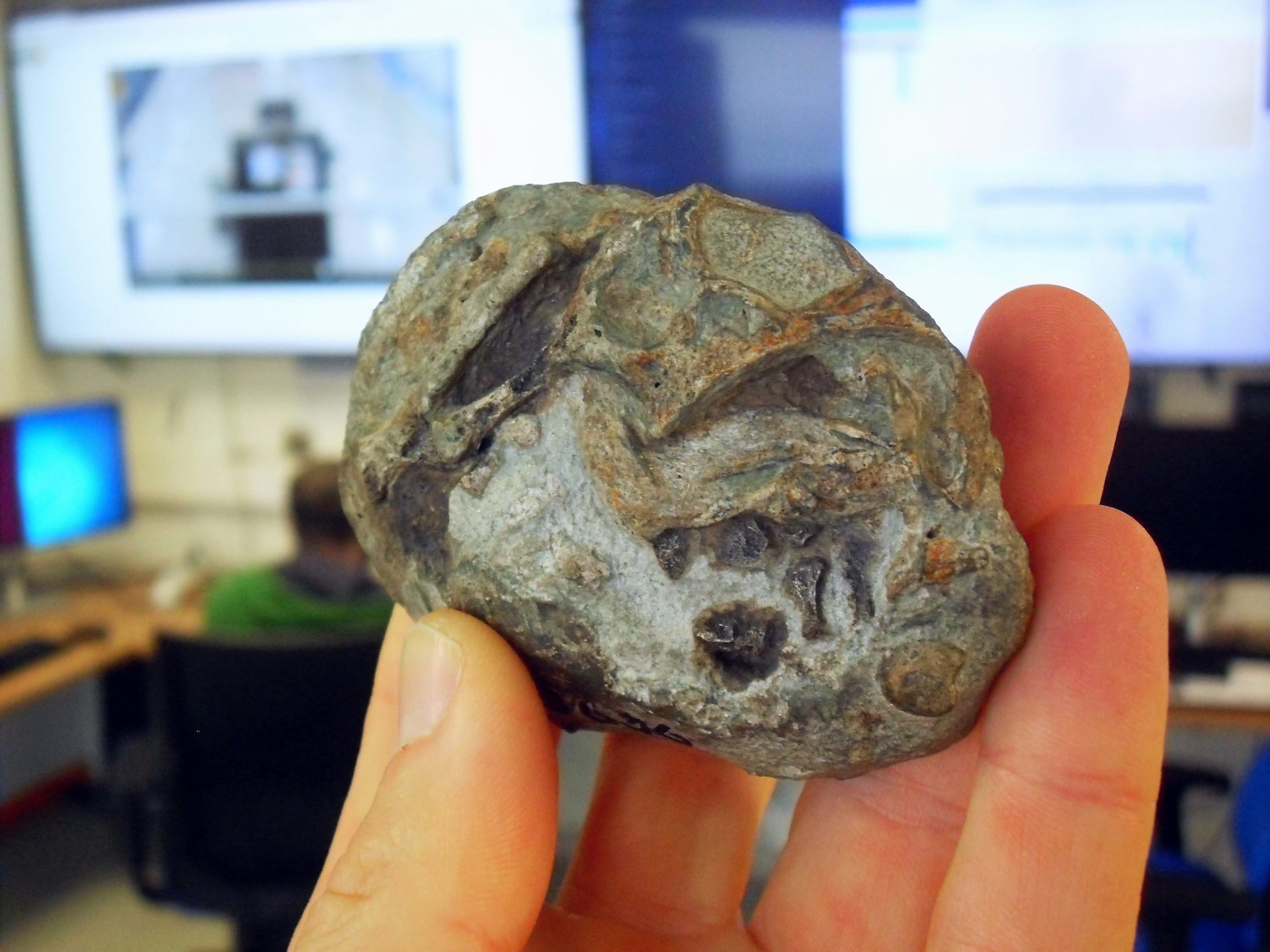
The egg about to be synchrotron scanned at the ESRF.
Author provided, CC BY
The fossil egg and embryo we described was discovered near Oviston, in the Eastern Cape province of South Africa, by John Nyaphuli, a palaeontologist from Bloemfontein, in 2008. It’s been kept in the National Museum in Bloemfontein. We knew that it belonged to a species that lived 252 million to 250 million years ago called Lystrosaurus, but we didn’t know whether the species was an egg-layer. The adult looked like a pig, with naked skin, a beak like a turtle, and two tusks sticking out and pointing down.
The reason it took 20 years to prove that it had been in an egg is that this fossil preserves no shell. Only a curled-up embryo is visible. If there was a shell, it was likely leathery or had dissolved. Only the most advanced dinosaurs laid hard-shelled eggs.
So how could we find out whether this young creature had once been inside an egg?
The answer to this question lay in the advanced technology of the European Synchrotron Radiation Facility at Grenoble, France. There, we used a powerful X-ray source to image the inside of the bones of the embryo. Under this treatment, the fossil unveiled all its long-kept secrets – most crucially, its stage of development.
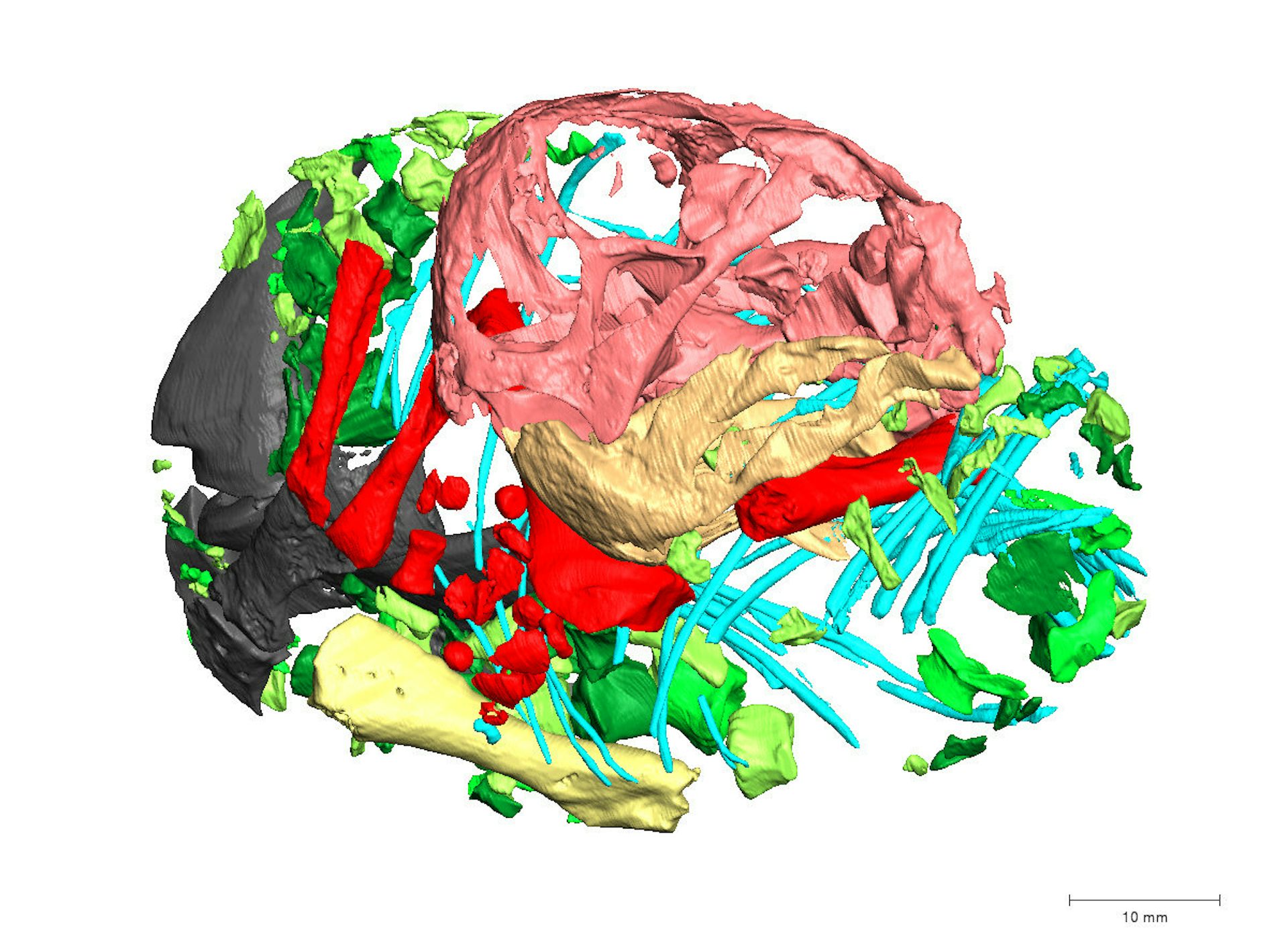
3D reconstruction of the embryo based on synchrotron scan performed at the ESRF.
Author supplied, CC BY
This meant that our curled up Lystrosaurus embryo had died in ovo (in an egg), tightly nestled in its soft, leathery eggshell. This was the evidence palaeontologists had been looking for.
Thanks to the synchrotron-assisted examination of its lower jaw, we could finally demonstrate that this embryo was indeed that of an unhatched Lystrosaurus baby.
Famous survivor
What does it unravel about the survival strategy of Lystrosaurus?
Lystrosaurus is a herbivorous (plant-eating) therapsid famous for surviving the “Great Dying”, which was a major mass extinction of species 252 million years ago. During this event, 90% of all living things on Earth died. Life almost ceased to exist, which makes this the second most important event in the history of life on Earth after the origin of life itself.
How Lystrosaurus survived this is still an intriguing mystery, but the egg gives a possible clue. The fossil we describe shows that the animal laid arguably large eggs for its body size. Large eggs are produced by species that feed their embryos with yolk rather than milk. The young develop to an advanced stage in the egg and then they hatch. In contrast, monotremes (the platypus and echidnas), which feed milk to their young, lay small eggs because the baby is fed after hatching. The large size of its egg implies that Lystrosaurus did not feed milk to its young.
More relevant to its survival strategy, this further indicates two things. Firstly, it means that the egg was less prone to desiccation (drying out). The larger the egg, the smaller its surface area (comparatively speaking), so Lystrosaurus eggs would lose less water through their leathery shell than those of other species of that time. Given the dry environment during and in the immediate aftermath of the extinction, this was a significant advantage, especially since hard-shelled eggs would not evolve for another 50 million years, at least.
Secondly, a large egg implies that Lystrosaurus was likely precocial, meaning that the babies likely hatched at an advanced stage of their development. Lystrosaurus hatchlings were big enough to feed by themselves and run away from predators, and would reach maturity faster so they could reproduce early.
Growing up fast, reproducing young and proliferating were the secrets of Lystrosaurus survival.
Our ability to identify the fossil egg adds to our understanding of the origin of mammalian reproductive biology and lactation, and the survival strategy of Lystrosaurus in the most devastating biological crisis. This is significant to better grasp how modern species might cope with the current sixth mass extinction of species.

Julien Benoit, Associate professor in Vertebrate Palaeontology, University of the Witwatersrand; Jennifer Botha, Professor, University of the Witwatersrand, and Vincent Fernandez, Research associate, Evolutionary Studies Institute, University of the Witwatersrand
This article is republished from The Conversation under a Creative Commons license. Read the original article.

So, yet again, the evidence points not to sudden, separate acts of magical creation, but to a long, branching history of descent with modification. Here we have a therapsid embryo from about 250 million years ago, preserved in what was almost certainly a soft, leathery egg, showing that one of the lineages leading eventually to mammals still retained a deeply ancestral mode of reproduction. That is exactly the sort of transitional evidence evolution predicts and exactly the sort of evidence creationism has no coherent way to accommodate.


For young-Earth creationists, the problem is twofold. First, the fossil exists at all in rocks laid down hundreds of millions of years before their preferred date for the creation of the universe. Secondly, it documents continuity between major groups, not the abrupt appearance of fixed, unrelated ‘kinds’. An egg-laying therapsid is not an anomaly for evolutionary biology; it is a glimpse of the gradual transformation of one lineage over immense spans of geological time. It fits neatly into the pattern. It is only creationism that must deny, distort or ignore it.
And that is the recurring lesson from discoveries like this. The natural world does not look as though it was assembled in a single burst of supernatural manufacture a few thousand years ago. It looks exactly as though life has a deep history, with old traits being modified, retained or discarded over time as lineages diverged and changed. Science follows that evidence wherever it leads. Creationism, by contrast, can survive only by pretending the evidence is not there.
Advertisement
Amazon

Amazon

Amazon

Amazon

Amazon

Amazon

Amazon

Amazon

Amazon

Amazon

Amazon

Amazon

All titles available in paperback, hardcover, ebook for Kindle and audio format.
Prices correct at time of publication. for current prices.



No comments :
Post a Comment
Obscene, threatening or obnoxious messages, preaching, abuse and spam will be removed, as will anything by known Internet trolls and stalkers, by known sock-puppet accounts and anything not connected with the post,
A claim made without evidence can be dismissed without evidence. Remember: your opinion is not an established fact unless corroborated.