
A point I have made before in this blog is that the ignorance of the Bible’s authors is revealed as clearly by what they omitted as by what they included. When examined in the light of modern science, many of their claims turn out to be wrong, showing that they filled gaps in their knowledge with stories that reflected the prevailing superstitions of their culture. Meanwhile, the omissions reveal just how narrow their geographical and intellectual horizons were.
There is no unmistakable fact in the Bible that could not have been known, inferred or imagined by people living in the ancient Near East when its various books were written. There is no knowledge that required revelation from an omniscient being and no awareness of vast regions, peoples or periods of history lying beyond the experience of its human authors.
That is entirely understandable if the Bible is a collection of human writings. It is much more difficult to explain if its ultimate author was an omniscient god. Such an author would not have shared the cosmological limitations of ancient people or presented the world in the familiar ancient Near Eastern form found in Genesis: primordial waters divided by a firmament, dry land beneath it, and the Sun, Moon and stars placed in that firmament as lights. Whatever ingenious reinterpretations modern apologists may retrofit to the text, there is nothing in it that anticipates the real structure, age or scale of the Universe.
Nor is there any hint that people were already living on the other side of the planet. Archaeological evidence from Madjedbebe in northern Australia indicates human occupation by about 65,000 years ago. The Bible’s authors knew nothing of Australia, its First Peoples or the tens of thousands of years of human history that had already elapsed before the supposed events of Genesis.
What is perhaps more surprising is that educated adults today can still imagine that the Genesis creation myth is an accurate and inerrant account of history, despite its demonstrable errors and enormous omissions. The text contains no Australia, no Americas, no Pacific peoples and no conception of the deep human past—only the restricted world known to its authors, projected onto the entire planet.
Augustine of Hippo provides an illuminating example of how treating Scripture as historical fact could obstruct an otherwise rational consideration of the evidence. Contrary to a common misconception, Augustine did not insist that Earth was flat. By his time, its spherical shape had been understood by educated Greeks and Romans for centuries, and Augustine was prepared to concede that it might be demonstrated scientifically.
What he could not accept was that the far side of a spherical Earth might be inhabited, because that appeared irreconcilable with the biblical claim that every human descended from a single original man—and, after the supposed global flood, from Noah and his family. In De Civitate Dei, he wrote:
The reasoning is revealing. Augustine began with the non-negotiable premise that Scripture “gives no false information”. Because inhabited lands across a great ocean appeared incompatible with universal descent from Adam, the existence of their inhabitants had to be rejected. Evidence was not permitted to determine the conclusion; the conclusion had already been dictated by Scripture.But as to the fable that there are Antipodes, that is to say, men on the opposite side of the earth, where the sun rises when it sets to us, men who walk with their feet opposite ours, that is on no ground credible. And, indeed, it is not affirmed that this has been learned by historical knowledge, but by scientific conjecture, on the ground that the earth is suspended within the concavity of the sky, and that it has as much room on the one side of it as on the other: hence they say that the part which is beneath must also be inhabited.
But they do not remark that, although it be supposed or scientifically demonstrated that the world is of a round and spherical form, yet it does not follow that the other side of the earth is bare of water; nor even, though it be bare, does it immediately follow that it is peopled. For Scripture, which proves the truth of its historical statements by the accomplishment of its prophecies, gives no false information; and it is too absurd to say, that some men might have taken ship and traversed the whole wide ocean, and crossed from this side of the world to the other, and that thus even the inhabitants of that distant region are descended from that one first man. [My emphasis]
Source: De Civitate Dei, Book XVI, Chapter 9—“Whether We are to Believe in the Antipodes”,
translated by the Rev. Marcus Dods, D.D.; Christian Classics Ethereal Library.
Augustine was not referring specifically to Australia, nor did he calculate how quickly Noah’s descendants might have built boats after the supposed flood. Nevertheless, he had turned literal biblical history into a testable geographical claim: people could not inhabit remote lands across the ocean because there was no credible way for descendants of Adam—and subsequently Noah—to have reached them. The existence of the peoples of the Americas and Oceania, together with the archaeological evidence of their deep history, showed that conclusion to be spectacularly wrong.
Most creationists will probably not be aware of Augustine of Hippo, nor of what he wrote, yet he is regarded as the father of Catholic theology. And yet few if any Christian apologist ever mention the fact that he unwittingly, but effectively, refuted the Bible's chronology and thus falsified the notion of it inerrancy. In science, falsification of a central principle would be the subject of intense scrutiny and debate in an attempt to resolve it, but in theology, it is something to be quietly swept under the metaphorical carpet and studiously ignored while eulogising and sanctifying its author but never mentioning his blunder ever again.
The evidence from Australia does considerably more than establish that people lived beyond the biblical authors’ geographical horizon. It shows that Aboriginal peoples had occupied and developed cultures in Australia for tens of thousands of years before the supposed creation of the world, let alone before Noah’s mythical flood and the equally mythical dispersal from Babel.
Cloggs Cave, in GunaiKurnai Country near Buchan in East Gippsland, Victoria, contains one particularly remarkable record. Securely dated stone artefacts show that people were visiting the cave between 27,390 and 24,760 years ago, with evidence of subsequent cultural activity extending into the late Holocene. The sequence represents about 25,000 years of engagement with the cave—approximately a thousand human generations. When the earliest securely dated activities were taking place there, Archbishop Ussher’s supposed Creation Week of 4004 BCE still lay roughly 19,000 years in the future.
The latest research did not first establish the antiquity of the cave. Instead, it added a new and extraordinarily detailed line of evidence about what the GunaiKurnai Old Ancestors were doing there. In a paper published in Frontiers in Environmental Archaeology, researchers working with the GunaiKurnai Land and Waters Aboriginal Corporation analysed microscopic silica bodies called phytoliths preserved in the cave sediments.
Phytoliths form within plant tissues and can survive long after the rest of the plant has decayed. The team analysed sediment samples from two excavated sequences, together with ancient Common Brushtail Possum droppings, to distinguish plant material brought into the cave by people from that deposited by animals.
The distinction was important because possums had repeatedly entered the cave and their droppings also contained grass phytoliths. Burnt phytoliths, however, were found throughout much of the archaeological sequence but were entirely absent from the possum droppings. Those blackened microscopic remains provide secure evidence that people carried plants into the cave and burned them there.
The phytolith assemblage was dominated by grasses. Crucially, it contained structures originating from leaves, stems and flower heads, showing that whole grass plants—not merely edible seeds—had deliberately been gathered outside and transported deep into the cave. The scarcity of charcoal and of microscopic ash remains derived from woody plants indicates repeated, relatively cool burning of soft grass material rather than ordinary wood fires.
This supports other evidence that Cloggs Cave was a secluded place used for special cultural and ritual practices rather than routine habitation or food preparation. Earlier investigations revealed two miniature fireplaces, dated to about 11,000 and 12,000 years ago, containing carefully trimmed Casuarina sticks smeared with animal or human fat. Around 2,000 years ago, a small standing stone was erected, and vegetation was repeatedly burned around it, leaving 73 thin ash layers over approximately 400 years. These archaeological features closely resemble GunaiKurnai practices recorded ethnographically during the nineteenth century and preserved in traditional cultural knowledge.
The new phytolith evidence therefore adds intimate detail to a cultural history extending across some 25 millennia. It records people deliberately selecting plants, carrying them into a dark cave and using them in repeated cultural practices long before the biblical creation supposedly occurred.
Three of the paper’s authors have also published an article in The Conversation explaining their research and its significance. Their article is reprinted below under a Creative Commons licence and reformatted for stylistic consistency:

Deeply etched into a cliff face in GunaiKurnai Country, near the township of Buchan in East Gippsland in rural Victoria, is a large limestone cave that hosts an extraordinary story.
Today, the area outside Cloggs Cave is mainly grassland and open woodland, with eucalypt forests further behind the cave. But this was not always so.
The environment changed as the last ice age came and went, and as the Old GunaiKurnai Ancestors managed Country through cultural burning and daily activities on the land. Photographs from the 19th century, as well as regional pollen records, show that during the early colonial times of the mid- and late 1800s, sheoaks were more abundant.
Early colonists cleared nearly all those that then stood near Cloggs Cave. But it is their grassy understorey that is of greatest interest to this story, which we can now tell.
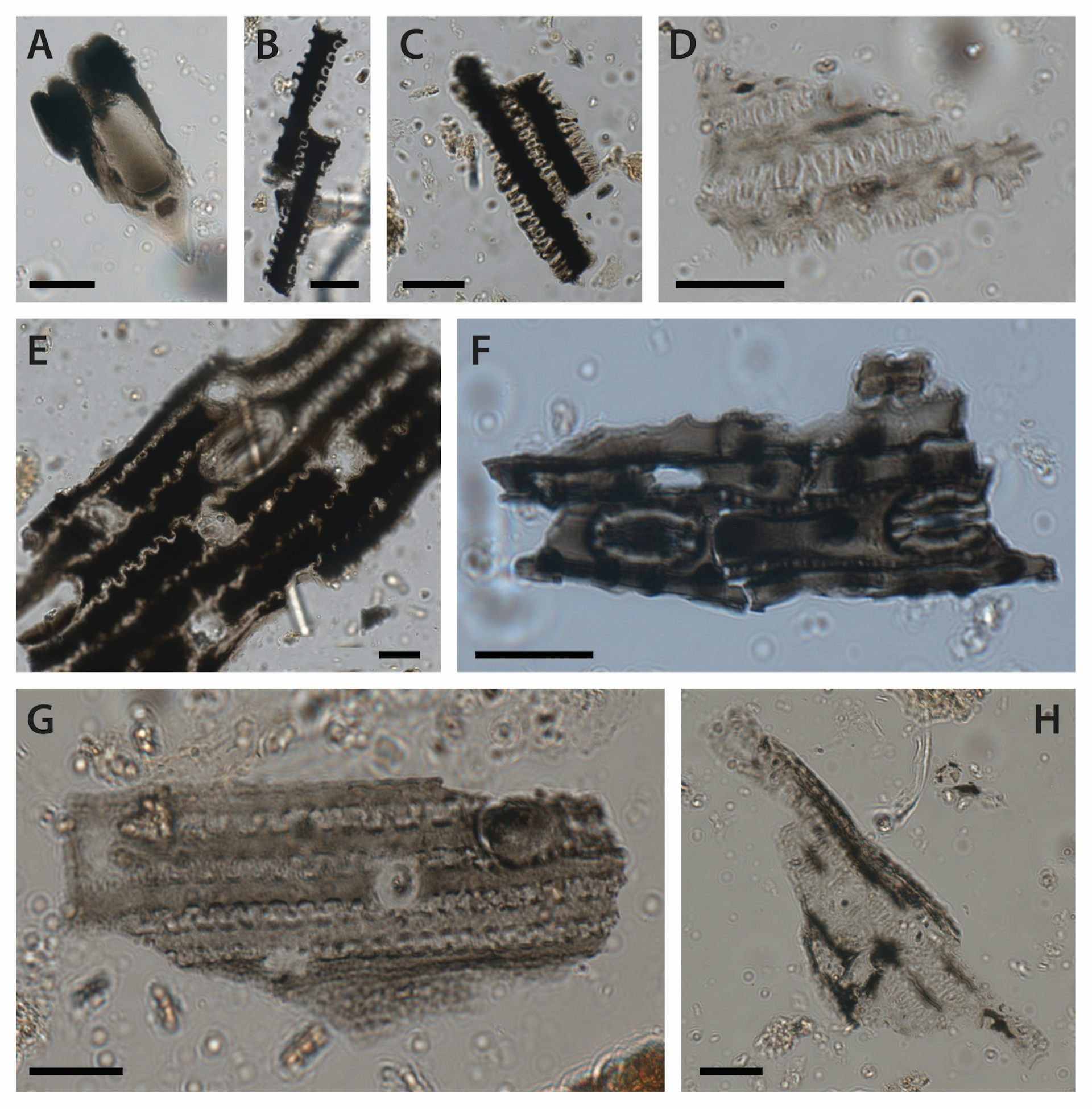
In a new paper published in the journal Frontiers in Environmental Archaeology, we report the discovery of thousands of microscopic plant remains known as phytoliths that are testimony to GunaiKurnai rituals repeatedly performed over the past 25,000 years.
Who carried the plants inside?
Phytoliths are microscopic silica bodies that occur in plant tissues, their shapes and sizes varying in different parts of plants and between plant taxa.
Unlike pollen, which is dispersed by wind or insects, the hard, glassy phytoliths mostly get left behind at the spot where a plant decays. They can survive underground for thousands and even millions of years. They can also survive fires.
As sediments accumulate, the phytoliths become trapped in the soil, so that over time the buried sequence leaves a record of the plants that once grew or had been placed there.
Plants cannot grow inside Cloggs Cave, as there is neither sufficient light nor moisture. So the buried phytoliths must have been carried in by people or by animals, such as possums, on their fur or through their scats.
In 2019 and 2020, we were part of a team of scientists and local Aboriginal community members who undertook archaeological excavations deep in the cave, to work out how the Old GunaiKurnai Ancestors used it in the past.
As the excavations progressed, we collected small samples of sediment, one to two centimetres at a time. In the laboratory, we focused on the half-burnt phytoliths from the ashy layers, because these layers were clearly the result of fires lit by people inside the cave.
The burnt phytoliths were so concentrated they could not have been incidental to other activities nearby. They were found in thin layers of ash densely packed one on top of the other, unlike during earlier times when the ash was more sparse.
The phytoliths from the various ash layers had almost all come from different parts of grasses, such as stems, leaves, flowers and roots. This indicated the grasses had been brought into the cave whole, roots and all.
The archaeological excavations showed people had entered the cave for some 25,000 years, beginning just as the coldest phase of the last ice age began. They never used the cave for everyday living though, nor for communal food preparation or consumption.
There are hundreds of thousands of animal bones in the cave. But almost all of those dating to the period of human occupation came from owls dropping their pellets on the cave floor, mainly tiny unbroken bones.
Instead, people used the cave to perform secluded rituals, some involving the breaking of stalactites and the erecting of standing stones from blocks of limestone obtained from inside the cave.
A carefully positioned stone revealed
Some 73 thin, superimposed ash layers underlie and then surround one such, fully buried, standing stone.
The 28-centimetre-tall stone was positioned upright on a bed of ash 2,000 years ago, and fires were then regularly burnt around it over the next 400 years. The microscopic phytoliths in the thin layers of ash now reveal otherwise invisible traces of those activities.
We found 29 different types of phytoliths from a range of plant groups including grasses, herbs, and woody plants at different levels of the excavation. Most of the phytoliths were well preserved, and even delicate silica forms such as hair cells and multicellular structures had survived intact in their original plant positions.
Grasses were the most abundant plant type identified (up to 97%). Two subfamilies of grasses were particularly well represented: Pooideae, which grows in temperate, cool conditions, and Panicoideae, which prefers warm, humid climates.
Woody plants and herbs are low phytolith producers, and phytoliths from these plant types were rarely observed.
Retelling the stories in the land
The phytoliths are more than an indication of the simple burning of grasses in the cave.
Senior members of the GunaiKurnai community told local pioneering ethnographer Alfred Howitt in the 1800s that individuals would be smeared with ash and charcoal powder during the jeraeil initiation ceremony and various other powerful rituals to perform healing, cursing and magic.
Plants were also laid and burnt on the ground to leave ashy floors to make it easier to track the footsteps of dangerous beings who may be lurking nearby, such as nargun who are thought to have lived in caves.
The details of these rituals have been partly forgotten over the years. But our research – together with GunaiKurnai people’s retained cultural knowledge of ancestral practices in local caves – is helping to unearth and make sense of them.
These were peopled landscapes whose rich stories can again be told.

>Russell Mullett, Traditional Custodian — Kurnai, Indigenous Knowledge; Bruno David, Professor, Australian Research Council Industry Laureate, Monash University, and Elle Grono, Postdoctoral Researcher, School of Culture, History & Language, Australian National University
This article is republished from The Conversation under a Creative Commons license. Read the original article.

These microscopic particles of silica are not vague impressions open to theological reinterpretation. They occur in dated, stratified deposits and can be distinguished from material deposited by possums because many were altered by fire. They preserve evidence of particular human actions: whole grasses were selected, carried into the darkness of the cave and burned in repeated cultural practices.
By the time young-Earth creationists imagine the Universe was being created, the earliest securely dated evidence of human activity at Cloggs Cave was already about 19,000 years old. Across Australia, human history stretches back much further still. These people were not descendants of passengers from Noah’s Ark dispersing from Babel; their ancestors had reached Sahul tens of thousands of years before either event supposedly occurred.
Augustine’s mistake was not simply that he reached the wrong conclusion about the inhabitants of distant lands. It was that he began by declaring Scripture incapable of error and then rejected any conclusion incompatible with it. Modern creationists employ precisely the same method: biblical history must be true, so radiocarbon dating, archaeology, genetics, geology and every other conflicting body of evidence must somehow be wrong.
Cloggs Cave exposes the futility of that approach. Its deposits preserve a long and intricate cultural history that simply could not exist within the biblical chronology. This is not merely another failure to find evidence supporting Genesis; it is positive evidence of people, activities and traditions that should never have existed if Genesis were history.
The people were real, the fires were real and their microscopic remains survive. Adam, Noah and the global flood survive only as stories written by people who knew nothing of them, so failed to incorporate them or even the possibility of their existence into their invented historical narratives, which of course made themselves central to the creation story.
Advertisement


All titles available in paperback, hardcover, ebook for Kindle and audio format.
Prices correct at time of publication. for current prices.



No comments :
Post a Comment
Obscene, threatening or obnoxious messages, preaching, abuse and spam will be removed, as will anything by known Internet trolls and stalkers, by known sock-puppet accounts and anything not connected with the post,
A claim made without evidence can be dismissed without evidence. Remember: your opinion is not an established fact unless corroborated.