

Different varieties of rice grown today
A point made several times in these blog posts is that the creationist interpretation of Genesis presents the living world as having been deliberately created for human use. That raises an obvious question: why have humans needed to modify virtually every domesticated animal and cultivated plant to make it more useful?
In many cases, selective breeding has altered organisms so extensively that modern breeds and crop varieties are barely recognisable as descendants of their wild ancestors. Did the supposed creator fail to anticipate how humans would use them, or was it simply incapable of finishing the job and obliged to leave the improvements to us?
Creationists have never produced a satisfactory, evidence-based answer. Instead, they appeal to “mystery”, “unknowable intentions” or some other form of theological evasion — ways of avoiding the question while pretending to have answered it. Alternatively, they simply ignore the problem and continue asserting that Genesis provides an accurate account of history and the origins of living species.
Rice, of course, doesn't get a mention in the Bible, the cultural origins of whose authors were primarily the Tigris-Euphrates rivers of Mesopotamia and later the Nile in Egypt, where wheat and barley were the staple crops, so they knew nothing of the origins or cultivation of rice, nor of India or China for that matter. Wheat by contrast is mentioned in the Bible 51 times and barley, 37.
Science, by contrast, allows us to reconstruct increasingly detailed and testable histories of domesticated animals and cultivated plants. Genetics, archaeology and the study of ancient plant remains show how humans selected heritable variations and gradually changed wild populations through artificial selection, hybridisation and the movement of crops between regions. One particularly fascinating example is the origin and cultivation of Asian rice, Oryza sativa, which now provides sustenance for more than 3.5 billion people.
The evidence traces this history across a timescale wholly incompatible with the creationist belief in a 6,000–10,000-year-old Earth. Wild rice ancestral to modern cultivated rice was growing in the lower Yangtze region of China about 100,000 years ago. Humans began gathering and processing it approximately 24,000 years ago, and evidence of pre-domestication cultivation appears about 13,000 years ago. By around 11,000 years ago, plant remains show a rapid increase in characteristics associated with domestication, as generations of human selection transformed wild rice into a recognisably cultivated crop.
There is also evidence of rice cultivation in the Ganges valley of northern India as early as 6500 BCE—about 8,500 years ago. The details remain a subject of legitimate scientific debate, particularly whether Indian rice was domesticated independently and how much the eventual development of indica rice owed to hybridisation between local rice and japonica introduced from China. What is not in dispute is that modern rice emerged through a prolonged history of cultivation, selection, migration and hybridisation — not through an instantaneous act of creation.
The history of rice is the subject of an article in The Conversation by Garritt C. Van Dyk, Senior Lecturer in History at the University of Waikato, New Zealand. His article is reprinted below under a Creative Commons licence and reformatted for stylistic consistency:

One grain to rule them all: the history of rice as a global food
Garritt C. Van Dyk, University of WaikatoRice is the most popular food in the world, providing sustenance to more than 3.5 billion people each day.
Rice is deeply embedded in food, daily rituals, language and spirituality. It is easy to take it for granted.
But where did rice come from? And how did it spread to become the foundation of global food security?
Early origins in China and India
In the lower reaches of the Yangtze River, China, Oryza sativa rice grew 100,000 years ago. It was first gathered by humans 24,000 years ago, and cultivated 13,000 years ago.
Changes to the plant through selective breeding resulted in a domesticated plant distinct from the wild varietal about 11,000 years ago.
There is debate about how early forms of domesticated rice developed outside of China, but there is evidence of parallel rice cultivation in India along the Ganges in Uttar Pradesh as early as 6500 BCE.
One possibility is that the two most common subspecies of rice, short-grained (japonica) and long-grained (indica) developed separately: the former in China and the latter in India.
A related theory is that indica is a hybrid between a local Indian rice and japonica, introduced to India around 2500 BCE.
African rice: the other origin story
Another rice species, Oryza glaberrima, developed in Africa some 2,000 years after rice was domesticated by farmers in Asia.
African rice is lower yielding than Asian rice species, but is drought and pest resistant. It tolerates severe climatic extremes, parasites and viruses, and will flourish in poor soil without irrigation or weeding.
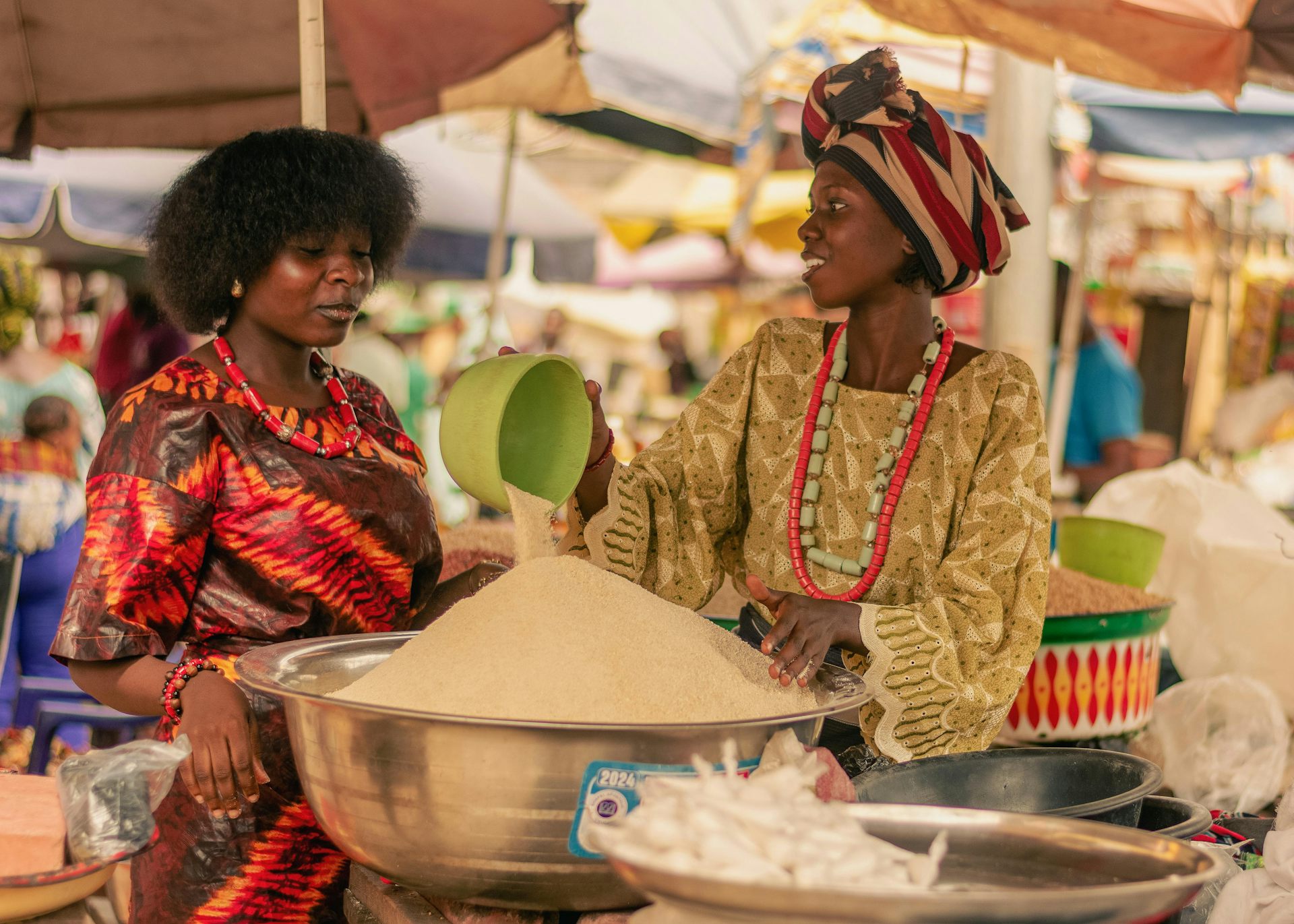
African rice is better suited to the dry, harsh climate of Western Africa.
This trait was successfully bred out of Asian rices over a long period to ensure maximum crop yields.
Migration, wars, trade and slavery
The migration of prehistoric farmers spread rice across Southeast Asia.
Archaeological evidence from 4,000 years ago suggests farming techniques were introduced to Southeast Asia – including modern day areas of Vietnam, Cambodia, Myanmar and Thailand – by distant migrants from South China, rather than being learned from neighbours or through experimentation.
There is a possibility the same scenario was replayed in numerous regions across Eurasia as rice spread across the globe.
The movement of armies also brought rice to new parts of the world.
Naturalists who accompanied Alexander the Great’s campaigns in India brought rice home with them to Ancient Greece and Macedonia around 320 BC.
Invading Moors, from North Africa (present-day Morocco and Algeria) in the eighth century brought rice to the Iberian peninsula. Crusaders returning from wars in the Middle East brought back small quantities of rice to Europe in the 11th century.
From the second century, overland trade along the Silk Road and maritime trade from the Indian Ocean to the Mediterranean brought rice to Central Asia and Europe. Rice was not cheap to ship, so as an import it would have been a luxury – like exotic spices – rather than a staple commodity.
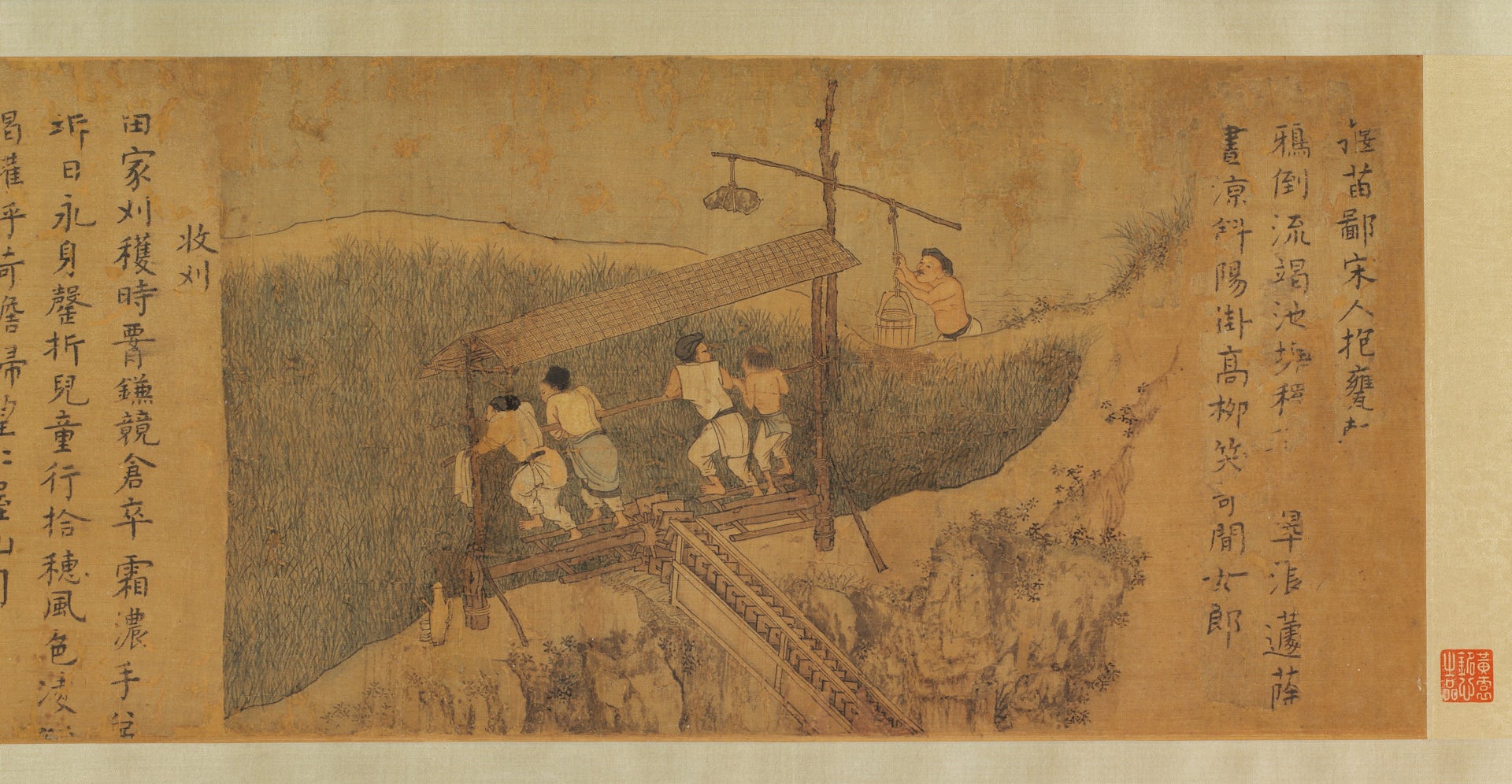
This scroll is dated before 1353, based on illustrations from the 12th century. Titled Rice Culture, it depicts the cultivation and harvesting of rice in China.
Enslaved Africans from the rice coast countries of West Africa introduced techniques for irrigation and tilling the soil using hoes, so the crop could be grown in the North American climate.
Devastatingly, the African expertise led to an increase in the slave trade, because improved rice production made it easier to feed a growing population of enslaved Africans.
Rice as ritual
The importance of rice in many cultures is embedded in the daily life, cultural practices, rites and rituals.
In Thailand, the centrality of rice is reflected in language: kin khao, meaning “let’s eat”, literally translates to “eat rice”.
Annual royal ceremonies in Cambodia, Myanmar, Thailand and Japan mark the beginning of rice growing season in the first half of May.
Every year the King and Queen of Thailand preside over the Buddhist Royal Cultivation Ceremony, and the Brahmin Royal Ploughing Ceremony, combining prayers and offerings to ensure successful harvests.

Japanese Shinto rice-planting festival, Mibu no Hanadaue
Rice is also central to Hindu rituals, from birth to death.
A baby’s first solid food is sweet rice marking the annaprashana rite of passage. Rice is an offering and a blessing at weddings, and serves as an offering for the journey into the afterlife.
The future of rice
Traditional rice growing is water intensive. Methane emissions from growing rice make it the third highest contributor to global food-related agricultural emissions.
New techniques are being developed to mitigate the environmental impact of rice cultivation while maintaining production levels to meet growing demand.
The secret may lie in the past, as researchers investigate ancient rice DNA in an attempt to produce the next hybrid that will once again change how rice feeds the world.

Garritt C. Van Dyk, Senior Lecturer in History, University of Waikato
This article is republished from The Conversation under a Creative Commons license. Read the original article.

There is another problem here for anyone who insists that the biblical Flood was a real global event. By the time creationists commonly place it, rice had already been cultivated for thousands of years. Communities across Asia possessed established rice-growing traditions, locally adapted varieties, accumulated agricultural knowledge and settlements organised around the crop. According to Genesis, every one of those communities—and every cultivator who possessed that knowledge—would have been exterminated, apart from eight people aboard a vessel supposedly constructed in the Middle East.
A worldwide flood would not merely have interrupted rice cultivation. It would have submerged the fields, destroyed seed stocks, displaced or obliterated the ecosystems in which wild and cultivated rice grew, and erased the human populations maintaining the crop. The long process of selection would have been abruptly terminated. Rice agriculture would then have had to begin again after the Flood, carried back into China, India and elsewhere by descendants of Noah who somehow possessed the necessary seeds, techniques and knowledge—none of which is mentioned in the biblical story.
That is not what the evidence shows. Instead of a universal layer of flood debris followed by agricultural abandonment, population replacement and the re-establishment of cultivation from a Middle Eastern source, archaeology reveals regional continuity. Rice varieties continued to develop, established cultivation practices persisted, and agricultural traditions spread along identifiable routes through migration, trade and cultural exchange. The record is one of cumulative human activity, not worldwide destruction followed by an inexplicably rapid reconstruction.
The history preserved in rice therefore joins the histories recorded in human genetics, archaeology, geology and countless other domesticated species in exposing the Flood as mythology, not history. A global catastrophe of the kind described in Genesis could not have occurred without leaving an unmistakable break in this record. No such break exists. Rice cultivation continued because there was no global flood to interrupt it—and no eight-person bottleneck from which its cultivators had to begin again.
That they were apparently unaware of rice, its cultivation and its importance to distant cultures testifies to the parochialism and ignorance of the Bible's authors and refutes any notion of its diving authorship by an omniscient creator.
Advertisement
Amazon

Amazon

Amazon

Amazon

Amazon

Amazon

Amazon

Amazon

Amazon

Amazon

Amazon

Amazon

All titles available in paperback, hardcover, ebook for Kindle and audio format.
Prices correct at time of publication. for current prices.



No comments :
Post a Comment
Obscene, threatening or obnoxious messages, preaching, abuse and spam will be removed, as will anything by known Internet trolls and stalkers, by known sock-puppet accounts and anything not connected with the post,
A claim made without evidence can be dismissed without evidence. Remember: your opinion is not an established fact unless corroborated.