Araucaria forest at sunrise.
Photo by Douglas Scortegagna (CC BY-SA 3.0, from Wikimedia Commons)


Araucaria augustifolia (Brazilian pine)
One of the clearest indications that the Bible was written by people with a severely limited knowledge of the world is, in addition to the factual errors in it, such as Earth being flat with a dome over it, there is the evidence of what is not in it. Its authors wrote as though the small part of the ancient Near East familiar to them was effectively the whole inhabited Earth, so there is nothing in the Bible from outside a small area around the Middle East. They had no conception of a southern hemisphere, knew nothing of continents such as South America, and had no awareness of the peoples, cultures and complex histories that had existed there for thousands of years.
That parochial view of the world is exposed every time archaeologists and palaeoecologists reconstruct the history of regions the Bible’s authors did not even know existed. Far from being a divinely inspired account of the whole planet, the Bible reflects the geographical horizons and cultural assumptions of the scientifically illiterate people who composed it.
The latest example comes from the cold highlands of southern Brazil, where an international team of researchers has reconstructed how climate, fire and Indigenous land management shaped the distinctive mosaic of Araucaria forest and campos grassland during the past 6,000 years. The research is described by Oliver J. Wilson, a lecturer in the School of Natural Sciences at the University of Lincoln, in an article in The Conversation and was published in Scientific Reports.
The researchers combined several independent sources of evidence: pollen and microscopic charcoal preserved in continuously accumulating bog sediments, radiocarbon-dated archaeological evidence, a rainfall record preserved in a cave speleothem, and ecological models showing how the forest should have responded to climatic change. Together, these sources reveal a detailed history of gradual climatic shifts, changing fire regimes, forest expansion and human modification of the landscape.
The wider region has been inhabited by Indigenous people for more than 12,000 years. During the past two millennia, the southern Jê people — ancestors and relatives of the modern Kaingang and Laklãnõ Xokleng — built settlements and ceremonial earthworks, cultivated crops such as maize and beans, used fire and encouraged useful Araucaria trees. Rather than simply destroying the forest, they altered its structure and composition, apparently managing parts of it as a productive cultural landscape.
For creationists, however, the chronology presents an insurmountable problem. The study’s 6,000-year environmental record begins at approximately the time young-earth creationists claim the entire universe was created. It then continues through the period in which their biblical chronology places Noah’s supposedly global Flood — commonly dated to about 2348 BCE — and onwards into the historical era.
Yet there is no interruption marking a planet-wide catastrophe. There is no sudden destruction of the ecosystem, no replacement of the vegetation, no break in sediment accumulation, no extermination of the human population and no subsequent recolonisation by descendants of eight Middle Eastern boat-builders. Instead, the evidence records continuous sedimentation, local fires, gradual climatic changes, vegetation responding through understandable ecological processes and Indigenous communities continuing to shape the land around them.
A global flood capable of covering every mountain, killing every terrestrial human and animal outside a wooden boat, and violently remodelling the surface of the planet could not somehow have passed unnoticed over southern Brazil while leaving delicate layers of pollen, charcoal and archaeological evidence intact. The record continues across the supposed catastrophe because the catastrophe never happened.
The contrast could hardly be clearer. Science reveals a vast southern continent with its own ancient environments, changing climates and long-established human societies. Genesis reveals only the tiny mental world of its authors — a world bounded by the geography they knew and populated by the people they had heard about. Its supposedly global history is global only in the same sense that a village map is an atlas: it mistakes the limits of its authors’ knowledge for the limits of the world.
Oliver Wilson's Article in The Conversation is reprinted here under a Creative Commons license, reformatted for stylistic consistency:

Brazil’s highland forest has been shaped by climate change and Indigenous people for 6,000 years
Araucaria forest and campos grasslands on the highlands of southern Brazil.
When you think of a South American rainforest, you probably don’t imagine biting winds, heavy frosts and freezing temperatures. But in the mountains of southern Brazil, that’s exactly what you can find. On this highland plateau, far from Amazonia in the country’s coldest region, grows one of the world’s most intriguing ecosystems.
For millions of years, this region has been home to a biodiverse patchwork of Araucaria forests and campos grasslands. The Araucaria trees which characterise this region are closely related to the monkey puzzle trees widely cultivated in Britain, and their relatives once fed dinosaurs around the world. In the present, though, this landscape is in trouble – 150 years of logging and agricultural expansion has destroyed most of the forest-grassland mosaic, and the cool, wet conditions it needs are now rapidly disappearing.
Lessons from the past can help us conserve this ancient ecosystem. Rolling back the centuries with an international team, my recent research uncovered the unexpected ways in which humans and climate changes combined to shape Brazil’s Araucaria forests over the last 6,000 years. Far from being inherently destructive, they were critical in forming the ecosystem’s character.
The Araucaria forest region is peppered with archaeological sites, including many belonging to the southern Jê people. After arriving in the region around 2,000 years ago, they transformed the landscape, from pit-house villages in the forests to funerary earthworks on commanding heights.
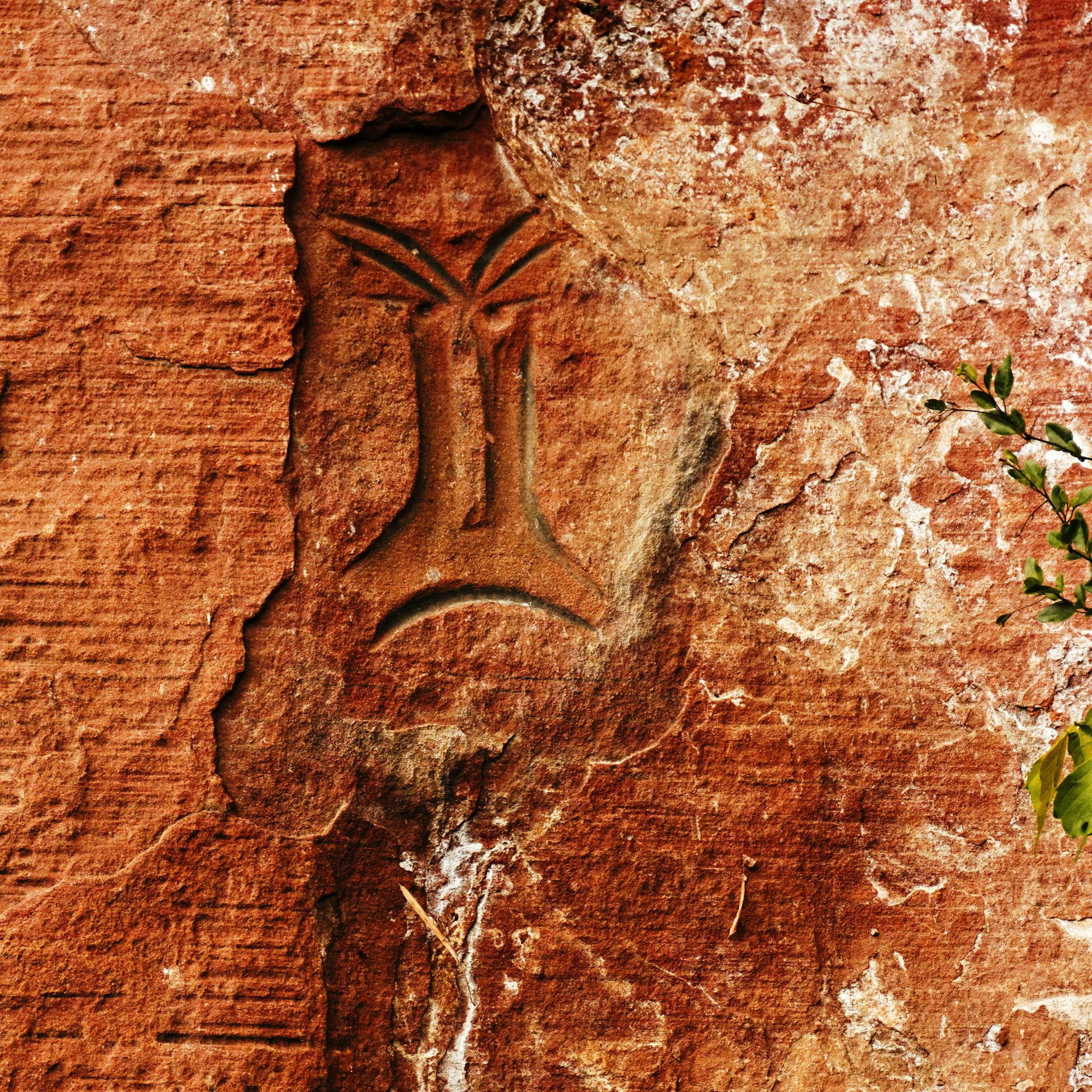
Southern Jê rock art at Avencal, Urubici.
We used a combination of different approaches to understand the last 6,000 years of Araucaria forest history. Pollen and tiny charcoal fragments preserved in layers of bog mud showed how the surrounding area’s vegetation and fire activity changed through time. We compared these results to archaeological findings and a record of past rainfall from a nearby cave, as well as to computer models which predicted how the forest would have behaved if climate alone had driven its dynamics. Together, the results revealed a surprise.
An unexpected history
My colleagues and I found that, when the forests expanded, they generally did so at the times and places we’d predicted based on climate conditions. Strangely, though, vegetation change was very uneven across the region.
Most pollen records – including three new ones near archaeological sites – showed only minor forest expansions, if any at all. But a few sites exhibited drastic increases in forest pollen – even when close neighbours didn’t. This patchy response suggests that the forest dynamics were driven by something more complex than just broad-scale climatic changes.
The answer lies in the interaction of climate change and fire dynamics. Fire is a natural part of the Araucaria forest region. Campos grasslands burn readily, killing tree seedlings and preventing forest expansion, though mature Araucaria forest patches are fairly fireproof.
In the past, changes to warmer and wetter conditions, which slightly favoured the forests and reduced fire, had limited effects in most places. Where major changes happened, it seems to have been because the landscape was already close to a tipping point. In those areas, it only took a little more forest and a little less fire to spark a chain reaction that saw forest growth shut out the fires and overrun the grasslands.
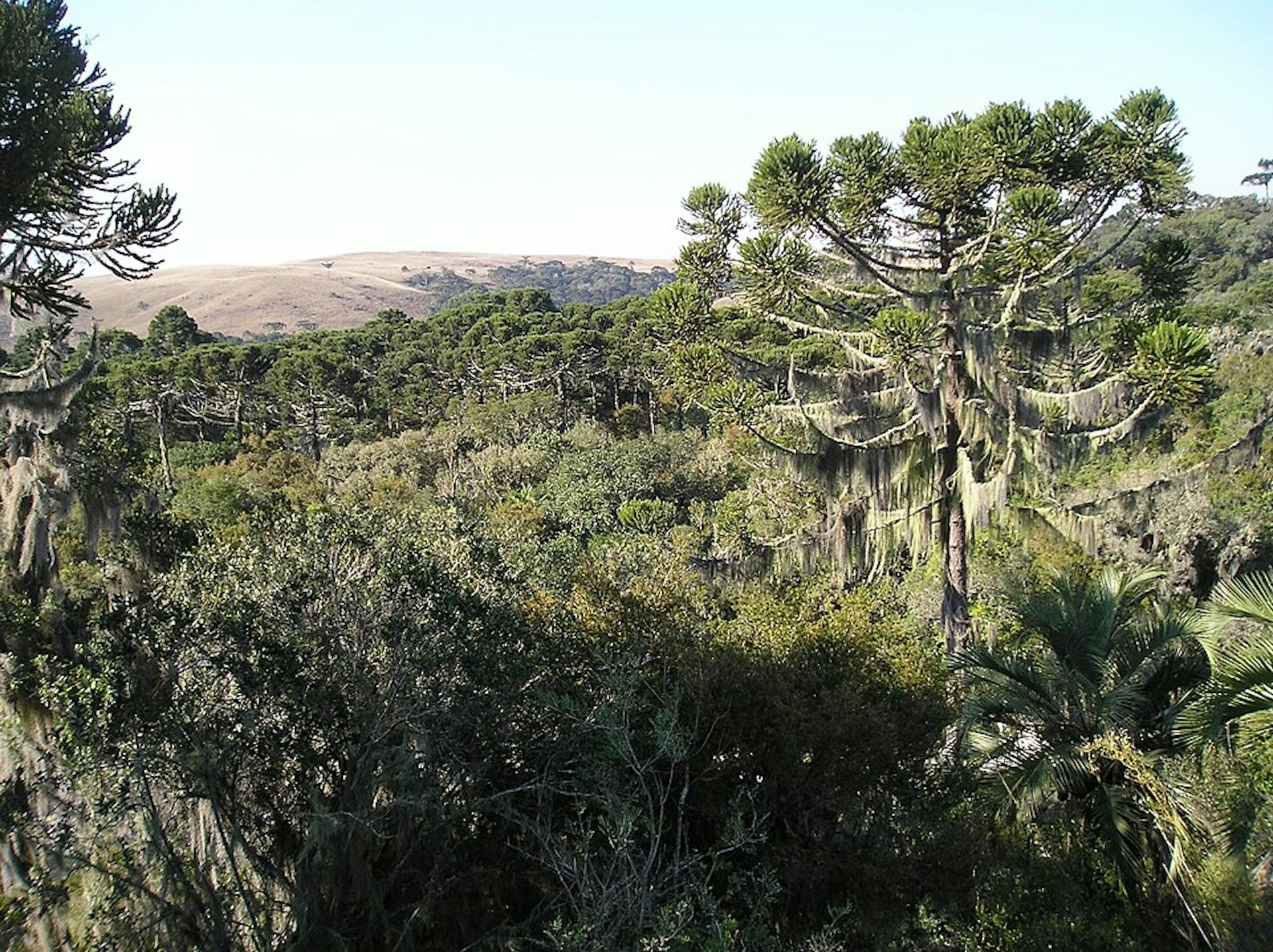
Brazil’s Araucaria forest has been shaped by climate and Indigenous peoples over thousands of years.
Our data can’t tell us exactly what this looked like, but it does give us clues. Charcoal probably came from a mixture of daily life and land management, with fires clearing spaces for crops to be planted. There’s no sign that this led to forest loss, though – it may even have been an agroforestry system, with maize and beans growing under the canopy of culturally useful trees, including Araucaria. At one site, this influence created a landscape unlike any seen in previous studies, which developed and changed over centuries with the rhythms of the nearby village. The southern Jê may not have spread trees widely across the landscape, but they certainly shaped the forests around the places they lived.
Although our findings focus on the past, they are invaluable for this ecosystem’s future. Seeing how climate changes pushed forest-grassland dynamics over tipping points in unpredictable ways is a worry: as conditions in southern Brazil continue to get warmer and wetter, this will make it harder to conserve both Araucaria forest and campos grasslands.
And the revelations about the region’s human history matter, too. Southern Brazil still has southern Jê communities – the Kaingang and Laklãnõ Xokleng. Our results highlight that there’s no inherent conflict between people and Araucaria forest. As these Indigenous communities continue to fight for their rights to their ancestral land, conservation would do well to learn from them and to establish better ways of linking people with the forests – before it’s too late.

Oliver Wilson, Lecturer, School of Natural Sciences, University of Lincoln
This article is republished from The Conversation under a Creative Commons license. Read the original article.

What the Brazilian highlands preserve, therefore, is not merely a record of changing vegetation. They preserve a record of a real landscape responding gradually to climate, fire and human activity over thousands of years. Pollen accumulated, forests advanced and retreated, fires occurred, and Indigenous communities modified their surroundings in ways that left detectable ecological and archaeological traces.
None of this resembles the abrupt destruction and repopulation demanded by a literal reading of Genesis. A genuinely global flood would not be a minor disturbance hidden between layers of pollen and charcoal. It would be the dominant event in the record: a catastrophic break separating the world before the Flood from the world after it. Instead, the supposed catastrophe passes without leaving any recognisable trace because it belongs to mythology, not history.
The study also provides another reminder that the peoples of the Americas were not passive occupants of an untouched wilderness. Long before European colonisation, Indigenous societies were managing plants, using fire, constructing settlements and shaping ecosystems. Their history is written into the landscape, even though the authors of the Bible knew nothing of their existence and could not have imagined the continent on which they lived.
Creationists can preserve the biblical timeline only by dismissing radiocarbon dating, archaeology, palaeoecology, climatology and the physical continuity of the sediments themselves. In other words, they must reject every independent line of evidence that allows the past to be reconstructed and retain instead the geographically provincial folklore of ancient Middle Eastern storytellers.
The Brazilian forest record does not merely fail to support Genesis; it documents, layer by layer, a world that continued perfectly well while the biblical Flood was supposedly destroying it.
Advertisement
Amazon

Amazon

Amazon

Amazon

Amazon

Amazon

Amazon

Amazon

Amazon

Amazon

Amazon

Amazon

All titles available in paperback, hardcover, ebook for Kindle and audio format.
Prices correct at time of publication. for current prices.



No comments :
Post a Comment
Obscene, threatening or obnoxious messages, preaching, abuse and spam will be removed, as will anything by known Internet trolls and stalkers, by known sock-puppet accounts and anything not connected with the post,
A claim made without evidence can be dismissed without evidence. Remember: your opinion is not an established fact unless corroborated.