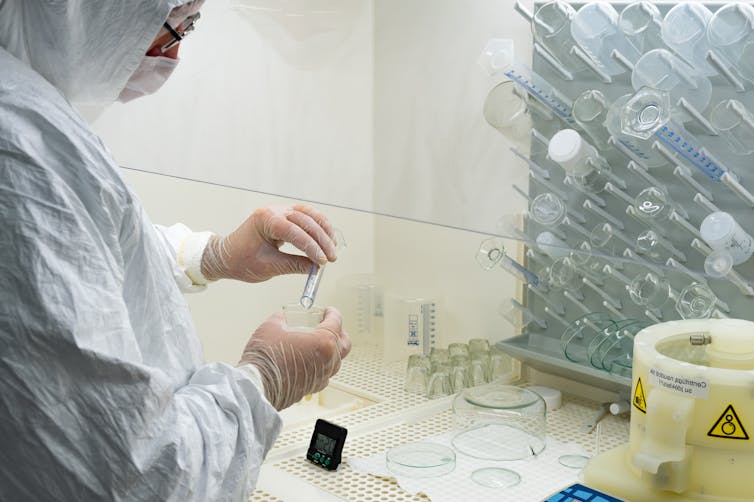
A new study has shown that the Pfizer-BioNTech mRNA COVID-19 vaccine significantly reduces the proportion of sever COVID-19 infections, reducing the risk of hospitalisation in 5–11-year-olds by two-thirds. Although it was lower for the Omicron variant than for Delta, protection against hospitalisation remained high for 12–18-year-olds. It also gave high protection against critical COVID-19 requiring life-supporting interventions for adults during both Delta and Omicron waves.
Structure and function of Rubisco. (A) Schematic depiction of photosynthesis in chloroplasts and the role of Rubisco. The light reaction and Calvin-Benson-Bassham (CBB) cycle of CO 2 fixation, as well as the side-reaction of photorespiration are shown. RuBP, ribulose-1,5-bisphosphate; 3PG, 3-phosphoglycerate; G3P, glyceraldehyde-3-phosphate; 2P-glycolate, 2-phosphoglycolate. (B) Structure of hexadecameric form I Rubisco. Side and top views of Rubisco are shown in surface representation (PDB: 1RCX, Taylor and Andersson, 1997). One antiparallel RbcL dimer with RuBP bound in the active sites is shown in ribbon representation. (C) Superposition of open and closed conformations (PDB: 1RXO and 1RCX, respectively; Taylor and Andersson, 1997) of Rubisco. In the closed state (dark green), loop 6 (cyan) covers the active site, trapping the bound RuBP (red), and is pinned down by the flexible C-terminal peptide (pink) that stretches across the RbcL subunit. In the open conformation (pale green), loop 6 (dark blue) is retracted and the C-terminal peptide (pink) is disordered.
RuBisCo is probably the least efficient of all enzymes - which is why it is so abundant in nature, accounting for the green we see where photosynthesising plants are growing. It's what gives the planet its characteristic green colour everywhere, apart from the deserts, oceans, polar ice caps and mountain peaks.
It is the enzyme responsible for 'fixing' the carbon in carbon dioxide in the atmosphere, so it can be built up into glucose in photosynthesis. Glucose is the basic sugar from which most other carbohydrates are built and the source of energy on which almost all living organisms ultimately depend. It is also the building block of structural material such as cellulose and lignin for plants and chitin for the exoskeletons of arthropods.
In fact, RuBisCo is so inefficient that it would be a major breakthrough in agriculture if scientists could make it more efficient so more food could be produced with the same resources. An added bonus would be that more CO2 would be extracted from the atmosphere, so reducing global warming.
Imagine that! Something creationists believe was intelligently designed by an omniscient, omnipotent designer that is so badly designed that mere humans are having to redesign it to make it more efficient!
Pastor Tony Spell, Life Tabernacle Church, Baton Rouge, Louisiana
"Government of USA should be by prophets (himself) at the top, then priests, then princes, then the people, God sez!"
It is unusual for a Talibangelical Christian pastor to be so honest (and lacking in nouse) as to admit their political ambitions in public, knowing full well that they need to pretend to be good democrats and supportive of US democracy if they are to keep fleecing their dupes, but extreme right-winger, Pastor Tony Spell, of the Life Tabernacle Church in Baton Rouge, Louisiana, has no such qualms. He wants to run the government, or at least have the right to veto government policies he doesn't like and command others instead.
Not to put too fine a point on it, he has ambitions to be the American equivalent of the Iranian Supreme Leader or the equivalent of a Taliban Caliph. Unelected, accountable to no-one but himself and having the power to meddle in every aspect of public and private life in the USA.
In contrast to religion, which depends on a closed mind and fixed, unchangeable dogmas and axioms which cannot be questioned without effectively leaving the 'faith', science is an open-minded process of constant reassessment and revision.
In science, dogma is anathema and the only certainty is that there are no certainties. There is always the possibility that what we think we know is merely an illusion or the product of our limited perception, and not reality itself.
This is perhaps perfectly illustrated by the curent debate in theoretical physics about the nature of space-time, and time in paticular.
It seems every few weeks we hear about a new COVID variant, and it’s hard to know how concerned we ought to be.
A “recombinant” variant has emerged, dubbed “Omicron XE”, which is the result of two omicron strains merging together in a single host and then going on to infect others.
So what do we know about this new hybrid, and do we need to worry?
A study by researchers at the University of Virginia, Charlottesville, VA, USA, has shown why it is not only important to get vaccinated, but why it is just as important to get boosted and this is especially true for those vaccinated with Pfizer's BNT162b2 vaccine, but also for those vaccinated with either Moderna's mRNA-1273 vaccine or the single-shot Johnson & Johnson Ad26.COV2.S vaccine.
It shows that for the Pfizer vaccine, antibody levels rose more slowly than with the Moderna mRNA vaccine and fall more quickly, especially in older people. Antibody levels also fell with the Moderna vaccine, but age did not appear to make a significant difference. Peak levels were reached after about 20 days for all three vaccines, but levels for Pfizer and Moderna were some 50 times higher than with Johnson & Johnson's Ad26.COV2.S vaccine.
According to the University of Virginia news item:
Yet more evidence, if any were needed, of the efficacy and desirability of getting vaccinated against COVID-19 was provided today in a paper published by a Swiss team from the Université de Genève (UNIGE) and the Hôpitaux universitaires de Genève (HUG). The results of their study were published in Nature Medicine a few days ago.
The team have shown that vaccinations reduce the viral load and thus the infectivity of vaccinated people who are unfortunate to become infected.
The press release from the Université de Genève explains:
Layer-deflecting bright red concretion of haematitic chert (an iron-rich and silica-rich rock), which contains tubular and filamentous microfossils. This co-called jasper is in contact with a dark green volcanic rock in the top right and represent hydrothermal vent precipitates on the seafloor. Nuvvuagittuq Supracrustal Belt, Québec, Canada. Canadian quarter for scale.
Scientists from University College, London (UCL) and State Key Laboratory of Biogeology and Environmental Geology, School of Earth Sciences, China University of Geosciences, Wuhan, China, believe they may have found evidence of the earliest life on earth, from just 300 million years after its formation.
The traces of bacterial deposits were found in rocks from Quebec’s Nuvvuagittuq Supracrustal Belt which are believed to have been formed in hydrothermal vents - regarded as the most likely place for the formation of organised, self-replicating, biotic systems from inorganic sources.
The evidence is in the form of tubes, branching filaments and ellipsoids of haematite, very similar to structures formed today by chemosynthetic bacteria in hydrothermal vents such as those close to the Loihi undersea volcano near Hawaii, as well as other vent systems in the Arctic and Indian oceans. Although the scientists concede that these structures could conceivably be the result of chance chemical reactions, no structures like these that are the result of chemical reactions have ever been found.
The UCL press release which accompanied the team's open access publication in Science Advances explains the technique used to examine the microfossils:
There has been some serious forgery going on in the world of evolution!
And, despite any hopes the thought of that might raise in the deluded minds of creationists, I'm not talking about human forgeries such as the famous Piltdown skull hoax, but natural forgeries produced by the natural force of evolution by natural selection.
The forgeries in question are the way brood parasite birds' eggs mimic those of the hosts.
Cuckoo Finches and Arms Races.
The cuckoo finch or parasitic weaver, Anomalospiza imberbis of East Africa is an obligate brood parasite on other birds of the Cisticolas and Prinias families. As we have seen with the earlier brood parasites, this has resulted in the inevitable evolutionary arms race as the parasitized hosts evolve strategies to reduce the depredation and the cuckoo finch evolves ways to circumvent the defence strategies of its intended hosts.
The strategy adopted by the tawny-flanked prinia, Prinia subflava, is to change the colours of its eggs more quickly than the cuckoo finch can and to produce eggs in an array of colours with markings that the prinia recognises as its own, almost like a signature.
The red-faced cisticola, Cisticola erythrops, on the other hand, while not varying the colour of its eggs has evolved to be better at spotting the cuckoo finch’s eggs and removing them. Another species, the rattling cisticola, Cisticola chiniana which might be expected to be an ideal host for the cuckoo finch appears to have won the arms race and is not parasitized at all (89).
Now one of the zoologists I cited in that section of my book, Professor Claire Spottiswoode from the Department of Zoology, Cambridge University, England, UK and the FitzPatrick Institute of African Ornithology, University of Cape Town, South Africa, along with Professor Michael Sorenson of the Department of Biology, Boston University, Boston, MA, USA, and others, has published an open access paper in PNAS which addresses the following questions:
What is not generally appreciated is that the coronavirus pandemic is not the only pandemic the human population of Earth is being subjected to. We are also in the midst of a cholera pandemic - the seventh such pandemic - caused by the bacterium Vibrio cholerae, a waterborne pathogen that infects the gut of humans through contaminated water and food. When ingested, V. cholerae colonizes the gut’s inner surface, causing a watery diarrhea, that if left untreated, can lead to severe dehydration and death. The form that infects humans differs from the 'wild' form in a number of ways, one of which is the low number of plasmids they carry, but quite why remained a mystery until now.
Now, three researchers at the Laboratory of Molecular Microbiology, Global Health Institute, School of Life Sciences, Ecole Polytechnique Fédérale de Lausanne (EPFL), Lausanne, Switzerland have discovered that the variant responsible for the current pandemic has been modified to make it better able to defend itself against viruses and ingression of genetic material from other bacteria via horizontal gene transfer of plasmids. Their paper was published a few days ago in Nature
According to the EPFL new release:
Horizontal gene transfer
Only a few strains of V. cholerae can cause pandemic disease, with most being harmless aquatic organisms. This is because the pandemic strains have acquired specialized “toolboxes” of genes and other genetic elements called “pathogenicity islands”, which can turn the bacterium into a pathogen.
Strains that cause cholera pandemics have acquired pathogenicity islands through a process known as “horizontal gene transfer”, by which bacteria share genes both within and across species. Horizontal gene transfer is a powerful driver of bacterial evolution because it can quickly endow bacteria with new abilities that help them adapt and survive. But it is also indiscriminate, passing on genes that are unnecessary or even harmful to their new host.
Horizontal gene transfer often involves plasmids – self-replicating circular pieces of DNA found in bacteria that can carry up to hundreds of genes. But strains of V. cholerae that are causing the currently ongoing 7th pandemic of cholera only rarely carry plasmids while plasmids are abundant in related strains isolated from the environment instead of patients.
We wanted to find out why plasmids are so rare in the 7th pandemic clade of V. cholerae, shedding light on how bacterial pathogens evolve.
Professor Melanie Blokesch, lead author
Laboratory of Molecular Microbiology
Global Health Institute
School of Life Sciences
Ecole Polytechnique Fédérale de Lausanne, Lausanne, Switzerland
This surprising phenomenon caught the attention of scientists at EPFL, who decided to look into it.
Mystery of the missing plasmids
First, the researchers introduced a small model plasmid into V. cholerae strains from the 6th and 7th pandemics, as well as non-pandemic strains isolated from different water bodies. They then tthracked the plasmid’s stability over the course of many generations. Surprisingly, the model plasmid persisted in all strains, but was quickly eliminated from the 7th pandemic ones.
Two DNA defense systems
Encouraged, the scientists used genetic engineering methods to identify the parts of the V. cholerae genome responsible for this loss. This approach led to the discovery of two novel defense systems that work together to eliminate plasmids, and are encoded within two distinct pathogenicity islands.
Publishing in Nature, the researchers named the systems ‘DNA defense modules’ (Ddm). The first one, DdmDE, is made up of two proteins that target and degrade small plasmids in a process helped by a second defense system, DdmABC.
This finding might explain why the recent pandemic strains mainly carry antibiotic resistance integrated in their genome and not on plasmids.
Professor Melanie Blokesch
This second system turned out to have a much broader role in bacterial defense. Not only can it enhance the elimination of small plasmids, but it can turn against the
The combined activity of these two defense systems solves the long-standing mystery of the missing plasmids in the 7th pandemic V. cholerae strains. Furthermore, our discovery suggests that the ability of the 7th pandemic strains to defend against mobile genetic elements has likely played a key role in their evolution and success.
host cell, degrading its DNA and triggering a form of cell suicide. Essentially, DdmABC protects bacterial population against viruses by killing infected cells before the virus has time to replicate and spread.
The team also found that DdmABC targets large plasmids that often carry huge arrays of antibiotic-resistance genes, and can persist by jumping from one bacterium to the next, spreading multidrug resistance.
In summary then, it seems that the ability to pick up plasmids left around by other bacteria and thus acquire new traits is a two-edged sword because it can also insert harmful genes into the bacterium. The pathogenic form of V. cholerae is sufficiently well adapted to living in the specialised environment in the human gut that, on balance, picking up more plasmids carries a greater risk of harm than it does of acquiring a benefit, so they have been modified to reject any such plasmids. The same mechanism also protects them against the phage viruses that abound in the human gut.
Of course, a biologist will explain this as the result of evolution, but a creationist is obliged by dogma to reject that explanation and instead attribute this to intelligent [sic] design by their favourite magic deity - which unfortunately leaves that deity looking responsible for making 4 million people sick and killing 143,000 of them every year, by designing a specialised form of V. cholerae to do it with.
For some reason, the politically motivated extremist frauds behind the creationist movement would prefer their dupes to see their putative deity as some sort of evil, pestilential genius than to accept that the scientific method is the best tool we have for discovering the truth about the world. Could this be because the scientific method is also the best tool we have for exposing the fallacies that underpin their political ambitions, so they prefer an ignorant, superstitious and above all, fearful, population?
Population genomic structure in six codistributed Amazonian bird species groups. For each species, results of the best k value for STRUCTURE analysis of split datasets (left) and example replicates of the t-distributed stochastic neighbor embedding (t-SNE) analysis (right) are shown. Colored bars underneath the STRUCTURE plots and circles on the t-SNE plots are colored on the basis of major interfluvial regions in map 1 (top left). Map 2 (top right) shows the topography of the study region within the dark red box, where yellow contours represent the 250- to 300-m elevational zone demarcating dynamic lowland (>250 m; shaded in blue) from relatively stable upland (>300 m; shaded in red) basins. Map 3 (top right inset) shows precipitation during the driest annual quarter (76), with high precipitation in gray, low precipitation in red, and a strong cline across the middle to lower reaches of the rivers draining the Brazilian Shield (plotted using QGIS).
The major driver of evolutionary diversity is environmental change because it is the environment the species finds itself in that selects for fitness to survive and reproduce in that environment. This is why species can superficially look as though they are designed to suit their particular environment.
So, it is not surprising that a group of scientists led by Dr. Lukas Musher of the American Museum of Natural History’s Richard Gilder Graduate School found that changes in the local environment in the Amazon River basin are what led to the rich biodiversity in the Amazon Rain Forest. What was surprising, however, was the fact that it was dynamic changes in the courses of the many small tributaries to the Amazon that were the major factor and that proliferating bird species were the result, despite the fact that small rivers do not present major barriers to flying birds.
The team also discovered that this dynamic system had produced several local micro-species along the banks of these rivers, which are vulnerable to extinction.
From the American Museum of Natural History press release:
One of the most contentious questions in evolutionary biology is, how did the Amazon become so rich in species?
A new study focused on birds examines how the movements of rivers in the Amazon have
Evolution of SARS-CoV-2 between February 1, 2020 and July 1, 2021 depicted by waves (i.e., successions of “mutation groups”) in UK (a), USA (b), India (c), and Global (d). Sequencing data were obtained from the GISAID database. The frequencies of nonsynonymous mutations (A) and synonymous mutations (S) reaching the frequency cutoff of 0.3 at their peaks are presented. The number of mutations is shown in the parentheses. Although a curve represents the rise and fall of a variant, each observed curve usually represents multiple curves that overlap completely. In COVID-19, there are five waves (W0 to W4). Note that the decline in each wave as the next one rises (between W1 and W2, W2 and W3, or W3 and W4) is true in both relative and absolute abundance.
Since the Coronavirus pandemic first took off in early 2020, the world has experienced several waves of new, more infectious variants. This presents creationists with two possibilities:
Either their preferred 'intelligent [sic] designer' is intentionally modifying its original design to overcome human efforts to contain and control the pandemic.
Or, the SARS-CoV-2 virus is evolving naturally under environmental pressure in exactly the way scientists explain how evolution works.
Now, to make matters worse for creationists, a team of Chinese scientists have shown how the waves of new variants followed patterns exactly as predicted by the Theory of Evolution, not to show that creationism is wrong, but to warn the world that more such waves are to be expected unless we break the cycle of new variants leading to a population explosion, leading to new variants, and so on… Evidence that creationism is wrong is, as always, the unintended but inevitable consequence of discovering the truth.
This heat map reveals significant differences in the amounts of fertility-related proteins in the semen of healthy men (control) and those who had recovered from COVID-19 (COVID-19R).
With the SARS-CoV-2 pandemic far from over, new research shows why men should get vaccinated to avoid the risk of an infection seriously affecting their fertility.
The research by Indian scientists working at the Department of Biosciences and Bioengineering at the Indian Institute of Technology in Mumbai, has shown that even a mild or moderate illness could change the levels of semen proteins related to male reproductive function.
The information supplied by the Americam Chemical Society (ACS) explains more:
Many people who recover from COVID-19 experience long-term symptoms, such as brain fog or heart problems. Increasing evidence suggests that the virus can also impair fertility. Now, researchers reporting in ACS Omega have analyzed protein levels in semen of men who have recovered from COVID-19. The pilot study suggests that even mild or moderate illness could change the levels of proteins related to male reproductive function, the researchers say.
Although SARS-CoV-2 mainly affects the respiratory system, the virus — and the body’s response to it — also damages other tissues. Recent evidence indicates that COVID-19 infection can reduce male fertility, and the virus has been detected in male reproductive organs. Firuza Parikh and Rajesh Parikh at Jaslok Hospital, Sanjeeva Srivastava at the Indian Institute of Technology and colleagues wondered if COVID-19 infection could have long-term impacts on the male reproductive system. To find out, they decided to compare levels of proteins in the semen of healthy men and those who previously had mild or moderate cases of COVID-19.
The researchers analyzed semen samples from 10 healthy men and 17 men who had recently recovered from COVID-19. None of the men, who ranged in age from 20 to 45, had a prior history of infertility. The team found that the recovered men had significantly reduced sperm count and motility, and fewer normally shaped sperm, than men who hadn’t had COVID-19. When the researchers analyzed semen proteins using liquid chromatography-tandem mass spectrometry, they found 27 proteins at higher levels and 21 proteins at lower levels in COVID-19-recovered men compared with the control group. Many of the proteins were involved in reproductive function. Two of the fertility-related proteins, semenogelin 1 and prosaposin, were present at less than half their levels in the semen of the COVID-19-recovered group than in the semen of controls. These findings suggest that SARS-CoV-2 has direct or indirect effects on male reproductive health that linger after recovery, the researchers say. The work might also reveal insights into the pathophysiology of human reproduction in recovered men, they add. However, they note that larger studies should be done to confirm these findings, and a control group of men who recently recovered from other flu-like illnesses should be included to ensure that the findings are specific for COVID-19.
The team's findings were published open access yesterday in AMC Omeg:
Creationism's beloved malevolence is never short of ideas for making life a little (or preferably a lot) more unpleasant in it's never-ending quest to increase the amount of suffering in the world.
For instance, as a group of research scientists have shown, not content with creating cancers, it has enlisted the help of the bacteria it also created to help spread the cancers once they take hold in a body. The bacteria travel inside the cancer cells as they circulate in the blood looking for somewhere else to start a new tumour, and help defend them against the mechanical stresses they encounter in the circulation.
The findings by Shang Cai of the Westlake Laboratory of Life Sciences and Biomedicine, Westlake University, Hangzhou, Zhejiang, China and colleagues was published yesterday in the journal Cell, sadly, behind an expensive paywall. However, the abstract is available here.