

A retouched stone point from ‘Uruq Aljelibah
Chris Clarkson
Some 125,000 years ago, people living beside a freshwater lake in southern Arabia were making hunting weapons and exploiting the plants and animals around them. This was roughly 119,000 years before the universe supposedly existed, according to the familiar young-Earth creationist interpretation of Genesis. Far to the south of the region in which the biblical traditions took shape, a chapter of human history was unfolding for which those traditions provide neither a chronology nor an explanation.
The evidence comes from ‘Uruq Aljelibah, beside the ancient lake in the Mundafan basin of southern Saudi Arabia, now part of the forbidding Rub’ al-Khali, or Empty Quarter. Reported in Science, the discovery reveals a landscape very different from today’s desert.
Fresh water and surrounding vegetation supported human activity and abundant wildlife. As a Griffith University news release explains, the surviving evidence includes stone hunting points, traces of the materials used to attach them to shafts, and chemical residues suggesting that some weapons may have carried plant poisons. These were people with practical knowledge of their environment and the skills to combine different materials into effective tools.
The researchers recovered more than 5,500 stone tools and pieces of manufacturing debris. Luminescence dating of the deposits, supported by evidence from hippopotamus teeth, places the archaeological shoreline at about 125,000 years ago. The resulting picture is of people making tools, processing plants and exploiting animal resources during a wetter phase of Arabia’s history. Their world has disappeared, but enough of its physical record remains to reconstruct aspects of their daily lives.
This adds an important dimension to the story of human dispersal out of Africa. Arabia was more than a stretch of territory to cross on the way somewhere else: during favourable climatic intervals, it offered environments in which people could live and apply sophisticated technologies. Human expansion involved repeated movements through changing landscapes, with opportunities opening and closing as water and other resources became available or disappeared. The precise routes and the relationships between early populations and later migrants remain subjects of research. This site helps illuminate how people lived during that wider history without resolving every question about their ancestry or eventual fate.
For biblical literalism, however, the difficulty is more fundamental than an unanswered question about a migration route. People cannot have been making hunting weapons 125,000 years ago if humanity began only a few thousand years ago. Genesis contains no recognisable account of this Arabian prehistory, its vanished lakes or its place in human dispersal. That omission alone would not disprove a religious belief, but the chronology directly contradicts young-Earth creationism. The contrast is precisely what we would expect from ancient origin stories composed by people who lacked knowledge of the deep history of their wider region.
First, some background information:
Green Arabia: How a Desert Became a Home for Early Humans. Arabia has not always looked like the desert we see today. At intervals in its past, increased rainfall sustained lakes, rivers and grasslands in areas that are now extremely dry. These episodes of “Green Arabia” created opportunities for animals and humans to expand into the peninsula. They were repeated environmental changes, not a single transformation or a period when the whole region was uniformly lush.In the following article, reproduced from The Conversation under a Creative Commons licence and reformatted for stylistic consistency, four of the paper’s authors — Chris Clarkson, Carney D. Matheson, Gilbert Price and Michael Petraglia — explain the discoveries and what they reveal about life in a greener Arabia.
What made Arabia greener?
Slow changes in Earth’s orbit and the orientation of its axis alter how sunlight is distributed between seasons and latitudes. Under favourable conditions, stronger Northern Hemisphere summer heating can intensify monsoon circulation and carry rainfall farther into Arabia. Ice sheets, ocean conditions and other aspects of the climate system also influence the result: the landscape does not respond to a simple, perfectly regular switch.
A study of Arabian cave deposits published in Nature documents recurrent humid intervals over the past eight million years. That is an environmental record, not evidence that our species inhabited Arabia for eight million years.
A place to live as well as a route to travel
Fresh water and vegetation made parts of the Arabian interior suitable for occupation. Lakes and grasslands supplied resources for herbivores and for the humans who exploited them. Research in northern Arabia has linked repeated episodes of human presence over the past 400,000 years to wetter conditions. Differences between the stone-tool assemblages indicate that this was not simply one population maintaining an unchanged way of life throughout that time.
At ‘Uruq Aljelibah, beside ancient Lake Mundafan, the approximately 125,000-year-old evidence reveals people making tools and using plant and animal resources. The significance extends beyond identifying somewhere people passed through: favourable environments could support occupation and complex activities within Arabia itself.
Why did the opportunities disappear?
As rainfall declined, lakes could shrink or dry out, vegetation could retreat and suitable habitats could become separated. Such changes could restrict movement and make formerly habitable places difficult to occupy. At Mundafan, the researchers do not yet know where the inhabitants went. The disappearance of a local archaeological record does not, by itself, establish whether a population migrated, died out or contributed descendants to later populations elsewhere.
Nor does “Green Arabia” imply a continuous carpet of vegetation from one coast to the other. Rainfall, terrain and drainage differed across the peninsula. Even during wetter intervals, some areas offered much better opportunities than others. Reconstructing human dispersal therefore requires evidence from particular places and times, rather than an assumption that the entire peninsula became habitable simultaneously.
A Brief Glossary
- Humid phase:
- An interval with wetter conditions than the region experiences during its arid phases.
- Monsoon:
- A seasonal circulation of winds associated with pronounced seasonal changes in rainfall.
- Palaeolake:
- An ancient lake, recognised from surviving sediments, shorelines or other geological evidence.
- Dispersal:
- The spread of a population into new areas, potentially over many generations.
- Speleothem:
- A cave mineral deposit, such as a stalagmite, whose growth and chemistry can preserve evidence of past environmental conditions.
The historical perspective:Today’s deserts are one stage in a long history of environmental change. The people who composed the biblical origin narratives had no recognisable account of these repeated transformations or of the human populations who occupied Arabia long before their own societies existed. Such ignorance is entirely incompatible with claims that the myths were the work of an omniscient creator god who wanted people to know the truth.

Discoveries from a 125,000‑year‑old lakeshore reveal life in a greener Arabia
A stone tool found in the desert.
Chris Clarkson
A fossil hippo tooth is an unlikely find in the middle of a desert. The vast sandy expanse of Arabia’s Empty Quarter or Rub’ al Khali stretches across the southern part of the peninsula, covering parts of Saudi Arabia, Oman, Yemen and the United Arab Emirates. Yet its ancient sands preserve evidence of a very different landscape.
About 125,000 years ago, a freshwater lake filled the Mundafan basin in southern Saudi Arabia. Hippos lived in its waters, while giant buffalo, gazelles and oryx roamed the surrounding grasslands.
People lived and worked along the shore, leaving behind stone tools that still preserve microscopic traces of their activities.
Our new study, published in Science, reveals how these people made hunting weapons and processed plants. Chemical traces on some stone points suggest they used plant poisons to hunt.
These findings offer a rare view of life in Arabia during an early period of human expansion beyond Africa. They help us understand the skills and resources that allowed humans to live in a place now dominated by desert.
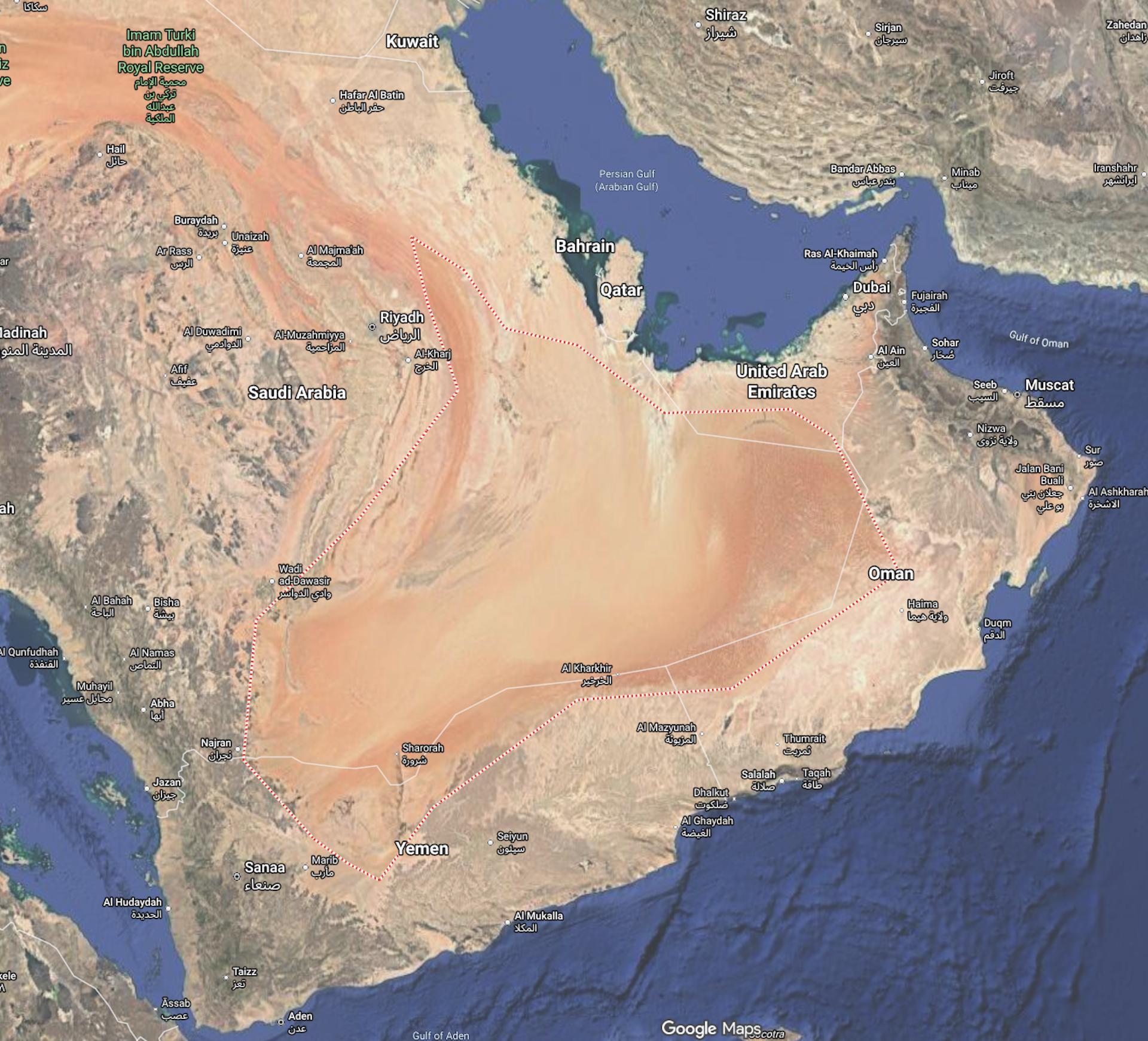
Rub’ al Khali desert stretches across the Arabian Peninsula.
Google Maps (2026)
Fossils show our species reached parts of Asia well before the major expansion about 60–70,000 years ago. Homo sapiens fossils in Greece and Israel, for example, place our species outside of Africa by about 200,000 years ago, while a human finger bone from northern Arabia places Homo sapiens on the Arabian peninsula at least 85,000 years ago.
Researchers continue to debate which routes people took and how these earlier populations relate to later ones.
Arabia occupies a central position between Africa and Asia. Earlier research documents repeated human occupation over the past 400,000 years, involving different human groups during wetter climatic phases.
These periods of “Green Arabia” created lakes and grasslands within today’s deserts. Our study examines how people lived in one such environment.
Evidence on stone-tipped weapons
Our international team investigated ‘Uruq Aljelibah, beside the ancient Mundafan lake.
We collected more than 5,500 stone tools and pieces left from making them, and mapped their positions alongside animal fossils. Some flakes refit together, helping us identify places where people made tools.
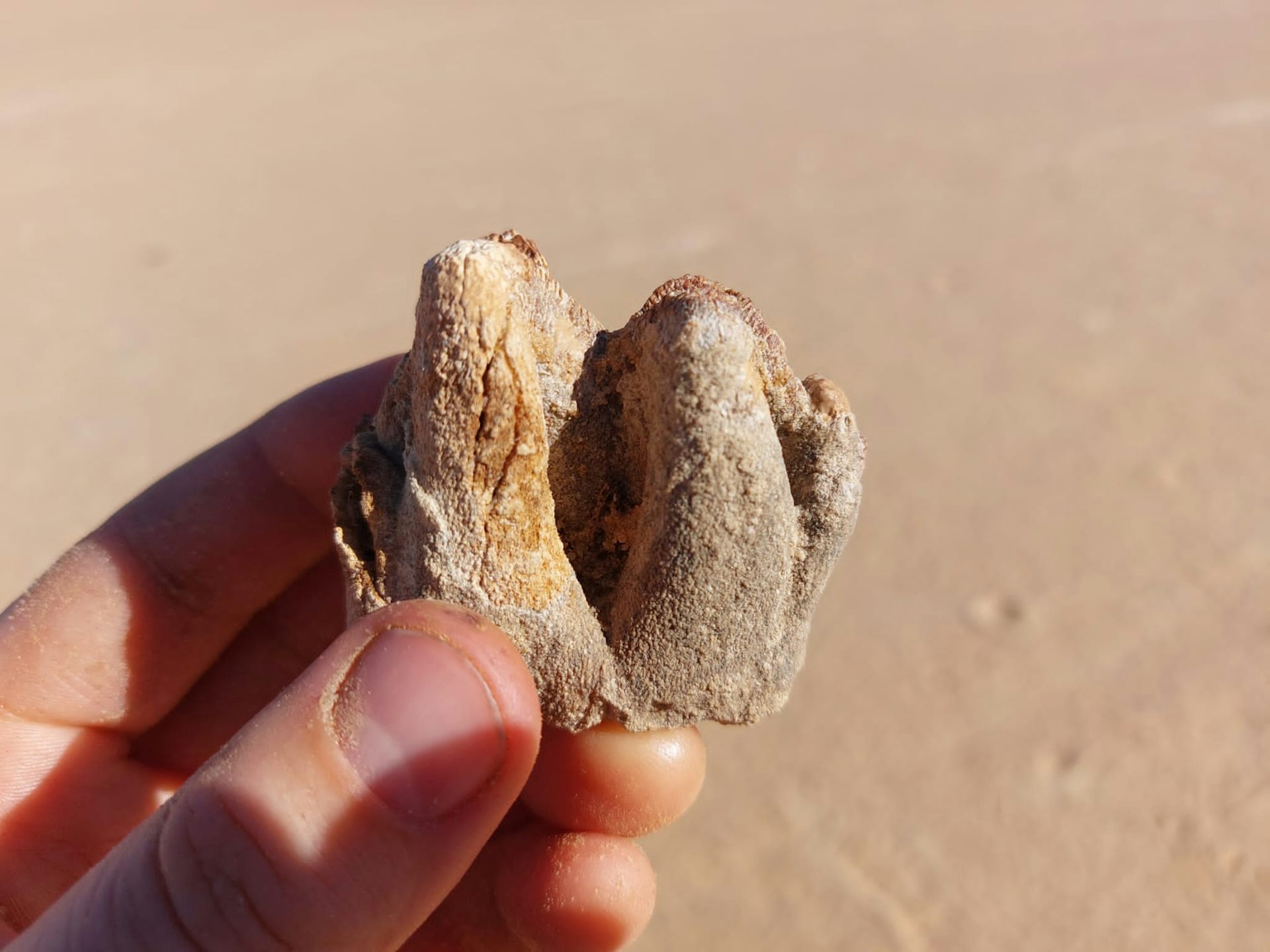
A hippo tooth from ‘Uruq Aljelibah.
Chris Clarkson
Microscopic examination revealed broken tips on several stone points, consistent with impact during hunting. One point preserved resin and plant fibres near its base, suggesting people glued and bound it to a shaft. Animal fats and protein survived nearer the tip.
Together, these traces support its use as a hunting weapon, although we can’t determine whether someone threw it or thrust it.
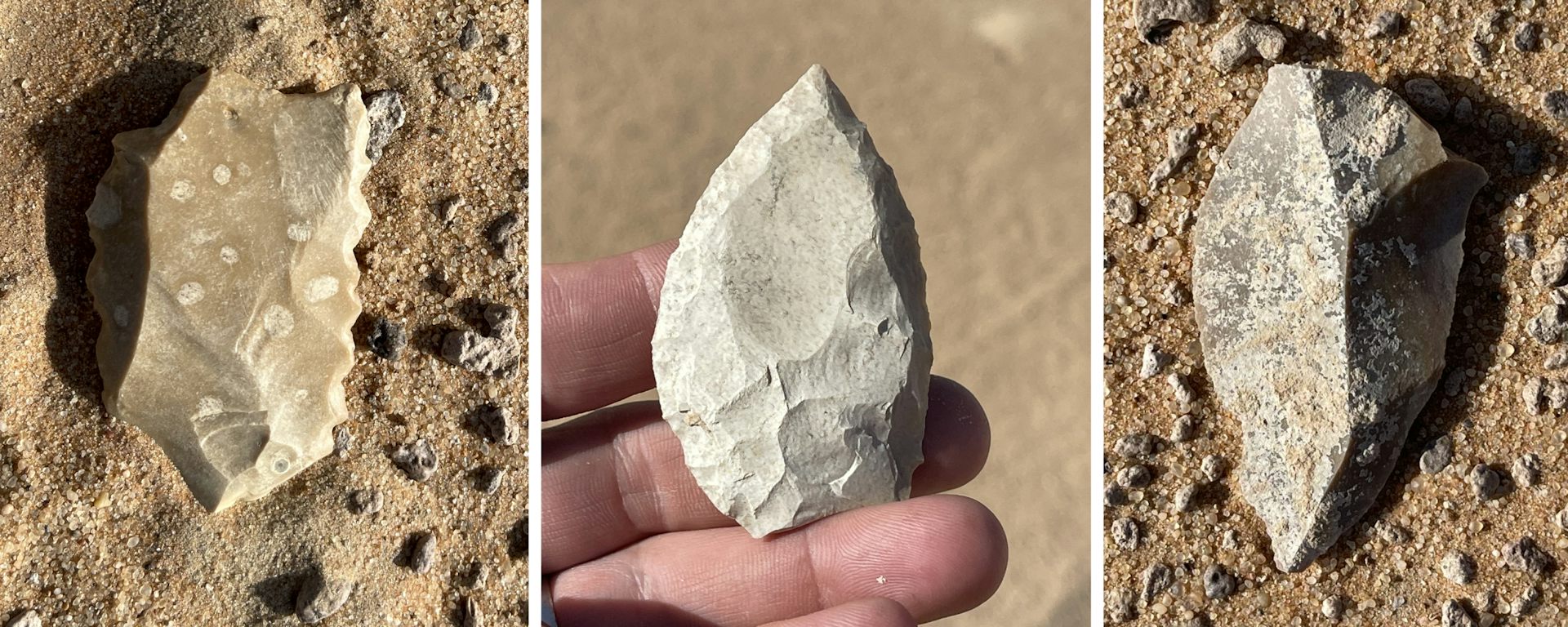
Left to right: saw-toothed ‘denticulate’ used to process plants including palm; a retouched stone point; a tool produced with the unique Levallois technique.
Chris Clarkson
These finds show humans used poison-assisted hunting about 65,000 years earlier than recently reported South African examples.
Plants were part of the toolkit Other tools preserved fragments of leaves, wood and fibres, including tissue from bark and palm leaves. We also found traces of reeds and underground plant parts. Fibres and wear on tools with toothed edges suggest people sawed or shredded plants, potentially producing material for bindings and other equipment.
Wood and fibre usually disappear from the archaeological record. Their surviving traces help us reconstruct parts of ancient technology that stone alone cannot reveal, including weapon shafts and possible cord or containers. Plants provided materials that could serve many purposes.
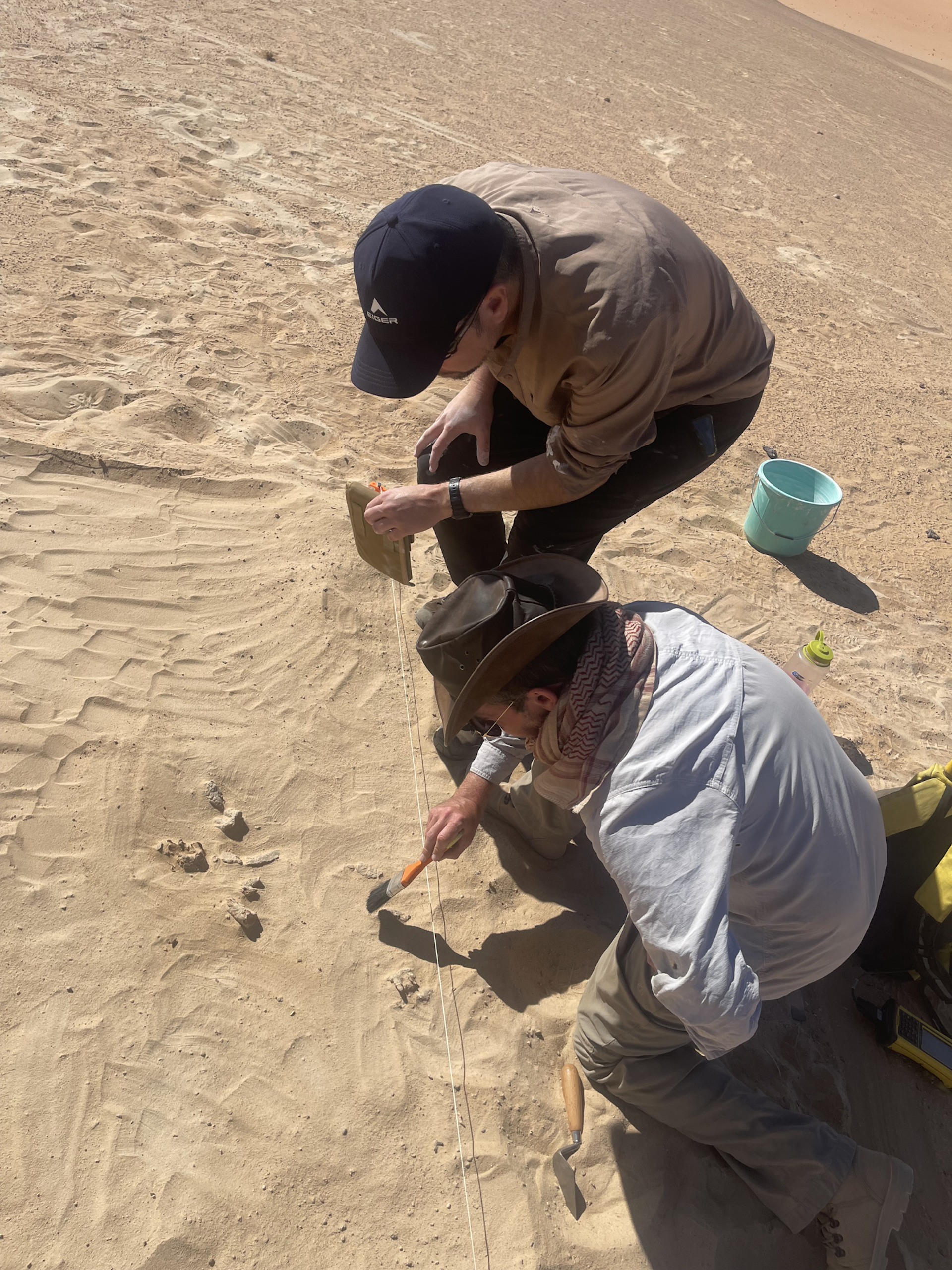
Gilbert Price from the University of Queensland and Paul Breeze from Kings College London excavating ‘Hetti’ the hippo.
Chris Clarkson
Together, they suggest a landscape that offered people water and a range of potential prey. Animal remains also cluster in areas with high concentrations of stone tools, linking some lakeshore activities to the fauna.
This association supports the evidence that the humans living here hunted and processed the animals they killed.
An ephemeral life Mundafan filled during separate wet phases, and the opportunities it offered changed as the climate became drier. We don’t yet know where its inhabitants went.
What their tools reveal is how knowledge of local plants and animals helped people occupy a landscape that was later abandoned as the lake dried and deserts returned.
Mundafan offers us a glimpse of an early stage in the human journey beyond Africa, with later traces of Homo sapiens documenting our species’ widening presence in China, Laos, Indonesia and, by about 65,000 years ago, Australia.
The authors would like to acknowledge the Saudi Heritage Commission, particularly Faisal Al-Jibreen and his team; Frans van Buchem and Laurence Hapiot of King Abdullah University of Science and Technology; and Abdullah Alsharekh of King Saud University for their invaluable collaboration and contributions to this research.

Chris Clarkson, Professor, Chair of Rock Art and Archaeology, Griffith University; Carney D. Matheson, Associate Professor, School of Environment and Science, Griffith University; Gilbert Price, Lecturer in Palaeontology, The University of Queensland, and Michael Petraglia, Director, ARC Centre of Excellence for Transforming Human Origins Research, Griffith University
This article is republished from The Conversation under a Creative Commons license. Read the original article.

The people who lived beside Lake Mundafan were making tools, exploiting local resources and meeting the practical challenges of survival some 125,000 years ago. Their activities belong to a human history that was already immensely long before anyone composed the biblical creation narratives. On the conventional young-Earth creationist chronology, these people were living and working roughly 119,000 years before there was supposedly a world for them to inhabit. No uncertainty about the precise use of a particular stone point can bridge that chronological gulf.
The discovery also adds substance to the story of human expansion beyond Africa. A greener Arabia offered places in which people could live, develop technologies and draw on their knowledge of plants and animals. Reconstructing that history means investigating changing climates, habitats, resources and populations. There are still questions about the routes people followed and the eventual fate of the Mundafan community, but those are questions within an increasingly detailed account of the past. They provide no evidence for a recent creation or a dispersal of all humanity from the survivors of Noah’s Flood.
Notice, too, how scientific confidence is matched to the evidence. The case for hunting weapons draws on their form, damage and surviving residues; the suggestion that some carried plant poisons requires its own assessment. Researchers can debate or revise that interpretation without erasing the archaeological site, its age or the evidence of a vanished lakeside environment. Science advances by distinguishing what is well supported from what remains uncertain. A commitment to defending a predetermined reading of Genesis offers no comparable means of discovering an unknown past.
The biblical authors need not be blamed for lacking knowledge of Pleistocene Arabia. They had neither the methods nor the evidence available to modern researchers. The problem arises when their culturally situated origin stories are promoted as an infallible account of natural and human history. Not even the deep past of the wider region in which those traditions developed is recognisably preserved in their narratives. The remains at Mundafan speak of generations of human experience entirely outside the timescale those stories allow when read as literal history.
Every carefully investigated site adds another piece to that larger human story. Here, a vanished lake and the traces of ordinary work reveal people whose existence young-Earth creationism cannot accommodate. The archaeological record has preserved something the biblical narratives did not: evidence that these people were ever here.
Advertisement
Amazon

Amazon

Amazon

Amazon

Amazon

Amazon

Amazon

Amazon

Amazon

Amazon

Amazon

Amazon

All titles available in paperback, hardcover, ebook for Kindle and audio format.
Prices correct at time of publication. for current prices.



No comments :
Post a Comment
Obscene, threatening or obnoxious messages, preaching, abuse and spam will be removed, as will anything by known Internet trolls and stalkers, by known sock-puppet accounts and anything not connected with the post,
A claim made without evidence can be dismissed without evidence. Remember: your opinion is not an established fact unless corroborated.