

Reconstruction of Homo longi from the Harbin cranium, now identified as that of a Denisovan.
© Nobu Tamura, CC BY-SA 3.0, via Wikimedia Commons.
One of the most important differences between science and creationism is not that science possesses absolute certainty while creationism does not. It is that science has procedures for recognising uncertainty, testing assumptions and preventing an interesting possibility from being promoted prematurely into an established fact. Creationism, by contrast, begins with an asserted certainty and then selects, distorts or dismisses the evidence according to whether it supports the required conclusion.
That distinction is illustrated particularly well by the recent suggestion that Denisovans may have been exceptionally tall. The claim originated in a preprint by Yousuke Kaifu and colleagues describing an incomplete femur and tibia recovered by dredging from the Penghu Channel between Taiwan and mainland China. Ancient proteins preserved in the bones identify them as Denisovan, giving scientists the first known Denisovan leg bones and potentially valuable information about the bodies of these enigmatic archaic humans.

Penghu 2 and Penghu 3 hominin leg bones.
Anterior (a), medial (b), and distal (c) views of the Penghu 2 right femoral shaft. Anterior (d), lateral (e) and distal (f) views of the Penghu 3 right tibia. Symbols: m=medial, p=posterior. Scale bar=10cm.
Anterior (a), medial (b), and distal (c) views of the Penghu 2 right femoral shaft. Anterior (d), lateral (e) and distal (f) views of the Penghu 3 right tibia. Symbols: m=medial, p=posterior. Scale bar=10cm.
But two large individuals do not establish that Denisovans as a population were exceptionally tall. Modern humans vary considerably in height, and no responsible anthropologist would attempt to calculate the average stature of the entire species from two people selected from a crowd. The problem is even greater when dealing with two incomplete bones recovered by trawling rather than from a documented archaeological excavation. Their exact discovery locations and original geological contexts are unknown, while large, robust bones are more likely than small or fragile ones to survive, become caught in fishing nets and be recognised as scientifically interesting.
This is the point made by palaeoanthropologist Sally Christine Reynolds in an article in The Conversation. The height estimates may be perfectly reasonable for the two individuals concerned, but extending those estimates to Denisovans generally would require a much larger and more representative sample. At present, “two Denisovans were tall” is a defensible conclusion; “Denisovans were a tall species” remains an intriguing but weakly supported generalisation.
This is evolutionary population thinking in practice. Species are not collections of identical specimens conforming to an ideal form. They are variable populations in which individuals differ because of their genes, sex, nutrition, health, environment and developmental history. Treating one or two specimens as definitive representatives of an entire species is a remnant of the typological thinking that sits much more comfortably with the creationist notion of separately manufactured and essentially unchanging “kinds”.
Creationists habitually misrepresent scientific disagreements about details as evidence that scientists are abandoning evolution. Nothing of the sort is happening here. Reynolds is not questioning whether Denisovans existed, whether they shared common ancestry with Neanderthals and Homo sapiens, or whether they interbred with the ancestors of some living people. She is questioning whether two bones provide sufficient evidence for one proposed characteristic of the Denisovan population.
Indeed, identifying these bones as Denisovan depended upon evolutionary science. Proteins change through inherited mutations, so similarities and differences in their amino-acid sequences retain evidence of common ancestry. Even when recoverable DNA and diagnostic skeletal features are unavailable, palaeoproteomics can place a fossil within an evolutionary family tree. Creationism supplies no corresponding method for predicting those nested molecular relationships and no explanation for why the history recorded by fossil proteins should agree with that reconstructed from DNA and anatomy.
One qualification should be added to the account in The Conversation. Reynolds states that neither bone has been dated directly. However, a companion preprint reporting radiocarbon and stable-isotope analyses gives Penghu 3 a direct radiocarbon age of approximately 45,575–44,522 calibrated years before the present. Penghu 2 remains undated, and the lack of stratigraphic provenance still prevents the two individuals from being assumed to have lived together or even during the same period. Both studies are also preprints and have yet to complete peer review.
Scientific scepticism therefore does not weaken the evolutionary account; it protects it from exaggeration. Scientists can accept that the bones belonged to two large Denisovans, recognise the importance of their molecular identification and direct dating, and nevertheless withhold judgement on whether Denisovans generally were unusually tall. That willingness to make the conclusion no larger than the evidence can support is one of the defining strengths of science—and the antithesis of a creationist doctrine in which the conclusion was declared infallible before any evidence was examined.
Sally Christine Reynolds's article in The Conversation is reprinted here under a Creative Commone License, reformatted for stylistic consistency:

Were Denisovans tall compared to other ancient humans? We should be sceptical
The Harbin Cranium
Picking just two from the crowd to represent the whole human species would be a tall order. But that is exactly what we do when we find fossils of ancient hominins (human relatives).
Anthropologists can estimate a person’s height with reasonable accuracy from the long bones – your femur (thigh bone) works well. On average, the size of this bone scales well with overall height, given a large samples of bones.
This is exactly what a group of scientists have done using fossils dredged from the seafloor off Taiwan. To add to the mystery, these bones are those of Denisovans, currently one of the most enigmatic species of hominins.
The Denisovans were a widespread species of Homo (the genus which encompasses our own species, as well as close relatives such as Neanderthals). They were initially known only from genetic sequences that had been extracted from isolated fragments of material, such as a small finger bone, at Denisova Cave in the Altai Mountains of Siberia.
The apparent absence of substantial fossil material from this species made them mysterious, although in recent years, fresh discoveries have added to our understanding. These include the Dragon Man (or Harbin) skull, recovered from a river in northeast China. DNA and protein analysis has now linked this large skull to the Denisovans.
The remarkable feature of the fossils analysed by Yousuke Kaifu, from the University of Tokyo, and colleagues, is that they were dredged from the Penghu Channel in the Taiwan Strait.
Most rare hominin fossils are carefully excavated, allowing researchers to record their exact position within layers of sediment and their relationship to associated animals, artefacts and environmental evidence.
These bones were instead recovered from the seabed among the fossilised remains of terrestrial ice age mammals, probably deposited when sea levels exposed the channel as dry land around the time when the ice age was at its height. Their precise discovery locations and geological contexts were not recorded.
This makes the fossils scientifically unusual: their anatomy and preserved proteins contain valuable evidence. However, much of the contextual information normally supplied by an archaeological excavation has been lost.
Two new Denisovan fossils have emerged from the seafloor of the Penghu Strait, near Taiwan. I look at what these tell us about the survival of Denisovans into the time frame of the “classic” Neanderthals.https://t.co/pOkJ8ISjZC
— John Hawks (@johnhawks) August 9, 2026
Recovered long bones
The bones – an incomplete femur (thigh bone) and tibia (the largest bone in the shin) – have been assigned to two Denisovans on the basis of analyses of their recovered ancient proteomes. A proteome is the collection of proteins preserved within a fossil. These proteins can retain evidence of evolutionary relationships, even when DNA has been lost.
These bones produced slightly different proteome signals, which is why the authors suggest that these represent two individuals. The newly described femur and tibia are likewise not directly dated.
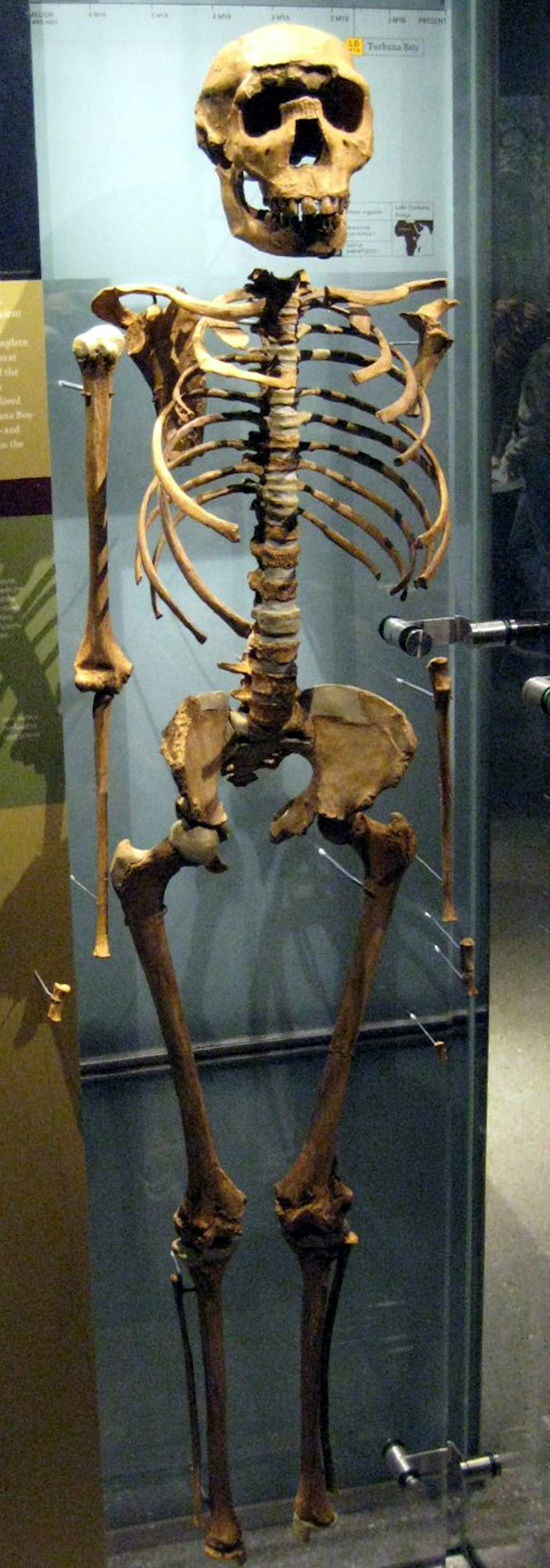
A replica of the Turkana boy skeleton at the American Museum of Natural History in New York.
Aside from assigning the bones to Denisovans, the researchers have used them to infer the stature of the two individuals. They are incomplete, which complicates matters somewhat, but skilled anatomists can be reasonably confident on the complete bone sizes.
The lack of context for the fossils – normally provided by the sediments in which they are recovered from – means we don’t know if the two individuals lived at the same time or at least a similar interval.
But the bones are long and when the other body elements are scaled based on the leg bones, it suggests that these individuals were tall. In the new paper, Yousuke Kaifu and colleagues say that the estimated height of Penghu 2 (one of the newly described specimens) was approximately 1.8 metres (5'11"), with a weight of around 83kg.
Their estimates for the other fossil, Penghu 3, give a height of about 1.9 metres (6'3") and a weight of about 91kg. These estimates, the team writes in their study, “are comparable to the largest known Pleistocene Homo from Africa and Europe”.
Inferring tallness as a species-level trait based on two individuals is challenging, although it has not prevented some headlines from claiming that Denisovans were tall. Think back to our walk in Trafalgar Square.
Proceed with caution
The dangers of reconstructing stature are illustrated by the famous Turkana Boy or Nariokotome Boy, a remarkably complete Homo erectus skeleton discovered in Kenya in 1984. He was unusual because his skull, teeth and long bones were all complete and available for study.
He was already around 1.6 metres tall when he died, but estimates of his age have differed. Dentally, he appears younger than his skeleton suggests. His skeletal development appeared comparable to that of a modern human aged around 11-13, while microscopic growth increments in his teeth suggested that he was only about eight or nine.
The discrepancy reflects uncertainty over whether Homo erectus grew slowly like us, including an adolescent growth spurt, or matured more rapidly.
Different assumptions consequently produced different projections of his adult height, although more recent modelling suggests he would probably have reached approximately 1.76–1.80 metres.
He is the only example of such a complete Homo erectus skeleton, but does this mean that all members of his species would have been as tall? We should be sceptical – just as we should be about the height of Denisovans.

Sally Christine Reynolds, Associate Professor in Hominin Palaeoecology, Bournemouth University
This article is republished from The Conversation under a Creative Commons license. Read the original article.

Whatever further fossils may reveal about average Denisovan stature, the importance of the Penghu bones does not depend upon portraying their owners as giants. They provide rare evidence of Denisovan anatomy below the skull, extend our knowledge of these archaic humans into eastern Asia and demonstrate how ancient proteins can identify evolutionary relationships when recognisable anatomy and recoverable DNA are insufficient.
For now, the evidence supports the conclusion that two Denisovan individuals were unusually large. It does not establish that exceptional height was characteristic of Denisovans as a whole. More fossils could confirm that possibility, modify it or show that Penghu 2 and Penghu 3 happened to lie near the upper end of a much broader range. Science loses nothing by waiting for that evidence because acknowledging what is not yet known does not invalidate what is already well supported.
And what is well supported remains thoroughly incompatible with creationism. The bones belong to members of an archaic human lineage that diverged from the Neanderthal lineage hundreds of thousands of years ago, spread across Asia and interbred with ancestors of living people. One of the Penghu individuals has been dated to about 45,000 years ago—tens of thousands of years before the supposed biblical creation and global flood. Its Denisovan identity was recovered from inherited molecular differences produced and preserved through evolutionary descent.
Creationists may try to portray disagreement over Denisovan height as uncertainty about human evolution, but that would merely substitute misrepresentation for evidence. Scientists are debating how much can be inferred from two incomplete bones; they are not debating whether Denisovans evolved, whether they were related to other humans or whether Earth’s history extends vastly beyond the biblical chronology.
Science can say, “We do not yet know whether Denisovans were generally tall,” while still explaining exactly what the available evidence shows and what further discoveries would test the hypothesis. Creationism can offer no comparable test, no molecular method and no independently verifiable account of the evidence. It offers only certainty without investigation—the very opposite of the disciplined scepticism through which science turns fragments of bone into an increasingly detailed history of human evolution.
Advertisement
Amazon

Amazon

Amazon

Amazon

Amazon

Amazon

Amazon

Amazon

Amazon

Amazon

Amazon

Amazon

All titles available in paperback, hardcover, ebook for Kindle and audio format.
Prices correct at time of publication. for current prices.



No comments :
Post a Comment
Obscene, threatening or obnoxious messages, preaching, abuse and spam will be removed, as will anything by known Internet trolls and stalkers, by known sock-puppet accounts and anything not connected with the post,
A claim made without evidence can be dismissed without evidence. Remember: your opinion is not an established fact unless corroborated.