Where does red become blue?

Taxonomy is an indispensable tool for organising the living world, but it can also create a misleading impression of nature divided into sharply separated compartments. The familiar Linnaean hierarchy was devised in a pre-evolutionary age, principally to classify organisms as distinct types. It was not designed to accommodate fragmentary snapshots of populations undergoing continuous change over millions of years.
That problem becomes particularly acute in palaeoanthropology. Fossils do not come with labels identifying their species and genus, and palaeoanthropologists cannot test whether their owners could have interbred. They must infer relationships from incomplete and often distorted remains, sometimes consisting of little more than a few teeth or part of a jaw. They must then assign those remains to discrete taxonomic boxes, even though evolution within each lineage was continuous, while populations were also branching, diverging, coexisting and sometimes exchanging genes.
The boundary traditionally drawn between Australopithecus and Homo has always seemed especially arbitrary. It gives the impression that, at some point between the two, evolution took a sudden stride and produced something qualitatively different: a creature sufficiently human to be admitted into our genus. In reality, the characteristics once used to define Homo did not appear together as a package. Bipedalism preceded substantial brain enlargement by millions of years; tool use is no longer regarded as the exclusive preserve of Homo; and fossils repeatedly present mosaics of supposedly “primitive” and “advanced” features.
Nor is there a universally objective amount of anatomical difference that separates one genus from another. A genus is a humanly constructed rank, not something that can be excavated from the ground alongside the fossil. Drawing a firm boundary across a gradually changing lineage can therefore exaggerate the differences on either side of it, artificially turning a succession of small evolutionary changes into an apparent leap.
This is the problem addressed by Monash University palaeoanthropologist Dr Ian Towle in a new paper, Clades, grades, and the genus problem: A case for revising hominin taxonomy, published in the American Journal of Biological Anthropology. Towle proposes expanding the genus Homo to include the species currently assigned to Australopithecus and Paranthropus—in effect placing the closely related hominins of the past four or five million years within one broadly defined genus.
The distinction he draws is between a clade and a grade. A clade consists of a common ancestor and all its descendants, whereas a grade groups organisms according to a broadly similar level of anatomy, ecology or behaviour. Terms such as “small-brained australopith” and “large-brained human” can describe grades, but they do not necessarily represent distinct branches of the evolutionary tree. If Homo and Paranthropus arose from among species assigned to Australopithecus, then Australopithecus, as conventionally defined, may not be a natural evolutionary group at all.
Towle’s proposal would not imply that “Lucy” was anatomically or behaviourally indistinguishable from a modern human, any more than placing lions and domestic cats within the same family makes them identical. The species would remain distinct, and their anatomical, ecological and behavioural differences would remain available for study. What would change is the artificial genus-level boundary that encourages us to imagine a decisive transformation where the evidence increasingly reveals a branching continuum.
The expression “muddle in the middle” is generally applied more narrowly to the confusing assortment of Middle Pleistocene members of Homo, but the underlying problem extends much further back. Much of the apparent muddle may lie not in evolution itself, but in the attempt to force a dynamic, branching history into a rigid series of named categories. The fossil record is the biological reality; the taxonomic scheme is merely the filing system devised to describe it.
Creationists will no doubt seize upon words such as “rethink”, “problem” and “muddle” and portray this as another scientist questioning human evolution. It is nothing of the sort. Towle is not disputing that these hominins evolved, that they shared common ancestors or that they lived millions of years before creationists believe the universe existed. He is asking whether the inherited terminology still represents that evolutionary history accurately.
Indeed, his argument would make no sense without evolution. It arises because an expanding fossil record has revealed more intermediates, more mosaics of features and more continuity than the old categories can comfortably accommodate. This is science doing what dogma cannot: responding to new evidence, questioning its own conventions and refining the way it describes reality.
In the following article in The Conversation, Dr Towle explains why it may now be time to redraw the taxonomic boundaries within the human family tree.

Why it might be time to rethink the human family tree.
Ian Towle, CC BY
Humanity’s family tree is long and tangled. Scientists sort our ancient relatives into three familiar groups: Homo, Australopithecus and Paranthropus.
Each of these is a “genus”, the rank just above a species. (In Homo sapiens, Homo is the genus and sapiens is the species.)
These names dominate how we talk about human origins. But new fossils, advances in genetic analysis, and more rigorous methods for figuring out who’s related to whom show these groupings don’t really reflect the true shape of our family tree.
Is it therefore time to come up with a new way to classify humans and our closely related extinct relatives? As I argue in a new paper in the American Journal of Biological Anthropology, the current system is overdue for revision.
Finding family branches
The core problem is the current groups often don’t represent real family branches – what scientists call “clades”. A clade is one common ancestor and every one of its descendants.
There’s a second issue too. Ideally, a genus should also tell us something about the behaviour, key traits, or way of life shared by all its member species.
Australopithecus (which includes the famous “Lucy” skeleton) is the clearest case. Large-scale analyses consistently find this genus isn’t a real family branch at all.
The problem traces back to how the genus was originally defined – not by shared ancestry, but by shared lifestyle or appearance. Recent fossils show traits such as brain size and gait, as well as diet and behaviour, don’t map cleanly onto the actual family tree.
Distinctive human traits are hard to find
Homo has its own problems. Traits once thought to define our genus, such as large brains, tool use and dietary shifts, and committed full-time land-dwelling bipedalism, have been undercut by more recent discoveries. Species such as Homo naledi and Homo floresiensis (the so-called “hobbit” species) pair small brains and other “primitive” features with traits typical of other Homo species.
It’s now hard to name a single feature shared by all Homo species not also found in some Paranthropus or Australopithecus species. That’s because different body parts evolve at different rates and directions, in what is called mosaic evolution. Traits also tend to evolve more than once, independently, in different closely related lineages facing similar pressures.
What’s more, key behaviours we associate with being human emerged much later than the genus itself did. The earliest members of Homo, as currently defined, include very small-brained species that may even have evolved independently from different Australopithecus lineages. The small-brained, later-surviving species mentioned above may likewise have surprisingly deep, separate roots.
Even Paranthropus, arguably the most physically distinctive of the three, known for its heavy jaws and huge molars, isn’t safe. Those features have long been read as adaptations for eating hard foods such as nuts, but evidence now suggests eastern and southern African species ate quite differently from one another, and neither relied heavily on hard foods.
Some researchers argue the group may not even be a single lineage, but rather two independent regional groups that evolved oversized teeth, meaning Paranthropus would not be a real family branch either, although most researchers today think this group is the most likely to be a genuine clade out of the three.
Taken together, there’s now little anatomical, behavioural or ecological evidence to justify keeping these three genera.
Why classification matters
This may sound like an abstract semantic question. But when genus names don’t reflect real relationships, they can obscure patterns of descent, overstate differences between groups, and reinforce outdated “primitive versus advanced” thinking. With a fast-growing fossil record and better methods for reconstructing family trees, the gap has become too large to ignore.
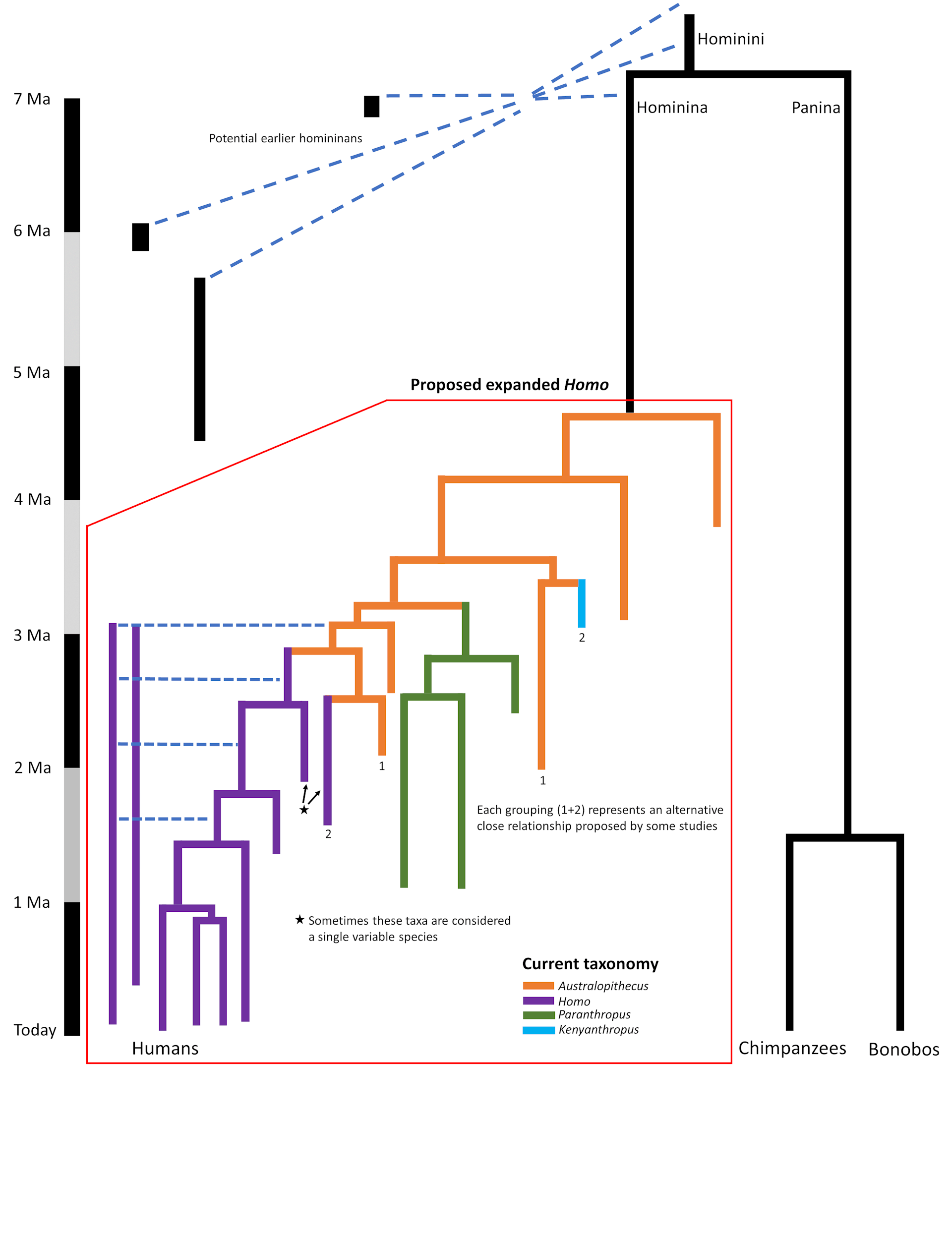
Hominin family tree showing the proposed changes to an expanded genus Homo. Dashed lines represent alternative hypotheses for the relationships of these taxa within the broader tree.
Ian Towle, CC BY
Changing the classification would have costs. We’d lose some intuitive distinctions researchers rely on, especially the ecological and physical uniqueness of Paranthropus and later, large-brained Homo.
Language must keep up with understanding
The fossil record seems to be increasingly showing a large, branching burst of evolution beginning around 4 million years ago, with diet, brain size, movement and tooth size all varying substantially among groups in ways that don’t necessarily map neatly onto their true relationships. A group this large and complex, shaped by migration and repeated rapid bursts of evolution in particular traits and behaviours, is best captured under a single genus.
Our everyday language is changing too. Humans were only formally recognised in recent decades as great apes – in the sense of being placed in the same family as chimps, gorillas and orangutans (Hominidae) – yet “ape” in casual usage still often excludes humans.
Similarly, “monkey” is often assumed to be a genuine evolutionary group, but isn’t. New World monkeys are more distantly related to Old World monkeys and apes than those two groups are to each other. Someone who consistently hears “monkeys, apes and humans” may reasonably draw wrong conclusions about our evolutionary relationships.
We are therefore in a transition period in how we discuss our place in the primate family tree, both in science and in everyday language. As biology increasingly embraces taxonomy that reflects genuine evolutionary relationships, perhaps it is time for our terminology, and the way we talk about ourselves, to catch up.

Ian Towle, Research Fellow in Biological Anthropology, Monash University
This article is republished from The Conversation under a Creative Commons license. Read the original article.

Whether or not Towle’s proposal is eventually accepted, the important point is that changing a taxonomic name would not alter a single item of evidence. No fossil would become younger, no anatomical feature would disappear and no evolutionary relationship would be overturned. The debate concerns how best to describe the evidence, not whether the evolutionary history recorded by that evidence occurred.
Creationists will predictably portray disagreement over where to draw the boundary around Homo as uncertainty about human evolution itself. But the difficulty in drawing that boundary exists precisely because the fossils do not fall into the sharply separated groups their argument requires. Instead, they exhibit overlapping combinations of features—bipedal bodies with small brains, relatively humanlike hands in otherwise australopith anatomy, and members of Homo retaining characteristics once thought to exclude them from our genus.
Far from exposing a gap in the fossil record, the blurred boundary between Australopithecus and Homo is what an evolutionary transition should look like. If every fossil could be assigned instantly and unambiguously to one side or the other, creationists would demand the intermediates between them. When those intermediates are found and make the boundary difficult to define, the same creationists complain that scientists cannot agree on their classification.
This also illustrates an essential difference between science and dogma. Scientific names and classifications are tools, not sacred truths. When accumulating evidence shows that an inherited system no longer represents natural relationships adequately, scientists are free to revise it. They do not need to defend the terminology of earlier generations regardless of what subsequent discoveries reveal.
Towle is therefore not weakening the evolutionary account of human origins but attempting to make its classification reflect that account more faithfully. Human evolution was not a sequence of magic transformations in which one finished “kind” abruptly became another. It was a branching history of populations changing by small increments, acquiring different mosaics of inherited and newly evolved characteristics, and sometimes coexisting for hundreds of thousands of years. The apparent strides are largely products of the boxes into which we place the fossils; the continuity lies in the fossils themselves.
Advertisement
Amazon

Amazon

Amazon

Amazon

Amazon

Amazon

Amazon

Amazon

Amazon

Amazon

Amazon

Amazon

All titles available in paperback, hardcover, ebook for Kindle and audio format.
Prices correct at time of publication. for current prices.



No comments :
Post a Comment
Obscene, threatening or obnoxious messages, preaching, abuse and spam will be removed, as will anything by known Internet trolls and stalkers, by known sock-puppet accounts and anything not connected with the post,
A claim made without evidence can be dismissed without evidence. Remember: your opinion is not an established fact unless corroborated.