

More dogs
Internet sources.
Last November, just as I was finalising the second of my Ice Age Tales novels, two papers appeared in Science examining a subject central to their underlying theme: the long relationship between humans and the wolves whose descendants became domestic dogs. My stories are set some 30,000–40,000 years ago and imagine the beginnings of that relationship. The new research examines later chapters, revealing that substantial diversity among dogs was already established thousands of years before the intensive breeding that produced modern pedigree breeds.
The distinction matters. These papers do not show that domestication began only 11,000 years ago, nor that today’s breeds originated then. One identifies recognisably dog-like skull shapes in specimens dating to about that time, together with considerable variation among early Holocene dogs. The other traces how ancient dog populations moved and mixed alongside human communities over nearly 10,000 years. Both illuminate a prolonged history, rather than a single moment when wolves suddenly became dogs.
Earlier associations between wolves and hunter-gatherers remain possible, although neither paper establishes the particular scenario imagined in my novels. Taming an individual wolf is also different from domesticating a population: domestication involves inherited changes across generations, and behavioural changes need not coincide with readily identifiable changes in skull shape. The earliest stages of this relationship therefore remain difficult to reconstruct.
Dog domestication is, of course, a classic example of evolution under human influence. Its history presents several awkward questions for creationism, especially claims that substantial biological change is impossible and that the natural world fits a chronology of only a few thousand years.
First, it demonstrates how selection acting on heritable variation can transform anatomy and behaviour over successive generations. Evolution does not require an entirely new set of genes for every new characteristic. Changes in existing genes, their regulation and their combinations can produce striking differences. Mutations supply new variation, while recombination reshuffles it and selection changes its frequency. Human breeders exploit these processes; they do not need to invent a new genome every time they favour a different trait.
Calling this merely variation within a “kind” does nothing to explain away the mechanism. The changes remain evolutionary changes, whatever label creationists attach to the animals involved.
Second, the evidence belongs to a chronology incompatible with conventional young-Earth creationism. Dogs were already diversifying before the supposed “Creation Week”, and their subsequent history records repeated movements, exchanges and changes in ancestry associated with human populations. A recent global flood cannot explain this geographically structured history simply by invoking a single catastrophic deposit. Its advocates would need to explain both the dated archaeological contexts and the genetic relationships recovered from the remains.
Third, there is a theological question for those who insist that animals were perfectly designed for human use. Why did humans have to spend generations modifying inherited wolf characteristics to obtain dogs suited to particular tasks? If an omniscient creator intended to provide hunting companions, herding dogs and other working animals, why leave their development to a lengthy process of selection? Evolution explains that history through changing circumstances and the modification of what already existed. Claims of perfect provision merely add a designer whose contribution becomes increasingly difficult to identify.
The first paper, by Allowen Evin, based at the Institute of Evolutionary Science in Montpellier, and colleagues, analysed the size and shape of 643 canid skulls spanning the past 50,000 years. Using three-dimensional comparisons, the researchers identified distinctive dog skull morphology in specimens dating to about 11,000 calibrated years before present, with substantial physical diversity already present among early Holocene dogs. This places important roots of canine diversity many millennia before the intensive breeding associated with modern kennel clubs. It does not establish that earlier dogs or earlier stages of domestication were absent.
The second paper, by Shao-Jie Zhang of the Kunming Institute of Zoology, Chinese Academy of Sciences, and colleagues, analysed 73 ancient dog genomes, including 17 newly sequenced individuals from East Asia to the western Eurasian steppe, spanning nearly 10,000 years. The researchers found relationships between dog ancestry and particular ancient human populations, including Ancient Palaeo-Siberians, Eastern hunter-gatherers, East Asians and steppe pastoralists.
They also identified several changes in dog ancestry that coincided with the dispersal of hunter-gatherers, farmers and pastoralists. The implication is that people frequently took dogs with them, while exchanges between communities also helped shape canine populations. These findings document the intertwined histories of humans and dogs; they do not, by themselves, demonstrate deliberate breeding for particular tasks.
The significance of both studies is discussed in an article in The Conversation by Kylie M. Cairns of the University of New South Wales and Professor Melanie Fillios of the University of New England, Australia, neither of whom was an author of the two research papers.
Their article is reprinted below under a Creative Commons licence, with formatting adjusted for stylistic consistency.

Dogs 10,000 years ago roamed with bands of humans and came in all shapes and sizes
Eurasian wolf, Canis lupus lupus, at Polar Zoo in Bardu, Norway
From village dogs to toy poodles to mastiffs, dogs come in an astonishing array of shapes, colours and sizes. Today there are estimated to be about 700 million dogs living with or around humans.
To many of us, dogs are loyal companions, working partners, and beloved family members – and the histories of our species are deeply woven together. But how did this incredible diversity come to be – and how far back does this relationship with humans go?
Two new studies published today in Science provide some answers. One, led by Allowen Evin from the University of Montpelier, draws on ancient skeletal remains. The other, led by Shao-Jie Zhang from the Kunming Institute of Zoology, draws on the study of DNA from ancient Eastern Eurasian dogs.
Together, these studies suggest the story of dogs and their relationship with humans is older and more complex than once thought.
The origins of modern dog diversity
The study by Evin and her colleagues used 643 dog and wolf skulls spanning the past 50,000 years to address the origins of modern dog diversity.
Her team’s analysis suggests the distinctive “dog-like” skull shape first arose around 11,000 years ago, during the Holocene epoch, the time since the most recent ice age. They also found substantial physical diversity in dog skulls from the same period.
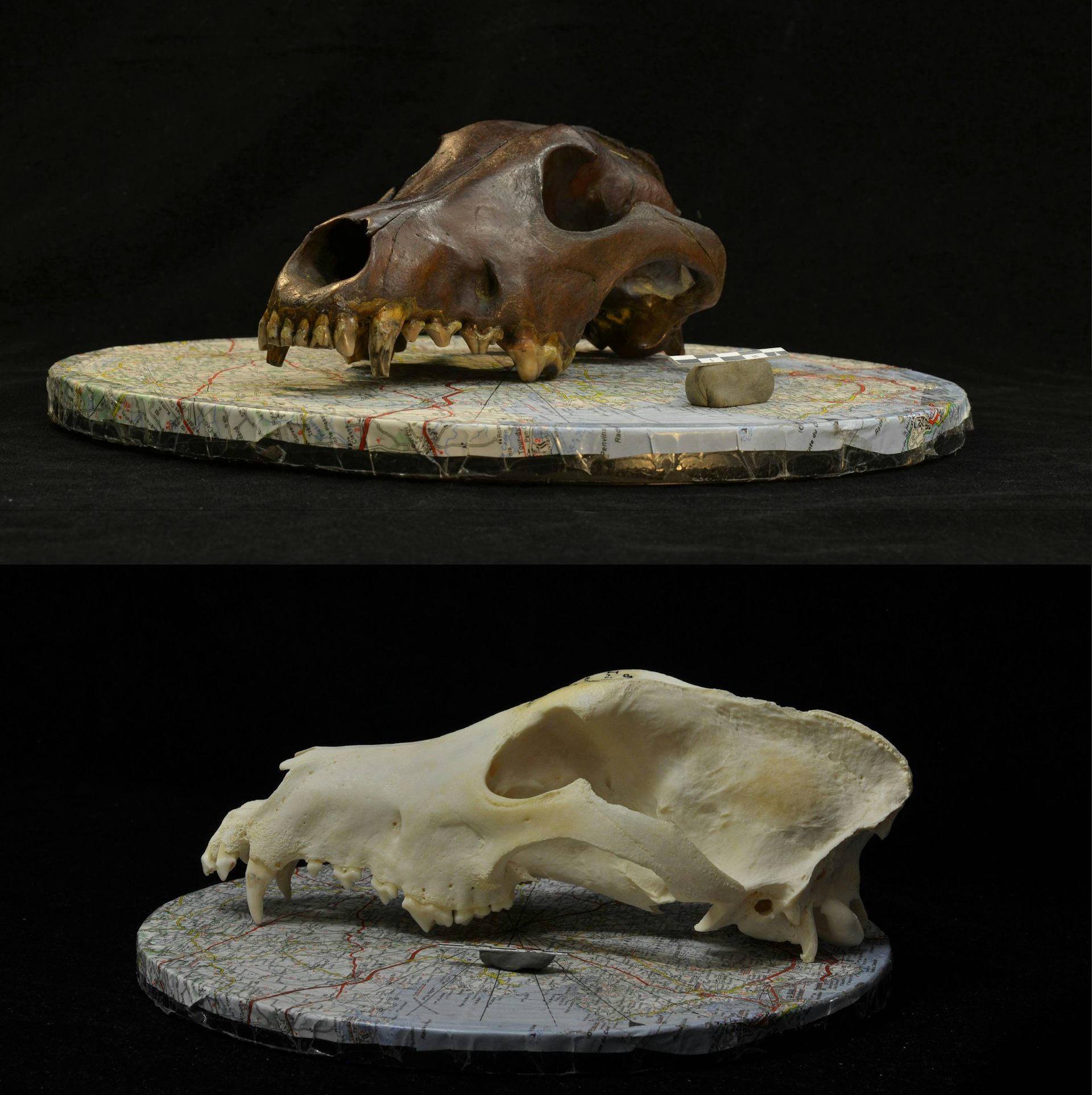
Photograph of an archaeological canid skull (top) and a modern dog skull (bottom) used for the photogrammetric reconstruction of 3D models in the study.
C. Ameen/University of Exeter
The team re-analysed the skull shapes of all 17 known dog or wolf skulls from the Late Pleistocene, a geological period from 129,000 to 11,700 years ago. Some skulls were 50,000 years old.
They found all of these Pleistocene skulls were essentially wolf-like in shape, including some previously identified as early dogs.
Importantly, this suggests that while the split between wolves and dogs likely occurred during the Pleistocene, the skull shape of early dogs didn’t start to change until closer to the Holocene – that is, 11,000 years ago. However, some Holocene dog skulls still retained wolf-like features.
This research suggests early dogs were much more diverse than previously thought. This diversity may have laid the groundwork for the extreme variations in size and shape of the dogs we have today.
Travelling companions
Earlier genomic studies have uncovered four major dog lineages that likely originated about 20,000 years ago: Eastern (East Asian and Arctic) and Western (Europe and Near East) dogs.
The origins of these ancient dog lineages are still being untangled. However, studying shifts in the ancestry of dogs through time and between different regions can help us better understand both the origins of dogs and the movement of Neolithic (new stone-age) humans.
The new study by Zhang and his colleagues used 73 ancient dog genomes spanning the last 10,000 years to explore how humans and dogs moved across Eastern Eurasia through time.
Analysis of these ancient dogs identified multiple shifts in the ancestry of dogs in Eastern Eurasia at times that correlate with the movement of specific human groups (hunter-gatherers, farmers and pastoralists). This suggests that as different human cultural groups moved across Eurasia, their dogs often moved with them, carrying their unique genetic signatures.
There was some discrepancy between human and dog population ancestry in some parts of Asia. For example, Eastern hunter-gatherers from Veretye and Botai, who were more closely related to Western Eurasian humans, had largely Eastern (Arctic) dogs rather than the Western dogs observed with other Western Eurasian cultures at the time.
This means dogs may have been a key part of cultural exchange or trade between different human cultures or communities. It may also illustrate complexities in the evolution of dogs that we are yet to understand.
The work by Zhang and his team presents compelling evidence that in Eastern Eurasia thousands of years ago dogs played an indispensable role in human societies as crucial “biocultural packages” that moved with humans. In other words, humans took their companions with them on their journeys (and perhaps traded them), rather than simply acquiring new dogs after moving.
These findings highlight the long-term, complex and intertwined relationship between dogs and humans that spans more than 10,000 years.
The genetic ancestry of dogs can act as a living record of ancient human migrations, trade networks and cultural exchanges. Studies on ancient dogs may also help us understand the environmental factors that contributed to the evolution of dogs, and their relationship with humans.
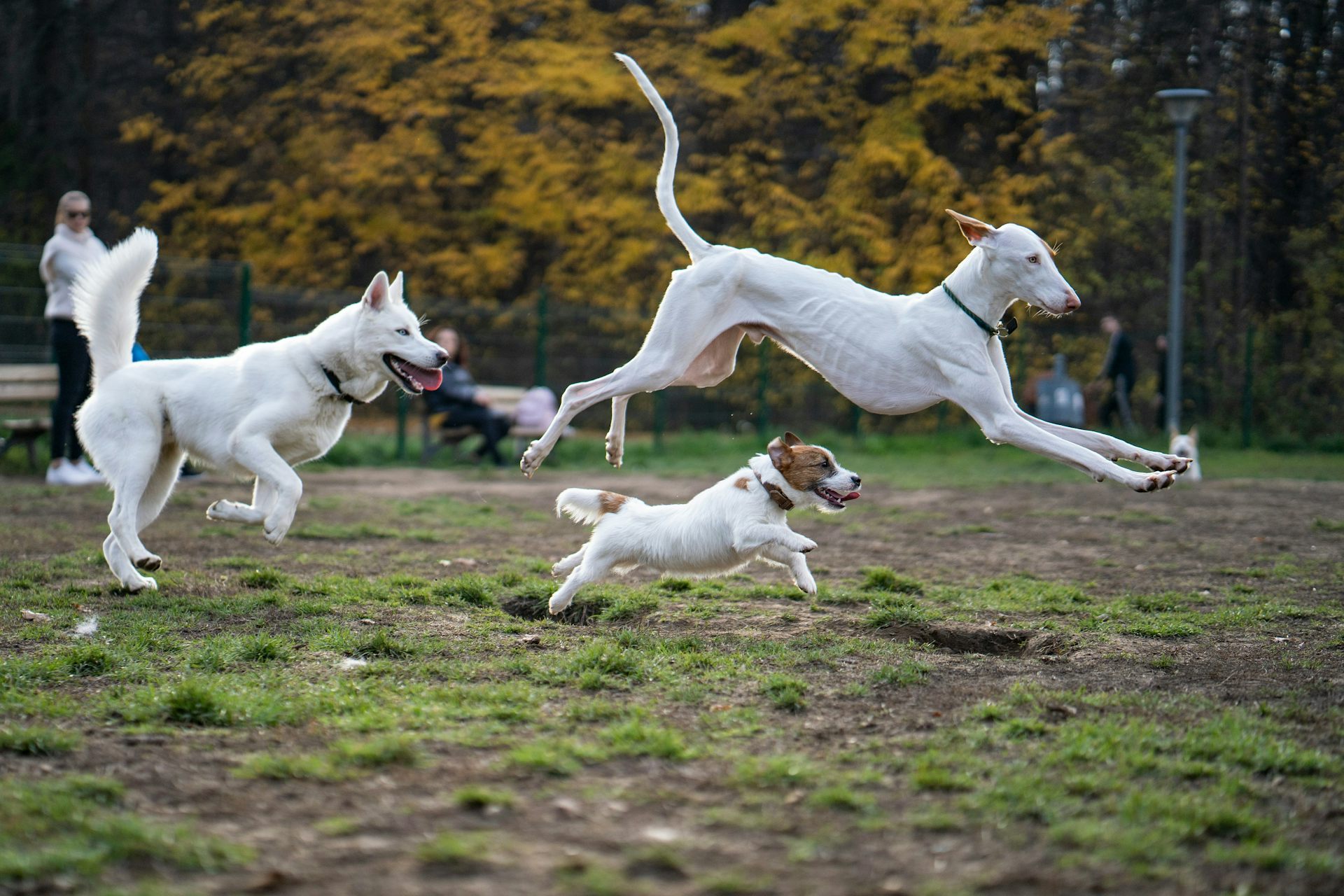
The groundwork for the extreme variations in size and shape of the dogs we have today was laid about 10,000 years ago.
Together, these new studies profoundly reshape our understanding of how dogs became so diverse and how they have related to humans along the way.
Both studies underscore that the incredible diversity in modern dogs is not an entirely recent phenomenon. The genetic and morphological foundations for this variation were laid thousands of years ago, shaped by natural selection, human selection and diverse environments, long before the structured breeding of the past few centuries.
Future studies investigating the physical diversity and ancestry of dogs through time could deepen our understanding of the complex origins and spread of dogs across the globe. Whatever their origins, this research deepens our appreciation for the unique and ancient bond between humans and dogs that was almost as diverse as canines themselves.

Kylie M. Cairns, Research Fellow in Canid and Wildlife Genomics, UNSW and Melanie Fillios, Professor, Department of Archaeology and Palaeoanthropology, University of New England
This article is republished from The Conversation under a Creative Commons license. Read the original article.

What emerges from these studies is a history of populations changing, moving and interbreeding over thousands of years. Dogs accompanied human communities, crossed cultural boundaries and diversified long before the establishment of modern pedigree breeds. Their history makes sense as an evolutionary process, shaped by inherited variation, environmental pressures and an increasingly close association with humans. No separate creation events are needed to explain it.
The predictable creationist response — “but they are still dogs” — misses the point. Evolution does not require descendants to cease belonging to their ancestral lineage. What needs explaining is how inherited characteristics change and diversity arises within that lineage. Calling the resulting animals a single “kind” neither explains those changes nor establishes a biological barrier beyond which evolution cannot proceed.
For young-Earth creationism, the chronology presents an additional difficulty. Here are recognisably dog-like animals and substantial canine diversity from before the supposed creation of the world, followed by a complex history of ancestry and dispersal associated with human societies. A mythical global flood explains neither that chronology nor those relationships. Rejecting the dates does not supply an alternative explanation for the evidence.
And for those who regard animals as a perfect designer’s provision for humanity, the question remains: why did their supposed provision require so much subsequent modification? Human preferences eventually supplied some of the direction, but the biological material came from an inherited evolutionary history, with all its possibilities and constraints. The dogs beside us today are the descendants of animals whose relationship with humans developed over countless generations. They are evidence of what evolution can produce, not an exception to it.
Advertisement
Amazon

Amazon

Amazon

Amazon

Amazon

Amazon

Amazon

Amazon

Amazon

Amazon

Amazon

Amazon

All titles available in paperback, hardcover, ebook for Kindle and audio format.
Prices correct at time of publication. for current prices.



No comments :
Post a Comment
Obscene, threatening or obnoxious messages, preaching, abuse and spam will be removed, as will anything by known Internet trolls and stalkers, by known sock-puppet accounts and anything not connected with the post,
A claim made without evidence can be dismissed without evidence. Remember: your opinion is not an established fact unless corroborated.