

Artistic reconstruction of the new dinosaur from Maranhão state. It was 20 meters long and had a European relative .
Paleoart: Jorge Blanco.
A newly described giant dinosaur from Brazil presents creationists with more than the familiar problem of a fossil vastly older than their supposed creation of the Universe. Its evolutionary relationships also preserve evidence of a world whose geography has changed profoundly: continents separating, ancestral populations dispersing, and related lineages following different evolutionary paths. This is precisely the sort of historical pattern we expect when common descent operates on a planet reshaped by plate tectonics.
The dinosaur, Dasosaurus tocantinensis, was approximately 20 metres long and lived around 120 million years ago, during the Early Cretaceous. Its remains were discovered during construction of a road–rail terminal at Davinópolis, in the north-eastern Brazilian state of Maranhão. Described by Elver Luiz Mayer and colleagues in the Journal of Systematic Palaeontology, it has its closest known evolutionary relative in what is now Spain. The researchers interpret this affinity as evidence that its ancestors probably reached South America from Europe via North Africa between about 140 and 120 million years ago.
That proposed route needs to be understood against the geography of the time. Africa and South America had not yet completed their separation, and connections between landmasses offered opportunities for dispersal that the modern map conceals. The finding therefore concerns ancestral movements through an ancient landscape, rather than dinosaurs somehow crossing the present-day Atlantic.
The broader evolutionary principle is straightforward. Populations can spread when geographical connections permit; when barriers interrupt gene flow, their descendants can diverge. Consequently, relationships between species should reflect both their ancestry and the changing opportunities for movement and isolation. Evolutionary biology supplies the explanation for the branching relationships, while plate tectonics supplies the changing geographical setting. This particular fossil does not, by itself, prove that continental separation caused a specific speciation event, but its affinities fit the larger picture remarkably well.
For young-Earth creationism, the difficulty is therefore both chronological and explanatory. A dinosaur living 120 million years ago cannot be accommodated within a literal Genesis chronology. Nor does the assertion that a creator suddenly produced separate “kinds” explain why their anatomical relationships should correspond to ancient geographical connections. Common descent makes that correspondence intelligible; magical creation provides no comparable prediction.
What emerges is a history of life unfolding on a changing Earth, with neither continents nor their inhabitants fixed in their present arrangements. Understanding that history requires evidence, evolutionary relationships and deep time — all conspicuously absent from the biblical creation account.
When Brazil’s dinosaur relatives lived in Europe^ evolution on a moving planet. Why should a dinosaur from Brazil have a close evolutionary relative in Spain? The apparent puzzle arises partly because we instinctively picture today’s continents and oceans. During the Early Cretaceous, the geographical opportunities for animals to spread were very different.Agência FAPESP’s report explains the discovery and its significance:
An ancient route between continents
Dasosaurus tocantinensis lived approximately 120 million years ago. At that time, much of Europe formed an archipelago, while Africa and South America were undergoing the prolonged process of separation that opened the South Atlantic. Their separation was not a single event that occurred everywhere simultaneously.
The researchers propose that the ancestors of Dasosaurus dispersed from Europe through North Africa into South America between about 140 and 120 million years ago. This reconstruction involves ancient geographical connections, including opportunities for interchange between European landmasses and Africa, followed by movement between Africa and South America before their final separation. It does not require dinosaurs to have crossed the modern Atlantic.
The route is a scientific inference from evolutionary relationships and ancient geography, rather than a migration directly documented at every stage by fossils.
Dispersal and vicariance: two ways geography shapes evolution
Dispersal occurs when organisms spread into new areas. A population may expand across connected land or reach a previously inaccessible region. Such movements can establish populations beyond the ancestral range.
Vicariance occurs when a new barrier divides an existing geographical range. An opening ocean, rising mountain range or expanding belt of unsuitable habitat can separate populations that previously exchanged genes.
Both processes can produce geographical isolation. Once gene flow is reduced, mutation, natural selection and genetic drift can cause populations to diverge. Given sufficient reproductive divergence, they may become separate species. Isolation does not guarantee speciation, however, and the splitting of a continent does not instantly create new species.
The Brazilian discovery chiefly supports a proposed history of ancestral dispersal. It should not be treated as proof that a particular continental split directly caused the divergence of these particular dinosaurs.
How do palaeontologists recognise relatives?
Researchers compare anatomical features across many species to reconstruct an evolutionary family tree, or phylogeny. Especially informative are shared derived characteristics: features inherited from a common ancestor that distinguish a particular branch from more distant relatives.
Overall resemblance is insufficient because similar features can evolve independently. Phylogenetic analyses therefore assess combinations of characteristics and test alternative relationships. Researchers then compare the resulting trees with fossil ages and geological reconstructions to investigate where ancestral lineages might have lived and how they spread.
A close fossil relative is not necessarily a direct ancestor. Nor does a family tree, on its own, establish the direction of migration.
An older example: fossils that helped reunite continents
The Early Permian aquatic reptile Mesosaurus is known from southern Africa and eastern South America. Its distribution was among the classic fossil clues that these now-separated continents had once been joined. This is evidence from a much earlier episode in Earth’s history, not evidence for the particular route proposed for Dasosaurus.
Glossary
- Dispersal
- The spread of organisms into new geographical areas.
- Vicariance
- The division of an existing geographical range by a new barrier.
- Gene flow
- The transfer of genetic variants between populations through reproduction.
- Common ancestor
- An ancestral organism or population from which two or more lineages descend.
- Phylogeny
- A reconstruction of evolutionary relationships among organisms.
- Plate tectonics
- The movement and interaction of the plates forming Earth’s rigid outer shell, reshaping continents, oceans and mountain ranges over geological time.
New long-necked dinosaur found in Northeast Brazil was a close relative of a European species
Dasosaurus tocantinensis was about 20 meters long and lived approximately 120 million years ago. Its closest relative lived in present-day Spain.
By André Julião | Agência FAPESP – A study published in the Journal of Systematic Palaeontology describes a new species of dinosaur discovered during construction of a road-rail terminal in the city of Davinópolis in the state of Maranhão, in the Northeast of Brazil. The animal, named Dasosaurus tocantinensis, was approximately 20 meters long and lived about 120 million years ago.
From an evolutionary perspective, its closest known relative lived in what is now Spain. The discovery indicates not only the presence of a new group of dinosaurs in the Brazilian region, but also the ancient connection between the European archipelago of that time and present-day South America.
The researchers state that the ancestors of the Maranhão species likely dispersed to the South American continent via North Africa between 140 and 120 million years ago, when the territories were connected as part of the supercontinent Gondwana.
It’s the largest known dinosaur for Maranhão, which has other species, but not sauropods like this one; rather, it has smaller ones, such as the diplodocid Amazonsaurus maranhensis, which was about 10 meters long.
Professor Elver Luiz Mayer, lead author
a Colegiado de Geologia
Universidade Federal do Vale do São Francisco,
Senhor do Bonfim-BA, Brazil.
A specialist in mammals from the much more recent Quaternary period, Mayer was contacted in 2021 while stationed in São Félix do Xingu in the state of Pará, where he served as a professor at the Federal University of Southern and Southeastern Pará (UNIFESSPA)
A team of archaeologists monitoring the Davinópolis construction site, as required for environmental licensing, found the fossils. Initially, they thought the fossils were from megafauna mammals that might have coexisted with ancient humans.
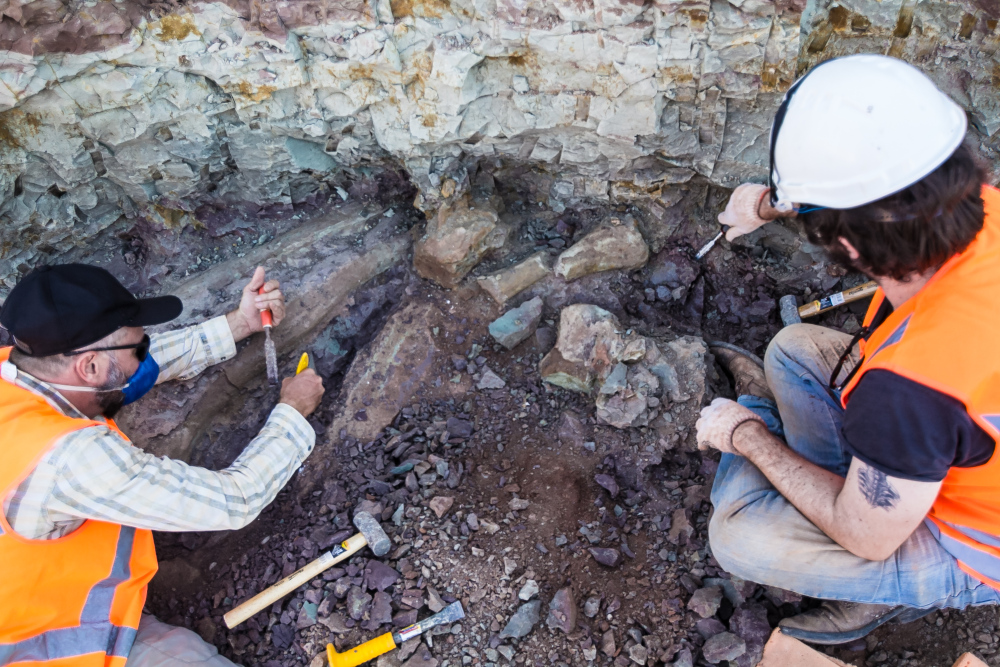 Elver Mayer and a team member excavate around the fossilsImage: Amai Fotografia)
Given its depth of about eight meters, I realized that it was much older. The age of the geological formation was already known from previous research and indicated that it was material from the transition from the Lower to the Upper Cretaceous, about 120 million years ago.
Professor Elver Luiz Mayer.
[Professor Mayer] then contacted various specialists and formed a multidisciplinary group to study the specimen.
After an extensive fossil preparation phase, analyses were conducted in Pará. Then, the specimen returned to Maranhão and is currently housed in the state capital of São Luís at the State Center for Natural History and Archaeology Research, which also participated in the study.
Because it includes tail vertebrae, a 1.5-meter femur, ribs, foot bones, and arm and leg bones, this is considered a relatively complete specimen. We believe there are more fossils from this same specimen yet to be excavated at the site.
Professor Max Langer, corresponding-author
o Departamento de Biologia
FFCLRP, Universidade de São Paulo
Ribeirão Preto-SP, Brazil.
Langer coordinates the project “Exploring the Diversity of South American Cretaceous Dinosaurs and Their Associated Faunas”, which is supported by FAPESP.
Forest dinosaur
The name of the new species refers to the state of Maranhão. “Daso” means “forest,” referring to the woodlands of the region, which the first Portuguese colonizers said formed a large tangle, or “maranhão.” “Tocantinensis,” in turn, refers to the Tocantins River, as the site is located near its eastern bank.
Analyses of the bone microstructure led by researchers Tito Aureliano and Aline Ghilardi of the Federal University of Rio Grande do Norte (UFRN) revealed a growth pattern combining characteristics of older sauropods and titanosaurs, a group closely related to the newly discovered species.
The finding suggests that certain growth and bone remodeling patterns evolved earlier than previously thought. This helps explain how some dinosaurs reached such extreme sizes (read more at agencia.fapesp.br/41684).
The circumstances surrounding the discovery of Dasosaurus reveal a great deal about the paradox of paleontological research. While large-scale construction projects could destroy fossil records, these developments access the ground in ways that paleontologists could not achieve using only pickaxes and chisels.
Brazil is a tropical country with dense vegetation. Geologists and paleontologists rely heavily on human activity to excavate, expose the rocks, and reveal the fossils. If we map Brazil’s fossil sites, we’ll see highways and quarries. These projects are important for understanding our heritage. But it’s obvious that specialized monitoring and artifact recovery are necessary, which doesn’t always happen.
Professor Max Langer
That’s why it’s urgent to foster closer cooperation between the parties to reconcile construction projects with federal legislation on fossils and promote new discoveries while ensuring the proper preservation of our heritage.
Professor Elver Luiz Mayer.
Currently, the research team is negotiating with the construction company to continue excavating in search of more fossils, which could provide new information about the species and the group as a whole.
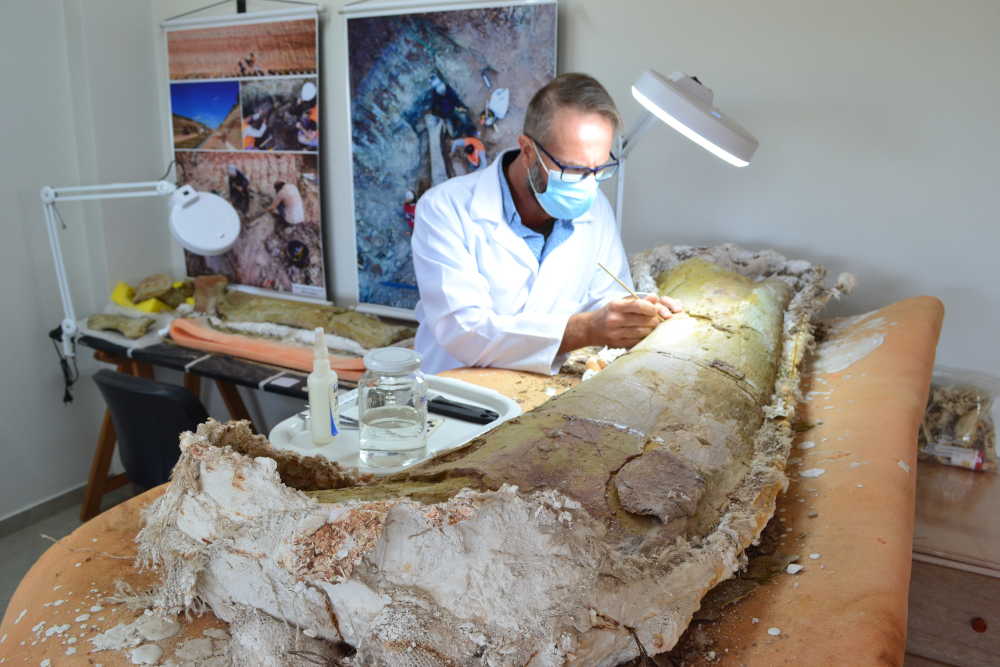 Mayer prepares a femur fossil, approximately 1.5 meters longphoto: Elver Mayer/Univasf
The work received support from FAPESP in the form of a doctoral scholarship, postdoctoral fellowship, and a grant under the Young Investigator modality.
Publication:
The difficulty this discovery presents for young-Earth creationism goes well beyond its age, although 120 million years is quite enough to demolish a chronology of just a few thousand. Dasosaurus tocantinensis also adds to a coherent picture of life evolving on a changing planet. Its affinities with a European dinosaur make sense in the context of common ancestry and ancient opportunities for dispersal — connections that today’s oceans have obscured.
The theory of evolution is central to understanding that evidence. Anatomical comparisons allow researchers to reconstruct relationships, while geology helps establish when and where ancestral populations could have spread. The proposed route through North Africa remains open to refinement as further fossils emerge. That is how science progresses: explanations are tested against evidence, and their details change when the evidence warrants it.
Sudden supernatural creation supplies no comparable explanation for why evolutionary relationships should fit the geography of a vanished world. Invoking a creator capable of producing any imaginable arrangement does not predict the particular arrangement we actually find. Common descent, dispersal and geographical isolation give researchers something far more useful: explanations whose implications can be investigated.
These dinosaurs inhabited an Earth already carrying an immense geological and evolutionary history. Continents moved, habitats changed, and populations encountered opportunities and barriers with no knowledge of what lay ahead. Their descendants followed different evolutionary paths without a plan or predetermined destination. The fossil record preserves traces of that history, however inconvenient they may be for those who insist that reality must conform to Genesis.
Advertisement
Amazon

Amazon

Amazon

Amazon

Amazon

Amazon

Amazon

Amazon

Amazon

Amazon

Amazon

Amazon

All titles available in paperback, hardcover, ebook for Kindle and audio format.
Prices correct at time of publication. for current prices.



No comments :
Post a Comment
Obscene, threatening or obnoxious messages, preaching, abuse and spam will be removed, as will anything by known Internet trolls and stalkers, by known sock-puppet accounts and anything not connected with the post,
A claim made without evidence can be dismissed without evidence. Remember: your opinion is not an established fact unless corroborated.