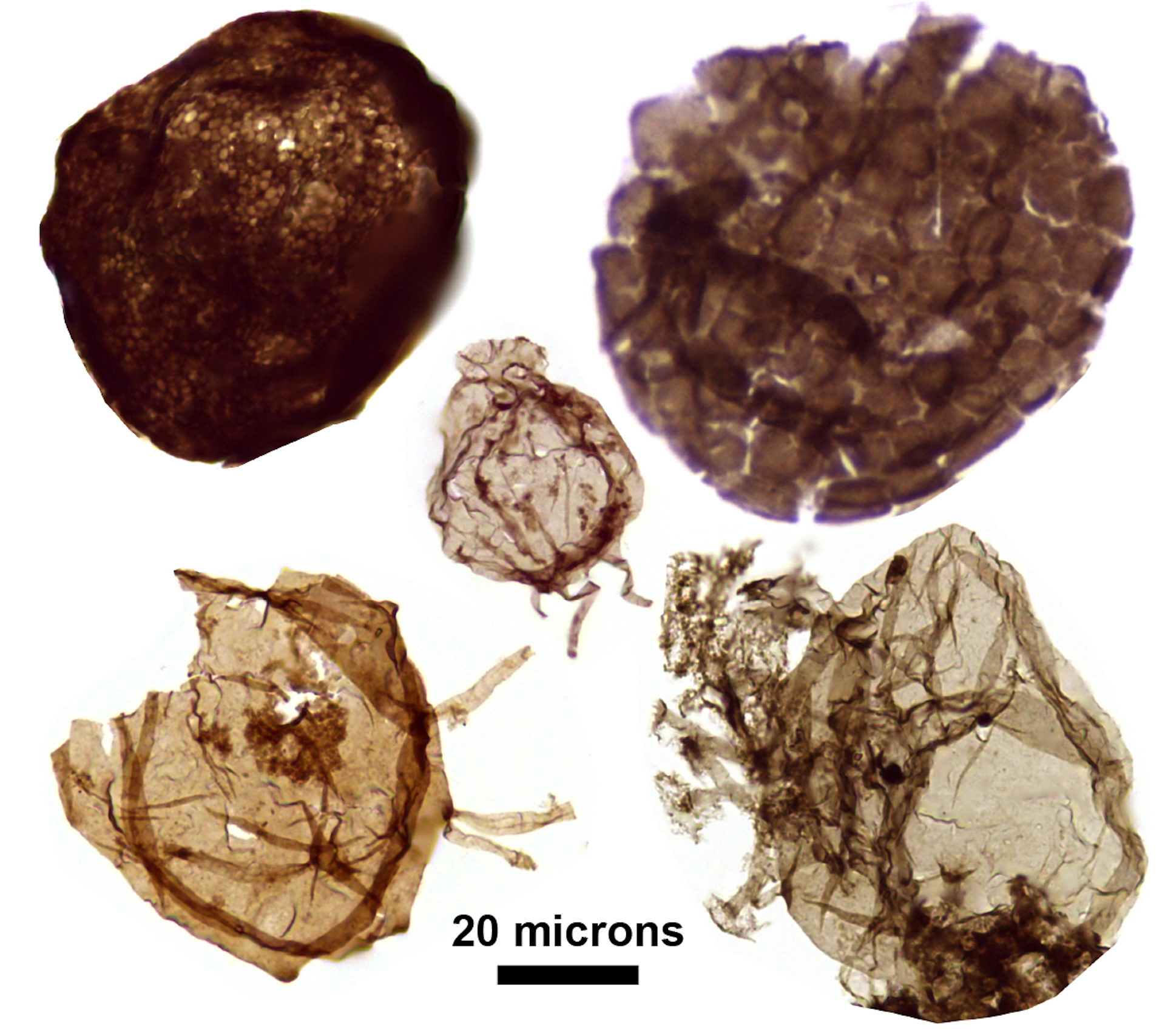
Fossils of single-celled eukaryotic organisms with complex surface features such as extensions and plates.
Leigh Anne Riedman
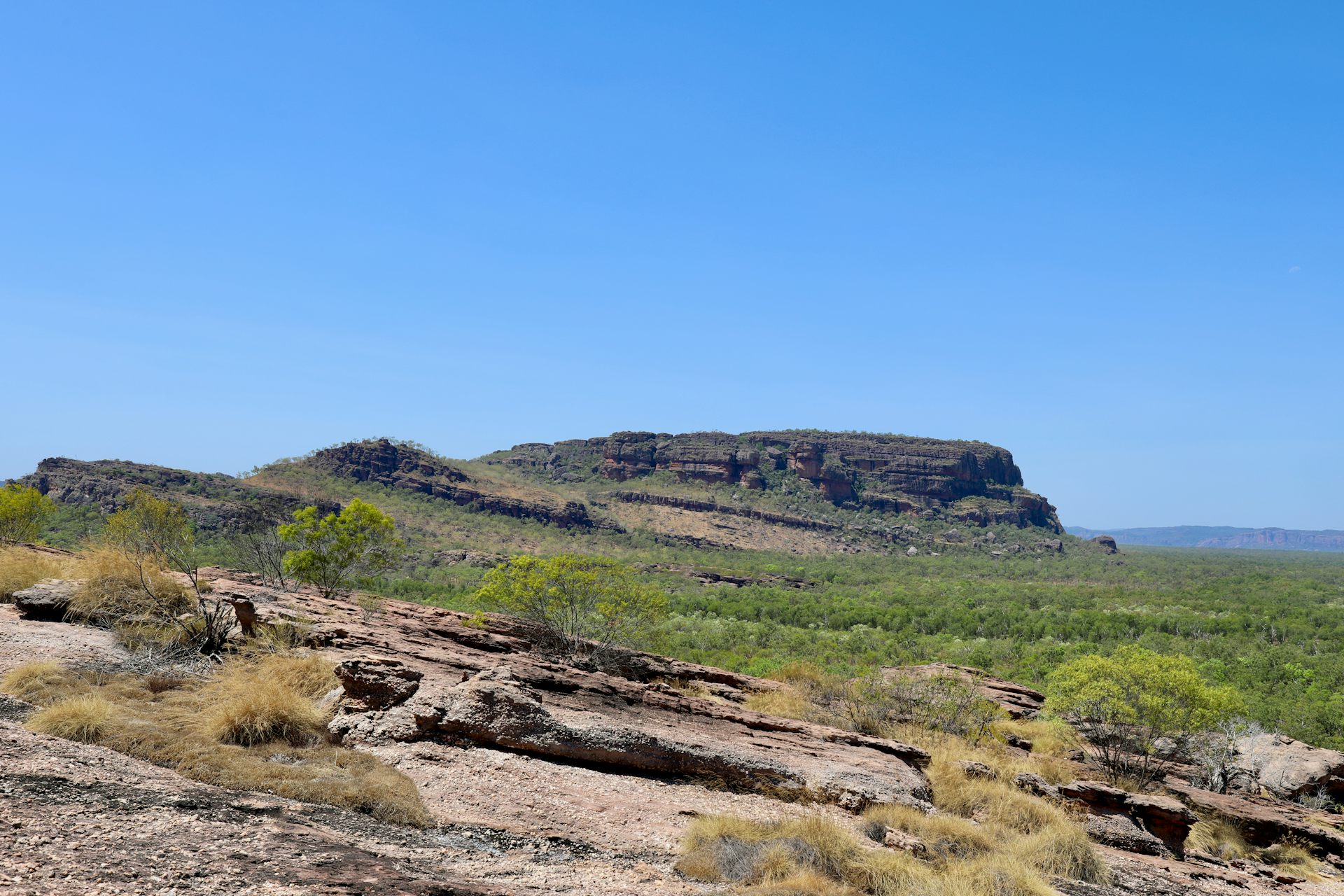
For young-Earth creationists, some of the most troublesome evidence comes in the smallest packages. Microscopic fossils preserved in ancient Australian mudstones record organisms living approximately 1.75–1.4 billion years ago — an antiquity impossible to reconcile with the few thousand years allowed by a literal reading of the biblical genealogies. These organisms were already part of aLayers of 1.7 billion-year-old sedimentary rocks, Kakadu National Park, Northern Territoryn evolving biosphere more than a billion years before the supposed “Creation Week”. Their existence presents a chronological problem that no amount of argument about the meaning of “kind” can resolve.
These fossils are the subject of a paper in Nature, by Maxwell A. Lechte and colleagues, investigating the environments inhabited by some of the earliest known eukaryotes. Eukaryotes are organisms with structurally complex cells, typically containing a nucleus and specialised internal compartments; they include animals, plants, fungi and numerous microscopic organisms. Here, “complex life” refers to cellular organisation, not to miniature animals swimming through those ancient seas. Understanding these early cells helps explain the evolutionary foundations upon which much later forms of life depended.
Glossary.
- Aerobes
- Organisms that use oxygen in their metabolism. Obligate aerobes require it; facultative anaerobes can grow with or without it; microaerophiles require oxygen at concentrations below those in ordinary air.
- Benthic
- Living on, in or close to the bottom of a sea or lake. A “benthic habit” means a bottom-dwelling way of life.
- Planktonic
- Living suspended in the water and drifting largely with currents, rather than inhabiting the seabed.
- Bottom waters
- The water immediately above the seabed. It can lack oxygen even when the surface waters contain it.
- Morphological complexity
- Complexity of physical form or structure. Elaborate fossil walls, ornamentation and extensions can help researchers recognise probable eukaryotes.
- Palaeontological, sedimentological and geochemical analyses
- Studies of fossils, sediments and their formation, and the chemical composition of geological materials, respectively. Combining them helps reconstruct both ancient organisms and their environments.
- Body fossils and molecular biomarkers
- Body fossils preserve remains or impressions of organisms. Molecular biomarkers are chemical traces of biological molecules that can provide evidence of ancient life even without recognisable bodies.
- Proterozoic eon
- The interval from approximately 2.5 billion to 539 million years ago, encompassing much of the early history of eukaryotic life.
- Neoproterozoic era
- The final part of the Proterozoic, approximately 1 billion to 539 million years ago. The researchers propose that eukaryotes expanded substantially into planktonic habitats during this interval.
The research also illustrates something creationist caricatures of science routinely overlook: scientists continually test their explanations against evidence. Discoveries of living eukaryotes capable of surviving without oxygen, together with evidence that ancient seas were widely oxygen-poor, had raised questions about whether the earliest eukaryotes needed oxygen at all. To investigate, the researchers turned to rock cores drilled decades ago during mineral exploration and subsequently stored in Darwin. They examined more than 12,000 microfossils and analysed the sediments and their chemistry to reconstruct the organisms’ habitats. Old collections, approached with new questions, can still yield major discoveries.
The resulting pattern was revealing. Eukaryotic fossils occurred almost exclusively in sediments deposited beneath oxygenated waters, whereas sediments from oxygen-free settings still preserved other microbial fossils. Their distribution suggests that these early eukaryotes used oxygen and probably lived on the seabed. The researchers also propose that a much later expansion into planktonic habitats helped shape subsequent diversification. This connects evolutionary history with the availability of suitable environments: the opportunities for complex organisms to flourish depended on the physical and chemical conditions around them.
This does not establish every step in the origin of the eukaryotic cell, nor demonstrate that one particular rise in oxygen directly caused its appearance. It does strengthen the evidence that oxygen availability constrained early eukaryotic habitats. The broader picture is one of evolution unfolding within a changing planet, with environmental conditions opening opportunities and imposing limits. There is no requirement here for foresight or a predetermined destination.
Creationists may welcome any suggestion that scientists are reassessing an earlier interpretation, but the revision offers them no chronological refuge. Whether these organisms inhabited the seabed or drifted in the water, and precisely how they used oxygen, are questions within an ancient evolutionary history. Reconsidering those details does not compress that history into a biblical timetable. Science advances because its explanations remain answerable to evidence; a chronology fixed in advance can survive only by refusing the evidence that contradicts it.
In the following article from The Conversation, reproduced here under a Creative Commons licence, researchers Maxwell Lechte and Leigh Anne Riedman explain what these tiny fossils reveal about the early evolution of complex life.

Tiny fossils found in 1.7 billion‑year‑old mud yield clues to the evolution of complex life
Drill cores of sedimentary rock which contains microscopic fossils.
Maxwell Lechte
Stored in an open-air warehouse in tropical Darwin, Australia, are dozens of trays containing cylindrical cores of rock. They are from drill holes bored hundreds of metres below the surface by mineral exploration companies decades ago.
Some of these cores at the Northern Territory Geological Survey are mudstone – a type of sedimentary rock formed from hardened seafloor mud. The companies that drilled these cores were largely unaware that within these mudstones were fossils of microscopic organisms buried on the seafloor of an ancient inland sea that covered much of northern Australia over 1.5 billion years ago.
As our new study, published today in Nature, shows, these fossils are crucial for addressing a longstanding puzzle about the major evolutionary leap that led to all complex life on Earth: the origin of eukaryotes.
Layers of 1.7 billion-year-old sedimentary rocks, Kakadu National Park, Northern Territory.
Maxwell Lechte
All life on Earth can be placed into one of two types which are fundamentally different at the cellular level.
Prokaryotes (bacteria and archaea) have simple cellular organisation and are mostly single celled. Eukaryotes – including all animals, plants, algae and fungi – are very different. They have much more complicated cells featuring a nucleus and other specialised structures such as organelles which perform specific jobs.
The eukaryotic revolution transformed the planet. It led to the rise of animals and, eventually, to us. Based on observations from the genes of living organisms, it is now widely agreed that the last common ancestor of all living eukaryotes resulted from the symbiotic union of (at least) two prokaryotic microbes: an archaeon and a bacterium.
The first evidence for eukaryotic life comes in the form of these fossils of single-celled organisms. They show a level of cellular complexity not seen among prokaryotes, but common in eukaryotes.
Eukaryote fossils can be found around the world in rocks dating back at least 1.5 billion years. The fossils of the Northern Territory, the oldest of which date back to 1.75 billion years ago, are the oldest currently known eukaryote fossils globally.
But the ancient world in which early eukaryotes evolved remains shrouded in mystery. And so many fundamental aspects regarding their nature are unknown.
Oxygen – friend or foe?
Many types of bacteria can live and grow in places without oxygen. But nearly all eukaryotes alive today use oxygen for their survival. That’s because aerobic respiration – breaking down food using oxygen – provides the vast amounts of energy that complex life demands.
But the idea that oxygen has always been beneficial for all eukaryotes has come under fire in recent years. This follows the surprising discoveries of enigmatic eukaryotes that can thrive in conditions without oxygen.
There is also mounting evidence from the geological record that when eukaryotes were first evolving, oxygen was likely much scarcer. This means oxygen-free marine habitats would have been the norm. Collectively, these observations have called into question the assumption eukaryotes have depended on oxygen since their inception.
Genetic studies of living microbes belonging to groups considered closest to the ancestors of the first eukaryote can offer key insights into eukaryote ancestry. But only the fossil record can tell us about long-extinct lineages. And only geology can offer a window into the kind of world these organisms lived in.
Fossils of single-celled eukaryotic organisms with complex surface features such as extensions and plates.
Leigh Anne Riedman
For our new study, we crushed up samples of the mudstone cores stored in Darwin, then dissolved them. We identified more than 12,000 fossils by analysing the organic residue left behind by this dissolution under a microscope.
We also studied the mudstones the fossils were preserved in to better understand what the environment was like when the sediments were deposited. This offered insight about the habitats in which these eukaryotes lived. And by analysing the chemistry of these mudstones, we could determine whether oxygen was present in the ancient seawater.
Our results show that eukaryote fossils were found in environments ranging from coastal mudflats to the open sea. But they were present only in samples deposited in oxygenated settings. Samples from oxygen-free environments contained only simple, prokaryotic forms.
This suggests that even the oldest known eukaryotes that lived on Earth 1.7 to 1.4 billion years ago were dependent on oxygen. These data lend support to a long-held hypothesis that oxygen played a key role in driving the evolution of early eukaryotes.
Resolving the drivers and context of the major evolutionary leap represented by early eukaryotes is one of the major outstanding questions in the life sciences. Ongoing studies of these enigmatic, ancient microfossils will no doubt tell us more about our own origins – and our place in the cosmos.

Maxwell Lechte, Research Associate in Geobiology, University of Sydney and Leigh Anne Riedman, Postdoctoral Researcher, Department of Earth Science, University of California, Santa Barbara
This article is republished from The Conversation under a Creative Commons license. Read the original article.

For young-Earth creationism, the fundamental problem remains the chronology. These microscopic organisms inhabited Earth more than a billion years before the supposed biblical creation. Debates about their metabolism or preferred habitat cannot make that immense span of time disappear. There is no evidence-based reconciliation between this geological history and a world only a few thousand years old; preserving the latter requires rejecting the former.
The study also illustrates how science progresses. Researchers revisit specimens, question assumptions and combine different kinds of evidence to distinguish between competing explanations. Whether early eukaryotes depended on oxygen is a question to investigate, not a doctrine to defend. Revising an interpretation in response to evidence strengthens our understanding; it does not render every alternative explanation equally credible.
What emerges is a history in which the evolution and distribution of complex life were constrained by environmental conditions. Oxygen availability helped determine where these early eukaryotes could flourish, while subsequent ecological expansion offered further opportunities for diversification. This does not mean that oxygen alone explains the origin of complex cells, but it places their history firmly within the workings of a changing natural world.
There is no need to imagine those ancient seas being prepared with humans in mind. Evolution has no foresight: organisms survive and reproduce under the conditions they encounter, and their descendants inherit the consequences. These tiny fossils preserve evidence of that long, contingent history — a history we can reconstruct by examining the rocks, rather than insisting that the rocks conform to an ancient creation story.
Advertisement
Amazon

Amazon

Amazon

Amazon

Amazon

Amazon

Amazon

Amazon

Amazon

Amazon

Amazon

Amazon

All titles available in paperback, hardcover, ebook for Kindle and audio format.
Prices correct at time of publication. for current prices.



No comments :
Post a Comment
Obscene, threatening or obnoxious messages, preaching, abuse and spam will be removed, as will anything by known Internet trolls and stalkers, by known sock-puppet accounts and anything not connected with the post,
A claim made without evidence can be dismissed without evidence. Remember: your opinion is not an established fact unless corroborated.