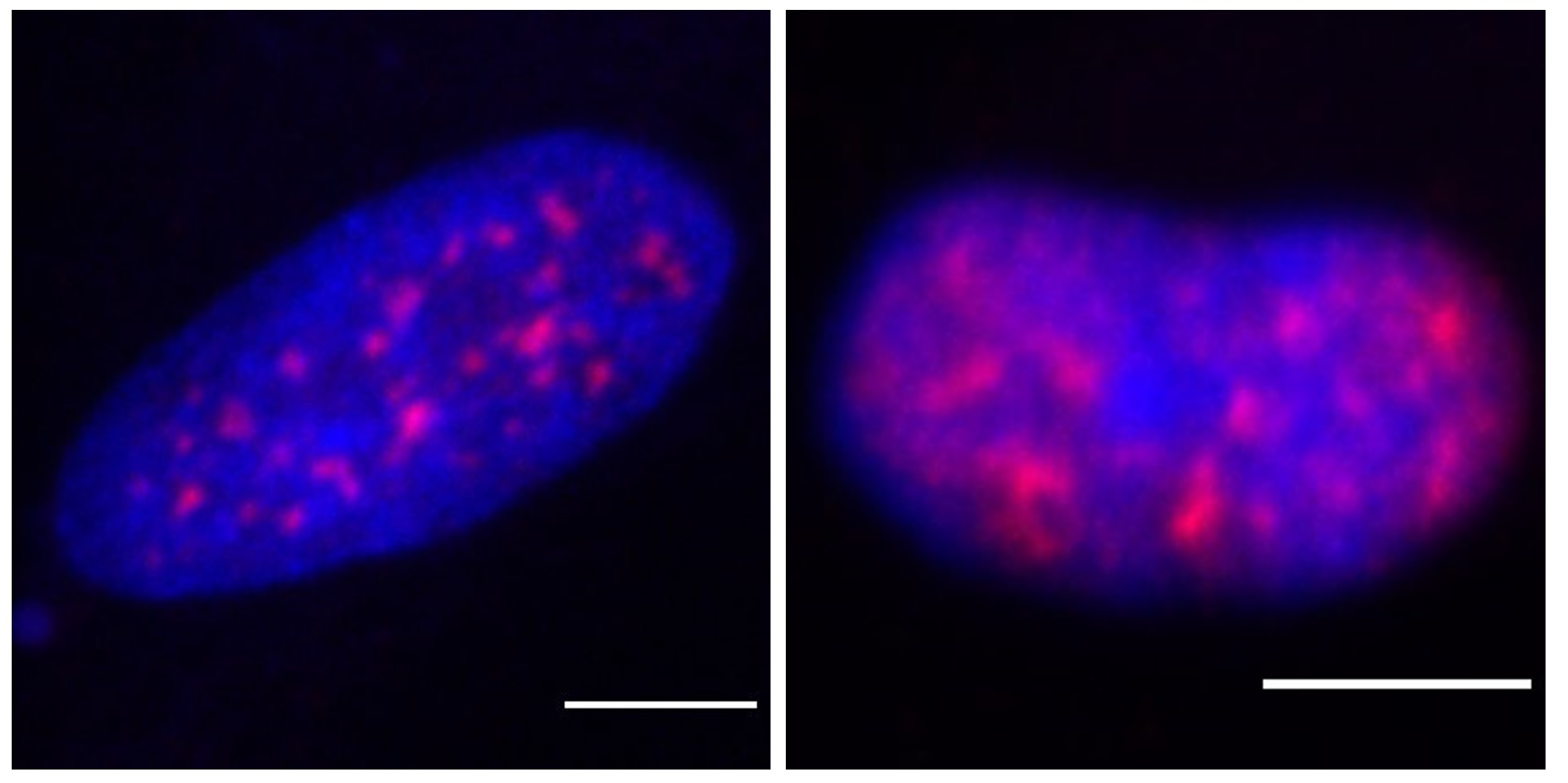
In the central nuclei (blue) of immune cells called macrophages, removing the WASP gene (as in the right panel) leads to fewer clusters of RNA splicing proteins (red).
Credit: Xuan Zhou of KAUST
Wiskott-Aldrich syndrome is just one of a whole host of childhood diseases that have a genetic basis and which any decent scientific theory should be capable of explaining, if not yet devising a cure for them. For creationists however, they present a special problem if they are to stick to their dogma that nothing happens at the level of the genome that isn't the specific will and intent of their putative designer god.
This is especially relevant now that scientists working at the Salk Institute, La Jolla, CA, USA and King Abdullah University of Science and Technology (KAUST), Saudi Arabia have discovered the underlying cause of this rare and distressing childhood disorder. As the Salk Institute press release describes it:
This study not only suggests new targets for treating Wiskott-Aldrich syndrome with small molecule drugs, but also sheds new light on the basic biology of RNA splicing, an important and not fully understood process.
These RNA splicing factors could both be a biomarker for monitoring Wiskott-Aldrich syndrome, and a potential target for treatment.
Professor Juan Carlos Izpisua Belmonte, corresponding author
Gene Expression Laboratory
Salk Institute, La Jolla, CA, USA
Gene Expression Laboratory
Salk Institute, La Jolla, CA, USA
Babies with Wiskott-Aldrich syndrome begin to develop symptoms quickly after birth: itchy, scaly rashes, frequent bruises and nose bleeds are some of the first signs. Over time, they become prone to infections and are more likely than other children to develop autoimmune diseases and cancers. The only potential cure is a bone marrow transplant, which carries a host of complications and only works in some children.The underlying mechanism concerns how cells normally cut and paste strands of RNA in a process called RNA splicing. RNA splicing is often needed because a 'gene' may be composed of non-contiguous segments of DNA separated by various lengths of non-coding DNA. The entire section gets translated into RNA which then needs these 'introns' removed and the RNA spliced together to form a template for the protein, before it can be transcribed. In Wiskott-Aldrich syndrome, a genetic mutation disrupts this process which in turn means that numerous immune and anti-inflammatory proteins are not made properly.
The SALK Institute press release continues: