Thursday, 13 July 2023

How Science Works - Peer Reviewers Slate a Submitted Research Paper Suggesting Homo Naledi Buried their Dead


Evidence for deliberate burial of the dead by Homo naledi

Extraordinary claims require extraordinary evidence.

Christopher Hitchens.

The Homo naledi hand and foot were uniquely adapted for both tree climbing and walking upright.

Credit: Peter Schmid and William Harcourt-Smith | Wits University
The things that make the hominin species, Homo naledi, at the same time, something of an enigma and exciting for paleoanthropologists, is that it:
  • Has a mosaic of features of both anatomically-modern humans and chimpanzees, making it a candidate species for our early ancestor. One of the chimpanzee-like features is the small brain, little larger than a chimpanzee.
  • Was apparently contemporaneous with early modern humans in East Africa and yet had failed to evolve a larger brain, believed to have been driven in hominins by the African savannah environment.
  • Is from South Africa, but the Homo genus is believed to have emerged in East Africa in the Rift Valley and Ethiopian Highlands, from the Australopithecines such as Au. afarensis ('Lucy')
These sorts of enigma are the stuff of science and suggest new avenues for research. Nothing spurs science more than discovering something which doesn't fit in with the existing consensus or for which there is no obvious explanation at present, so there is a great deal of interest in the findings from the Rising Star Cave System in South Africa, so far the only source of fossil H. naledia. The remains are found deep within the cave system in locations that would have been difficult to reach, so the large number of individuals found there suggest they were placed deliberately in these deep chambers.

And now the team investigating the cave have produced evidence that they believe indicates that the remains in the cave were not only placed there but were ritually interred in specially prepared graves. If confirmed, this would be the earliest known deliberate internment of a hominin species, indeed the only example other than of modern humans and Neanderthals. This practice also strongly suggests respect for the dead and maybe even a spiritual belief in an after-life - which would be astonishing for a species with a brain little larger than that of a chimpanzee.

Wednesday, 12 July 2023

Historical Christian Abuse - New Museum to Scotland's Witch Hysteria


New museum remembers Scotland's dark era of witch hysteria

News that there is now a museum to the Scottish witch hysteria, prompted me to do a little bit of research into witchcraft and societies changed attitude toward the idea of witches casting evil spells and suspending the laws of nature with their thoughts.

Our modern-day attitude toward the whole idea of witches and witchcraft, compared to what it was when the atrocities of witch-finding and witch burning were being committed, mostly but not exclusively, by the Catholic Church at the behest of the Pope, shows how our morals are evolving and consigning religious 'morals' to the dustbin of history where they belong.

On of the main driving forces behind witch hysteria in Europe was a book, "Malleus Maleficarum" (Hammer of Witches) written by a sex-obsessed and misogynistic German Catholic clergyman Heinrich Kramer (under his Latinized name Henricus Institor). This classified witchcraft as heresy and thus punishable by burning alive, and recommended torture as the best way to discover the truth. Kramer's hatred for women whom he blamed for tempting him to 'sin', could scarcely be disguised, and on that faith-based misogyny, the witch burnings were based.

Although it was rejected by the Catholic Church at the time, "Malleus Maleficarum" was later revived by insecure royal courts during the renaissance for the same reason witch hysteria has been promoted since - to unite a frightened population behind a 'war' against an internal threat. The same way America's Republicans are waging a 'culture war' against the 'evil of liberalism' today.

Protestant Christianity also did its share of the persecution and murder of (mostly) unmarried or widowed women, of course, as the Pendle witch trials in England, the Salam witch trial in the Puritanical Massachusetts Bay Colony in Colonial America and the witch trials in Presbyterian Scotland attest.

The change in attitude towards the idea of witchcraft between then and now illustrates how societies do not get their morals from religion but religions get their morals, such as they are, from society. No organized church ever spoke out against the witch trials and demanded they cease or preached that they were immoral. But the churches, inspired by the Bible (Exodus 22:18) were very much the instigators of the atrocities, as they still are in some parts of Africa, where children are regularly targeted by preachers and accused of witchcraft in order to spread fear and distrust amongst their followers to keep them dependent on the church for 'protection against evil'.

What brought about the changes was an injection of a large dose of enlightened Humanism into western culture, with its sense of fairness, justice and evidence-based decision-making in place of faith-based superstition and reactionary dogma.

Tuesday, 11 July 2023

Creationism in Crisis - The 36 Million-Year Geological Cycle That Drives Burst of Biodiversity.


Scientists discover 36-million-year geological cycle that drives biodiversity - The University of Sydney

The thing about believing Earth is only 8,000 years old is that the cognitive dissonance that arises when evidence such as these 36 million-year geological cycles can cause all manner of bizarre, childish behaviour, like pretending the facts aren't there and if you don't look at them, they'll go away, or going on line and lying in the social media in the hope that, if you can fool a few more simpletons into believing your counter-factual superstition, it'll become true because whether facts are true or not doesn't depend on evidence but on how many people believe they are true.

This bizarre behaviour in an adult comes directly from the fact that, as research has shown, creationism, like conspiracism, is caused by a thinking defect where an adult has retained a childhood mode of thinking known as teleological thinking where nothing happens unless there is agency and where everything, even elementary particles are sentient and aware of whatever a directing entity is telling them to do. To a toddler, questions like, "How does DNA know how to mutate?" or "How does natural selection know what to select?" seem like intelligent questions.

And underlying the whole thing is the unshakeable belief that what their mummy and daddy believed must be true, because mummy and daddy are always right.

So, imaging the cognitive dissonance this latest piece of research will cause the truubuleeving creationist. Not only does it concern an Earth that is many orders of magnitude older than they believe Earth and the Universe have existed for, but it explains the periodic bursts of biodiversity caused by change in the fundamental environment - just as the Theory of Evolution predicts, and which, incidentally, could explain the appearance of 'punctuated equilibrium' in the fossil record.

The research, which has been published in the journal Proceedings of the National Academy of Sciences, was led by Associate Professor Slah Boulila from Sorbonne Université, CNRS, Institut des Sciences de la Terre Paris, Paris, France, and included Professor Dietmar Müller, from the School of Geosciences at the University of Sydney, Australia. The team also included Shanan E Peters of the Department of Geoscience, University of Madison, Madison, WI, USA, Bilal U. Haq of the Département d’astronomie, Université de Genève, Genève, Switzerland.

It is explained in a news release from Sydney University:

Monday, 10 July 2023

Unintelligent Design - Why Did Creationism's Designer Give Honey Bees a Better Brain for Decison Making Than it Gave Us?


Bees make decisions better and faster than we do ... for the things that matter to them | The Lighthouse

This is one of those pieces of research which leaves you wondering, if we had been intelligently designed, especially by a designer for whom we were a special creation with everything else created just for us, why it didn’t give us the best available from all the systems it had designed for other species.

For example, why don't we have the immune system of bats, the respiratory system of birds, the eyesight of the peregrine falcon or the cancer resistance of sharks and elephants? And now we learn that the little honeybee, Apis mellifera, with its brain the side of a sesame seed, can make decisions much more quickly that we can. Surly, with our large brains, there was room to incorporate a honeybee's decision-making process.

But these are problem for creationists and those who like to imagine they were the special design of an omniscient god who only wanted the best for them. For evolutionary biologists of course, the answer is that there is no design and no plan and humans are the result of their own evolution with its environmental selectors and compromises that enabled our ancestors to survive over time, and honeybees, bats, birds and sharks are the result of theirs.

Evolution isn't a process that can remember what it did in a different branch of the tree of life and copy that into another branch, as an intelligent designer could, which is why species can be arranged in nested hierarchies.

The research in question, which was focused on machine learning and robot autonomy, rather than exposing the infantile stupidity of creationism, was conducted by a team led by Professor Andrew Barron from Macquarie University, Sydney, NSW, Australia and Dr HaDi MaBouDi, Neville Dearden and Professor James Marshall from the University of Sheffield, South Yorkshire, England, UK.

It is explained in The Lighthouse, the online news magazine of Macquarie University:

Malevolent Designer News - How Ticks are Designed to Infect Deer With a Prion Disease


Ticks may be able to spread chronic wasting disease between deer

White-tailed deer, Odocoileus virginianus
May catch fatal Chronic Wasting Disease from tics


Black-legged or Deer tick,
Ixodes scapularis
The thing about being a troobuleeving creationist is that you have to find a way to avoid crediting your putative intelligent [sic] designer deity with all the nasties that exist in nature, while insisting that only your beloved intelligent [sic] designer designed everything.

You also need to buleeve your putative designer is omniscient because it's one and the same as the allegedly omniscient and omnipotent god of the Bible and Qur'an, so knows exactly what its designs will do when it designs them, which amounts to designing them for that purpose.

The same deity is also allegedly omni-benevolent, which makes parasites and prey-predator arms races difficult to explain, especially since it supposedly boasted to Isaiah about creating evil, so the Bible claims (Isaiah 45:7).

So, imagine the mental gymnastics that a troobuleeving creationist will need to perform to accommodate the knowledge that one of their intelligent [sic] designer's designs, the black-legged or deer tick, Ixodes scapularis, might be responsible for transmitting the prion that causes Chronic Wasting Disease (CWD) in deer, as this piece of research, led by Heather Inzalaco of the Wisconsin Cooperative Wildlife Research Unit, University of Wisconsin, Madison, USA, suggests.
The black-legged tick and how it transmits the rickettsia parasite, Anaplasma phagocytophilum to humans - The Malevolent Designer: Why Nature’s God is Not Good pp. 15-17.
First, a little about prions and the diseases they cause:

Sunday, 9 July 2023

Creationism in Crisis - Even 'Artificial' Cells With a Minimal Genome Evolve Naturally


Electron micrographs of a cluster of minimal cells magnified 15,000 times.

Credit: Tom Deerinck and Mark Ellisman
University of California at San Diego.
Artificial cells demonstrate that "life finds a way": 2023 news: News: News & Events: Department of Biology: Indiana University Bloomington

It's turning out to be another terrible week for those few creationists capable, and willing, to read the science.

Here for example is a report on the work of a team led by evolutionary biologist, Professor Jay T. Lennon, of the Department of Biology in the College of Arts and Sciences at Indiana University. It shows a number of things that refute basic creationist dogmas:
  • The team use a genetically engineered, stripped down version of the bacterium Mycoplasma mycoides, a parasitic organism that, in common with many parasites had lost genes in the course of its evolution as a dependent parasite in the gut of goats and similar animals, reducing its genome to just 901 genes. So here we have evolution by loss of information (something creationists claim can't happen because their dogma says loss of information is invariably detrimental) as the starting point of this research.
  • The team then removed all but the essential genes needed to maintain a functional, reproducing cell, removing a further 45 percent of the genes, reducing the genome to just 493 genes, showing the massive amount of redundancy in a cell's genome - something that no intelligent designer would have designed, showing there was no intelligence in the design of M. mycoides. By comparison, a typical cell can contain 20,000 genes!
  • The team then allowed the minimal cell to evolve for 300 days, or 2000 generations (equivalent to 40,000 years of human evolution). They found that even with a minimal genome and so fewer targets for mutation and selection to act on, the minimum cells evolved towards greater fitness, just as the TOE predicts.
  • And of course, as with all biological research, there is the complete dependence on the TOE to understand and explain the results, with no hint of doubt in it's explanatory powers or any suggestion that the creationists superstition with its magic and unproven supernatural entity might offer a better explanation of the facts.
Here then is how the Indiana University news release describes the research:

Creationism in Crisis - The Universe is Larger and More Majestic Than the Ignorant Authors of Genesis Ever Imagined - Don't Blame Them, They Were Only Doing Their Best With What Little Knowledge They Had

Slideshow code developed in collaboration with ChatGPT3 at https://chat.openai.com/

Seven Amazing Accomplishments the James Webb Telescope Achieved in Its First Year | Science | Smithsonian Magazine

How is it that hardly any major religion has looked at science and concluded, “This is better than we thought! The Universe is much bigger than our prophets said, grander, more subtle, more elegant?” Instead they say, “No, no, no! My god is a little god, and I want him to stay that way.” A religion, old or new, that stressed the magnificence of the Universe as revealed by modern science might be able to draw forth reserves of reverence and awe hardly tapped by the conventional faiths.

Saturday, 8 July 2023

Creationism in Crisis - 500 Million Year-Old Fossil Reveals How Tunicates Evolved


Discovery of 500-million-year-old fossil reveals astonishing secrets of tunicate origins | Department of Organismic and Evolutionary Biology
Newly-discovered tunicate from the Middle Cambrian Marjum Formation in Utah, USA

Left:
Holotype (UMNH.IP.6079) and only known specimen of Megasiphon thylakos, showing overall morphology including paired siphons and barrel-shaped body
Right:
Counterpart fossil of the same specimen
Tunicates are interesting for a number of reasons, not least of which is that they are believed to be ancestral to all the chordates, which includes us and all other vertebrates. However, it's not obvious to look at them how they evolved into the chordates in the first place, until you examine the juvenile form, which is motile, unlike the adult which is sedentary, anchored to a rock by what had been its head.

The juvenile form had the beginning of a notochord, or collections of neurons along its back that evolved into the central nervous system, encased, in the case of the vertebrates in the bony spinal column with a cranium at the head end.

Another interesting thing is that it was not clear what ancestry they had and how they evolved from it. Modern tunicate form two groups: the sedentary (when adult) appendicularias and the free-swimming ascidiaceans or "sea squirts", but it was not clear which form, if either, was the stem tunicate. That mystery came some way to being solved recently with the discovery of a rare fossil from 500 million years ago, in the Middle Cambrian Marjum Formation in Utah, USA, and the study carried out on it by four Harvard biologists led by Dr Karma Nanglu, a postdoctoral researcher in the Department of Organismic and Evolutionary Biology.

Just how, is explained in a Harvard news release:

Creationism in Crisis - Now It's Stone Tools Being Used in Kent, Almost 300,000 Years Before Creationists Think Earth Was Created.

Giant handaxe recovered from fluvial deposits in the Medway Valley, Kent, UK

The Maritime Academy handaxe
Giant stone artefacts found on rare Ice Age site in Kent | UCL News - UCL – University College London

The problem with being a devotee of a counter-factual superstition like creationism in order to feel important enough, is that reality keeps trying to intrude and make you wonder if you could be wrong and less important than you feel you should be. So, it's a characteristic of a creationist that they have to have a whole repertoire of mental gymnastics to continue to fool themselves into thinking practically every discovery by science isn't a problem, because, somehow, it isn't real.

One of these tactics is to tell yourself that you must be right because lots of others agree with you, regardless of the fact that even more people disagree with you, so you have to keep recruiting new members of your cult. In the childish belief that facts become truer the more people believe them, you have to plumb ever greater depths of dishonesty to fool gullible people into joining your cult by seeking out scientifically illiterate fools with a child-like thinking ability to misrepresents science to.

A fundamental counter-factual creationist belief is that a magic supernatural deity created everything out of nothing with you in mind, in just 6 days about 6,000 years ago, and all living species were created in one day without ancestors. And of course, it holds you in such high regard as the pinnacle of its creative ability that it did it all for you!

So, one of the problems you need strategies for dismissing is the evidence that Earth is several billion years old, there were tool-making hominins living on it several hundred thousand years ago every species, including modern humans, had ancestors. If you ever concede those facts, your entire counter-factual world disintegrates and leaves you not feeling important enough and feeling stupid for having been fooled into believing it in the first place.

So, to prick the pomposity of creationists again, here is solid evidence that hominins were creating stone tools in what is now Kent, in the UK, 300,000 years ago - some 294,000 years before Earth was supposedly created.

Since anatomically modern humans had not migrated out of Africa at that time and Neanderthals and Denisovans had not yet evolved in Eurasia, the descendants of an earlier migration, such as Homo heidelbergensis, H. antecessor or even H. erectus, must have made these tools.

These tools, some of the largest ever found in Europe, were discovered during a survey by archaeologists from University College London (UCL) of a site at Frindsbury, Kent on which it is planned to develop the Maritime Academy School.

A UCL press release explains the finding:

Friday, 7 July 2023

Creationism in Crisis - How Evolution Helped the Avian Dinosaurs Survive the K-Pg Extinction to Become Birds


Fossil of an extinct Enantiornithine, Zhouornis hani
Fossils reveal how ancient birds molted their feathers— - Field Museum

All modern birds have evolved from the few early birds and avian dinosaurs that survived the mass extinction that killed off the Cretaceous megafauna such as dinosaurs at the so-called Cretaceous-Paleogene (K-Pg) boundary, also erroneously called the K-T (Cretaceous-Triassic) boundary. Incidentally, K is the initial letter for the German for Cretaceous (Kreide).

It is believed that one thing that helped some of the early birds survive was that they were clothed in feathers, which, like the fur of the early mammals, enabled them to survived several years of ice-age weather that were caused by the dust in the stratosphere the exploding meteorite threw up, dimming the sun and causing an expansion of the polar ice sheets.

But not all birds survived. One group that didn't was the Enantiornithines which went extinct along with the non-avian dinosaurs.

Now two researchers, Yosef Kiat and Jingmai Kathleen O’Connor, from the Negaunee Integrative Research Center in the Field Museum of Natural History, Chicago, IL, USA believe they have discovered why. The key to the discovery was feathers from this group of birds preserved in amber.

Their research is explained in a press release from the Field Museum of Chicago:

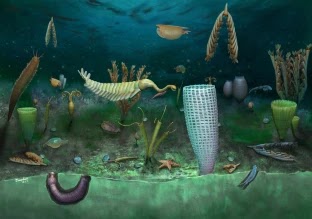
Creationism in Crisis - More Evidence for Evolution in Soft-Bodied Fossils from Wales

Slideshow code developed in collaboration with ChatGPT3 at https://chat.openai.com/

A reconstruction of the ancient inhabitants of the Castle Bank Quarry in Wales.
Credit: Yang Dinghua
Newly discovered soft-bodied fossil site found in Wales | Department of Zoology

Creationists frauds like to make much of the so-called 'Cambrian Explosion' some 542–485 million years ago, when, so they claim the fossil record shows that a whole range of multicellular species with different body plans, suddenly appeared without ancestry, as if by magic.

Of course it was nothing of the sort and lasted some 6-10 million years during which multicellular organisms evolved out of the Ediacaran biota and arms races between predators and prey, made possible by the evolution of mobility (the Ediacarans had probably been sedentary filter-feeders, fixed to rocks and the sea bed) led to the evolution of different forms of mobility, senses such as sight and touch which require a nervous system, defensive armour like shells, spines and scales, burrowing and of course advanced digestive and excretory systems to process the new food supplies.

With little competition for natural niches, it is hardly surprising that diversification was rapid, but the impression of sudden appearance in the fossil record is due to the fact that most of the biota were soft-bodied (bones, teeth and shells not yet having evolved) and so the conditions in which they were preserved was rare. Previously, almost all out knowledge of the Cambrian biota came from the Burgess Shales from Canada, so all we have is a snapshot of the state of play at a moment in time with nothing on which to base a claim of sudden appearance or unnaturally rapid diversification.

But now though, thanks to a chance discovery made during the Covid-19 pandemic lockdown, we have another collection of soft-bodied fossils from Wales from the Ordovician Period, some 462 million years ago, the geological period immediately following the Cambrian. This collection of fossils shows the state of play some 20 million years after the Cambrian. Not surprisingly, these reveal a clear ancestry in the Cambrian with some of the species bearing a striking resemblance to Cambrian species such as the iconic Opabinia, Yohoia and Wiwaxia.

The discovery is the subject of a paper in Nature Ecology & Evolution by scientists from Cambridge University, UK, which is sadly behind an expensive paywall, together with several astonishing pictures of the fossils and artist's reconstructions, however, the abstract is available here. The work is also described in a brief news release from Cambridge University:

Monday, 3 July 2023

Unintelligent Designer News - How Trees Evolved Sub-optimal and Complex Seed Dispersal Mechanisms


A seed survival story: How trees keep ‘friends’ close and ‘enemies’ guessing | Penn State University
Hawes, the fruit of the common hawthorn, Crataegus monogyna, in an English hedgerow in Autumn
Hips (Rosa Canina) and blackberries (Rubus Fruticosus)


© 2023 Rosa Rubicondior

Back in November 2013 (was it really nearly ten years ago?!) I wrote a blog post which anticipated this latest piece of research. It was all about how a symbiotic relationship between birds and flowering plants had evolved in which the plants provide birds with food in exchange for them dispersing their seeds, and how this incidentally led to us evolving colour vision. Now this research by a large international team led by Assistant Professor Tong Qiu, of the College of Agricultural Sciences, Penn State University, has looked at the dynamics of this relationship in which trees need to balance the loss of seeds by consumption and their dispersal by those same consumers, and how this balance can change in years of plenty (mast years) and lean years.

The relationship is complex and sub-optimal, exactly as might be expected of an evolved system, but not of an intelligently designed system, which would be optimized and minimally complex to avoid the unnecessary waste of the naturally evolved system. Climate too plays a part in the complex, especially the occurrence of summer drought.

The research is explained in a Penn State News release:

Friday, 30 June 2023

Creationism in Crisis - Our Placental Ancestors Briefly Lived With Dinosaurs and Survived the Mass Extinction


June: Humans’ ancestors survived asteroid impact that killed the dinosaurs | News and features | University of Bristol
The beginning of the end for larger dinosaurs. The beginning of the age of placental mammals for us.
According to a new study by palaeontologists from the University of Bristol and the University of Fribourg, placental mammals had evolved in the Cretaceous and were living alongside dinosaurs when the asteroid struck and precipitated the mass extinction that wiped out the larger fauna, leaving smaller feathered dinosaurs to evolve into birds and the early placental mammals to diversify quickly into all today's placental mammals and occupy niches vacated by the larger dinosaurs.

This event is known as the Cretaceous-Paleogene (K-Pg) boundary, marked in the geological column by a thin layer of iridium, believed to be of asteroid origin, the asteroid having vapourized on impact.
The question the team set out to answer was when exactly the placental mammals evolved relative to the mass extinction. The fossil evidence, which has only been found in rocks younger than 66 million years, suggested they evolved after the K-Pg boundary, but molecular data suggested an earlier origin.

The research, which is published, open access, in the journal Current Biology, is described in Bristol University press release:

Thursday, 29 June 2023

Abiogenesis News - Urea May Have Been The Precursor to Life.


Why urea may have been the gateway to life | ETH Zurich
Artist's impression of the pre-biotic Earth.

A new technique for observing chemical reactions with an extremely high temporal resolution has enabled Swiss scientists working at Eidgenössische Technische Hochschule, Zürich (ETH Zürich) and Geneva University to see what happens when urea in water is subject to ionizing radiation - the conditions that would have existed on pre-biotic Earth, billions of years ago.

The dominant theory explaining abiogenesis is that it took place around deep ocean hydrothermal vents, or black smokers, but a rival theory, which harks back to Darwin's 'warm little pond', is that it could have occurred in shallow pools subjected to ionizing radiation from the sun. The team's observation of how urea reacts lends support to the latter theory.

Urea is a highly reactive molecule that exists in concentrated solutions as a dimer (two molecules chemically bonded). The researchers observed that ionizing radiation causes a hydrogen ion (i.e., a proton, which carries a positive charge) to move from one molecule in the dimer to the other, creating a negatively charged urea- radical from one molecule and a protonated urea+ molecule from the other. The former is highly reactive and can then form malonic acid - believed to be the first step in creating larger molecules such as RNA. This happens so fast (in about 1 femtosecond, or 150 billionths of a second) that it effectively monopolizes the dimer and prevents other chemical reactions from occurring, so favouring the formation of malonic acid.

The details are given in the ETH Zürich press release:
Web Analytics