Wednesday, 30 August 2023

Creationism in Crisis - 520 Million-Year-Old Common Ancestor of Crustaceans and Insects Found in the Fossil Record


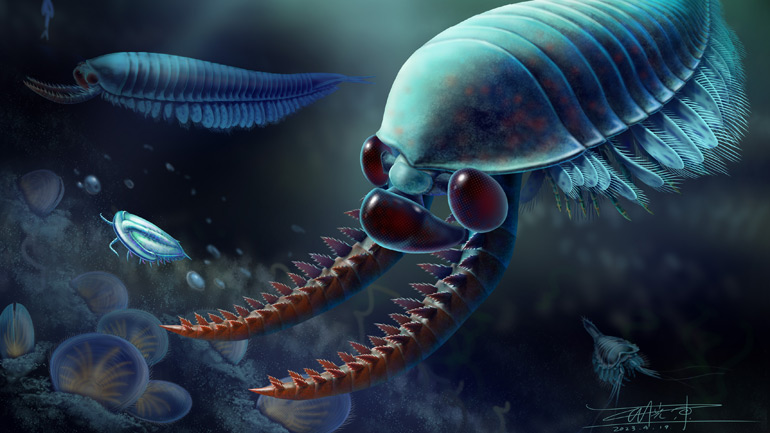
Artists impression of Kylinxia zhangi in life
X. Wang
Three-eyed distant relative of insects and crustaceans reveals amazing detail of early animal evolution | News | University of Leicester

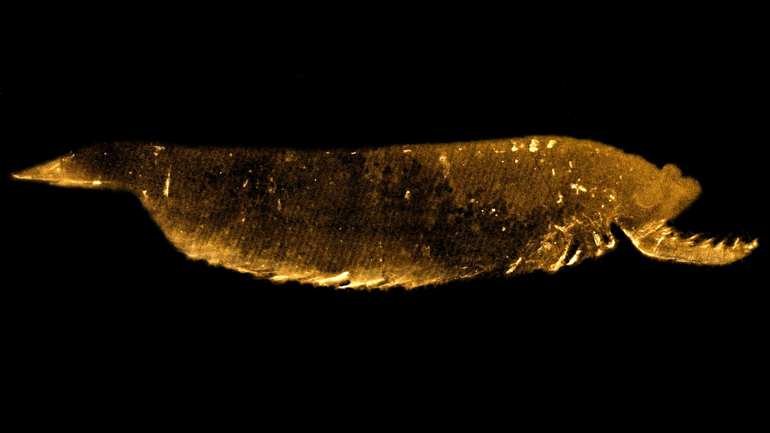
A team from the University of Leicester, Yunnan Key Laboratory for Palaeobiology and the Institute of Palaeontology at Yunnan University, Chengjiang Fossil Museum, and the Natural History Museum in London, have redescribed a unique fossil animal from rocks nearly 520 million years old that fills in a gap in our understanding of the evolution of animals known as arthropods.

The animal, Kylinxia zhangi, simply shouldn’t be there if creationists claims were true. It is from almost 520 million years before Earth and the life on it was created and its one of those 'transitional' species showing characteristics of not just two different species, but two entire classes of the arthropod phylum. As such, of course, they are evidence of the evolutionary common origin of those two classes within the major taxon.

They're the sort of species that would have any creationist scratching their heads and declaring, "But they're still er... insects.... er... crustaceans"! before hurriedly redefining 'kind' as a major taxonomic class that includes hundreds of thousands of disparate species with different appendages and body plans of the sort that the same creationist will assure you can't have evolved because 'macro-evolution', i.e., evolving new appendages, body plans, etc., is impossible, while 'micro-evolution, i.e., evolution within the same 'kind' is now perfectly possible. 25 years ago, it was impossible until they realised no Ark could be big enough to contain 2 (or 7)of each known and extinct species.

So, the standard knee-jerk response will be necessary: the scientists lied; the scientists got the dates wrong; the dating techniques are flawed; the scientists are part of a world-wide satanic conspiracy to turn people away from Jesus - even the Chines scientists for whom Jesus and Satan are as mythical as are the Chinese Taoist gods to an American Christian fundamentalist.

But, leaving aside the arrogant cultural chauvinism in assuming the locally popular god in America is the only real one, I wonder how many creationists can explain why the dating methods used were wrong by many orders of magnitude, returning dates in the hundreds of millions of years when the real date should have been about 4,000 years.

The find and its significance is explained in a University of Leicester news release:

Tuesday, 29 August 2023

Creationism in Crisis - New Zealand Fossil Hoard From 3 million years Before Creationists Believe Life was Created


Shell fossils from the Māngere Shellbed fossil fauna.
Auckland wastewater pipe dig reveals 'fossil treasure trove' - Taylor & Francis Newsroom

Not only is the age of these marine fossils a problem for creationism, so is the composition. It's a central dogma of creationism that all fossil deposits and rock strata are the result of a single genocidal flood in which 'all living substance' was destroyed - including and especially terrestrial animals, so any deposit of fossils resulting from that alleged flood should contain terrestrial species and plants. Not only that, but they should be from all over the globe, not just the local fauna because in a global flood there would be no barriers and dead animals would be free to float anywhere.

And yet here we have a fossil deposit consisting wholly of marine species from a particular time, found in a narrow range of habitats local to New Zealand at that time. There are no Eurasian, African or American species and not even any Australian species - from just a short float away.

The fossils were found by workers laying a new wastewater pipeline in a major civil engineering project. The find and its significance is described in research paper in the Taylor & Francis journal New Zealand Journal of Geology and Geophysics and an accompanying news release by Taylor & Francis:

Saturday, 26 August 2023

Unintelligent Design News - How the Human Y Chromosome Evolved


The 'weird' male Y chromosome has finally been fully sequenced. Can we now understand how it works, and how it evolved?

An international team of scientists led by researchers from the National Human Genome Research Institute, National Institutes of Health, Bethesda, MD, USA, together with colleagues from the University of California Santa Cruz, Santa Cruz, CA, USA, the University of Connecticut, Storrs, CT, USA, Johns Hopkins University, Baltimore, MD, USA, have finally completed the task of sequencing the entire human Y chromosome from end to end or T2T (Telomere-to-Telomere). This completes the entire human genome now sequenced T2T.

Unsurprisingly, they found that most of the DNA was non-functional junk, containing the remnants of ancient retroviruses and duplicated genes that had then mutated.

The X and Y chromosomes, or sex chromosomes, are how gender is determined in humans and other mammals. Females have two copies of the X chromosome while males have one of each. Males inherit their Y chromosome from their father.

The significance of the research, and how it informs our understanding of the evolution of the Y chromosome from one of the two X chromosomes that females carry is the subject of an article in The Conversation by Professor Jenny Graves Jenny Graves, La Trobe University, Australia. Her article is reprinted here under a Creative Commons Licence, reformatted for stylistic consistency:

Friday, 25 August 2023

Creationism in Crisis - Science is Revising Its Thinking About Human Origins - But It's No Comfort For Creationists


Graecopithecus freybergi, possibly a contemporary of Andoluvius turkae, lived 7.2 million years ago in the dust-laden savannah of the Athens Basin. (Artist's impression)
Image credit: Velizar Simeonovski.
New ancient ape from Türkiye challenges the story of human origins | Faculty of Arts & Science

Science might have the human evolutionary story wrong. But before creationists get over-excited, no-one is suggesting it was all done by magic without any ancestors just a few thousand years ago. The new thinking is over the where, not the how of evolution. That humans and the other apes evolved from a common ancestor is not in any doubt. The question is only where that common ancestor lived - Eurasia or Africa?

This discovery in Turkey adds support to the idea that the African apes, including humans, evolved from an ancestor that migrated into Africa from Eurasia via the Eastern Mediterranean, between 9 and 7 million years ago, having evolved in Western Europe and lived there for some 5 million years.

The news release from the University of Toronto, where the leader of an international team, Professor David Begun, is based, explains the find and its significance for the human evolution story:

Unintelligent Design - A Ludicrously Complex Method for A Parasitic Orchid to Get Its Flowers Pollinated


The non-photosynthetic, parasitic orchid, Gastrodia foetida
Fungi-eating plants and flies team up for reproduction | Research at Kobe

A characteristic of evolved systems is that they tend towards increasing complexity, the antithesis of an intelligently designed system, which should be minimally complex for the simple reason that complexity is expensive in terms of energy and resource, and more likely to go wrong.

Unnecessary complexity and prolific waste, which are normal components of evolved systems, are the strongest arguments against intelligent design and for a mindless, utilitarian, near-enough-is-good-enough, process such as evolution by natural selection.

And just such a case of quite ludicrous complexity has been revealed by Kenji Suetsugu of Kobe University Graduate School of Science, Kobe, Japan.

Sadly, the paper in Ecology is behind a paywall, however the research and its significance is the subject of Kobe University press release:

Thursday, 24 August 2023

Creationism in Crisis - Another 'Uniquely Human' Trait is Also Present in Bonobos


Bonobo, Pan Paniscus Shares 'uniquely human' trait

Photo: Leon Harberkorn
Deutsches Primatenzentrum: Bonobos grow similarly to humans

The problem creationists have with trying to maintain the myth that humans are a special creation by citing uniquely human traits, is that science keeps on showing that these are not unique after all, and in fact support the idea of common origins.

One such 'uniquely human' trait was thought to be the adolescent growth spurt where children have a rapid increase in height soon after puberty. Now researchers led by Dr. Verena Behringe of the Endocrinology lab at the German Primate Center (DPZ), Leibniz Institute for Primate Research, Göttingen, Germany, have shown that our closest relatives, bonobos, Pan paniscus, have a similar growth spurt at a similar stage in the development and that other primates may also have similar growth spurts.

The research is explained in a DPZ News release:

Creationism in Crisis - Cave Art in Borneo From 35,000 Years Before Earth Existed (According to Creationists)


Gua Sireh, Sarawak, Borneo, Malaysia
This cave on Borneo has been used for 20,000 years – and we’ve now dated rock art showing colonial resistance 400 years ago

According to creationists, about 8-10,000 years ago a god made of nothing made everything in the Universe out of nothing using nothing more than magic words. It also created humans and all the other animals a few days later. Then, in a fit of anger because its creation hadn't turned out the way it had designed it, it killed almost all of it in a genocidal flood, reducing the human population of Earth to just 8 related people.

While all that was happening, there were people using a large cave in Sarawak on the island of Borneo, in Malaysia from 35-43,000 years before Earth existed and up until and including European colonisation about 400 years ago. These people left a record of their existence and cultural history in the form of drawings on the cave wall. There is no record of a genocidal flood, and nothing about a god creating other people about 10,000 years ago.
But, according to creationists, just a few thousand years ago the island of Borneo was repopulated by people from the Middle East, who, although all descended from 8 related individuals of Middle Eastern origin, mysteriously adopted the same artistic style as the antediluvian population, forgot all about the genocidal flood and the god who caused it, invented their own gods and continued as though nothing unusual had happened.

That is the sort of mental gymnastics a creationist needs to perform to avoid the dreadful prospect of wondering if they could be wrong.

First, a little about the caves in Sarawak and the art and artifacts found in them:

Wednesday, 23 August 2023

Creationism in Crisis - How a Deleterious Gene Can Survive in a Population


Coyote tobacco, Nicotiana attenuata

It all depends on the genetic diversity | Max Planck Institute for Chemical Ecology

Mutations in genes that are essential for defence against predator attack are usually deleterious and would be expected to be quickly eliminated from a population, however, occasionally, the same mutation can convey an advantage which it is able to assert in conditions where predator populations are low, and this is especially true if wide genetic diversity within the population makes it more likely that the mutation can operate synergistically with other genes.

This can lead to a dynamic situation in which, in periods of low predation, the mutation can increase, or at least remain at a stable level in the population, and, in periods of high predation, it can be reduced. This dynamic can result in deleterious genes being retained in a population for much longer than would be expected if they were wholly deleterious.

An example of this was found recently by researchers from the Max Planck Institute for Chemical Ecology, Jena, Germany, in a wild member of the tobacco family, Nicotiana attenuata. Their finding is published in Proceedings of the National Academy of Science (PNAS)

The research and its significance are explained in a press release:

How Science Works (And Why Creationism Doesn't) - The Peer Review Process Explained


10 Stages of the Peer Review Process: A Step-by-Step Guide for Authors | The International journal of Innovative Research & Development

Creationist frauds tell their dupes that the scientific process of peer review, is a device to ensure conformity to scientific dogma and to prevent unorthodox (i.e., creationist) opinions from being published in respected journals.

This helps maintain the delusion that there is real scientific support for creationism and that many more scientists are really creationists than is apparent from the scientific literature.

It also plays to conspiracism, which is a normal component of creationism, caused by the same childish teleological thinking defect in an adult, by helping to maintain the delusion that scientists and publishers of scientific journals, periodicals and books, and their staff, are all part of a gigantic international Satanic conspiracy to turn people away from God and destroy people's trust in the church and the Bible.

The truth is that peer review is simply a device to ensure the research was conducted with sufficient rigor and proper controls, that the authors have provided the required standard of evidence to support their claims and that their conclusions are indeed supported by the evidence. It also helps insure against plagiarism since the expert reviewers will very likely be aware of the work of others in their field of expertise.

Here, for example is the peer-review process as outlined in a blog by the International Journal of Innovative Research and Development (IJIRD):

Tuesday, 22 August 2023

Creationism in Crisis - Urban Great Tits Have Beome Paler Than Their Rural Relatives


European great tit, Parus major.
Urban great tits have paler plumage than their forest-living relatives | Lund University

In an example of how the environment, and in this case probably the availability of different food items, can cause changes on which natural selection can act, a study by an international team or reserchers led by Pablo Salmón of Lund University, Sweden, has shown that great tits, Parus major living in an urban environment have paler breasts than those living in a forest environment.

Although this is probably not an evolutionary change, i.e., a change in the frequency of alleles in the population gene pools, as the cause is probably dietary difference, it illustrates how an environmental change can produce changes in features on which natural selection can act to bring about true evolutionary changes, and so begin the process of allopatric speciation.

Of course, there will be creationists who will misrepresent the scientific fact of evolution, either deliberately, or mendaciously in order to mislead others, who will dismiss this as "not evolution", not for the reason given above but because "they're still great tits/still birds" and haven't grown a new structure or turned into an unrelated taxon.

The research is explained in a Lund University press release:

Sunday, 20 August 2023

Creationism in Crisis - Why Our Ancestors Evolved to Walk Upright - 21 Million Years Before Creationists Believe Earth Existed


Morotopithecus bishopii
Wooded grasslands flourished in Africa 21 million years ago – new research forces a rethink of ape evolution

Scientists are changing their mind about when and why the ancestors of hominins evolved to walk upright - but it's no comfort for creationists, as it all happened 21 million years before they believe Earth existed and only needs the standard Theory of Evolution by Natural Selection to explain it.

There is no doubt about how it evolved. Needless to say, as always, the paleoanthropologists found nothing that needed magic or a supernatural deity to explain it.

The scientists have published their findings in two papers in Science, one by a team led by Daniel Peppe, Associate Professor, Department of Geosciences, Baylor University, and the second led by Laura M. MacLatchy, Professor of Anthropology, University of Michigan.

Three of Laura MacLatchy's team have written about their research in The Conversation. Their article is reprinted here under a Creative Commons license, reformatted for stylistic consistency:

Saturday, 19 August 2023

Creationism in Crisis - Fijian Folk Tale Has Nothing About a Global Flood or The God Who Allegedly Caused It!


Nabukelevu, Kadav, Fiji.
Eruption remembered in riddles and fantastical oral traditions.
A dramatic volcano eruption changed lives in Fiji 2,500 years ago. 100 generations have kept the story alive

2,500 years ago, just 1,500 years after creationists believe the human population of the world had been reduced to just 8 people in a genocidal flood, there was a volcanic eruption on one end of the island of Kadavu in the south of the group of Pacific islands now known as the Fijian Islands.

The people who were already living there, having presumably migrated there from the Middle East in just 1,500 years, remembered the details of the eruption and passed them on, complete with the local gods to whom they attributed the events, not in writing, but encoded in riddles and a symbolic oral tradition which "included fantastic beings flying through the sky, fighting each another furiously and noisily, drinking the ocean dry, and throwing giant spears with force enough to leave massive holes in rocky headlands", according to research by a group of scientists including Professor Patrick Nunn of the University of the Sunshine Coast, Australia.

Curiously, if the Bible tales of a global flood had been true, people to whom a local volcanic eruption was such an important event in their history that they remembered it in such an elaborate way, regarded a genocidal global flood as not worth a mention, and the god who allegedly caused it as unworthy of inclusion in their pantheon.

This is the ludicrously unlikely scenario that creationists have to try to rationalise in order to avoid considering that their favourite Bronze Age fairy tales are anything other than literal truths.

The research which has decoded the Fijian oral traditions is the subject of an article by Professor Nunn in The Conversation. His article is reprinted here under a Creative Commons licence, reformatted for stylistic consistency:

Creationism in Crisis - A Mass Extinction in Southern California, 7000 Years Before Creationists Think Earth Was Created!


Illustration depicting the hunting behavior of La Brea carnivores, including saber-toothed cats, dire wolves, and coyotes.

Credit: Mauricio Antón
Scientists Zero In On Timing, Causes Of Ice Age Mammal Extinctions In Southern California - Texas A&M Today

It’s hardly surprising anymore because all but the most recent history of Earth took place millions, even billions of years before Earth was created, according to Creationists’ literal reading of the Bronze Age creation myth recorded in the Bible, but here we have evidence of a sudden mass extinction in Southern California, not by a genocidal global flood, but by rapid climate change, human activity and devastating regional fires.

This is the conclusion of a detailed study by a team of scientists that included Texas A&M University archaeologist, Dr. Michael Waters. The team focused on the Rancho La Brea Tar Pits.

First a little AI information about the Rancho La Brea Tar Pits:
The Rancho La Brea Tar Pits

The Rancho La Brea Tar Pits, also known as the La Brea Tar Pits, is a famous fossil excavation site located in the Miracle Mile district of Los Angeles, California, USA. It is one of the most significant paleontological sites in the world and has provided an incredible wealth of information about the prehistoric life that existed in the region during the Pleistocene epoch. Here are some key points about the Rancho La Brea Tar Pits:
  1. Formation: The tar pits were formed as a result of crude oil seeping to the surface from underground deposits. The oil would bubble up to the surface, forming pools of sticky asphalt or tar. These pools were often covered by water, leaves, and other debris, which attracted animals that became trapped in the tar.
  2. Fossil Preservation: The unique conditions of the tar pits resulted in excellent preservation of the trapped animals. The tar's stickiness trapped animals, and the lack of oxygen and bacteria in the tar slowed down decomposition. Over time, bones and other remains of animals accumulated in the pits.
  3. Prehistoric Fauna: The tar pits contain a wide variety of fossils, including those of mammals, birds, reptiles, and plants. Some of the most common animals found in the pits include dire wolves, saber-toothed cats, mammoths, mastodons, ground sloths, and various species of birds.
  4. Research and Discoveries: Excavations at the Rancho La Brea Tar Pits began in the early 20th century. The first scientific excavations took place in the early 1900s, and since then, thousands of fossils have been recovered. These fossils have provided invaluable insights into the animals that lived in the Los Angeles area during the Pleistocene epoch, which occurred approximately 10,000 to 40,000 years ago.
  5. Page Museum: The George C. Page Museum, now known as the La Brea Tar Pits and Museum, was established in 1977 near the tar pits. It houses a vast collection of fossils and artifacts recovered from the site. The museum also includes exhibits that provide information about the history of the tar pits, the animals that were trapped there, and the science of paleontology.
  6. Active Excavations: Despite decades of research and excavation, the tar pits are still actively studied and excavated. New discoveries continue to shed light on the ancient ecosystem of the region.
  7. Public Engagement: The La Brea Tar Pits and Museum offers educational programs, guided tours, and interactive exhibits for visitors of all ages. It's a popular destination for tourists, students, and researchers interested in paleontology and natural history.
The Rancho La Brea Tar Pits are a unique and invaluable resource for understanding the ancient history of Southern California and the diverse range of life that once inhabited the region. The site's ongoing excavations and research contribute to our understanding of prehistoric ecosystems and the interactions between humans and the environment during that time.

ChatGPT3.5 "Tell me all about the Rancho La Brea tarpit" [Response to user request]
Retrieved from https://chat.openai.com/
The work of the scientists is explained in a news release from Texas A&M:

Creationism in Crisis - Finish Scientists Have Worked out How Modern Elephant Teeth Evolved - It Was Darwininian Natural Selection, Obviously!


Elephant ancestors´ teeth evolved in response to long term changes in diet and climate in Africa | University of Helsinki

In marked contrast to the childish creationists superstition that a magic supernatural man in the sky created everything as is, including Earth itself, about 8-10,000 years ago, two research palaeontologists at the University of Helsinki, Finland, have shown that the proboscideans, which includes modern elephants, their ancestors, and ancient relatives, evolved their teeth in response to environmental changes in East Africa over a period of between 20 and 7 million years ago.

They have published their findings, open access in the Journal, Nature Ecology & Evolution.

As we have come to expect, there is not a hint in their research that elephant teeth are the result of anything other than an evolutionary process, driven, as the Theory of Evolution predicts, by environmental change. There is never a hint that magic played any part in the process.

As the University of Helsinki news release explains:
Web Analytics