Saturday, 23 March 2024

Creationism in Crisis - Now It's a Giant Amazon Dolphin from 16 Million Years Before 'Creation Week'!


Type specimen (holotype) of Pebanista yacuruna, including a photo of the specimen and a surface 3D model in dorsal view.

Image: Aldo Benites-Palomino.
Ancient Giant Dolphin Discovered in the Amazon | | UZH

The third in a clutch of very recent papers casually refuting the childish beliefs of the creation cult.

This one concerns a giant freshwater dolphin that inhabited the Amazon 16 million years before creationists think there was a Universe, let alone an Earth with life on it.

Tell me about the Peruvian Amazon 16 million years ago. Around 16 million years ago, during the Middle Miocene epoch, the Peruvian Amazon region would have been significantly different from its present-day appearance. This period falls within the broader geological timeframe known as the Neogene Period, characterized by significant changes in climate and biodiversity.

During this time, the Amazon basin was undergoing a transformation from a relatively dry environment to a more humid and tropical one. The climate was warmer and wetter compared to today, with vast stretches of lush tropical rainforest covering much of the region.

The landscape would have been dominated by dense forests, rich in diverse flora and fauna. Ancient ancestors of many of today's Amazonian species would have been present, including various types of plants, mammals, birds, reptiles, and insects. Megafauna such as giant ground sloths, glyptodonts, and various types of large herbivores and predators may have roamed the area.

The river systems of the Amazon basin would have been different as well, as the Andes Mountains continued to uplift and shape the landscape. However, the basic hydrological structure of the Amazon River and its tributaries would have already been established, providing the necessary water sources for the flourishing ecosystems.

Overall, the Peruvian Amazon 16 million years ago would have been a vibrant and biodiverse ecosystem, albeit with species compositions and environmental conditions differing from those of today due to ongoing geological and climatic changes over millions of years.

Friday, 22 March 2024

Creationism in Crisis - How Batesian Mimicry In The Female Diadem Butterfly Evolved - Convergently


The female Diadem (bottom left) mimics the African Queen (top left). The male Diadem (right) keeps a distinct pattern to attract mates
Scientists discover how Diadem butterfly mimics African Queen - News

This is the second in a sudden spate of research papers that casually and unintentionally refute creationism without even trying, simply by revealing the facts. It deals with the evolution of Batesian mimicry in a species of butterfly.

Scientists working at the universities of Exeter, Edinburgh and Cambridge, and Mpala Research Centre in Kenya have discovered the genetic basis for the clear example of Batesian mimicry to be found in the female of the pantropical species of butterfly, the Diadem butterfly, Hypolimnas misippus, which closely resembles the toxic African queen butterfly, Danaus chrysippus.

Batesian mimicry is the natural phenomenon where an otherwise harmless species evolves to resemble a harmful or distasteful species as a defence mechanism. The prerequisite for Batesian mimicry to evolve is that a prey species is predated upon by the predator of a harmful species which coexists in the same locality. The predator learns to avoid the dangerous or distasteful species so any other species that comes to resemble the harmful or distasteful species might be mistaken for it and avoided. The more closely it comes to resemble the avoided species, the more likely it is to survive and reproduce.

Thursday, 21 March 2024

Creationism in Crisis - How Hair Evolved From A Keratin Gene In A Frog-Human Common Ancestor


Genetic basis for the evolution of hair discovered in the clawed frog
Western Clawed Frog, Xenopus tropicalis
Carries the precursor gene for mammalian hair.


"When sorrows come, they come not single spies but in battalions" - Claudius in Hamlet.

That was never more true of creationism than it is today with the publication of not just the usual casual refutation of creationism we've come to expect most days, but of four disparate papers each of which casually and unintentionally refutes creationism to anyone who understands biology and is familiar with the basic dogmas of the creation cult, simply by revealing real-world facts.

The papers range from this one, which shows how mammalian hair has its genetic origins in a common human-amphibian ancestor, through how a female butterfly evolved Batesian mimicry, through the discovery of a giant Amazonian dolphin from 16 million years before creationists think Earth existed, to how early modern humans survived a super-volcano eruption in South-West Ethiopia a mere 64,000 years before 'Creation Week'.

With so many papers I'll do my best to cover all of them in the next few days, so keep checking back!

Firstly, the evolutionary origin of mammalian hair.

The gene for this originated in a common ancestor of humans (and the other mammals) and a modern clawed frog. The gene controls the growth of keratin, of which the claws of a clawed frog are composed, as is mammalian hair. The evidence for this common origin was found by researchers from the Medical University of Vienna, Austria, led by led by Leopold Eckhart. The team have published their findings open access in Nature Communications and described their work in a Medical University of Vienna new release:

Creationism in Crisis - Order From Chaos in The Namibian Desert


A typical fairy circle on the Kamberg on the edge of the Namibian Desert

Photo: Stephan Getzin.
Information for the Media - Georg-August-Universität Göttingen

Scientists are hotly debating how the 'fairy circles' which arise in the vegetation on the edge of the Namib desert actually form. Whatever the process, they are examples of order emerging from chaos by the operation of natural forces. The debate is over what exactly those forces are.

Typical of the mindless parroting that constitutes creationism in the social media, is the claim that 'you can't get order from chaos', which of course is nonsense, since any chaotic system will tend to order if a directional force is applied to it.

Suns and galaxies condense out of the chaos of dust and gas clouds under the directional force of gravity; raindrops form in clouds under the directional forces of gravity and electrostatic attraction; and 'fairy rings' form in grassland under the influence of fungal hyphae and nutrient depletion, and rings form in ell grass because of a build-up of toxic sulphides in the marine sediment, just to cite a few examples

Here's a little bit of fun which you can use to show any creationist acquaintance what nonsense they've been fed. Next time you're playing Scrabble, place all the tiles in the upturned box lid and make sure no tile is on top of another. Ask them to swirl it round to show you're not cheating. Observe that the tiles are in a chaotic arrangement. Now apply a directional force in the form of gravity by tipping the box lid about 15 degrees to produce a slope and tapping it or shaking the lid gently to provide a little energy to the system. Observe now that the tiles have formed themselves into neat rows and columns at one end of the lid. If not, give it a little more shaking or tapping.

Order has emerged out of chaos under nothing more magical than the directional force of gravity.

More examples of emergence of order out of chaos are:

Wednesday, 20 March 2024

Creationism in Crisis - Closing The Last God-Shaped Gap - How The Simplest Cells Could Have Evolved, Naturally


Last Chance Lake in September 2022. At the end of the summer, the water has almost all evaporated, leaving a salty crust on the surface.

Credit: Zachary R. Cohen/Washington University
Did the first cells evolve in soda lakes?

According to a new study by Zachary R Cohen of the Chemistry Department of Washington University, Seatle, WA, USA and colleagues, soda lakes which are rich in sodium and carbonates could have provided the right conditions for the simplest, RNA-based cells to have arisen.

It is widely assumed that the earliest simple cells were based on RNA enclosed in a lipid membrane but there is a problem in that RNA requires divalent ions such as Magnesium (Mg2+ to function, but Mg2+ damages lipid membranes, so it isn't easy to explain how they could have co-existed within the same cell structure.

So the question is whether the low levels of (Mg2+ found in soda lakes, such as the Last Chance Lake in British Columbia, Canada, could have provided the right conditions of enough (Mg2+ for RNA to function but not so much as to prevent the formation of an enclosing membrane.

To explore this possibility, Zachary Cohen and his colleagues collected water from Last Chance Lake and the similar but subtly different Goodenough Lake after seasonal evaporation. According to information from Washington University published in phys.org:
These soda lakes each contained ~1 M Na+ and ~1 mM Mg2+ at pH 10. The authors found that spontaneous extension of short RNA primers occurred in lake water at a rate comparable to the rates in standard laboratory conditions.

The authors added fatty acids, which could have been available on the early Earth, to the lake water to see if the molecules would assemble into membranes. The membranes formed in dilute water that simulates a rainfall event, and the membranes persisted even when surrounded by concentrated lake water from the dry season.

According to the authors, soda lakes on the early Earth could have supported key features of protocell development, with RNA copying and ribozyme activity taking place in the dry season and vesicle formation occurring during the wet season.
The scientists give more technical details in their open access paper in PNAS Nexus:

Tuesday, 19 March 2024

Creationism's Heath-Robinson Designer - Muddling Through With Even More Ramshackle Complexity


Gut Bacteria Make Neurotransmitters to Shape the Newborn Immune System | Newsroom | Weill Cornell Medicine

The story so far, according to the Creationists Gospel:

Once upon a time, just a few thousand years ago, a magic man in the sky magicked a small flat planet with a dome over it in the Middle East, and then made some people to live on it.

It also made lots of harmful bacteria and other parasites to live in them and make them sick, but luckily, it also gave the humans an immune system to stop the parasites it made to make them sick, from doing what it designed them to do.

The only problem was that the ramshackle immune system it designed, which often doesn't do what it was designed to do, is also a little hypersensitive and prone to treating other things like the body it should be protecting as a parasite and mounting an attack on it so we suffer from all sorts of 'autoimmune' diseases that require another layer of complexity to keep in check. The other thing about it is that it needs training and until that's complete, it will treat all manner of things as parasites, including the food babies eat - and that could result in food allergies that would make life miserable!

But rather than do the simple thing and design the immune system to be able to tell the difference between food and harmful parasites, creationism's version of William Heath-Robinson went for one of the most bizarre solutions you can imagine. Rather like William Heath-Robinson's solution to an every-day problem, it co-opted things in the baby's environment to perform functions they were never intended to perform, like an upright piano being used to stand a step-ladder on to give it enough height, or a stick and some string being used to mend a broken spoke in a wheel, creationism's designer co-opted some of the bacteria that live in a baby's gut.

How it did this is explained in a free access paper in Science Immunology by a team of researchers from the Department of Pediatrics at Weill Cornell Medicine, led by Assistant Professor Dr. Melody Zeng of the Gale and Ira Drukier Institute for Children's Research. Their work is described in a Weill Cornel Medicine news item:

Creationism in Crisis - An Ancestral Croccodile from 215 Million Years Before 'Creation Week'


An artist’s interpretation of the newly identified aetosaur Garzapelta muelleri
Márcio L. Castro.
Tanks of the Triassic: New Crocodile Ancestor Identified | Jackson School of Geosciences | The University of Texas at Austin

In that very long period of Earth's history, long before creationism's god decided to create a small flat planet with a dome over it, and before even the dinosaurs rose to pre-eminence, another group of reptiles had evolved into armour-plated tank-like creatures with thick body-plates and fringes of curved spikes to deter predators. Some of these were later to evolve into the modern crocodiles.

Now three researchers from the University of Texas at Austin have identified a new species that lived 215 million years ago in the Triassic. The newly-identified species was found on a museum shelf where it had been since its discovery in Garza County in northwest Texas, some 30 years ago by the palaeontologist, Bill Mueller. The researchers have named the new species in his honor, as Garzapelta muelleri (Pelta = plate).

Monday, 18 March 2024

Religion News - People Who Believe Absurdities Will Commit Atrocities!


Why Religions Seem to Involve Outlandish Beliefs | Psychology Today

It's axiomatic that people who can believe absurdities can be persuaded to commit atrocities.

One only need look at the history of just about every world religion to know that is especially true of people who hold to religious beliefs, yet most religious people will look at other religions and wonder how on Earth they can believe that nonsense, while having no understanding why others who look at their beliefs have the same thoughts.

How many devout Christians, for example, would find nothing strange in the belief that the sun was swallowed each evening by the goddess Isis, who then gave birth to it every morning or that ancient Celtic chiefs physically mated with the Earth goddess at Tara to unite the Irish people with the land they lived on?

Yet those same Christians have no difficulty believing that the blood sacrifice of an innocent person can atone for collective 'sins' inherited from ancient ancestors or that the dismembered bodies of ancient holy men can somehow persuade a god to change his perfect plans for their better one, or an omniscient, omnibenevolent god needs to be told about a wrong and why if should be righted, or a mind-reading god needs to be told their thoughts.

And a Moslem who believes the founder of their religion split the moon in half and flew to Heaven on a magic flying creature finds it incomprehensible that saying prayers to a painting of an ancient holy man or priest can change the direction of the universe, or that the prohibition on 'graven images' doesn't apply to gold-covered icons or depictions of a god nailed to a stick, worn by people who believe tiny images of a blood sacrifice or miniature instrument of torture worn around their neck protects them from evil spirits?

There are even people who believe the sun can be made to perform strange maneuvers in the sky while no-one else on Earth noticed it and without Earth itself needing to suddenly change its speed and direction of rotation or orbital path round the sun. Even the leaders of a major branch of Christianity, with a whole panel of expert scientific advisors, believe that really happened and continue to send people to Fatima where it is alleged to have happened - just one of the many equally implausible and evidence-free beliefs orthodox Catholics needs to hold.

Even coeliac suffering Catholics can believe a piece of wafer, when the right spells are cast over it, miraculously becomes the body of a dead god to be consumed in a cannibalistic ritual, while knowing they need to avoid eating it to avoid the consequences of gluten intolerance! That's a condition of belonging to a cultural group called 'Catholics'.

How Science Works - Checking, Rechecking and Questioning What We Think We Know. The Only Certainty Is That There Are No Certainties


New research suggests that our universe has no dark matter | About us
A leading theoretical physicist has questioned whether dark matter really exists.

Dark Matter is a placeholder for what appears to be mass without substance which suffuses the universe, observable only by the gravity it exerts and thought by mainstream cosmologists to account for 27% of the matter in the universe with 'ordinary' matter making up just 5%. The rest - 68% - being composed of dark energy, another placeholder for something theory says should be there to account for the expansion of the universe, but which we don't have a model for in the standard model of particles and related fields.

I don't pretend to understand this stuff, but I'll post it here by way of a rebuttal of creationist claims that scientists devise experiments to try to prove preconceptions and that peer-review is just to ensure conformity to scientific orthodoxy.

Besides, the HTML coding is the sort of challenge I enjoy.

In fact, science is about continued reassessment and revision with names made not by confirming preconceptions but by overthrowing established consensus or exposing flaws in it which require further investigation. The leading theoretical physicist is Professor Rajendra Gupta of the Faculty of Science, University of Ottawa, Canada, who has just published a paper in The Astrophysical Journal. He has also authored an earlier paper which he believes shows the Universe to be about twice as old as the mainstream consensus believes it to be, so he can hardly be described as subscribing to some establishment orthodoxy. His work is explained in a University of Ottawa News release:

Saturday, 16 March 2024

Why Religious People Find Atheism and Science Hard To Understand - Study Shows Atheists Are Generally More Intelligent Than Religious People


Why Are Religious People (Generally) Less Intelligent? | Psychology Today

One of the frustrating things about trying to debate with religious people in the social media, especially fundamentalists and creationists, is that they seem to have difficulty understanding simple logic such as the idea that the only reason for belief is evidence or the fact that lots of people believe something doesn't affect the truth of the belief.

There is also the impression (actually, it’s more than an impression, it seems to be a characteristic) that they think ignored evidence can be disregarded, so they will never read an article showing their beliefs to be wrong.

They generally seem more easily fooled by, for example, believing that an internet source supports them, when it is almost a rule that a link to a science paper provided by a fundamentalist will always say the opposite to what they claim it says, or that the ridiculous parody of science they've been fed by a creationist disinformation site such as AnswersInGenesis.com that no sane person would believe, is actually what real scientists believe. They have simply swallowed a lie and didn't see any need to check.

So, why do so many fundamentalists come across as limited in their ability to assimilate information and use it as the basis for opinions, other than an arrogant assumption that their beliefs must be true because they believe them, so no evidence is required and any contradictory evidence can be dismissed out of hand as 'wrong' or 'lies' or part of a giant conspiracy, and why do so many creationists came across as having the thinking ability of a toddler with a teleological view of the universe where even elementary particles are sentient and need to be told how to behave and which rules they must obey?

A meta-analysis of 63 earlier studies showed a statistically significant negative correlation between IQ and religiosity.

Friday, 15 March 2024

Creationism in Crisis - From Where Did The Bible's Authors Get The Idea That Humans Are Materially Different To Other Animals? And Why Were They Wrong?


Greek vase decoration - Dionysus and three figures.(Gods created in human image)
Friday essay: from political bees to talking pigs – how ancient thinkers saw the human-animal divide

It's a fundamental part of the Abrahamic religions and other religions that there is something materially different to humans, above and beyond the sort of difference that distinguishes one species from another. Biologically, of course, this is nonsense as any study of comparative anatomy and physiology will show. Humans are just another mammal, albeit with some highly evolved abilities that other species lack such as language, the ability to invent narrative, etc. The differences, as with the differences between any pair of related taxons is quantitative, not qualitative.

So, from where did religions and, especially the Abrahamic religions - Judaism, Christianity and Islam - get the idea of human exceptionalism from and why did they need to invent narratives to explain it, usually in terms of a special creation or a special closeness to gods - even a familial relationship or at least created in their image like children to their parents? In fact, as we will see, it’s much more likely that gods were created by humans in their image.

In the following article, reprinted from The Conversation, Professor Julia Kindt, Department of Classics and Ancient History, University of Sydney, SNW, Australia, explains the ideas origins in Ancient Greece and why it is wrong. Her article has been reformatted for stylistic purposes:

Creationism in Crisis - Bird Watching In The Age Of Dinosaurs - About 70 Million Years Before 'Creation Week'


Archaeopteryx
Credit: Dotted Yeti/Shutterstock
A brief guide to birdwatching in the age of dinosaurs

What would it have been like to go bird-watching in that very long period of pre-'Creation Week' history just before a cataclysmic meteor strike cause the extinction of almost all the dinosaurs, 66 million years before creationists believe their god created a small, flat planet with a dome over it in the Middle-east?

At that time, Earth had a large population of dinosaurs, some of which were later to become modern birds which evolved to fill the vacated niches formerly occupied by the dinosaurs, while another survivor, a small rat-like early mammal, the descendant of mammal-like reptiles radiated into modern mammals.

For a period, these early birds, the avian dinosaurs which had evolved from the bipedal theropod dinosaurs, formed two major groups - the ornithuromorphs and the enantiornithine.

Thursday, 14 March 2024

Creationism in Crisis - Rice Paddy Snakes In Thailand Diversified About 2.5 Million Years Before 'Creation Week'


Hypsiscopus murphyi sensu
Photo: Bryan Stuart
Rice paddy snake diversification was driven by geological and environmental factors in Thailand, molecular data suggests | KU News

In one of those far-away places that the simple-minded authors of the story in Genesis about a small flat Earth with a dome over it being magicked up out of nothing in the Middle East, 10,000 years ago, could never have guessed existed, and some 2.5 million years before they though Earth existed, major environmental changes were driving the diversification of a species of snake into several descendant species, just as the Theory of Evolution predicts.

If those simple-minded Bronze Age pastoralists had known about it and understood its significance in terms of the history of life on Earth and the dynamic geology of the planet, just imagine how different their imaginative tale would have been! As it was, they had to do their best with what little knowledge and understanding they had.

The snake in question was the Rice Paddy snake, otherwise known as a mud snake, and the far-away place was Thailand where the rise of the Khorat Plateau caused environmental changes that resulted in the evolutionary diversification of the Hypsiscopus genus.

The team of researchers from various American and Southeast Asian Universities, who have shown this link between environmental change and evolutionary radiation in a genus was led by Dr. Justin Bernstein, of the University of Kansas Center for Genomics. Their findings are published open access in Scientific Reports and are explained in a Kansas University news release:

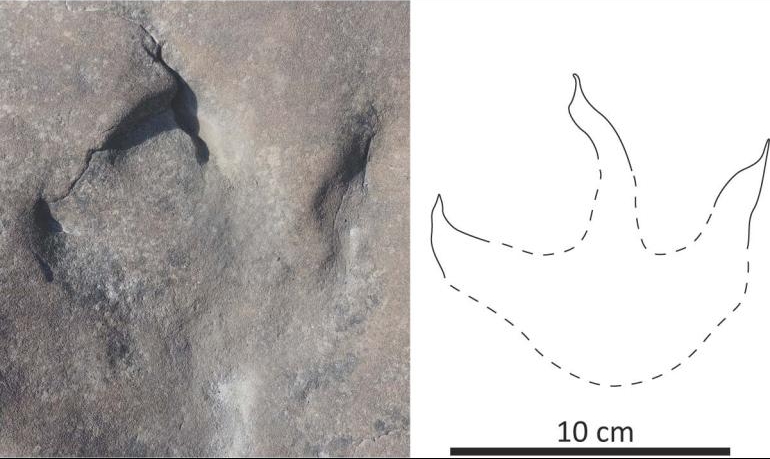
Creationism in Crisis - Dinosaur Footprints In Alaska from 100 Million Years Before 'Creation Week'!


A theropod track lies in rock near the west bank of the Kukpowruk River.

Photo: Anthony Fiorillo
Alaska dinosaur tracks reveal a lush, wet environment | Geophysical Institute

About 100 million yearsd before creationism's god decided to create a small flat planet with a dome over it to keep the water about its sky out, there were dinosaurs living in what is now northern Alaska. The problem for creationists is that the people who wrote their favourite creation myths were ignorant both of dinosaurs and Alaska so had no idea their tales needed to include something about them, which is why everything they wrote about either happened within a day or two's walk if the Canaanite Hills or were plagiarized from nearby cultures.

Now a team of paleontologists and archaeologists have discovered fossilised dinosaur footprints and the remains of plants in the Nanushuk Formation that show the climate there was warmer and wetter than today, at a time when species were migrating over the landbridge between Siberia in Asia and North America.

Unlike the Paluxy hoax, which had creationists fooled for the best part of a decade, there were no human footprints (hand-carved or otherwise) associated with these dinosaur tracks.

Because creationists will try to falsify the aging of the Nanshuk Formation, claiming the method must have been flawed to such an extent that if made 10,000 years or less look like 100 million years, here is actually how the dating was done - it’s; those dreaded zircons in volcanic deposits again, plus stratigraphy based on index fossils found in rocks of known age:
Do you have any information on the Nanushuk Formation in northern Alaska and how its age was estimated? The Nanushuk Formation is a geological formation located in northern Alaska, particularly in the North Slope region. It is primarily composed of sandstone, siltstone, and shale, and it contains significant oil and gas reserves. The formation is of great interest to geologists and petroleum geologists due to its hydrocarbon potential.

The age of the Nanushuk Formation has been estimated through various methods, including biostratigraphy and radiometric dating of volcanic ash layers within the formation. Biostratigraphy involves the study of fossil assemblages found within the rocks to determine their relative ages. By comparing the fossils present in the Nanushuk Formation to those found in other formations with well-established ages, geologists can infer the approximate age of the Nanushuk Formation.

Additionally, radiometric dating techniques, such as radiocarbon dating or uranium-lead dating, can be used to determine the absolute ages of specific minerals or volcanic ash layers within the formation. These methods rely on the decay of radioactive isotopes within the rocks to estimate the time since their formation.

Through a combination of these techniques, geologists have estimated that the Nanushuk Formation was deposited during the Late Cretaceous period, approximately 70 to 80 million years ago. However, the precise age estimates may vary depending on the specific location within the formation and the methods used for dating.
The team, led by Dr. Anthony R. Fiorillo of the New Mexico Museum of Natural History & Science, Albuquerque, USA and including Professor Paul McCarthy of University of Alaska Fairbanks (UAF) College of Natural Science and Mathematics, have published their findings open access in the journal Geosciences. It is explained in a UAF news item:
Web Analytics