Religion, Creationism, evolution, science and politics from a centre-left atheist humanist. The blog religious frauds tell lies about.
Friday, 8 August 2025
Unintelligent Design - When Snakes Borrow Genes from the Sea - It's Fatal To Creationism
New study unlocks mystery origin of iconic Aussie snakes | Newsroom | University of Adelaide
Intrigued by the information I unearthed while researching for my recent blog post about Australia's elapsid snakes and how skinks have evolved resistance to their venom, I discovered that these snakes have evolved from a common ancestor that once lived in the sea, and, while there, picked up a number of 'jumping genes' that are only found in marine animals as diverse as fish, sea squirts, sea urchins, bivalve molluscs and turtles.
The more we learn about genomes, the clearer it becomes that evolution is not a neat or predictable process—it is messy, opportunistic, and deeply influenced by historical contingency. A striking example of this comes from a recent genomic study that traced the origins of Australia’s iconic elapid snakes—not just through their DNA, but through the foreign DNA embedded within it. Researchers have identified at least 14 distinct horizontal gene transfer (HGT) events in these snakes, in which transposable elements—“jumping genes” — from unrelated marine organisms such as fish, tunicates, molluscs, and turtles have been incorporated into the snake genome.
This is compelling evidence that the ancestors of modern Australian elapids passed through a marine environment, acquiring genetic material from the organisms they encountered there. The transfers are not random. They show ecological specificity, temporally sequenced occurrence, and a nested pattern of inheritance — hallmarks of an evolutionary process rather than the actions of an intelligent designer.
For proponents of Intelligent Design creationism, this presents a serious interpretive problem. The idea that different species share features because of a “common designer” does not explain why Australian elapids should contain such a unique suite of genes from marine animals—genes absent in closely related snakes that remained on land. Nor does it account for the fact that many of these sequences serve no obvious function, are neutral or even mildly deleterious, and resemble the genetic detritus typical of unguided evolution.
ID advocates will likely claim this is just more evidence of “design reuse” or “genetic toolkits.” But such claims are not only ad hoc; they fail to explain the clear environmental and phylogenetic patterns observed in the data. The evolutionary explanation, by contrast, is both predictive and parsimonious: snakes dispersed through a marine environment, interacted with marine organisms, and as a result, their genomes bear the signature of that history.
In what follows, we will explore how this discovery not only sheds light on the evolutionary past of Australian elapids, but also exposes the weaknesses in ID’s core explanatory framework. The genome of a snake tells a story—and it's not the story of design.
Labels:
Biology
,
Evolution
,
Genetics
,
Refuting Creationism
,
Science
,
Snakes
,
Unintelligent Design
Malevolent Design - We COULD Have Been Designed To Re-Grow Lost Or Damaged Eyes - Malevolence Or Evolution?
Golden apple snail, Pomacea canaliculata
This Snail’s Eyes Grow Back: Could They Help Humans do the Same? | UC Davis
First, we had the example of Australian lizards which, unlike humans, have been endowed with immunity to snake venom through a simple mutation — the kind of change that creationists like William A. Dembski of the Discovery Institute would insist is the result of "intelligent design" because it is both complex and specified.
Now we have the example of the aquatic golden apple snail, Pomacea canaliculata, which — again, unlike humans — can regenerate a lost or damaged eye. The snail’s eye is genetically and structurally similar to the mammalian eye, so there appears to be no reason why an omnibenevolent, omniscient intelligent designer could not have endowed humans and other animals with that ability too. And of course, according to William A. Dembski and Michael J. Behe, the irreducibly complex eye and the complex, specified genetic information are both evidence for intelligent design by the same intelligent designer that designed the mammalian eye and it genetic underpinning.
Creationists, of course, believe that humans are the pinnacle of their putative intelligent designer’s work. So, from their viewpoint, the only reasons it didn't grant us the ability to regenerate eyes — or to resist snake venom — must be that it either didn’t want to, didn’t think to, or didn’t know how to. Yet all of those options are inconsistent with the claimed attributes of being omnipotent, omniscient, and omnibenevolent.
Which leaves us with only one other explanation: that it wants us to suffer when we damage or lose an eye.
All rather strange, really — especially considering that, according to the Bible, God views blemishes such as blindness as a form of profanity:
And the Lord spake unto Moses, saying, Speak unto Aaron, saying, Whosoever he be of thy seed in their generations that hath any blemish, let him not approach to offer the bread of his God.
For whatsoever man he be that hath a blemish, he shall not approach: a blind man, or a lame, or he that hath a flat nose, or any thing superfluous, Or a man that is brokenfooted, or brokenhanded, Or crookbackt, or a dwarf, or that hath a blemish in his eye, or be scurvy, or scabbed, or hath his stones broken;
No man that hath a blemish of the seed of Aaron the priest shall come nigh to offer the offerings of the Lord made by fire: he hath a blemish; he shall not come nigh to offer the bread of his God.
He shall eat the bread of his God, both of the most holy, and of the holy. Only he shall not go in unto the vail, nor come nigh unto the altar, because he hath a blemish; that he profane not my sanctuaries: for I the Lord do sanctify them.
And Moses told it unto Aaron, and to his sons, and unto all the children of Israel.
Leviticus 21:16-24
Almost as an added insult to the humans it denied this regenerative ability to, while giving it to golden apple snails, the golden apple snail is a major invasive agricultural pest which causes widespread damage to rice crops, when it gets into paddy fields.
Labels:
Biology
,
Evolution
,
Genetics
,
Malevolent Design
,
Refuting Creationism
,
Science
,
Unintelligent Design
Thursday, 7 August 2025
Malevolent Designer - We COULD Have Been Designed To Resist Snake Venom - Malevolence Or Evolution?
Major Skink, Bellatorias frerei
How Aussie skinks outsmart lethal snake venom - News - The University of Queensland
As though the recent news from the biological sciences wasn't already bad enough for creationists, we now have two examples demonstrating how—if an omnibenevolent, omniscient deity really had designed humans as the pinnacle of creation—it could have done a far better job. Yet, apparently, it chose not to.
The first, which is the subject of this blog post, involves a seemingly humble Australian lizard, the major skink (Bellatorias frerei), which possesses a simple mutation that renders it immune to Australian snake venom.
The second example, which I’ll cover in my next post, concerns the apple snail. This remarkable mollusc has an eye that is structurally and genetically similar to the mammalian eye—but unlike ours, it can regenerate if damaged or lost. But more on that later.
Australia is infamous for its venomous snakes—many of them deadly. Yet thanks to the widespread availability of antivenoms, there are only one or two fatalities annually, out of hundreds of snakebite cases.
However, if humans had been endowed with the same mutation as the skink, there would be no deaths at all—and no need for antivenoms. Interestingly, this is the same mutation that grants immunity to cobra venom in some mammals, such as mongooses and honey badgers. So, from a creationist perspective, there appears to be no good reason to deprive humans of this mutation — unless the designer was malevolent, indifferent, or just lazy.
It would pose an interesting challenge to intelligent design (ID) creationists to explain the "intelligence" in designing snakes to kill lizards with neurotoxic venom, only to then design lizards that are immune to it. Of course, creationists invariably avoid addressing these sorts of paradoxes—paradoxes which evolutionary biology easily explains as the outcome of an unintelligent evolutionary arms race.
These neurotoxic venoms work by binding to receptors on the surface of muscle cells and blocking the action of the neurotransmitter acetylcholine. This prevents muscle contraction, ultimately stopping respiration. The simple mutation in the skinks alters these receptors so that the venom can no longer bind effectively, neutralising its effects.
Labels:
Arms Races
,
Biology
,
Evolution
,
Refuting Creationism
,
Science
,
Unintelligent Design
Refuting Creationism - Adapting to Climate Change - 56 Million Years Before 'Creation Week'
Ancient soils preserved in the rock, known as paleosols, in the Willwood Formation, Bighorn Basin, Wyoming, are rich fossil sites.
Fossil studies of the extinct predator Dissacus praenuntius offer clues as to how ancient animals responded to environmental changes. The ancient omnivore was about the size of a jackal or a coyote.
ДиБгд, CC BY 4.0 , via Wikimedia Commons
Long before the supposed "Creation Week" — when creationists claim Earth was magicked into existence just a few thousand years ago — our planet was already teeming with life and undergoing dramatic changes. Around 56 million years ago, a mere tick in geological time, Earth experienced a sharp and rapid rise in global temperatures known as the Paleocene–Eocene Thermal Maximum (PETM). This event had a profound effect on ecosystems and the species that lived through it. Many, of course, did not survive, but those that did, adapted to the new, harsher conditions.
One such survivor was an early mammal, Dissacus praenuntius, a member of the now-extinct Mesonychidae order. D. praenuntius was an omnivore that resembled a hyena, but with small hooves on each toe, and like a hyena, it likely lived as an opportunistic scavenger and predator. Now, a team of palaeontologists has revealed how its behaviour changed during the PETM: it began consuming more bone, presumably because its usual prey had become scarce or disappeared altogether. In this respect, D. praenuntius serves as a record of the environmental pressures of the PETM and how some species responded to survive.
It paints a picture of an Earth that is far removed from the idealised, "perfect" planet imagined in creationist mythology — a planet supposedly fine-tuned for life. Instead, the fossil record tells the story of a world that can quickly become hostile, where survival depends not on divine design but on the ability to adapt — or perish.
Labels:
Climate
,
Creationism in Crisis
,
Evolution
,
Fossils
,
Palaeontology
,
Science
Refuting Creationism - Evidence That Would Not Be There If The Bible Is True History.
Excavation of a trench dug in about 5500 BCE, at the Podhajska site in southwest Slovakia.
© Till Kühl
Buried beneath a thick layer of silt containing a chaotic mixture of fossils from both nearby and distant land masses — the expected deposit of a supposed global genocidal flood — is... nothing. Such a layer should be observable worldwide, of course, but like at the archaeological sites in the Carpathians, it simply isn’t there.
Instead, what we find is an unbroken sequence of historical deposits stretching far beyond the time when creationists claim the Earth was magicked into existence. In other words, the evidence contradicts the Bible’s timeline and strongly refutes the notion of a global flood.
Importantly, this evidence isn’t the result of an attempt to disprove the Bible. Rather, archaeologists have simply uncovered facts that are starkly different from what one would expect if the Bible were the inerrant word of a creator god. A case in point: a team from Christian-Albrechts-Universität zu Kiel (CAU) investigating changes in social hierarchy associated with the introduction of agriculture in the Carpathian Basin.
According to expectations, the adoption of agriculture should have led to increased social inequality, as control of land and trade would concentrate power in the hands of a privileged elite. However, the researchers found no such evidence. Using house size as a proxy for social inequality — assuming that a ruling class would have built significantly larger dwellings — the team discovered that house sizes remained relatively uniform over the period.
Labels:
Archaeology
,
BibleBlunder
,
History
,
Refuting Creationism
,
Science
Wednesday, 6 August 2025
Refuting Creationism - Who's In Charge, You Or Your Gut Microbes?
Newly Discovered ‘Sixth Sense’ Links Gut Microbes to the Brain in Real Time | Duke University School of Medicine
Creationists like to believe they were created perfectly by a benevolent god. Evolutionary biologists, however, know better — and the latest research shows just how wrong the creationist fantasy really is. It turns out that your appetite isn’t entirely under your control. Instead, it’s influenced — perhaps even partly dictated — by the trillions of bacteria and other microbes living in your gut, which evolved to keep themselves well-fed. If you’re a creationist, that means your “perfect design” includes being manipulated by microorganisms.
To anyone who understands evolution, this will come as no particular surprise; to a creationist who believes they were created perfectly, it will be disturbing news, provoking the most convoluted of mental contortions to cope with the resulting cognitive dissonance.
The gut microbiome — consisting of multiple species of bacteria, archaea, viruses, and other single-celled organisms — has evolved to influence, if not completely control, our appetite. They do this to ensure they get an adequate supply of nutrients.
Labels:
Biology
,
Evolution
,
Physiology
,
Refuting Creationism
,
Science
Creationism Crushed - By Big Biting Dinosaurs
Dinosaur bite illustrations.
Rowe and Rayfield, Current Biology (2025)
Creationists will likely dismiss the recent paper in Current Biology because, as is common in creationist psychology, any scientific evidence contradicting their fundamental beliefs is either ignored, misrepresented, or actively denied—particularly if it suggests their views should be reconsidered.
The study by Andre J. Rowe and Emily J. Rayfield of the University of Bristol (UK) demonstrates that, during the long stretch of Earth’s history predating creationist timelines, giant carnivorous dinosaurs evolved markedly different jaw mechanics to tackle prey—leading to distinct ecological roles. For example, crushers such as Tyrannosaurus rex developed jaws optimised for forceful crushing, akin to crocodilians, whereas slashers - other large theropods such as allosaurids or spinosaurs - developed weaker jaws tailored to ripping and slashing flesh, like modern Komodo dragons [1.1].
This divergence in feeding mechanics underscores a fundamental principle in evolutionary biology: adaptive radiation and allopatric speciation — whereby offspring inheriting intermediate jaw characteristics (neither fully adapted for crushing nor ripping) would likely be at a disadvantage, reducing their reproductive success. Over time, this selective pressure fosters reproductive barriers and drives lineages apart.
Labels:
Biology
,
Creationism Refuted
,
Dinosaurs
,
Evolution
,
Fossils
,
Mechanics
,
Palaeontology
,
Science
Tuesday, 5 August 2025
Creationism Refuted - The Subterranean Microbes That Make Creationists Sick
Buried Alive: The Secret Life of Deep Earth Microbes
What if we could peer back through deep time and see what single-celled organisms looked like—not just thousands, but hundreds of millions of years ago—and compare them to their living descendants? It would be a revelation for science… and a nightmare for creationists.
That’s precisely what geobiologist Karen Lloyd and her team at the University of Southern California (USC) are uncovering. They study microorganisms that have made an incredible journey: born in the depths of the ocean, slowly buried under a relentless rain of sediment, and then carried by plate tectonics into the deep Earth, where subduction dragged them beneath continental crust. There, cut off from oxygen and sunlight, they survived for millions of years in a slow-motion existence, drawing nutrients from the surrounding rock. Their metabolic rates became so low they could no longer replicate, yet they endured by “breathing”—in the biochemical sense—through redox reactions, extracting energy from electrons provided by whatever electron donors the rocks could supply. Some have even evolved the ability to “breathe” carbon dioxide, something unknown among terrestrial life.
These organisms’ existence is a direct challenge to creationist dogma—not only because they have persisted for timescales far beyond the Bible’s allowance, but because they reveal how even apparently simple single-celled organisms can diverge and adapt over geological epochs. Environmental pressures have driven them into extraordinary evolutionary niches, each defined by what they have learned to “breathe.” Moreover, they exist in environments in which life as we know it couldn't survive, yet creationists insist that Earth was intelligently created, perfect for life, which begs the question, which life? The life that breathes using arsenic, lives for millions of years deep underground with almost no metabolic activity and survive in the heat and acidity of volcanic hot springs, or life the breathes oxygen and needs a regular supply of water and a narrow range of ambient temperatures in which to survive without special equipment?
Labels:
Biology
,
Creationism Refuted
,
Genetics
,
Geology
,
Microbiology
,
Science
Refuting Creationism - Evolving Butterfies Are Unkind To Creationists
Greta oto - Glasswing
Remapping the evolutionary tree of butterflies
A recent piece of research raises insurmountable problems for creationists trying to fit their definition of 'kind' into the real world of living organisms.
We often assume that closely related species look different from one another because visual cues are crucial for mate recognition. In many animals, especially birds, these differences help prevent interbreeding by acting as barriers to hybridisation. This makes particular sense in birds, where genetic architecture is unusually stable — chromosome numbers and gene mappings remain remarkably consistent — so, in theory, many closely related bird species could interbreed if not for the evolution of distinct plumage or mating displays. These are known as prezygotic barriers because they inhibit the formation of hybrid zygotes.
Given this, we might expect the same to apply to other vividly coloured groups like butterflies. But evolution doesn’t follow a single rulebook — it uses whatever tools are available. While visual cues are often important, other senses can also serve to maintain species boundaries. One of the most powerful is the sense of smell, particularly the use of pheromones.
Pheromones are widespread in the natural world, especially among insects. They’re used for everything from attracting mates to triggering mating behaviours. Some male moths, for instance, can detect a female’s pheromones from over a mile away and home in on her with astonishing precision — guided like a missile by the chemical trail.
Now, an international team of researchers has discovered that what was long thought to be a single species of glass-wing butterfly is actually a complex of six genetically distinct species. These butterflies all look nearly identical, thanks to strong selection pressure for Batesian and Müllerian mimicry — many are toxic, and they gain protection by resembling one another. Visual differences would reduce this shared advantage, so selection favours similarity, not distinction. But predators can't detect pheromones — so these butterflies have evolved subtle chemical differences instead, using scent as a hidden cue to prevent hybridisation.
Along with this chemical divergence, the researchers found significant genomic differences between the species, including striking variation in chromosome numbers — from just 13 to as many as 28. The team also discovered that the arrangement of the genes on the chromosomes is very volatile, so, different closely related species can have very different chromosomal arrangements, increasing the pressure for barriers to hybridization to evolve and allowing a species to rapidly radiate into new ecological niches.
So, the question for creationists is, how does this fit in with the definition of 'kinds' required for the Bible-literalist interpretation of taxonomy?
This fascinating study was conducted by a team including scientists from the Wellcome Sanger Institute, Universidad Regional Amazónica Ikiam in Ecuador, Universidade Estadual de Campinas in Brazil, the University of Cambridge, and others. Their findings are detailed in a paper published in Proceedings of the National Academy of Sciences, and summarised in a news release from the Wellcome Sanger Institute.
Monday, 4 August 2025
Fake of Turin - More Evidence that the 'Shroud' of Turin Was a Medieval Creation
3D analysis reveals Shroud of Turin image likely came from sculpture, not Jesus’ body | Archaeology News Online Magazine
More evidence has emerged indicating that the so-called 'Shroud of Turin'—which legend claims was the cloth used to wrap the body of Jesus for burial—is in fact a medieval artefact, likely created for use in religious ceremonies.
As I noted in a 2013 blog post, the 2D image on the cloth could not have been produced by wrapping it around a 3D human body. This can be easily demonstrated using an artist’s mannequin: coat it in paint, and while the paint is still wet, wrap a cloth around it as if preparing a body for burial. The resulting imprint bears little resemblance to the facial features or body contours of the mannequin, because the 3D form cannot transfer accurately to a 2D surface in that way.
There are, of course, many other reasons to doubt the shroud's authenticity. For example, the biblical account is inconsistent with the notion of a single burial cloth. The Gospel of John (20:5–7) clearly describes two cloths—one for the body and another for the head. But this inconsistency pales into insignificance compared to the forensic evidence showing that the cloth was woven on a loom not invented until the early Middle Ages in southern Germany, using flax grown in medieval France.
Even after disregarding or dismissing this wealth of contradictory evidence, believers are still faced with the insurmountable task of proving that the body supposedly wrapped in the cloth was that of the legendary founder of Christianity—Jesus of Nazareth.
In fact, the shroud was denounced as a forgery as far back as 1390 by Bishop Pierre d’Arcis, who, in a letter to Pope Clement VII, wrote:
[The Shroud is] a clever sleight of hand [by someone] falsely declaring this was the actual shroud in which Jesus was enfolded in the tomb to attract the multitude so that money might cunningly be wrung from them.
Bishop Pierre d’Arcis, Bishop of Troyes, 1390.
Labels:
Atheism
,
Catholics
,
Christians
,
Fraud
,
Miracles
Sunday, 3 August 2025
Abiogenesis News - Organic Precursors to Life Detected In Deep Space.
Planet-forming disc around V883 Orionis. This star is currently in outburst. The dark ring midway through the disc is the point where the temperature and pressure dip low enough for water ice to form.
Orbits of the planet Neptune and dwarf planet Pluto in our Solar System are shown for scale.
Credit: ALMA (ESO/NAOJ/NRAO)/L. Cieza
This article is best read on a laptop, desktop, or tablet
This artist’s impression shows the planet-forming disc around the star V883 Orionis. In the outermost part of the disc volatile gases are frozen out as ice, which contains complex organic molecules. An outburst of energy from the star heats the inner disc to a temperature that evaporates the ice and releases the complex molecules, enabling astronomers to detect it. The inset image shows the chemical structure of complex organic molecules detected and presumed in the protoplanetary disc (from left to right): propionitrile (ethyl cyanide), glycolonitrile, alanine, glycine, ethylene glycol, acetonitrile (methyl cyanide).
© Credit: ESO/L. Calçada/T. Müller (MPIA/HdA) (CC BY 4.0)
If you listen to creationists, you might be persuaded to believe that the formation of inorganic chemicals—often deliberately conflated with 'life' to evoke an emotional reaction—is, for all practical purposes, impossible without the intervention of a supernatural intelligence. This is, of course, nothing more than the familiar creationist fallback: the god of the gaps argument, coupled with a false dichotomy, and dressed up with a spurious veneer of mathematical ‘proof’.
But this tactic suffered yet another fatal blow recently with the publication of a study led by Abubakar Fadul of the Max Planck Institute for Astronomy (MPIA), which reported the discovery of organic molecules in the protoplanetary disc surrounding the young star V883 Orionis. This finding provides compelling evidence that the formation of prebiotic molecules can begin even before planets form—suggesting that Earth may have developed with a complement of organic compounds already present in the accretion disc from which it emerged.
An alternative, but equally plausible, hypothesis is that these molecules could have been delivered by meteorites or other interplanetary bodies.
Labels:
Abiogenesis
,
Biology
,
Chemistry
,
Cosmology
,
Creationism in Crisis
,
Physics
,
Science
Refuting Creationism - Ancient Viruses Hidden in Bird Genomes Reveal Evolution in Action
Phylogenomics Unveils the Complex Evolution of Retroviruses in Birds | Molecular Biology and Evolution | Oxford Academic
Information about endogenous retroviruses is normally unwelcome news for creationists because they form phylogenies which exactly map onto the evolution of different species from common ancestry. This is no less true of a new research paper published by four researchers from the College of Life Sciences, Nanjing Normal University, Nanjing, Jiangsu, China, published in Molecular Biology & Evolution.
Endogenous retroviruses for part of the 'junk' (non-coding/non-regulatory) DNA, but some of it have been exapted for other functions over the years and some of it has placed an evolving taxon onto a new evolutionary trajectory. For example, one exapted retrovirus with immuno-suppressive qualities has made placental mammals possible without the growing embryo being treated as a parasite and attacked by the mother's immune system.
The researchers have uncovered the complex evolutionary history of retroviruses in birds by analysing their genetic “fossils” — endogenous retroviruses (ERVs) — embedded in bird genomes. They scanned the genomes of 758 bird species and identified more than 470,000 ERV sequences, revealing a vast and previously underestimated diversity of retroviruses. These sequences are the remnants of ancient viral infections that became part of the host DNA, passed down from generation to generation.
Labels:
Biology
,
Birds
,
Creationism in Crisis
,
Evolution
,
Genetics
,
Ornithology
,
Parasites
,
Science
,
Virology
Saturday, 2 August 2025
Creationism Refuted - What Caused Our Teeth To Shrink Until 690,000 Years Before 'Creation Week'
Chronologically from left, the molars of human ancestors got longer over millennia to suit a diet of high-carb grassy plants.
Photo credits: Public domain; Don Hitchcock; Fernando Losada Rodríguez (rotated)
Changes in Diet Drove Physical Evolution in Early Humans | Dartmouth
A recent discovery by palaeoanthropologists, led by researchers from Dartmouth College, Hanover, New Hampshire, USA, highlights the stark difference between how a teleological thinker—such as a creationist—imagines evolution works and how it actually proceeds. The study found that the teeth of ancient hominins evolved over a period of some 700,000 years in response to the increasing availability of soft, starchy foods, which began to replace the coarse, fibrous plant matter they had previously consumed.
A teleological thinker—someone who sees purpose and agency in natural processes—would assume that something *caused* the teeth to evolve in order to better process the new food. However, as the theory of evolution predicts, any variation that improves efficiency in food processing or reduces the now-unnecessary cost of growing and maintaining large teeth will be favoured by natural selection. Over evolutionary time, such traits become more common. In the case of archaic hominins, this meant their teeth gradually became smaller.
Teleological thinkers often make the mistake of believing that asking, "Who or what told the teeth they needed to change?" or "How did the teeth know they had to evolve?" is a meaningful challenge to evolutionary theory. To them, it seems reasonable to assume a supernatural intelligence must be involved.
This simplistic view of evolution is actively encouraged by creationist pseudo-scientists such as William A. Dembski and his colleagues at the Discovery Institute, who claim that the genetic information resulting from such optimisation must have been intelligently designed because it is "specified" for a purpose. Of course, at every stage of human evolution, the genetic information that produced a particular tooth shape was necessarily "specified" for that outcome. Dembski never discloses this to his audience, nor does he attempt to correct the teleological bias on which his movement depends.
An interesting aspect of this discovery is that the evolutionary change in this case was driven not so much by environmental change - the starch foods had always been there - as by a change in behaviour - a case of meme-gene co-evolution, using the term 'meme' in the original sense as coined by Richard Dawkins in The Selfish Gene, to mean a unit of cultural inheritance - the analogue of the gene in genetic inheritance.
Labels:
Anthropology
,
Archaeology
,
Biology
,
Creationism Refuted
,
Evolution
,
Fossils
,
Palaeontology
,
Science
Creationism Refuted - A Speciation Event 9 Million Years Ago Gave Us Potatoes.
Potato evolved from tomato 9 million years ago | EurekaAlert
his story could almost have been tailor-made to embarrass creationists – though, in truth, most scientific papers do that. It concerns the evolution of potatoes by a process that creationists insist never happens: speciation. Adding to their discomfort, this event took place around 9 million years before ‘Creation Week’, during that vast expanse of ‘pre-Creation’ history in which 99.9975% of Earth’s history – and life’s – unfolded.
Speciation is usually a slow, gradual process, occurring over thousands or millions of years as populations diverge under environmental pressures. But in some cases – particularly in plants – a new species can arise almost instantaneously through hybridisation, when a fertile offspring results from the cross between two different species, genetically isolated from both parents.
This latter form of speciation has now been shown to account for the evolution of the potato. Some 9 million years ago, a natural hybridisation event between a tomato-like plant and a species of Etuberosum gave rise to a new lineage. Today, there are around 107 recognised potato species in South America. While closely related to both tomatoes and Etuberosum (a genus with three species that look remarkably like potatoes), neither of those relatives produce tubers. The hybrid did – and that made all the difference.
Researchers from the Chinese Academy of Agricultural Sciences have demonstrated that this ancient hybridisation created the genetic mechanism for tuber formation. This allowed the new species to survive harsher environments by overwintering underground as stem tubers. From this key innovation sprang a radiation of new potato species, each adapting to a range of ecological niches.
And, as an added discomfort for creationists, the scientists show no signs of thinking that the known mechanisms of biological evolution were inadequate to explain how this speciation event occurred and required a special magical act of divine intervention to make it happen by creating new information in the genome.
The genetic control of tuber formation in potatoes. The genetic control of tuber formation in potatoes has been the subject of extensive research, particularly because of its agricultural importance and evolutionary significance. The newly published study in Cell (2025) offers a major advance, pinpointing the evolutionary origin and genetic mechanism behind this trait. Here's a summary of what’s currently known, drawing from both the recent paper and prior research:
Labels:
Biology
,
Evolution
,
Genetics
,
Refuting Creationism
,
Science
,
Speciation
Creationism Refuted - Common Origins of Alcohol Metabolism In Humans And African Apes
Scrumped fruit key to chimpanzee life and a major force of human evolution | University of St Andrews news
(b) Scrumping of Pentadesma butyracea (Clusiaceae) by a western gorilla.
Photograph: MMR.
(c) Scrumping of Gambeya albida (syn. Chrysophyllum albidum; Sapotaceae) by an eastern chimpanzee.
Photograph: CH.
The human ability to consume and metabolise alcohol efficiently may trace back to our ape ancestors, who regularly ate overripe and fermented fruit with a naturally high alcohol content. This is according to researchers from the University of St Andrews, Scotland, and Dartmouth College, USA.
The bad news for creationists is that this discovery strongly supports the common ancestry of modern apes and humans. The researchers are in no doubt that the Theory of Evolution explains the presence of the same genetic mutation in African apes — including humans — which allows us to metabolise alcohol around 40 times more efficiently than orangutans, which lack the mutation.
This mutation enables African apes to consume fermented fruit — often as a social activity — in a pattern of alcohol consumption strikingly similar to that seen in humans.
To describe this behaviour in wild chimpanzees, the researchers have borrowed the term scrumping — a familiar UK English word for the (often illicit) picking and eating of apples, particularly by children. The word derives from the Middle Low German schrimpen, meaning ‘shrivelled or shrunken’ (to describe over-ripe fruit). It also survives in the name of the traditional West Country cider known as scrumpy.
Labels:
Biology
,
Common Origins
,
Creationism Refuted
,
Evolution
,
Genetics
,
Science
Friday, 1 August 2025
Refuting Creationism - A Diverse Human Population in China - 290,000 Years Before 'Creation Week'
A study reveals the human diversity in China during Middle Pleistocene | CENIEH
A study recently published in the Journal of Human Evolution reports the discovery of a mixture of archaic and modern traits in the dentition of 300,000-year-old hominin fossils unearthed at the Hualongdong site in Anhui Province, China.
These fossils predate the migration of anatomically modern humans (Homo sapiens) out of Africa by around 250,000 years. They indicate that hominin populations in East Asia were already diversifying and possibly interbreeding with archaic humans, such as Homo erectus, to form lineages distinct from both Neanderthals and Denisovans.
The research, led by Professor Wu Xiujie, director of the Hualongdong excavations, is the result of a longstanding collaboration between scientists from the Dental Anthropology Group at CENIEH — María Martinón-Torres, Director of CENIEH and corresponding author of the paper, and José María Bermúdez de Castro, researcher ad honorem at CENIEH — and the Institute of Vertebrate Paleontology and Paleoanthropology (IVPP) in Beijing.
The findings reveal a rich and complex picture of human evolution in East Asia, wholly at odds with the simplistic biblical narrative still clung to by creationists. That account, written by ancient people with no knowledge of the broader world, reflects a worldview in which Earth was small, flat, covered by a dome, and located at the centre of the universe.
Labels:
Anthropology
,
Archaeology
,
Common Origins
,
Creationism Refuted
,
Evolution
,
Palaeontology
,
Science
Refuting Creationism - Our Ancestors Evolved To Walk Upright In Trees - Like Modern Savannah Chimpanzees
A young male chimp feeds on woodland seeds (cropped).
Image by Rhianna C. Drummond-Clarke/Greater Mahale Ecosystem Research and Conservation (GMERC)
How much time did our ancestors spend up trees? Studying these chimpanzees might help us find out
A group of Issa Valley chimpanzees navigate an open woodland crown to forage on new leaves.
Image by Rhianna C. Drummond-Clarke/Greater Mahale Ecosystem Research and Conservation (GMERC)
What is particularly striking is the complete absence of any doubt among the scientists that evolution, driven by natural selection, is the correct framework for interpreting these observations. At no point do they resort to supernatural explanations or even hint that evolution might be insufficient to explain the data. On the contrary, their conclusions seamlessly integrate with the existing evolutionary narrative, demonstrating how behaviours seen in modern chimpanzees provide a living window into the adaptations of our shared ancestors. This directly undermines the creationist claim that mainstream biologists are “abandoning” evolution in favour of unproven religious explanations—a claim that has no basis in reality.
Creationist dogma insists on static, unchanging “kinds” and appeals to unverifiable supernatural causes. Yet, studies like this show that every aspect of our evolutionary past—anatomical, genetic, and behavioural—can be explained through natural processes, without the need for divine intervention. The evidence for a shared ancestry between humans and other primates grows with every new study, while creationism remains stuck with no predictive power and no scientific methodology.
In short, this research reinforces the power and universality of the Theory of Evolution. The scientists involved didn’t set out to “disprove creationism”; they simply applied rigorous observation and analysis, and the results—once again—fell squarely on the side of evolution. Far from being abandoned, the ToE continues to thrive as the backbone of modern biology, while creationism, with its untestable supernatural entities, offers no explanation at all.
Labels:
Anthropology
,
Biology
,
Creationism Refuted
,
Evolution
,
Palaeontology
,
Science
Thursday, 31 July 2025
Creationism Refuted - How Neanderthals Were Getting Fat - 125,000 before 'Creation Week'
Neanderthals smashing bones to extract the fat
AI generated image (ChatGPT 4o)
Excavation at the Neumark-Nord 2 in central Germany.
Photo: Professor Wil Roebroeks, Leiden University
More evidence has emerged that Neanderthals were far from the slow-witted, lumbering brutes of popular myth. In fact, they were highly organised, culturally sophisticated, and capable of processing food on what can only be described as an industrial scale.
This latest insight comes from a team of archaeologists led by researchers from MONREPOS (Leibniz Centre for Archaeology, Germany) and Leiden University (The Netherlands), in collaboration with the State Office for Heritage Management and Archaeology Saxony-Anhalt (Germany). Their findings were recently published in Science Advances.
At a site known as Neumark-Nord 2 in central Germany, dating back 125,000 years, the researchers have discovered compelling evidence of a bone-processing ‘factory’. Here, Neanderthals systematically broke up the massive bones of straight-tusked elephants and other large mammals—including deer, horses, and aurochs—to extract fat from the marrow by steeping the fragments in hot water. The straight-tusked elephant, which could weigh up to 13 tonnes, would have yielded enough meat to feed 2,000 adult humans their daily caloric needs.
This site predates the arrival of modern humans in Europe by tens of thousands of years, placing it firmly within the Neanderthal era. At the time, Europe was enjoying an interglacial period with a climate comparable to today's.
Labels:
Anthropology
,
Archaeology
,
Creationism Refuted
,
Evolution
,
History
,
Palaeontology
,
Science
Wednesday, 30 July 2025
Creationism Refuted - Scientists Got It Wrong About Coelacanths - But Not About Evolution
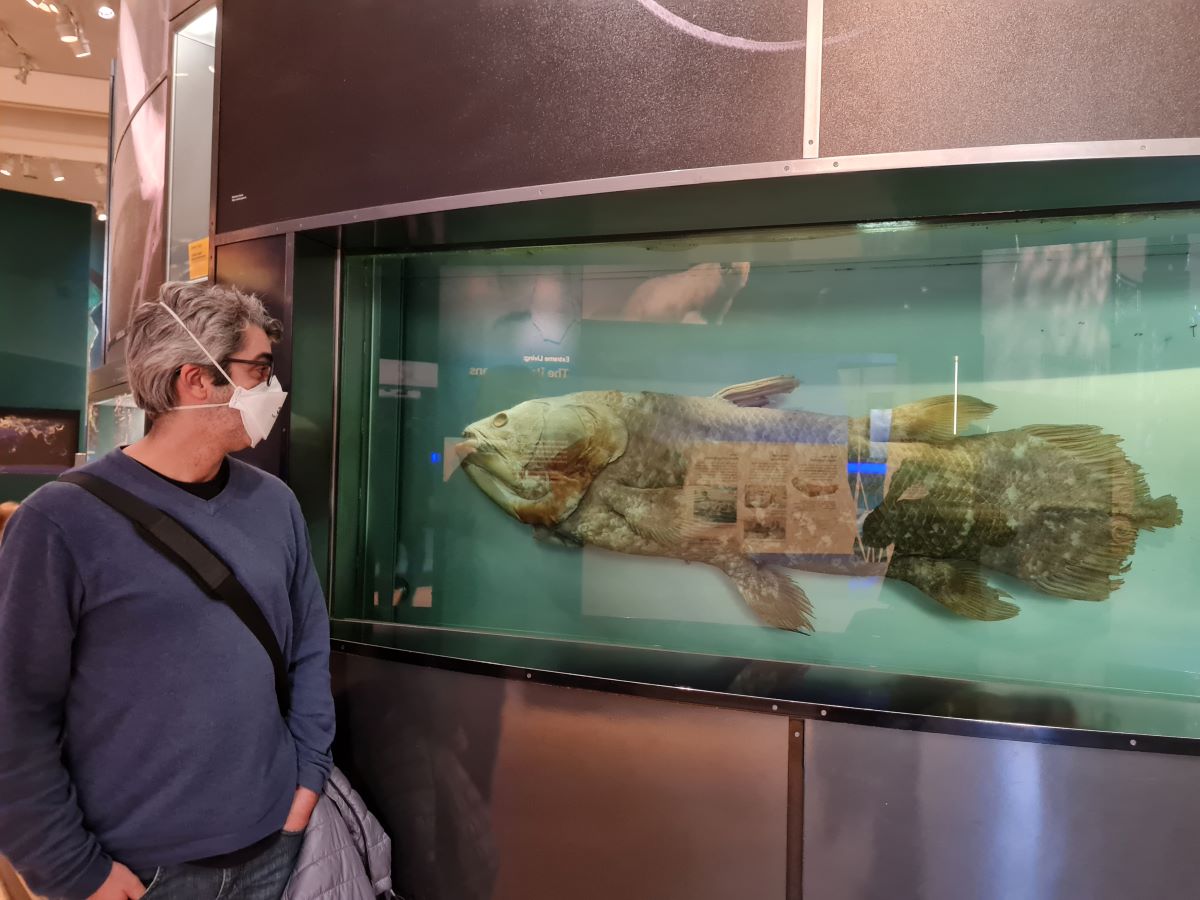
One of the authors of the study, Professor Aléssio Datovo, poses next to a coelacanth specimen on display at the Smithsonian Institution’s National Museum of Natural History (photo: personal archive)
New examination of fish considered a ‘living fossil’ changes our understanding of vertebrate skull evolution
Here is something that will cause creationists to jump for joy – until they read beyond the headline (if they ever do). Scientists have announced that they were wrong about the evolution of the vertebrate skull, including that of mammals.
However, beneath that headline lie some disappointing facts for creationists:
- The error was uncovered by re-examining the 400-million-year-old skull of a coelacanth.
- The mistake concerns details of how the vertebrate skull evolved – not whether it evolved.
- The paper directly contradicts the common creationist claim that scientists are only permitted to publish research that conforms to the scientific consensus. This study openly challenges the prevailing view.
- The discovery enhances our understanding of how the vertebrate skull evolved from that of ancestral lobe-finned fishes – precisely the kind of evidence creationists would rather didn’t exist.
Still, creationists can enjoy the headline and may even use it to 'prove' to their audience that science is unreliable because scientists sometimes make mistakes. Of course, they’ll likely ignore the fact that the fossil in question is 400 million years old, and gloss over the reality that – unlike religious dogma – science is a process of continuous refinement. Science allows for doubt, re-examination, and re-evaluation. When the evidence changes, scientists change their minds. In contrast, religious dogma is fixed and unchanging, usually despite the evidence, not because of it, hence the widening gap between what creationists are required to believe and what science reveals.
Upon re-examining the cranial musculature of the African coelacanth (Latimeria chalumnae), the researchers found that only 13% of the previously identified evolutionary muscle innovations in major vertebrate lineages were accurate. They also identified nine new evolutionary transformations related to innovations in feeding and respiration.
The researchers, Professor Aléssio Datovo from the University of São Paulo (USP) in Brazil and the late David Johnson from the Smithsonian Institution in the United States, who sadly died when the paper was in review, have just published their findings in Science Advances.
Labels:
Biology
,
Creationism in Crisis
,
Evolution
,
Fossils
,
Palaeontology
,
Science
,
Transitional Forms
Creationism Refuted - Ancient DNA Shows Origins Of Finns, Estonians & Hungarians Before 'Creation Week'
Map of all the sites that are sources of samples used in the study.
Source: Zeng, T.C., et al. (2025)
Ancient DNA solves mystery of Hungarian, Finnish language origins — Harvard Gazette
A recent paper in Nature marks a landmark advance in historical linguistics and ancient human migration studies.
Properly understood, the paper devastates Bible literalist dogmas. In solving what had been something of a mystery for linguistics and anthropology, it utterly refutes basic Bible narratives such as a global genocidal flood and a resetting of the human population of Earth some 4,300 years ago, followed by a repopulation from a focal point in the Middle East.
By sequencing and analysing 180 previously unstudied ancient Siberian genomes and integrating them with over 1,300 global ancient DNA datasets spanning 11,000 years, the study robustly traces the prehistoric roots of the Uralic language family—including Finnish, Estonian and Hungarian—to Central Siberia nearly 4,500 years ago [1, 2]. In doing so, it offers scientific clarity on how languages—and by extension cultures—spread via human migrations over millennia. This extends far beyond simplistic literal interpretations of Bible genealogies, emphasising the deep time, continuous migrations and cultural dynamics that falsify any notion of sudden, static origination of peoples as posited in young‑earth creation narratives.
Likewise, the Harvard Gazette article contextualises these genetic findings for a broader audience, highlighting how interdisciplinary scholarship — particularly the work led by recent graduates under guidance from ancient DNA expert David Reich — identifies a distinct genetic signature (“Yakutia\_LNBA”) strongly associated with speakers of Uralic languages who migrated from Eastern Siberia westward over thousands of years [2]. The piece explicitly notes that language transmission is not genetically deterministic, and warns against over‑simplified correlations. By underscoring the necessity of large data, critical caution, and peer‑reviewed methodology, the article reinforces the fundamentally scientific (not scriptural) basis for understanding human prehistory. From a Bible‑literalist creationist perspective—which often assumes humanity’s origins in specific, recent Middle Eastern events described in scripture—these studies are significant because they offer:
- Robust empirical timelines: ancient DNA data covering up to 11,000 years, demonstrating population movements and admixture across Eurasia.
- Clear geographic origins far from the traditional Biblical settings, with linguistic groups emerging from Central Siberian ancestries—not from post‑Flood dispersion from Babel.
- Methodological transparency: ancient genomes, radiocarbon dating, linguistic phylogenies, and cultural archaeology collectively underpin conclusions, in stark contrast to dogmatic, text‑based literalism.
Labels:
Anthropology
,
Archaeology
,
Genetics
,
History
,
Linguistics
,
Refuting Creationism
,
Science
Tuesday, 29 July 2025
Creationism Refuted Again - Neanderthal Footprints in Portugal - 68,000 Years Before 'Creation Week'
General view of the main tracksite with hominin trackways located in the northern cliff of Monte Clérigo beach
This article is best read on a laptop, desktop, or tablet
Gibraltar National Museum scientists participate in a major new international study - 505/2025
Reconstituted scenario of Monte Clérigo tracksite, generated by AI tools following the guidance, and final artworks of J.M. Galán (ChatGPT-4 was used to select the prompts, at https://openai.com/index/gpt-4/; Image Generator Pro to generate various versions, at https://imagegeneratorpro.com; DALL-E3 for the nuances and quality of the image, at https://openai.com/index/dall-e-3/; Photoshop 26.4.1 (www.adobe.com) and digital pencil of Procreate for iPad version 5.3.14, at https://apps.apple.com/us/app/procreate/id425073498, for drawing over the selected image version).
According to mainstream geological dating techniques, these footprints were made tens of thousands of years before the supposed biblical date of creation (around 6,000 to 10,000 years ago, depending on interpretation). For creationists who insist that all of Earth’s history must be crammed into a few millennia, these kinds of discoveries are profoundly inconvenient. Worse still, the clarity of the evidence — physical impressions in sediment, dated using well-established methods like optically stimulated luminescence — makes them difficult to hand-wave away.
Faced with such a challenge, creationists will likely fall back on a familiar toolkit of denial strategies. Some will try to cast doubt on the dating methods, resorting to pseudoscientific critiques of OSL or claiming unknown “contamination” skewed the results. Others may assert that the footprints were made after Noah’s Flood — an idea that stretches credulity beyond breaking point given the age and geological context. And, of course, some will simply ignore the evidence altogether, pretending it doesn’t exist or insisting that Neanderthals were just humans who lived in “post-Babel dispersion” times, despite the overwhelming fossil, genetic, and archaeological data to the contrary.
The discovery has been reported recently in the journal Scientific Reports by a team of researchers which includes experts from the Gibraltar National Museum and the University of Lisbon, Portugal.
Labels:
Anthropology
,
Biology
,
Creationism in Crisis
,
Geochronology
,
History
,
Palaeontology
,
Science
Jesus & Mary On Toast - Why We See Faces Everywhere.
New research details how our brains are drawn to and spot faces everywhere | University of Surrey.
From an early age, the human brain interprets patters and sees faces everywhere. Draw two large black discs on a white sheet of paper and show it to a human baby of just a few weeks old and you will probably make the baby smile, just as they smile when they look at your face. Their brain has perceived the dots as the eyes of a face. This is the phenomenon of human perception known as pareidolia.
Some religious people, in an effort to justify holding irrational beliefs, often attribute these appearances of 'Jesus' or 'Mary', as miracles with some deep religious significance. For example, this anti-Atheist Gotcha, which appeared on Quora a couple of years ago:
Atheists, if there is no God, then why does Jesus' face sometimes appear on toast?
Imagine walking through the woods and briefly believing you're seeing a face in a knot of moss—only to realise seconds later that it’s just a tree. That flicker of recognition is your brain’s face-detection machinery springing into action. In a recent experiment at the University of Surrey, researchers used gaze-cueing techniques to show that when people perceive a face-like arrangement in inanimate objects, their attention is captured even more powerfully than by the averted gaze of a real face. These face-like patterns don’t need eyes, a nose, or even realistic features—just the right suggestion of symmetry and placement is enough for the brain to “see” a face where none exists.
This phenomenon, known as face pareidolia, is a by-product of evolution, not evidence of design. From an evolutionary standpoint, it's safer to wrongly detect a face in a shadow than to miss a predator or an ally. But while this trait once had clear survival value, it now fuels more curious beliefs. Religious individuals, for instance, often interpret pareidolic faces—especially when perceived in burnt toast, water stains, or tree bark—as miraculous signs from divine figures like Jesus or the Virgin Mary. What neuroscience tells us is that these “visions” are false positives produced by a brain primed to find patterns and assign meaning, even when none exists. Evolution has given us a perceptual system that’s fast, but not always accurate—and our cultural context then fills in the rest.
How the human brain interprets so many things as faces is the subject of a recent open access paper in i-Perception by researchers led by Dr Di Fu of the University of Surrey, with colleagues from the Institute of Psychology, Chinese Academy of Sciences.
Labels:
Creationism Refuted
,
Delusion
,
Evolution
,
Neurophysiology
,
Psychology
,
Science
Friday, 25 July 2025
Creationism Refuted - Don't Laugh At the Bible's Authors, They Were Only Doing Their Best!
NGC 3285B (137 million lightyears from Earth)
NGC 3285B
A spiral galaxy with a disc made up of several swirling arms. Patchy blue clouds of gas are speckled over the disc, where stars are forming and lighting up the gas around them. The core of the galaxy is large and shines brightly gold, while the spiral arms are a paler and faint reddish colour. Neighbouring galaxies - from small, elongated spots to larger swirling spirals - can be seen across the black background.
Take a grain of rice and hold it between your thumb and forefinger at arm’s length while looking up at the night sky. The patch of sky hidden behind that tiny grain of rice probably contains thousands of galaxies—each with around half a trillion stars. Some of these stars are ancient, nearing the end of their tens-of-millions-of-years lifespans; others are just beginning to form from clouds of gas and debris left behind by older stars that exploded as supernovae.
What lies behind that grain of rice is a tiny fragment of a dynamic, evolving, ever-changing, and expanding universe. A universe of which our ancient prophets were completely unaware as they crafted imaginative descriptions of its origins—descriptions written just a few thousand years ago that portrayed it as a small, unchanging cosmos, with a flat Earth at the centre covered by a dome.
But let’s not be too hard on them. As they stood in their Canaanite pastures, the Earth must indeed have looked flat and small, and the sky would have seemed like the roof of a great tent, adorned with tiny lights and with the sun and moon suspended from it. To them, the Earth appeared fixed and immobile while the dome overhead turned slowly, or perhaps invisible spirits moved the lights across the heavens each night. They didn’t know where the sun went after sunset and imagined the moon might hide in a deep valley during the day.
Labels:
Astronomy
,
BibleBlunder
,
Cosmology
,
Creationism Refuted
,
Physics
,
Science
Thursday, 24 July 2025
Creationism Refuted - Complex Specified Information in 'Spanish Flu' Virus Makes ID Creationists Sick
Emergency hospital in Zurich’s Tonhalle during the so-called “Spanish flu” in November 1918
Image: Schweizerisches Nationalmuseum, Inventarnummer LM-102737.46
Swiss Genome of the 1918 Influenza Virus Reconstructed | UZH
A major stumbling block that non-biologist Christian fundamentalist theologian William A. Dembski has blundered into is that his so-called ‘proof of intelligent design’ (i.e., the Christian god) also, by the same reasoning, constitutes evidence for malevolent design — something found in virtually every genome of every parasite and pathogen. This presents CDesign proponentsists with a fatal paradox: either their ‘proof of intelligent design’ also proves the existence of an evil designer, or ‘complex specified information’ is not the definitive evidence for design they like to claim it is.
A classic example — and another blow to creationist reasoning—has just been described in a study by researchers from the Swiss universities of Basel and Zurich. They have recovered and analysed the genome of the virus responsible for the 1918–1920 ‘Spanish flu’ pandemic, which killed more people than were killed in the First World War. In fact, the term ‘Spanish flu’ is a misnomer; the virus is now believed to have originated in a U.S. military base in Kansas and was brought to Europe by American soldiers.
The Swiss team discovered that from the outset, the virus appears to have been pre-adapted for infectivity and immune evasion. They identified three key mutations that remained unchanged as the virus evolved over the course of the pandemic. Two of these mutations made the virus resistant to an antiviral component of the human immune system, while the third enabled it to bind more effectively to receptors on the surface of human cells, allowing it to enter and infect them more readily. These mutations were so effective that victims frequently died within hours of the onset of symptoms.
Labels:
Biology
,
Evolution
,
Health
,
Malevolent Design
,
Parasites
,
Refuting Creationism
,
Unintelligent Design
,
Virology
Creationism Refuted - A Planet Is Born - And The Bible Tale Looks Even More Absurd
This image, taken with ESO’s Very Large Telescope (VLT), shows a spiral disc around the young star HD 135344B.
ESO/F. Maio et al.
This article is best read on a laptop, desktop, or tablet
This image, captured with ESO’s Very Large Telescope (VLT), shows a spiral disc around the young star HD 135344B. The image, which was released in 2016, was obtained with the Spectro-Polarimetric High-contrast Exoplanet Research (SPHERE) instrument.
It takes a special form of self-deluding immunity to facts and reason for creationists to cling to the absurd belief that the Bible’s description of a small universe formed *ex nihilo* in a few days — by nothing more than a few magic words spoken in a language no one was alive to understand — could possibly reflect reality.
Meanwhile, science continues to produce evidence for a very old, immense universe that is constantly changing and evolving, where new stars and planetary systems are being observed as they form. Many of these systems lie so far away that the light from them has taken billions of years to reach us — in stark contrast to the few thousand years allowed by the Biblical narrative.
As I’ve previously explained on this blog, modern astronomy and the wealth of evidence it provides shows that the Biblical account is not merely inaccurate — it is irredeemably wrong. It can’t even be salvaged as metaphor or allegory. It is exactly as wrong as one would expect from people who believed the Earth was a small, flat disc with a dome over it, and that life was created out of soil, fully formed, just a few thousand years ago.
Today, we have yet more evidence that utterly refutes the Bible’s creation myth — and this time, it doesn’t come from events billions of years ago, but from a mere 440 light-years away. That means the light we’re seeing now set off on its journey in 1585 — the same year Sir Walter Raleigh attempted to found the ill-fated Roanoke Colony in North America, and the Anglo-Spanish War broke out.
Astronomers at the European Southern Observatory (ESO), using the Very Large Telescope (VLT), have observed a giant planet forming within the accretion disk of a young star — exactly as the modern theory of planetary formation predicts. In other words, the universe is still forming and evolving, in complete contradiction to the static, one-time-only creation described in Genesis.
Labels:
Astronomy
,
Cosmology
,
Physics
,
Refuting Creationism
,
Science
Subscribe to:
Posts
(
Atom
)